
Van Allen Radiation Belts: What the New Study Really Found
What the new Van Allen radiation belt study found, how electrons gained energy during the May 2024 storm, and what dramatic shield headlines leave out.
Contents
- What are the Van Allen radiation belts?
- What does “impenetrable barrier” actually mean?
- What the October 2026 study found
- Why local acceleration changes the explanation
- What are chorus waves?
- What this means for satellites—and what it does not prove
- How to check a dramatic radiation-belt headline
- Original sources and image credit
A new study has found evidence that extremely energetic electrons were accelerated inside a region near Earth where they are usually scarce. It does not establish that Earth has suddenly lost its protection from space radiation. The observations concern the May 2024 geomagnetic superstorm; the research was published on 26 October 2026.
That distinction matters when reading headlines about an “impenetrable barrier” being breached. The scientific advance is an explanation of how a hazardous particle population formed, rather than a warning that a new disaster is happening today.
What are the Van Allen radiation belts?
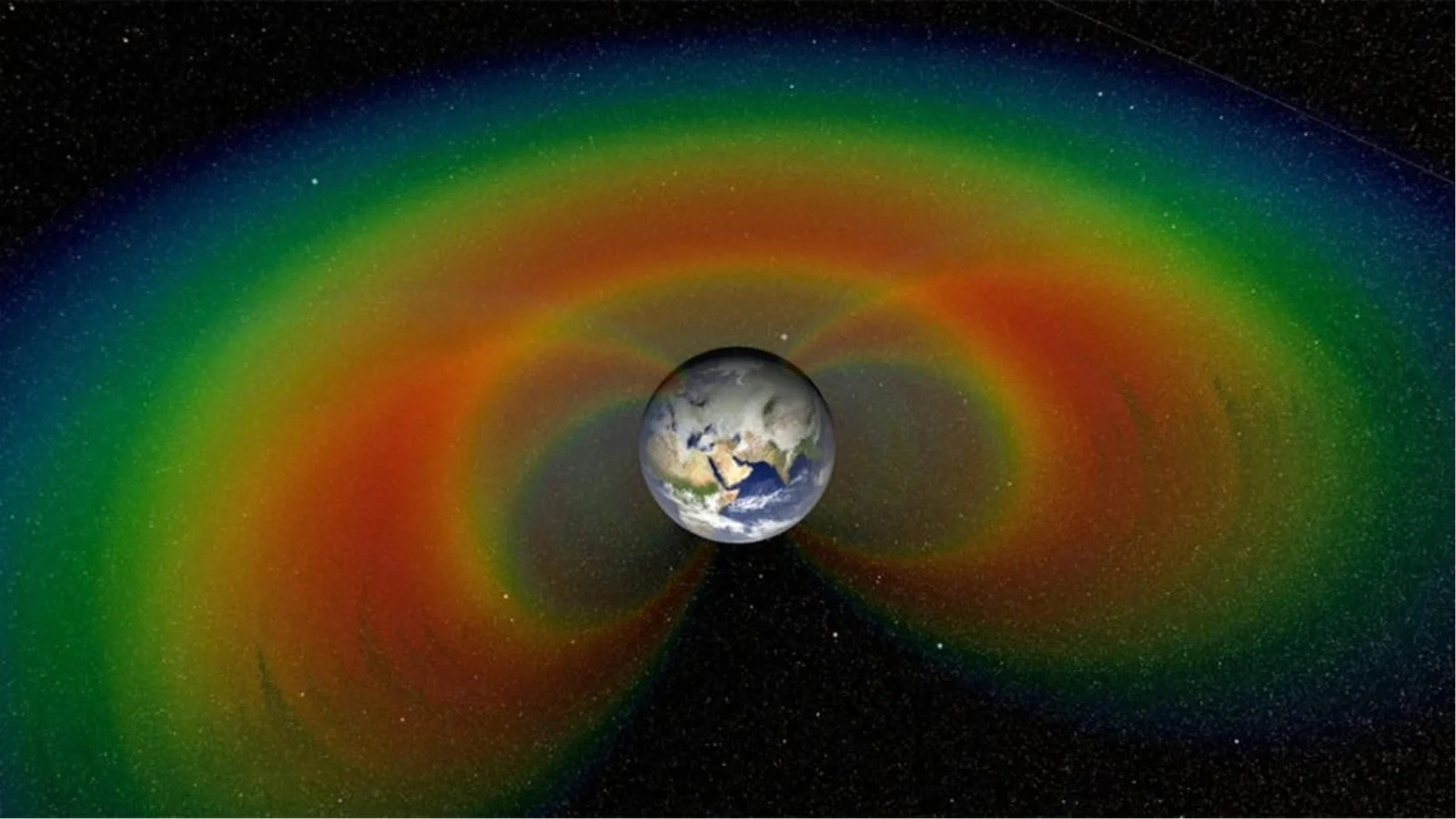
The Van Allen belts are regions where Earth’s magnetic field traps energetic charged particles. They are commonly described as two doughnut-shaped zones surrounding the planet, although their particle populations change with space weather. NASA’s introduction to the radiation belts explains their discovery and importance for space exploration.
The belts are not solid shells. Their familiar colored bands in space illustrations represent invisible particle environments. A visualization is useful for understanding their arrangement, but it is not a photograph showing glowing rings above Earth.
For a spacecraft, the relevant questions include which particles it encounters, their energies and how long it spends in that environment. Describing the entire region as either “safe” or “deadly” hides the conditions that engineers need to evaluate.
What does “impenetrable barrier” actually mean?
The phrase describes an observed boundary in the distribution of particularly energetic electrons. It does not mean that all forms of radiation stop at an indestructible wall. JAXA explains that earlier observations found ultra-relativistic electrons rarely reaching inward beyond a region near approximately three Earth radii from Earth’s center.
The word “center” is important. A distance expressed in Earth radii is not automatically an altitude above the surface. Likewise, a boundary for one particle population should not be confused with the atmosphere, the ozone layer or the edge of the entire magnetic field.
What the October 2026 study found
The research paper in Geophysical Research Letters, led by Yoshizumi Miyoshi and colleagues, examines observations from Japan’s Arase satellite during the May 2024 superstorm.
The researchers identified a growing local peak in electron phase space density inside the previously identified boundary. This quantity describes a particle distribution while accounting for properties of particle motion; it offers information that a simple count of passing electrons does not provide.
The significance is the location and growth of that peak. The evidence supports electrons gaining energy locally, rather than the increase being explained solely by particles arriving from farther out. The paper links this process to conditions favorable for acceleration by electromagnetic chorus waves.
Why local acceleration changes the explanation
Consider two explanations for a busy station: more passengers arrived from neighboring towns, or people already nearby entered the station. A headcount alone does not distinguish the explanations. Additional information about where and when the increase developed is needed.
That analogy is only a reading aid, not a model of particle physics. In the study, the diagnostic information comes from particle measurements and their spatial distribution. The useful question is therefore not simply “Were there more electrons?” but “What evidence distinguishes transport from acceleration?”
JAXA’s explanation of the results describes how Arase’s simultaneous observations of particles, magnetic fields, plasma density and waves helped address that question.
What are chorus waves?
Chorus waves are naturally occurring electromagnetic waves in the space environment around Earth. Their name reflects their birdsong-like character when measurements are converted into audible sound. They are not ordinary sound traveling through empty space.
Under suitable conditions, interactions with these waves can transfer energy to electrons. JAXA reports that the storm strongly contracted the plasmasphere, while its recovery was delayed. The resulting environment favored the wave-driven acceleration described by the researchers.
What this means for satellites—and what it does not prove
Energetic particles can damage spacecraft electronics. Understanding where hazardous populations can develop helps researchers improve radiation-environment models and investigate operational risks.
However, identifying an acceleration mechanism is different from documenting a specific satellite failure. This study should not be used on its own to claim that a named internet service went down, a phone was damaged or an upcoming launch is unsafe. Each claim needs its own measurements or operational evidence.
Our guide to solar storms, internet connections and GPS explains why those technologies have different vulnerabilities. This article focuses on the particle-acceleration finding, rather than treating every space-weather effect as the same process.
How to check a dramatic radiation-belt headline
- Separate the observation date from the publication date. Here, a 2026 paper analyzes a 2024 event.
- Identify what changed. A particular electron population is more precise than “Earth’s shield disappeared.”
- Look for the mechanism. Does the report distinguish particles moving inward from particles gaining energy locally?
- Check the claimed consequence. A potential hazard to electronics is not evidence of a particular outage.
- Read the original explanation. Compare the headline with the paper and the research institution’s account.
A useful summary of this discovery is that an unusually disturbed region of near-Earth space became a source of very energetic electrons. The scientific value lies in explaining how that happened and improving our understanding of exceptional space-weather conditions.
Original sources and image credit
- Miyoshi and colleagues: original research, published 26 October 2026.
- JAXA/ISAS: Arase observations and the acceleration mechanism, 27 October 2026.
- NASA: what the Van Allen belts are and why they matter.
Featured visualization: NASA. It depicts the radiation belts conceptually; it is not an image of the May 2024 event. Sources reviewed on 1 November 2026.
You may also like
 Science & Discoveries
UK November Cold Snap: What the Met Office Forecast Says
What the Met Office forecast says about the UK November cold snap, possible northern wintry showers, frost and…
 Science & Discoveries
Altermagnetism Explained: What the New Evidence Shows
What is altermagnetism? Understand the new MnTe experiment, how it differs from other magnetic orders, and what the…
 Science & Discoveries
White Christmas 2026: What Can We Actually Predict?
Can we predict a white Christmas in 2026? Learn to read NOAA’s historical snow map, understand the winter…