
Can Solar Storms Knock Out the Internet or GPS? What the Evidence Really Shows
Can solar storms disrupt GPS, satellite internet and power grids? See what happened in the May 2024 G5 storm, how NOAA alerts work and which outage claims are exaggerated.
Contents
- First, distinguish four technologies people call “the internet”
- What counts as a solar storm?
- Solar flares and radio blackouts
- Solar energetic particles and exposed equipment
- CMEs and geomagnetic storms
- Why GPS can get the wrong answer without losing the satellites
- A clearly hypothetical positioning example
- Can a solar storm disconnect a whole country from the internet?
- Distinguish outage pathways from direct damage
- May 2024: an unusually strong storm, without an internet apocalypse
- What about the 1989 Quebec blackout?
- How to read NOAA's G, R and S scales correctly
- A three-step method for interpreting an alert
- Would a phone, laptop or Wi-Fi router be fried by a flare?
- Why location matters: polar routes, mid-latitudes and lower latitudes
- A practical decision tree if navigation or connectivity suddenly fails
- A reproducible comparison that does not invent results
- What individuals and organizations can do before a severe event
- Myth-check: five claims that sound scientific but are not established
- What is established, what is plausible and what remains uncertain?
- Primary sources and scope of this guide
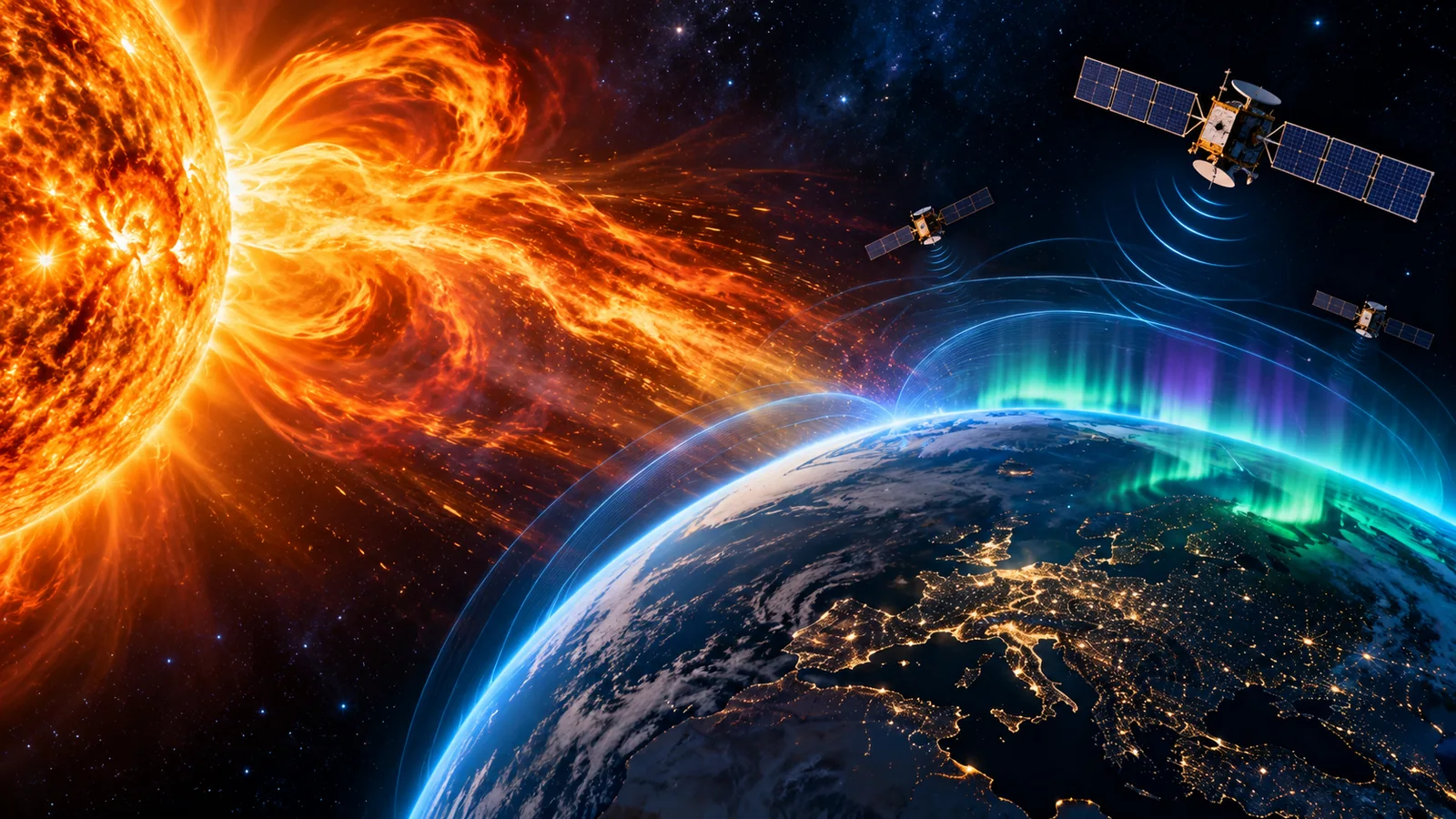
A powerful solar storm can disrupt GPS accuracy, some radio communications, satellites and electrical grids. That does not mean every solar flare shuts down Wi-Fi, mobile phones or the global internet. The actual outcome depends on the type of eruption, its direction, the affected technology, location, duration and the protections built into its network. The important distinction is between an observed disruption, a credible high-impact scenario and a viral claim that has skipped the evidence.
During the severe May 2024 G5 geomagnetic storm, satellite-internet service was degraded, some GPS-guided farm equipment suffered positioning problems, and high-frequency radio and aviation systems were affected. Yet the NASA review of the event notes that American emergency and energy agencies did not report significant population-wide impacts. It is possible to have a genuinely extreme space-weather event without the internet disappearing everywhere.
First, distinguish four technologies people call “the internet”
When a person says “the internet is down,” they may mean the router has lost power, the home provider has failed, a satellite connection has degraded, a mobile tower has stopped transmitting, or a single website cannot be reached. Those are very different failure points. Space weather interacts most directly with some of them and reaches others only through dependencies such as electricity, timing and satellite links.
| Technology or service | Main path | Plausible solar-storm exposure | What not to conclude |
|---|---|---|---|
| Home fiber broadband | Optical fiber, routers and powered network equipment | Indirect loss from damaged or unavailable power/network facilities | A solar flare directly burns through glass fiber |
| Cellular calls and mobile data | Terrestrial radio, towers, fiber backhaul, network clocks | Usually indirect; selected satellite/timing links may matter | Every mobile outage is solar-driven |
| Satellite broadband | Ground terminals, space links and satellites | Satellite electronics, orbital drag, changing radio propagation | Every affected satellite is permanently destroyed |
| GPS and other GNSS | Weak navigation signals from satellites | Ionospheric delay, scintillation and receiver loss of lock | GPS is itself an internet connection |
| High-frequency aviation radio | Signals that interact with the ionosphere | Direct short-term attenuation or blackout | A radio blackout means all digital communications have stopped |
| Electrical transmission grids | Long conductive power lines and transformers | Geomagnetically induced currents in susceptible systems | Every geomagnetic storm causes nationwide blackouts |
This systems view is supported by the NOAA Space Weather Prediction Center overview, which separates solar-flare radio blackouts, particle radiation and geomagnetic storms rather than combining them into a universal failure mode.
What counts as a solar storm?
“Solar storm” is an umbrella expression, not a single mechanism. The Sun regularly produces flares, bursts of energetic particles, and large expulsions of plasma called coronal mass ejections (CMEs). Their arrival times and affected technologies differ. A flare’s X-rays travel at the speed of light and can disturb the sunlit ionosphere almost immediately. Energetic particles can arrive later. A CME capable of driving a geomagnetic storm generally takes many hours to days to reach Earth, and not every CME is aimed toward Earth.
Solar flares and radio blackouts
A strong flare raises ionization in the lower ionosphere on the daylight side. Some high-frequency radio waves, used in long-distance and aviation communications, are absorbed instead of travelling as expected. NOAA’s HF communications explanation explicitly identifies the 1–30 MHz range and the relevance to aircraft and government radio networks. The effect does not automatically apply to ordinary Wi-Fi inside a house.
Solar energetic particles and exposed equipment
Energetic protons and other particles can interfere with electronics in space and affect polar high-frequency radio paths. Satellites operate outside much of the shielding enjoyed at Earth’s surface, so flight software, sensors and power systems must manage radiation exposure. Satellite operators can use protected components and operational procedures; whether a service fails cannot be predicted from an alarming headline alone.
CMEs and geomagnetic storms
When a CME interacts effectively with Earth’s magnetic environment, it may generate a geomagnetic storm. The varying magnetic field can drive currents in long terrestrial conductors, disturb the ionosphere, increase atmospheric drag on low-Earth-orbit satellites and produce auroras. The USGS description of the May 2024 storm documents the event’s G5 rating and emphasizes that infrastructure risks depend on where ground electric fields and susceptible equipment occur.
Why GPS can get the wrong answer without losing the satellites
GPS is not a map app, cellular network or internet service. Your receiver estimates distances to navigation satellites from the timing of weak radio signals. Those signals pass through the electrically charged ionosphere. If the ionosphere behaves differently from the model a receiver is using, propagation delay changes and the calculated distances become less reliable.
There are two related but separate issues. Range error occurs when the inferred travel time is wrong; signal scintillation is rapid signal variation that can cause a receiver to lose lock. NOAA’s GPS impact guide explains that severe conditions can turn normally small positioning errors into errors of tens of meters or cause lock failures. Such figures describe possible conditions, not a promise that every phone will jump the same distance.
Dual-frequency receivers are designed to estimate part of the ionospheric effect more effectively than simpler single-frequency receivers. However, when disruption is severe, even sophisticated equipment can suffer. Professional surveyors, precision farmers and aircraft may therefore care about errors that an ordinary pedestrian never notices.
A clearly hypothetical positioning example
Imagine a survey point whose usual horizontal error is two meters. On a disturbed day, imagine an error of forty meters. In that illustrative scenario, the error magnitude has increased twentyfold. Neither number is a measurement gathered for this article, and the ratio does not predict any specific storm. The lesson is that a modest-looking navigation problem can become operationally serious when equipment must repeatedly follow a narrow planting row or a precise approach path.
The example also shows why a blue dot jumping in a phone app is weak evidence of a solar storm. Urban buildings, indoor reception, app settings, Wi-Fi positioning, old map data and equipment faults can all create errors. Compare multiple devices and public space-weather observations before attributing the problem to the Sun. For everyday troubleshooting, the Horus Valley guide to Google Maps location errors covers the more common device-level causes.
Can a solar storm disconnect a whole country from the internet?
Not in the simple, universal manner implied by “the Sun switches off the internet.” The internet is a network of networks with different providers, physical routes, backup power systems and operating arrangements. Some components are more exposed than others. A severe geomagnetic storm can threaten electrical transmission infrastructure; a major power failure can then disable network hardware even if the underlying fiber remains intact.
Long submarine communications routes are a more nuanced topic. Fiber itself carries light and is not a giant copper antenna. But undersea systems also rely on electrically powered repeaters and shore facilities. Research scenarios have examined how extreme geomagnetically induced currents might affect components and long-distance connectivity. That is risk modeling, not proof that a global submarine-cable failure has already occurred or that such an outcome is inevitable in a future storm.
The widely circulated “internet apocalypse” framing grew from studies and media coverage of plausible worst-case vulnerabilities, rather than an observed global internet shutdown. The research question deserves attention because dependence on long routes, backup power and network redundancy is real. But a credible risk assessment must also examine protections, geography, failure correlation, repair times and alternative paths—variables a catchy disaster prediction usually omits.
Distinguish outage pathways from direct damage
A household fiber line may remain physically sound while its local exchange loses electricity. A satellite terminal may still have power but struggle with service quality. A phone may show strong mobile signal bars while an upstream data network is unavailable. These situations require different repairs and have different implications for service restoration. Treat “solar storm” as a possible contributing environmental cause, not a diagnosis made from a single symptom.
May 2024: an unusually strong storm, without an internet apocalypse
A useful real-world stress test occurred on 10–12 May 2024, when an extreme geomagnetic disturbance reached G5. NASA’s event narrative and scientific review summarize impacts across sectors. Positioning problems affected some GPS-guided agricultural machinery, Starlink reported degraded service, and high-frequency aviation communications and certain satellite operations were disrupted. Operators also responded to electrical-grid irregularities.
This event is particularly instructive because the same reports describe functioning systems, protective actions and the absence of major impacts to the population reported by the agencies named in NASA’s narrative. It supplies evidence both of vulnerability and of resilience. An honest explanation must include both parts rather than cherry-pick either “nothing happened” or “everything collapsed.”
| Observed or reported outcome in May 2024 | What it demonstrates | What it does not demonstrate |
|---|---|---|
| Some precision-agriculture receivers lost accuracy | GNSS can become operationally unreliable | All phones everywhere lost GPS |
| Starlink experienced degraded service | Satellite internet can be affected | All global internet routes failed |
| Some aviation HF/nav systems were disrupted | Space weather matters for operational planning | Commercial aviation stopped worldwide |
| Electrical grids experienced irregularities and mitigation | GIC risks require engineering response | A universal sustained blackout occurred |
| NOAA classified the storm G5 | Space-weather intensity was extreme | G5 mechanically guarantees a specific outage |
What about the 1989 Quebec blackout?
A different historical case illustrates a more severe electricity pathway. In March 1989, a geomagnetic storm contributed to a major grid failure in Quebec. This is well documented by NOAA’s space-weather background. But it does not establish that every modern grid or communication network responds identically. Grid design, local geology, conductor lengths, operational controls and storm characteristics all matter.
How to read NOAA’s G, R and S scales correctly
News headlines often say “G4 solar flare” or imply that G5 means five out of five internet systems will fail. Neither interpretation is sound. NOAA tracks different types of space weather with different scales. The official space-weather scale overview separates geomagnetic storms (G), radio blackouts (R) and solar radiation storms (S).
| Scale | Levels | What it tracks | Technology to watch |
|---|---|---|---|
| G | G1–G5 | Geomagnetic disturbance near Earth | Power systems, GNSS, satellites, aurora |
| R | R1–R5 | Flare-related radio blackouts | Daylight-side high-frequency radio |
| S | S1–S5 | Solar energetic particle radiation | Spacecraft, polar communications, radiation exposure |
A G3 observation is not the same as an R3 alert. Neither is a measure of the speed of a customer’s Wi-Fi. The scales describe potential consequences and physical activity; their classification alone cannot tell you whether your street, phone or flight will be affected.
A three-step method for interpreting an alert
- Find the actual agency product. Start at the NOAA Space Weather Prediction Center and read the time and scale on the observation or forecast.
- Identify the type. For an R alert, examine HF radio conditions and the daylight hemisphere; for a G alert, examine GNSS, electrical and satellite impacts. Treat forecasts as probabilities or warnings, not observations.
- Verify your service separately. Check provider incident reports, flight advisories, power-network information and other local causes. One space-weather alert cannot identify the reason a particular app stopped working.
NOAA distinguishes watches, warnings and alerts. A watch can be issued before an event with uncertain timing, while an alert indicates a threshold has been reached. This matters whenever social posts turn a forecast possibility into a claimed outage. See the National Weather Service definitions.
Would a phone, laptop or Wi-Fi router be fried by a flare?
A smartphone in your hand is not equivalent to a satellite exposed to energetic particles or a transformer connected to long power conductors. The mainstream established pathways are interference with some signals, stress on satellite hardware and effects on susceptible power infrastructure. There is no basis to tell ordinary users that a typical solar flare will directly burn out every unplugged household device.
If electricity becomes unstable during any emergency, standard power-protection practices are sensible for important electronics. They are not evidence that an extraordinary solar event has been forecast for your area. Avoid panic purchases of exotic shielding devices advertised as “solar-storm proof.” Their claimed protection is often unrelated to the known mechanisms.
Why location matters: polar routes, mid-latitudes and lower latitudes
Space-weather effects are geographically uneven. Energetic particles can strongly affect high-latitude radio paths, where magnetic field lines help channel particles toward the atmosphere. Geomagnetic induced currents depend partly on regional conductivity and grid layout. Ionospheric problems can also occur near the magnetic equator, where evening scintillation is a separate regular phenomenon that a dramatic solar flare is not required to create.
The NOAA GPS explanation notes both polar and equatorial effects. Consequently, an Egyptian mobile-network problem should not be equated with a disrupted transpolar flight; the engineering exposure and operational context differ. Conversely, being far from the poles does not make a system categorically immune to satellite or electricity dependencies.
A practical decision tree if navigation or connectivity suddenly fails
| Symptom | First ordinary checks | When space weather becomes relevant |
|---|---|---|
| One app reports an incorrect location | Location permissions, app update, map/address data | Several independent GNSS receivers show unusual errors and official disturbances are reported |
| Home Wi-Fi shows no internet | Router power, cables, provider status, alternate connection | Widespread upstream or power issues coincide with confirmed severe conditions |
| Satellite broadband slows or drops | Terminal alignment, local weather, service status | Provider reports plus active satellite/geomagnetic effects |
| GPS-guided survey or farm operation drifts | Equipment alarms, correction links, survey controls | Documented GNSS interference or regional space-weather advisory |
| Long-distance HF radio fails | Frequency, antenna, propagation and equipment | A relevant NOAA R or S alert across the actual radio path |
For safety-critical navigation, follow the relevant regulator, professional standard and equipment procedures. Do not rely on a consumer weather website or a single GPS application to clear an aircraft operation, agricultural guidance system or surveying result for continued use.
A reproducible comparison that does not invent results
If you want to understand the effect on civilian positioning, record the date, time, approximate location, device model, environment and whether the sky is obstructed. Obtain repeated outdoor fixes over a stationary reference point whose location is known by an independent method. Record the spread of readings, compare with a second independent receiver if available, and check official geomagnetic and ionospheric observations for matching times. This article does not claim that such a field experiment was performed.
Avoid measuring accuracy merely by counting digits of latitude and longitude. Map interfaces can show many decimals while the underlying fix is imprecise. Also avoid concluding causation from coincidence: weather, urban canyons, receiver differences and correction-service outages can confound the observations. Stronger evidence requires repeated measurements, controls and suitable technical instrumentation.
What individuals and organizations can do before a severe event
For an ordinary household, useful resilience measures overlap with preparing for conventional outages: keep essential devices charged, maintain a modest backup for the router if needed, save key contacts and offline maps, and know how to verify information from the provider. There is no need to disconnect from everyday technology whenever the Sun is active.
For professionals who rely on GNSS, document acceptable error thresholds, enable quality alarms, establish backup positioning methods and write explicit stop-work rules. Operators of data networks and power systems should follow engineering and regulator guidance, not generic consumer advice. Satellite and aviation operators already use specialized space-weather products, and severe episodes can require rerouting or operational changes.
- Household: Save offline navigation and emergency contacts; check service and power status before assuming a solar cause.
- Surveyor or precision farmer: Establish allowable accuracy, monitor integrity indicators and stop when tolerances are exceeded.
- Network administrator: Map power and satellite dependencies, verify redundancy and rehearse service continuity arrangements.
- Content publisher: Link directly to official NOAA/NASA reports and specify a claim’s date, scale, affected region and evidence.
Myth-check: five claims that sound scientific but are not established
| Claim | Evidence-based assessment |
|---|---|
| “An X-class flare means the global internet will stop tonight.” | Solar flare class does not establish a global internet outcome. |
| “Every G5 storm destroys satellites.” | G5 indicates extreme geomagnetic conditions; actual satellite impacts vary. |
| “If phone calls fail, the Sun is responsible.” | Network equipment, power and software failures have many independent causes. |
| “Fiber-optic light is disrupted in the same way as HF radio.” | Different transmission media and failure pathways must be distinguished. |
| “Solar storms pose no risk because the 2024 internet stayed online.” | The 2024 event documented genuine GPS, satellite and infrastructure effects. |
As a cautionary illustration of misattribution, NOAA stated that two major February 2024 flares were highly unlikely to have caused a widely reported cellular-network outage. The statement is published in NOAA’s incident note. Timing alone is not proof.
What is established, what is plausible and what remains uncertain?
Established: solar activity can disturb the ionosphere, degrade GNSS accuracy and HF radio propagation, affect spacecraft and stress vulnerable electrical infrastructure. The 1989 Quebec outage and operational impacts in May 2024 are documented examples.
Plausible but highly scenario-dependent: exceptionally severe storms could trigger cascading problems involving electricity, satellite links, and long-distance communication dependencies. Engineering analyses of submarine cable systems are valuable but cannot specify a universal outage probability from existing observations alone.
Unsupported as a specific forecast: claims that a known upcoming flare will erase the whole internet, burn all phones or cause an exact number of days without worldwide communications, unless substantiated by credible official forecasts and detailed infrastructure evidence.
The useful conclusion is balanced: space weather is a genuine infrastructure risk, not a reliable countdown to a global digital apocalypse. Read the correct alerts, distinguish the affected technologies, and use actual measurements rather than viral certainty. For readers interested in another satellite-linked subject, Horus Valley also explains how aircraft connect to the internet in flight, a useful comparison with land-based networks.
Primary sources and scope of this guide
This explanation uses NOAA’s Space Weather Prediction Center, its GPS and HF-radio technical pages, NASA’s 2024 storm narrative, the USGS geomagnetic-storm record and National Weather Service alert definitions. No personal storm measurements, network stress tests or commercial hardware tests were performed for this article. The article explains documented mechanisms and illustrative scenarios, not current live outage status or a prediction of a particular future event.
You may also like
 Science & Technology
Can AI Make mRNA Vaccines Stable at Room Temperature? What MIT Researchers Found
MIT researchers used AI to develop experimental mRNA vaccine formulations that withstood prolonged warm storage. Explore the evidence,…
 Science & Technology
Can AI Make Scientific Discoveries Before Human Researchers? Real Breakthroughs and Limits
Can AI make scientific discoveries on its own? Explore AlphaFold, autonomous labs, AI co-scientists, verification, limitations and real…
 Science & Technology
Aphantasia Explained: Why Some People Cannot See Mental Images
Explore aphantasia, the absence of voluntary mental images: neuroscience, memory, dreams, creativity, objective experiments, and what researchers still…