
Can AI Make Scientific Discoveries Before Human Researchers? Real Breakthroughs and Limits
Can AI make scientific discoveries on its own? Explore AlphaFold, autonomous labs, AI co-scientists, verification, limitations and real research examples.
Contents
- What counts as a scientific discovery?
- How AI changes the scientific workflow
- Protein structures: the breakthrough that changed expectations
- From AlphaFold to molecular interactions
- Can an AI laboratory run experiments by itself?
- AI co-scientists and research agents
- Why prediction is not the same as understanding
- Where AI is already useful
- The reproducibility problem
- Can AI invent a new scientific theory?
- Risks: false discoveries and research integrity
- What the next decade could look like
- How to evaluate a viral AI discovery headline
- Bottom line
- Scientific sources and further reading
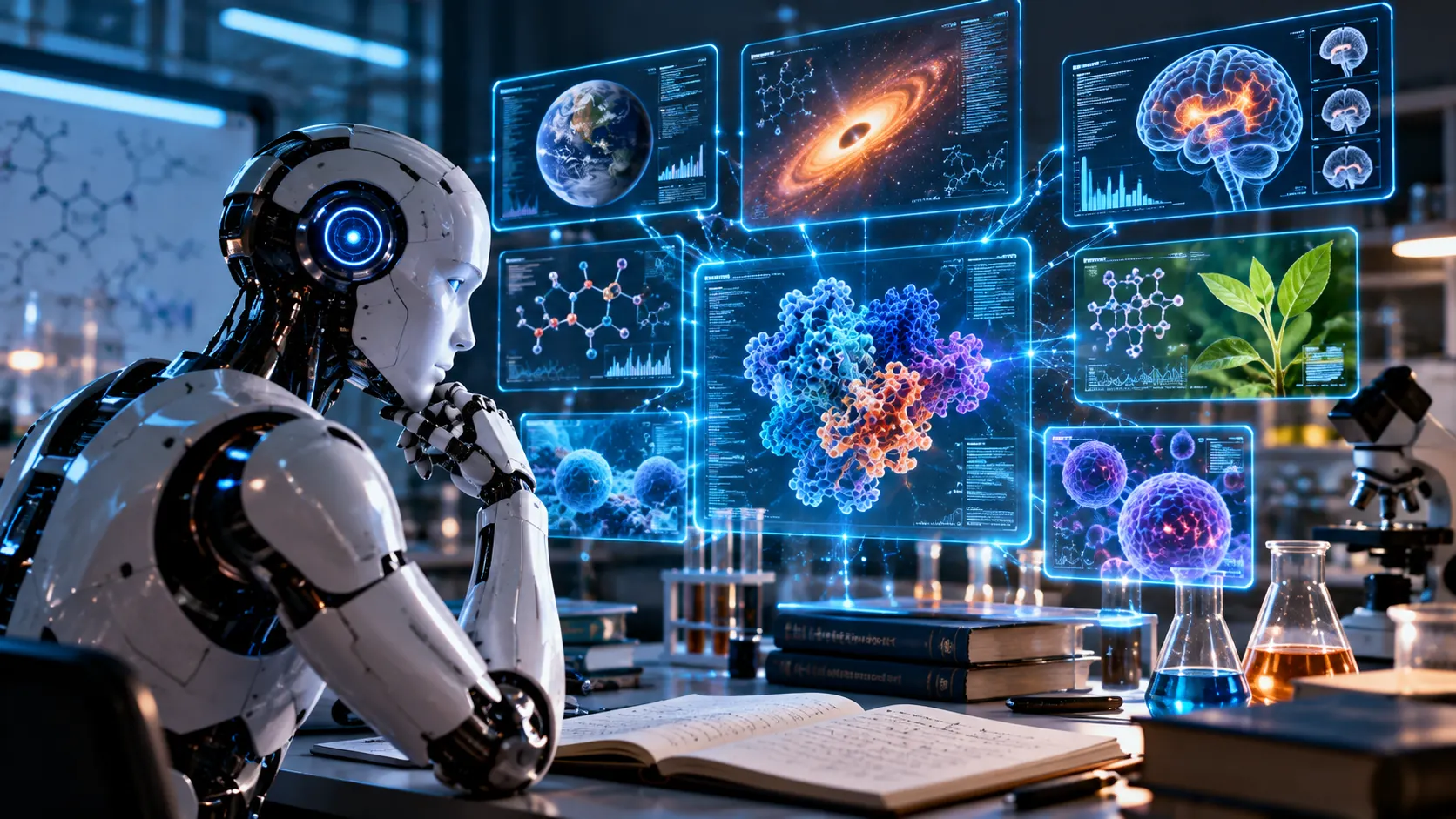
Can artificial intelligence make scientific discoveries before human researchers? The question is no longer purely science fiction. AI now shapes protein research, materials science and automated experiments. Yet there is a crucial difference between a promising prediction and a discovery that survives independent verification.
What counts as a scientific discovery?
A scientific discovery is not merely an attractive answer to a question. It is a new, testable finding supported by reproducible observations, experiments or rigorous reasoning. An AI system may propose a promising molecule, predict a protein structure, detect a pattern in telescope data or suggest an explanation. Those are valuable contributions, but a prediction is not automatically a confirmed discovery. The critical distinction is whether independent evidence supports the claim. Scientists also ask whether the result generalizes beyond the data used to develop the model.
How AI changes the scientific workflow
Traditional research often moves through literature review, hypothesis formation, experimental design, data collection, analysis and replication. AI can assist at each stage. Language models summarize papers and propose hypotheses; specialized machine-learning systems rank candidate materials and molecules; robotics platforms execute repeated experiments; statistical models help identify patterns in large datasets. A closed-loop system can use each experimental result to decide which experiment to run next. Yet every stage introduces risks, including biased training data, incorrect measurements and misleading correlations.
Protein structures: the breakthrough that changed expectations
Proteins are built from amino-acid chains that fold into three-dimensional shapes. Determining those shapes experimentally can require significant time and specialized equipment. AlphaFold demonstrated that AI can predict many protein structures with striking accuracy, making structural information accessible for research. The work was important enough to contribute to the 2024 Nobel Prize in Chemistry. Still, a predicted structure is not a complete account of a protein’s behavior inside living cells: flexibility, chemical conditions, interactions and experimental validation remain essential.
From AlphaFold to molecular interactions
AlphaFold 3 extended the approach toward predicting structures and interactions involving proteins, DNA, RNA, ligands and other molecular components. Such models can help researchers prioritize hypotheses about biological mechanisms and potential therapeutics. But the output depends on model assumptions and confidence; a plausible predicted interaction is not proof that a drug works, is safe, or reaches the right tissue in a person. Laboratory and clinical studies remain separate and necessary steps.
Can an AI laboratory run experiments by itself?
In 2023, researchers reported an autonomous laboratory called A-Lab that combined computation, machine learning and robotics to plan and perform materials-synthesis experiments. The system illustrates a practical meaning of automated discovery: algorithms propose targets, machines test them, and the next choices depend on results. However, autonomy within a defined experimental setup does not mean a machine independently understands all chemistry or can conduct unrestricted research. Human teams build the apparatus, select objectives, maintain instruments and scrutinize the results.
AI co-scientists and research agents
Research agents are being designed to compare papers, generate candidate explanations, critique proposals and suggest experiments. Google Research described an AI co-scientist system in 2025 that organizes competing hypotheses and iteratively refines them. These systems can speed brainstorming, particularly when the literature is too large for one person to read comprehensively. Their suggestions should be treated as research leads, not authoritative conclusions: fabricated citations, circular reasoning and the tendency to favor familiar ideas can distort their output.
Why prediction is not the same as understanding
A model can achieve high predictive accuracy without identifying the true causal mechanism. For example, it may learn that two measurements occur together without knowing whether one causes the other. In medicine, a system may classify images accurately yet fail when tested in a hospital with different patients or equipment. Scientific understanding requires interventions, causal reasoning, robustness checks and sometimes entirely new theoretical explanations. This is why expert interpretation and carefully designed experiments are not optional extras.
Where AI is already useful
In biology, models support protein analysis and the search for molecular candidates. In chemistry and materials science, they help prioritize experiments across huge combinations of ingredients and structures. In astronomy, pattern-recognition systems sift through images and time-series measurements to flag objects worth investigating. In climate science, models accelerate some forecasting and data-analysis tasks. The level of evidence varies dramatically by application, so it is misleading to describe all these systems as having independently solved the underlying scientific problems.
The reproducibility problem
A striking AI-generated claim can fail to reproduce because of data leakage, flawed evaluation, hidden experimental choices or insufficiently documented methods. Researchers should publish clear methods, datasets where ethically and legally possible, model versions, uncertainty estimates and negative findings. Independent teams must be able to repeat the critical test. Automated laboratories can improve consistency in some procedures, but faulty sensors or uncalibrated instruments can automate mistakes just as efficiently as valid experiments.
Can AI invent a new scientific theory?
There is no established general-purpose AI system that routinely produces major, experimentally confirmed theories without human direction. Algorithms can discover mathematical relationships in data and propose candidate models; in restricted settings, they may rediscover known physical laws. A transformative theory, however, must explain existing evidence, make new falsifiable predictions and survive independent testing. It also needs to be intelligible enough for scientists to probe where and why it fails. Claims that AI has replaced scientific reasoning go beyond the available evidence.
Risks: false discoveries and research integrity
AI tools can hallucinate references, generate convincing but incorrect explanations and amplify bias from published literature. They can also make it easier to flood journals with low-quality manuscripts. Sensitive fields such as pathogen research and drug development raise additional safety and security concerns. Good practice includes provenance tracking, disclosure of AI assistance, independent review, careful data governance and human accountability for experiments and public claims.
What the next decade could look like
The most plausible near-term future is a network of human researchers, specialized AI models and automated instruments. Researchers may spend less time screening routine candidates and more time designing decisive tests, interpreting anomalies and connecting findings across disciplines. The biggest gains could come where experiments are expensive but can be prioritized computationally. Progress will be uneven: data-poor fields, complex human behavior and questions requiring new measurement technologies may resist automation.
How to evaluate a viral AI discovery headline
First identify whether the claim describes a simulation, a laboratory experiment, an animal study or evidence in humans. Next ask who independently verified the result, whether the study was peer reviewed, and whether uncertainty or failure cases are reported. Check whether the headline says “discovered” when the paper actually says “predicted” or “proposed.” Finally, look for a direct link to the original study rather than relying on repeated social-media summaries.
Bottom line
AI is already changing how scientists search, model, plan and test ideas. In some well-defined tasks it has produced genuinely important advances, including protein-structure prediction and automated materials experimentation. But science is not a competition to generate the most plausible sentence. A result becomes reliable knowledge through measurements, transparent methods, replication and critical scrutiny. The strongest future is likely to combine AI’s scale with human judgment and independent experimental evidence.
Scientific sources and further reading
AlphaFold protein structure prediction, Nature (2021)
An autonomous laboratory for the accelerated synthesis of novel materials, Nature (2023)
You may also like
 Science & Technology
 Aphantasia Explained: Why Some People Cannot See Mental Images
Explore aphantasia, the absence of voluntary mental images: neuroscience, memory, dreams, creativity, objective experiments, and what researchers still…
 Science & Technology
 Can AI Detect Diseases From Your Voice? What Research Really Shows
Can AI detect diseases from your voice? Explore voice biomarkers, Parkinson's and Alzheimer's research, accuracy, privacy risks, and…