
Can AI Detect Diseases From Your Voice? What Research Really Shows
Can AI detect diseases from your voice? Explore voice biomarkers, Parkinson's and Alzheimer's research, accuracy, privacy risks, and clinical limitations.
Contents
- Why might illness change someone's voice?
- How voice-based AI works
- Step 1: Collect standardized speech samples
- Step 2: Process the signal
- Step 3: Extract acoustic and linguistic features
- Step 4: Train and independently validate a model
- Step 5: Report risk and uncertainty
- Which conditions are researchers studying?
- Parkinson's disease
- Alzheimer's disease and mild cognitive impairment
- Voice and laryngeal disorders
- Respiratory conditions
- Mood and mental health
- Children's speech and language conditions
- What does a high accuracy score actually mean?
- Why models fail outside the laboratory
- Population and language bias
- Device and environmental differences
- Confounding factors
- Weak study design
- Could AI detect a disease before symptoms appear?
- What is the NIH Bridge2AI Voice project?
- Voice privacy and consent: more than an audio file
- How to evaluate a medical voice-AI product
- When not to rely on a voice app
- What the next generation may look like
- Bottom line
- Scientific sources
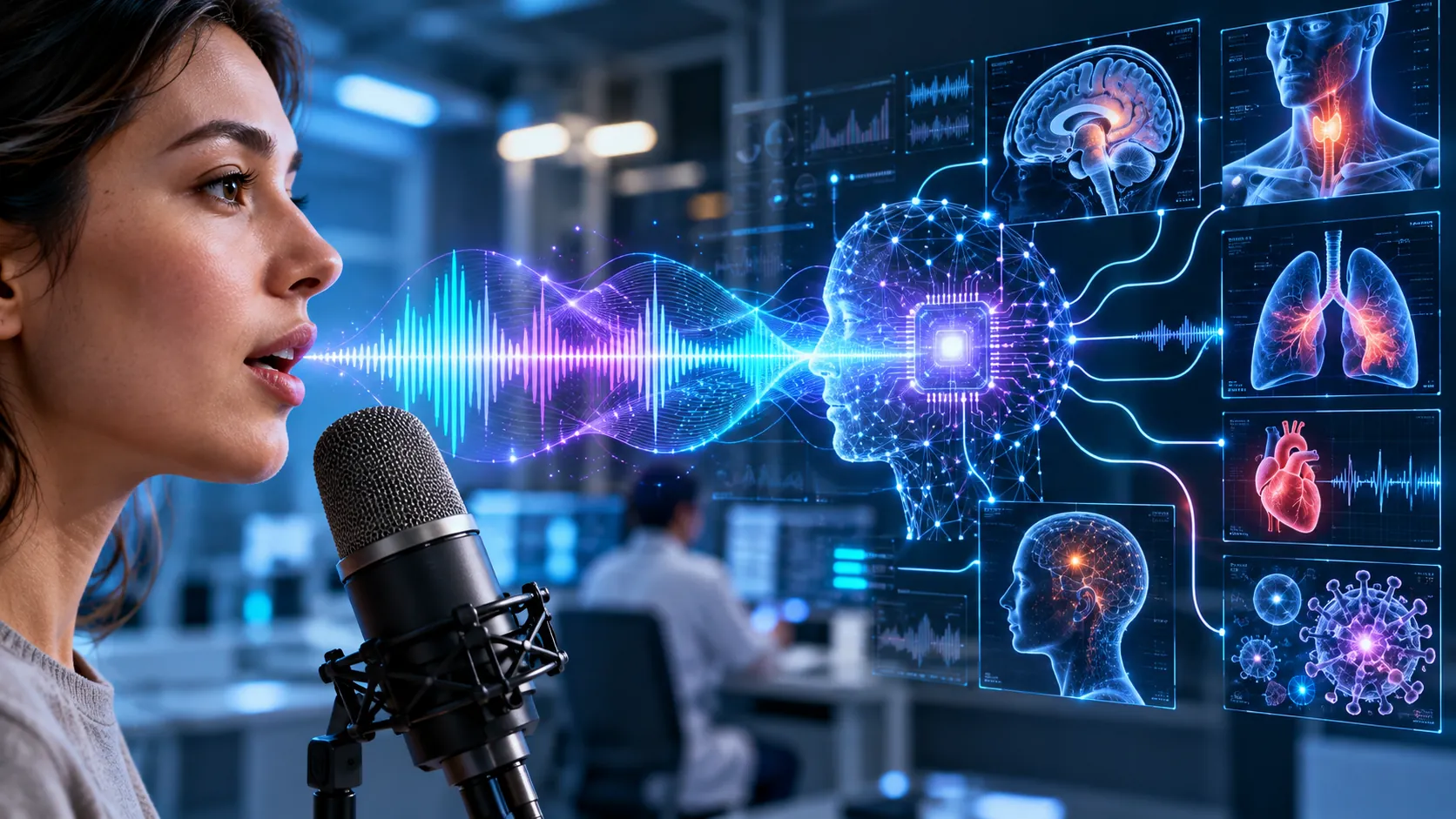
A voice recording contains far more information than the words being spoken. Its rhythm, pitch, breath support, pauses, and articulation reflect a complex interaction between the brain, respiratory system, vocal folds, and muscles. Researchers are increasingly investigating whether artificial intelligence can identify patterns associated with specific medical conditions. The answer is promising but nuanced: some AI systems distinguish groups of patients from controls in research settings; that does not mean a phone recording can reliably diagnose an individual.
Why might illness change someone’s voice?
Speech requires coordinated breathing, vocal-fold vibration, and rapid movement of the tongue, lips, jaw, and throat, all directed by the nervous system. Neurological conditions can alter motor control and language production; laryngeal conditions may affect vocal quality; respiratory illness may change breath patterns. But ordinary factors—including sleep deprivation, anxiety, medication, dehydration, age, infection, and recording conditions—can produce overlapping effects. A voice feature is therefore a potential biomarker, not a disease-specific fingerprint.
How voice-based AI works
Step 1: Collect standardized speech samples
Participants may sustain a vowel, read a passage, describe an image, speak spontaneously, or perform a cough task. Different tasks capture different aspects of physiology. The microphone, recording distance, background noise, language, and instructions all matter.
Step 2: Process the signal
Software identifies voiced segments and pauses, reduces some background interference, and may transform the waveform into a spectrogram showing energy across frequencies and time. Processing must be controlled: aggressive filtering can remove clinically meaningful variation.
Step 3: Extract acoustic and linguistic features
Potential measurements include fundamental frequency, pitch variability, jitter, shimmer, harmonic characteristics, speech rate, articulation, pause duration, and rhythm. Transcribed speech adds lexical diversity, word-finding difficulty, sentence complexity, and other linguistic measures. These are statistical observations, not stand-alone diagnoses.
Step 4: Train and independently validate a model
Researchers pair recordings with clinically established labels and train machine-learning or deep-learning systems. Good studies keep test participants separate from training participants and evaluate performance at other institutions, across languages, and with different devices. Otherwise, a model might inadvertently learn a hospital’s microphone or demographic differences rather than a disease signal.
Step 5: Report risk and uncertainty
A properly designed tool might flag a recording for further assessment, quantify change over time, or support a clinician’s decision. It should explain its intended population and limitations rather than declare a diagnosis from a single number.
Which conditions are researchers studying?
Parkinson’s disease
Parkinson’s can affect speech motor control, sometimes producing reduced loudness, less pitch variation, altered rhythm, and imprecise articulation. Researchers have tested sustained vowels and connected speech with multiple algorithms. A July 2026 umbrella review of 22 reviews reported widely varying performance and generally weak methodological quality, including limited external validation and insufficient reporting of medication state, language, disease severity, and recording conditions. The field has potential, but research scores should not be interpreted as proof that consumer apps can diagnose Parkinson’s.
Alzheimer’s disease and mild cognitive impairment
Cognitive changes may influence word retrieval, pauses, sentence structure, and verbal fluency. A September 2026 systematic review examined 63 studies with 18,540 participants. Many models separated Alzheimer’s cases from healthy controls with encouraging results, while identifying mild cognitive impairment against normal aging proved less reliable. Small, single-center datasets and limited independent validation remained major obstacles. Another systematic review in npj Digital Medicine highlighted the importance of explainability and real-world testing.
Voice and laryngeal disorders
Acoustic analysis can help characterize hoarseness, instability, and other changes in voice production. Yet similar acoustic features may arise from vocal strain, inflammation, reflux, structural problems, or other causes. Persistent hoarseness requires appropriate clinical assessment, potentially including examination of the vocal folds.
Respiratory conditions
Researchers are studying speech, breathing, and cough signals for respiratory health assessment. However, cough and breathlessness are nonspecific, and recordings vary dramatically by environment and device. Voice analysis alone cannot reliably distinguish among the many possible causes of respiratory symptoms.
Mood and mental health
Speech tempo, intonation, and pause patterns may correlate with some mental health states. But these markers are heavily affected by context, language, fatigue, culture, and medication. A flat or slow voice is not a diagnosis of depression. Tools in this area need especially careful evaluation for bias, consent, and potential harm.
Children’s speech and language conditions
Speech analytics may help specialists quantify articulation and track changes during therapy. Developmental variation, multilingual households, age, and individual language backgrounds make representative data and professional interpretation essential.
What does a high accuracy score actually mean?
Sensitivity is the proportion of people with a condition who test positive; specificity is the proportion without the condition who test negative. AUC measures discrimination across decision thresholds, not an individual’s probability of disease. Positive predictive value also depends on how common the condition is in the tested population.
Illustrative calculation, not a published trial: In 10,000 people with 1% prevalence, a test with 90% sensitivity and 90% specificity would correctly identify approximately 90 cases but also flag around 990 people who do not have the condition. Only about 8.3% of positive results would be true positives. This is why impressive results in case-control studies can translate poorly into general-population screening.
Why models fail outside the laboratory
Population and language bias
Age, sex, accent, language, dialect, socioeconomic conditions, and comorbidities may affect speech. Models developed primarily on one population can underperform in another.
Device and environmental differences
Phone models, microphone placement, room acoustics, noise suppression, and network compression can change acoustic measurements.
Confounding factors
Colds, medication, fatigue, dehydration, stress, and coexisting conditions can change voice features without indicating the disease being screened for.
Weak study design
Small datasets, repeated recordings from the same participant split across training and testing, selective reporting, and inadequate external validation can inflate reported performance. Clinically meaningful evaluation should include prospective studies and representative patients.
Could AI detect a disease before symptoms appear?
Repeated recordings could, in principle, reveal changes from an individual’s personal baseline. But proving presymptomatic detection requires longitudinal research following people before diagnosis, demonstrating that warnings are accurate and lead to beneficial care. A model’s ability to classify already-diagnosed patients is not evidence that it can predict disease years in advance.
What is the NIH Bridge2AI Voice project?
The US National Institutes of Health supports the Bridge2AI initiative, including efforts to build ethically collected voice datasets linked to clinical information. The voice research program covers neurological, respiratory, voice, mood, and pediatric speech and language domains. In January 2026, NIH announced a further program stage focused on trustworthy AI-ready research resources. Standardized, diverse data are essential because useful medical AI requires reproducibility, clinical labels, privacy safeguards, and evaluation beyond a single laboratory.
A feasibility study of the Bridge2AI Voice app enrolled 47 participants and found practical challenges with completing recording tasks, illustrating that usability is part of scientific validity. A separate NIH highlight discussed microphone and headset testing to improve recording consistency.
Voice privacy and consent: more than an audio file
Voice recordings can identify a speaker, reveal accent and emotional cues, and inadvertently capture bystanders. Before sharing a sample, check whether the provider stores raw audio, uses it for further model training, shares it with third parties, offers deletion, encrypts data, and clearly explains consent. Health-related inferences may be sensitive even when a recording appears anonymous.
How to evaluate a medical voice-AI product
A credible tool should specify its intended medical use, target population, clinical reference standard, independent validation, sensitivity and specificity, error rates across demographic groups, privacy practices, and relevant regulatory status. Be skeptical of claims that a short recording can diagnose dozens of unrelated diseases with near-perfect accuracy without independently published evidence.
When not to rely on a voice app
Sudden speech difficulty, facial droop, one-sided weakness, or confusion may indicate a medical emergency and requires immediate medical attention. Persistent hoarseness, progressive memory problems, difficulty swallowing, or breathing symptoms deserve professional evaluation. No voice-analysis app should delay urgent care or replace established diagnostic testing.
What the next generation may look like
The most useful applications may be monitoring changes over time, helping clinicians prioritize follow-up, and supporting remote assessment alongside conventional tests. Combining speech with clinical history and other validated measurements may be more informative than audio alone. Progress will depend on multicenter trials, longitudinal evidence, fairness across languages and devices, clear regulatory pathways, and strong data governance.
Bottom line
AI can detect voice patterns associated with certain health conditions in research studies. It cannot yet be treated as a universal disease detector, and impressive model scores are not equivalent to clinical reliability. Voice biomarkers may become valuable additions to healthcare, provided they are independently validated and used with human clinical judgment.
Medical disclaimer: This article is educational and is not individual medical advice or a diagnostic service.
Scientific sources
You may also like
 Science & Technology
 Can AI Make Scientific Discoveries Before Human Researchers? Real Breakthroughs and Limits
Can AI make scientific discoveries on its own? Explore AlphaFold, autonomous labs, AI co-scientists, verification, limitations and real…
 Science & Technology
 Aphantasia Explained: Why Some People Cannot See Mental Images
Explore aphantasia, the absence of voluntary mental images: neuroscience, memory, dreams, creativity, objective experiments, and what researchers still…