
Aphantasia Explained: Why Some People Cannot See Mental Images
Explore aphantasia, the absence of voluntary mental images: neuroscience, memory, dreams, creativity, objective experiments, and what researchers still debate.
Contents
- What is aphantasia?
- The apple experiment: a useful starting point, not a diagnosis
- How the phenomenon was identified
- How common is aphantasia?
- What happens in the brain?
- The pupil experiment and objective evidence
- Can people with aphantasia remember faces and places?
- Visual working memory can remain effective
- Dreams, sleep and involuntary imagery
- Does it affect creativity, reading or careers?
- Aphantasia versus hyperphantasia and other conditions
- How researchers assess imagery
- Is aphantasia a disease, and does it need treatment?
- When a new change warrants medical attention
- Practical approaches for learning and everyday life
- What science still does not know
- The bottom line
- Scientific sources and further reading
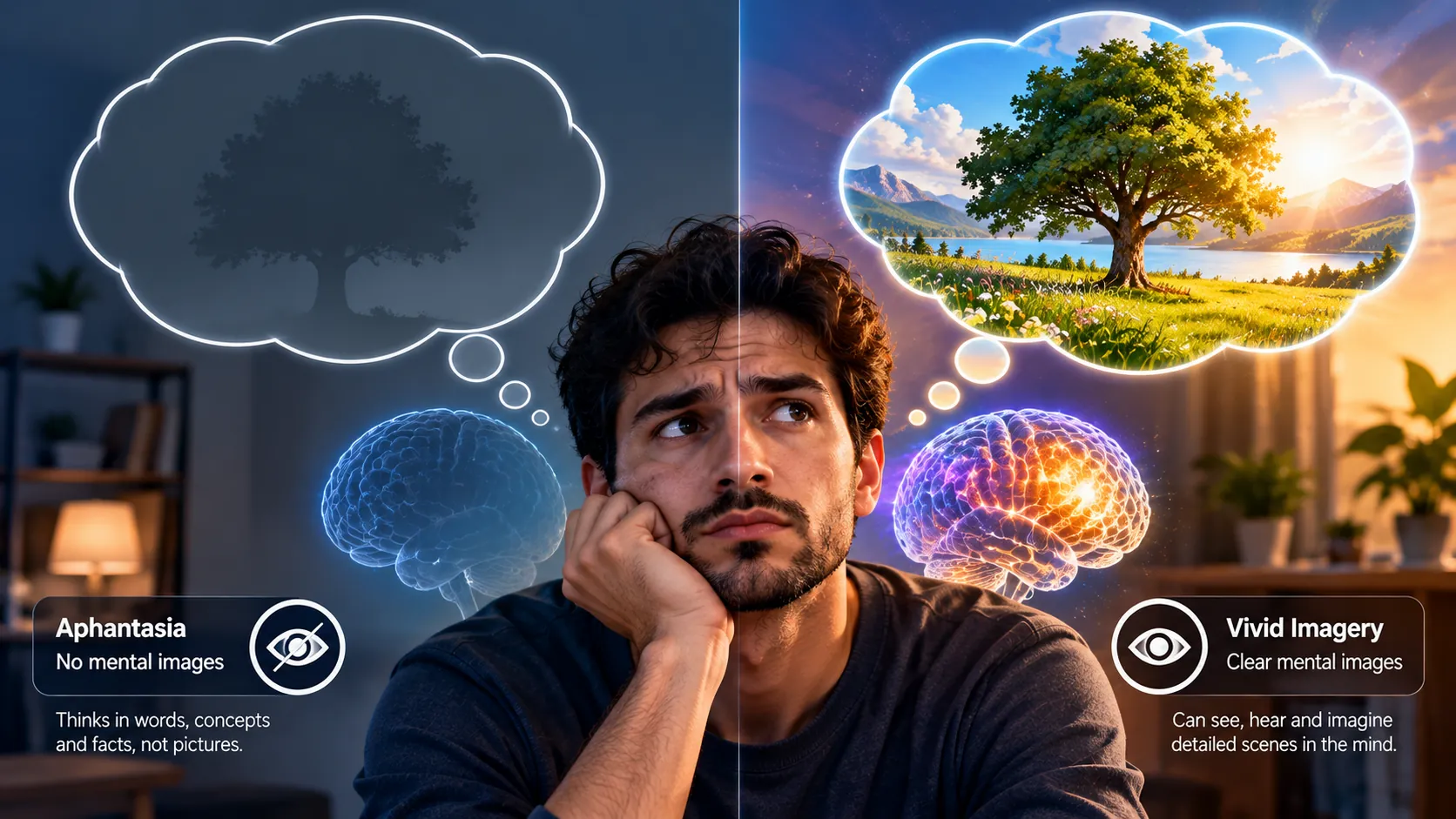
Imagine being asked to picture a beach at sunset. You understand every word and know what a beach looks like, yet no picture appears in your mind. This experience is called aphantasia. Here is a detailed, evidence-based guide to imagery, memory, dreams, creativity, neuroscience, and the questions science has not settled.
What is aphantasia?
Aphantasia describes little or no conscious voluntary visual imagery. A person may know exactly what an apple looks like, recognize one immediately, and describe its color and shape, yet not experience a picture of it when asked to imagine one. It is a difference in subjective mental experience, not blindness or an inability to think. Researchers distinguish the ability to represent information from the conscious feeling of seeing a mental image.
The apple experiment: a useful starting point, not a diagnosis
Close your eyes, if comfortable, and try to imagine a red apple on a table. Do you experience a picture with lighting, edges and color, a faint impression, or only the knowledge that an apple is there? Responses vary along a continuum. Some people also describe mental imagery with eyes open. This informal exercise cannot establish a diagnosis because interpretation of words such as “see” differs between people.
How the phenomenon was identified
Francis Galton documented striking differences in mental imagery in the nineteenth century. In 2015, Adam Zeman and colleagues introduced the term aphantasia for people who reported lifelong absence of voluntary visual imagery. The label made a previously under-discussed experience easier to study. Aphantasia can be lifelong, while a new loss of imagery following injury or illness is a different clinical situation.
How common is aphantasia?
Population estimates depend on how researchers define aphantasia and which questionnaire cutoffs they use. Earlier studies often cited a small single-digit percentage, but those numbers should not be treated as a universal prevalence rate. Online communities are especially vulnerable to self-selection bias: people who notice an unusual experience are more likely to participate. Aphantasia is better understood as one end of a broad spectrum of imagery vividness.
What happens in the brain?
Visual imagery recruits interacting brain networks involved in attention, memory, executive control and visual processing. The exact mechanism of aphantasia is unsettled. One possibility is that representations are present but do not reach vivid conscious visual experience; another is that the systems generating or coordinating sensory-like imagery operate differently. Brain imaging results are informative but do not identify a single damaged region or a universal neural signature.
The pupil experiment and objective evidence
A 2022 eLife study measured pupil changes when participants imagined bright and dark shapes. In people with typical imagery, pupil responses tracked the brightness of imagined content; the aphantasia group did not show the same imagery-linked response, although ordinary pupil reactions to actual light remained intact. The study provides physiological support for the distinction, but a single pupil test is not a clinical screening standard and cannot explain every individual case.
Can people with aphantasia remember faces and places?
Recognizing a familiar face is different from voluntarily picturing that face when it is absent. Many people with aphantasia recognize friends and navigate familiar routes normally. They may recall facts, verbal descriptions, spatial relationships or emotional associations instead of replaying a visual scene. Research has found group-level differences in some autobiographical memory measures, but this does not mean that everyone with aphantasia has poor memory or cannot remember childhood.
Visual working memory can remain effective
An important distinction is between the conscious sensation of an image and the ability to retain information about what was seen. Experimental studies have found that some aphantasic participants perform comparably to control groups on visual working-memory tasks, sometimes using different strategies. A 2026 study also reported no significant group differences across its behavioral and brain-decoding tests. These findings challenge the assumption that mental pictures are essential for every visual memory task.
Dreams, sleep and involuntary imagery
Voluntary imagination and dreams are not identical processes. Some people who cannot deliberately summon a picture still report visual dreams, while others describe fewer or less vivid dream images. Reports of flashes of imagery near sleep or during memories also vary. Aphantasia should therefore not be described as a universal inability to dream. Researchers continue to investigate whether voluntary and involuntary imagery rely on partially different pathways.
Does it affect creativity, reading or careers?
Aphantasia does not rule out artistic talent, storytelling, engineering, design or scientific creativity. Some people rely on reference images, sketches, verbal planning, conceptual models or iterative trial and error. Reading a novel may involve following the plot, emotions and relationships without seeing a mental movie. The useful question is which methods work for an individual, not whether one cognitive style is inherently superior.
Aphantasia versus hyperphantasia and other conditions
Hyperphantasia describes exceptionally vivid imagery, the opposite end of the spectrum. Prosopagnosia, or face blindness, is a difficulty recognizing faces and is not synonymous with aphantasia. Visual agnosia concerns recognizing objects despite visual input. Hallucinations are perceptual experiences without an external stimulus and are not simply strong voluntary imagination. These distinctions matter because a dramatic headline can easily conflate very different experiences.
How researchers assess imagery
The Vividness of Visual Imagery Questionnaire (VVIQ) asks participants to rate the clarity of imagined scenes. It is widely used in research, but scores depend on subjective interpretation and are not a stand-alone medical diagnosis. Researchers can combine questionnaires with behavioral tasks, binocular-rivalry methods and pupil measurements. Every method has limitations, and researchers must consider language, attention, expectations and sampling bias.
Is aphantasia a disease, and does it need treatment?
Lifelong aphantasia is generally discussed as a variation in cognitive experience rather than an illness that automatically requires treatment. There is no established, evidence-based therapy that reliably restores voluntary imagery for everyone. Online claims about guaranteed cures or rapid visualization training should be treated cautiously. If the difference is lifelong and causes no distress, medical intervention is usually not necessary simply because the experience differs from others.
When a new change warrants medical attention
A sudden new inability to visualize, especially alongside headaches, weakness, speech difficulty, visual changes, seizures or confusion, deserves clinical assessment. Acute neurological symptoms can be emergencies and should not be explained away as ordinary aphantasia. Changes after a head injury, stroke, medication change or major illness should also be discussed with a clinician. This advice concerns a new symptom, not lifelong differences in imagination.
Practical approaches for learning and everyday life
People who do not use vivid mental pictures may find external visual aids helpful: photos, maps, mind maps, labeled diagrams and written checklists. For remembering a route, a sequence of landmarks or verbal instructions may be more effective than trying to “see” the journey. In study, combining retrieval practice with notes and diagrams can support learning regardless of imagery style. None of these methods is a cure; they are options for adapting tasks to personal strengths.
What science still does not know
Researchers still debate how to define the boundaries of aphantasia, how often it occurs, which neural pathways explain it and why some people report visual dreams without voluntary imagery. Larger representative samples and cross-cultural studies are needed. An especially important question is whether absence of conscious imagery reflects absent visual representations or a different route to awareness. New studies should separate compelling personal stories from findings that replicate across laboratories.
The bottom line
Aphantasia shows that human minds can solve similar problems through different experiences. A person may remember, create, recognize and plan without seeing a vivid picture in the mind. Physiological and behavioral research supports the phenomenon, while its causes and consequences remain active research questions. It is neither evidence of low intelligence nor a supernatural ability, and it should not be confused with sudden neurological symptoms.
Scientific sources and further reading
Zeman et al. (2015), Lives without imagery
Kay et al. (2022), eLife pupil study
Dawes et al. (2020), Scientific Reports
You may also like
 Science & Technology
 Can AI Make Scientific Discoveries Before Human Researchers? Real Breakthroughs and Limits
Can AI make scientific discoveries on its own? Explore AlphaFold, autonomous labs, AI co-scientists, verification, limitations and real…
 Science & Technology
 Can AI Detect Diseases From Your Voice? What Research Really Shows
Can AI detect diseases from your voice? Explore voice biomarkers, Parkinson's and Alzheimer's research, accuracy, privacy risks, and…