
Why Electric Car Range Drops in Winter and What Actually Helps
Electric car losing range in cold weather? Explore real 2026 winter EV tests, battery science, charging and preheating tips, and realistic journey planning.
Contents
- Quick answer: how much EV range is lost in cold weather?
- A practical example: a 300-mile car in winter
- What actually happens to an EV battery in winter?
- 1. Chemical reactions slow in a cold lithium-ion battery
- 2. Cabin heating consumes energy that could otherwise move the car
- 3. Battery heating and conditioning are additional loads
- 4. Regenerative braking can be limited while the pack is cold
- 5. Winter roads increase the amount of energy needed to drive
- The dashboard range number is an estimate, not a fuel gauge of certain miles
- What genuinely helps EV range in winter: ten practical changes
- 1. Preheat the cabin while the car is plugged in
- 2. Use battery preconditioning when the car supports it
- 3. Heat the people efficiently—but never sacrifice visibility
- 4. Moderate motorway speeds and avoid sharp acceleration
- 5. Check tyre pressures while tyres are cold
- 6. Use Eco or efficiency modes intelligently
- 7. Prefer sheltered parking where practical
- 8. Combine short errands rather than repeatedly warming a cold vehicle
- 9. Start long trips with an appropriate charge and keep a reserve
- 10. Monitor real energy use instead of chasing one magic setting
- Heat pump versus resistance heater: does it really matter?
- Why rapid charging can be painfully slow on a freezing day
- Preconditioning for a motorway rapid charger
- Home AC charging versus public DC charging in winter
- How to calculate a realistic winter driving range
- A practical buffer example for a 160-mile winter journey
- Why EPA and WLTP figures differ from your winter road trip
- Planning a winter EV road trip: a practical checklist
- Does winter permanently damage an EV battery?
- Signs the problem may be more than normal winter loss
- Common winter EV range tips that are misleading
- “Turn off the heater and you will get all your range back”
- “Charge every EV to 100% every night in winter”
- “A heat pump completely fixes cold-weather range loss”
- “Slower DC charging means the charger is defective”
- “Your winter range display proves the battery has degraded”
- UK, US and European drivers: the differences worth knowing
- How much extra will winter charging cost?
- The best winter EV strategy: protect your trip, not an arbitrary range number
- Sources and further reading
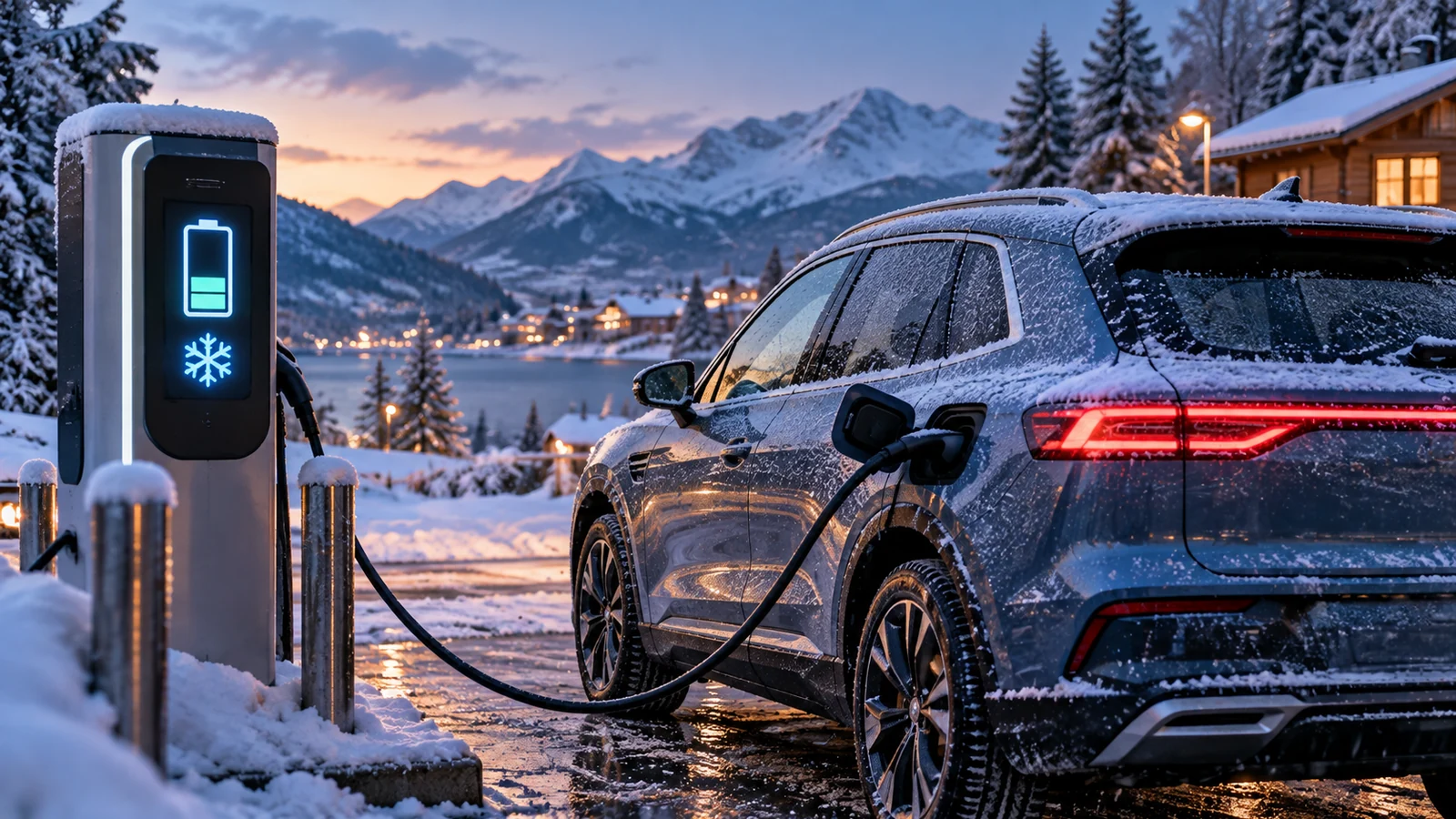
Your electric car showed 280 miles of range in September. Now it is a frosty December morning, the display says 205 miles, the heater is running, and a familiar commute seems to eat through the battery faster than it did in summer. Has the battery suddenly worn out? Usually not. Winter changes how much energy an electric vehicle (EV) can deliver efficiently, how much heating it needs, and how quickly it accepts a charge.
The important part is that not all winter range loss has the same cause—or the same remedy. Preheating while plugged in can move some heating demand away from the traction battery. A heat pump can reduce cabin-heating energy in many conditions. Gentle motorway speeds and properly inflated tyres also matter. By contrast, turning the heating off entirely, charging to 100% every day, or changing driving modes without measuring anything can be ineffective or unsafe.
This guide combines current American research, UK advice and demanding European winter road tests. It explains what happens to the battery, why the dashboard estimate can fall before you drive, and how to plan a winter journey without treating a manufacturer’s advertised range as a promise. Recommendations apply broadly, but your owner’s manual, software, battery chemistry and local weather always take priority.
Quick answer: how much EV range is lost in cold weather?
Winter range loss is real, but there is no universal percentage. In a controlled 2026 AAA study, the three EVs tested averaged a 39.0% reduction in calculated range at 20°F (−6.7°C), with cabin climate control set to 72°F, compared with 75°F conditions. Real-world fleets and newer designs can perform differently; battery temperature, journey length and speed matter as much as the forecast.
The May 2026 AAA study evaluated three electric vehicles and three hybrids using a climate-controlled dynamometer. The EVs showed a mean 35.6% reduction in efficiency and 39.0% decrease in calculated range in the cold test. It is a specific six-vehicle study with three EVs, not a guarantee that every EV will lose exactly 39%. Earlier 2019 AAA testing of five EV models reported a 41% average loss at the same cold temperature with heating running; those findings should not be treated as the performance of today’s whole market.
The picture looks different in a large real-world dataset. Recurrent’s November 2025 analysis of more than 30,000 US vehicles across 34 EV models reported an average 78% of their ideal-condition range at 32°F (0°C), equivalent to roughly a 22% reduction. The same analysis estimated 70% retention at 20°F (−7°C). Those figures reflect its particular fleet, model mix and ideal-condition comparisons—not the standardized EPA or WLTP test cycle.
Extreme Nordic conditions produce yet another number: Norwegian motoring organization NAF’s 2026 El Prix winter test found an average gap of 38% from cars’ official WLTP figures during a very cold road test, with temperatures as low as −32°C (−26°F). Because the reference is an official WLTP rating rather than each vehicle’s warm-weather driving on the same route, the number is not directly interchangeable with the AAA or Recurrent results.
| Evidence | Conditions and comparison | Reported result | Read it correctly |
|---|---|---|---|
| AAA, May 2026 | 20°F versus 75°F; HVAC at 72°F; three tested EVs | 39.0% average calculated range reduction | Controlled study; not all makes and models |
| Recurrent, Nov. 2025 | 32°F versus model-specific ideal-condition range; 34 models | 78% average range retained | Large observational dataset, different baseline |
| Recurrent, Nov. 2025 | 20°F versus ideal-condition range | 70% average range retained | Not a universal warranty or rating |
| NAF El Prix, winter 2026 | Road test down to −32°C versus WLTP range | 38% average below WLTP | Severe weather and different reference |
| AAA, Feb. 2019 | 20°F with heating; five tested EVs | 41% average range loss | Useful history; older vehicle technology |
A practical example: a 300-mile car in winter
Suppose the real warm-weather range you usually observe is 300 miles, rather than a brochure figure. If your own consumption rises enough to reduce practical range by 20%, you might see about 240 miles; at 30%, about 210 miles; and at 40%, about 180 miles. These are illustrative scenarios, not predictions for a specific car. Use real journey data in similar temperatures, with an appropriate safety margin.
| Illustrative winter reduction | Range from a 300-mile warm-weather baseline | Kilometres, approximate |
|---|---|---|
| 10% | 270 miles | 435 km |
| 20% | 240 miles | 386 km |
| 30% | 210 miles | 338 km |
| 40% | 180 miles | 290 km |
What actually happens to an EV battery in winter?
1. Chemical reactions slow in a cold lithium-ion battery
Electricity is released through electrochemical reactions inside battery cells. When the cells are cold, ion movement and related processes become slower, and their internal resistance rises. The battery-management system may restrict available power, regenerative braking or charging current to protect the pack. The vehicle’s estimated usable energy can temporarily appear smaller as a result. That is not the same thing as losing a chunk of physical battery capacity forever.
Some energy can become available again when the pack warms. Conversely, warming the battery may itself require electricity. Actual behaviour varies between lithium iron phosphate (LFP), nickel-rich chemistries, cell designs and thermal-management systems. Two cars parked in the same freezing car park can therefore show quite different range and charging performance.
2. Cabin heating consumes energy that could otherwise move the car
A conventional petrol or diesel car can warm the cabin using waste engine heat, although combustion cars also become less efficient in cold weather. EVs use electricity to heat the cabin, windows and sometimes the steering wheel or seats. Resistive heaters draw electric power to produce heat. A heat pump transfers heat more efficiently under many conditions, but it still needs electricity and its advantage can shrink in very low temperatures or during defrost.
That heating load is especially noticeable on a short journey. Imagine a heater consuming an illustrative average 2 kW for the first 15 minutes. That alone uses 0.5 kWh. On a ten-minute neighbourhood trip, this fixed warm-up demand may form a meaningful fraction of the total electricity used; on a long motorway drive, it is spread over many more miles. The exact draw of any vehicle’s cabin system can be much higher or lower.
3. Battery heating and conditioning are additional loads
Some cars use electric heaters, motor heat or a heat-pump-based thermal system to warm the battery toward its preferred operating range. That helps performance and charging but still has an energy cost. Preconditioning while connected to external power can reduce how much of that demand falls on the energy stored for driving. It does not create free energy; your electricity meter may record consumption at home, and the car may still draw from its battery depending on the available charging power.
4. Regenerative braking can be limited while the pack is cold
Regenerative braking sends some of a slowing car’s kinetic energy back to the battery. A cold pack may not be able to accept that energy at the normal rate, so the car can reduce regen and rely more on friction brakes. The Tesla Model 3 owner’s manual explicitly describes reduced regeneration, charging power and acceleration when the battery is cold. The principle is broader than Tesla, but the symbols, driver warnings and brake blending differ by brand and model.
5. Winter roads increase the amount of energy needed to drive
Thick winter tyres, low tyre pressure, slush and snow increase rolling resistance. Rain and headwinds increase drag and road losses; carrying skis or a roof box adds aerodynamic resistance. At motorway speed, overcoming air resistance is already a major load, so a strong headwind or higher speed can be costly. Vehicle-specific efficiency guidance from Tesla identifies speed, weather, tyre care, accessories and heating as important factors.
The dashboard range number is an estimate, not a fuel gauge of certain miles
An EV generally measures the battery’s state of charge and estimates how far that energy will take you. Range predictors may use recent consumption, temperature, elevation, navigation and selected settings, but the calculations are manufacturer-specific. In winter, the estimated miles can fall while the state of charge remains similar because the car expects a higher energy cost per mile. A lower range estimate alone therefore does not prove battery degradation.
A useful distinction is between battery state of charge (SOC), such as 65%, and estimated distance to empty, such as 130 miles. SOC describes a proportion of managed usable energy; range is a prediction of travel based on expected energy use. Neither tells the whole story of battery health. Do not treat the range display as permission to run down to 0% on an icy remote road.
| What changes on the dashboard | Possible explanation | Best next check |
|---|---|---|
| Estimated miles drop after a cold night; % barely changes | Forecast responds to temperature or recent consumption | Check kWh/100 miles or Wh/mi over several trips |
| Range falls rapidly during first 10 miles | Cabin and battery warm-up dominate a short journey | Compare longer trips and preheat while plugged in |
| Range improves when the weather warms | Normal seasonal efficiency or thermal change | Compare like-for-like temperatures |
| Persistent capacity or charging alerts in mild weather | Possible battery, sensor or thermal fault | Consult service diagnostics |
| Charge % declines unusually while parked | Remote climate, battery care or parked systems | Review app, preconditioning and standby use |
What genuinely helps EV range in winter: ten practical changes
1. Preheat the cabin while the car is plugged in
If your vehicle and charging setup allow scheduled departure, set it for the time you actually leave. You can step into a warm cabin with defogged windows while some of the energy comes from the charging connection rather than driving range. The US Department of Energy and UK Energy Saving Trust recommend cabin preheating while plugged in as a practical winter measure.
The energy still comes from somewhere: on a home charger it usually appears on your electricity bill. A low-power charging connection may not cover all heating demand, so the vehicle can consume some stored energy at the same time. Nevertheless, it often makes the first leg more comfortable and reduces the large initial in-drive heating load.
2. Use battery preconditioning when the car supports it
Cabin preheating and battery preconditioning are related but not identical. The former warms occupants and clears glass; the latter aims to bring battery cells toward a temperature suitable for driving or charging. Some cars warm the pack automatically as part of departure scheduling. Others trigger battery heating when you navigate to a supported rapid charging station using the vehicle’s own route planner. Check the manual and screen indicators rather than assuming every model has the feature.
For example, the Model 3 manual describes automatic battery preheating when navigation is used to route to a Tesla charging stop. That is a manufacturer-specific example, not a universal instruction that every EV starts preconditioning whenever you enter a public charger address. Battery preconditioning can consume energy during the drive, but may save substantial charging time in freezing weather.
3. Heat the people efficiently—but never sacrifice visibility
When comfortable and available, heated seats and steering wheels can keep occupants warm using less energy than raising cabin air temperature across the whole vehicle. Recurrent’s research also highlights the energy benefit of heat pumps in vehicles equipped with them. Avoid setting the cabin uncomfortably cold, particularly for children or vulnerable passengers.
Do not switch off demisting or defrosting to save range. Fogged windows and an icy windscreen are immediate safety hazards. Use the climate setting necessary to maintain clear glass; a slight reduction in an excessively high cabin setpoint is very different from driving with compromised visibility.
4. Moderate motorway speeds and avoid sharp acceleration
Highway driving can magnify the winter penalty because energy lost to aerodynamic drag rises sharply with speed. Reduce cruising speed where safe and legal, accelerate progressively and maintain sensible following distances. A modest speed reduction may extend range, but the benefit varies with terrain, vehicle shape, temperature and traffic. Never drive unnaturally slowly where doing so creates danger to other road users.
5. Check tyre pressures while tyres are cold
Pressure naturally falls as tyre temperature drops. Underinflation increases rolling resistance and may impair handling and tyre life. Use the vehicle manufacturer’s cold-tyre pressure on the driver-door placard or manual, not the maximum pressure moulded on the tyre sidewall. Be careful not to confuse pressures in psi, bar and kPa, and account for differing front/rear or loaded-vehicle requirements.
Where required, proper winter tyres are a safety necessity even if they lower efficiency compared with summer tyres. Never trade winter grip for a few extra miles. Remove unnecessary cargo and roof boxes when not in use, but do not remove safety equipment required for the trip.
6. Use Eco or efficiency modes intelligently
An Eco setting may soften accelerator response, moderate climate demand or alter accessory use. Try it on a familiar route and observe the car’s consumption readout. Its effect is not identical between vehicles, and it may alter heating performance in a way you do not want during very cold weather. Stay in a mode that maintains adequate windscreen clearing, traction and safe acceleration.
7. Prefer sheltered parking where practical
An enclosed or covered parking space may keep the car and charging equipment less exposed to wind, ice and precipitation. The Department of Energy advises considering covered parking and protecting charging connectors from freezing. Never improvise electrical covers, obstruct ventilation requirements, heat the charging port with an open flame or use a damaged connector. Follow the charger and car manufacturer’s instructions.
8. Combine short errands rather than repeatedly warming a cold vehicle
The first miles after a cold start are often inefficient because both cabin and pack may need warming. Several separate short trips, each after the car has cooled completely, can consume more energy than a single combined outing with the same total distance. This does not mean idling the vehicle unnecessarily; simply group journeys when convenient and preheat once if you can.
9. Start long trips with an appropriate charge and keep a reserve
Follow your model’s everyday charging recommendations. Some drivers use roughly 80% as a routine limit for certain battery types, but there is no single correct daily limit for every EV. Vehicle makers give different instructions for LFP and nickel-based packs. For a winter trip, a higher departure charge can be sensible where the manufacturer permits it, especially when reliable charging is sparse. Schedule higher charging levels so the car spends less time sitting at a high SOC if that is what its manual recommends.
Never treat charging to 100% as a substitute for journey planning or assume it reverses the cold-weather efficiency penalty. Leave an energy buffer appropriate for terrain, weather, charger availability and passenger safety; the minimum safe reserve differs by circumstance.
10. Monitor real energy use instead of chasing one magic setting
Track several comparable journeys using kWh/100 miles, Wh/mile, or kWh/100 km. Record temperature, speed, heating, tyre setup and charge used. That evidence can show whether preheating or a modest speed reduction actually helps your own vehicle. Dashboard “range remaining” is often less useful for comparing techniques because it may update its prediction before any additional distance is driven.
Heat pump versus resistance heater: does it really matter?
A heat pump moves thermal energy from outside to inside, so in many conditions it can provide more cabin heat per unit of electrical energy than a conventional resistance heater. It does not eliminate winter losses, particularly under extremely cold conditions, nor does it guarantee a given range increase for every car. Some heat-pump systems use resistive backup or change operating strategy during defrost.
In its analysis of 34 EV models, Recurrent estimated that heat-pump-equipped vehicles gained about a 10% range advantage at 32°F (0°C) relative to comparable non-heat-pump cases in its dataset. Treat this as an observational analysis with possible differences between model configurations, not a promise that retrofitting or buying any heat-pump variant adds exactly 10%. If you are shopping for a new EV in a cold region, the US Department of Energy recommends considering heat pump availability.
| Cabin heating approach | General behaviour in winter | Practical driver implication |
|---|---|---|
| Resistance heater | Turns electricity directly into heat; can create substantial draw | Preheating while plugged in is particularly valuable |
| Heat pump | Transfers heat; generally more efficient at many winter temperatures | Can reduce heating burden but still needs power |
| Heat pump with backup heating | May use backup or defrost cycles in severe conditions | Performance depends on design and climate |
| Heated seats / steering wheel | Directly warm occupants rather than all cabin air | Use with safe visibility and comfortable cabin temperature |
Why rapid charging can be painfully slow on a freezing day
Cold lithium-ion cells may not safely accept a high charging current. The battery-management system limits DC charging power until the pack is ready. A 150 kW or 350 kW charging station label describes the charger’s capability, not the rate the car must accept. Actual power depends on the vehicle’s battery state, cell temperature, charge level, charging curve, station condition and cable or hardware limits.
Cold charging matters on a road trip because the car may need a substantial warm-up period before it can take full power. NAF’s 2026 winter charging test emphasized how important preheating is for rapid charging; it also found that some models still met or beat stated charging times when their systems were prepared. A slower session does not automatically mean the charger is broken.
Preconditioning for a motorway rapid charger
- Check your manufacturer’s guidance for how its battery-preconditioning feature operates.
- If supported, enter the rapid charger as the actual navigation destination early enough for the car to begin thermal preparation.
- Arrive with a reasonable battery charge level rather than an unnecessarily full battery, while preserving your safety buffer.
- Choose an operational charger with a connector and power rating compatible with your vehicle.
- Watch actual kW, state of charge and battery-temperature messages; charging typically tapers as SOC rises.
- If the vehicle shows a charging fault, follow on-screen instructions or ask the charge-point operator for support; do not force frozen connectors.
For many cars the final 80–100% takes disproportionately long at a DC rapid charger, even in warm weather. In extreme cold, range needs, charging availability and safety may justify charging beyond 80%. The Department of Energy advises weighing how much range you need against the time and congestion involved in charging to near full.
Home AC charging versus public DC charging in winter
| Topic | Home or destination AC charging | Public DC rapid charging |
|---|---|---|
| Most useful for | Overnight replenishment and scheduled departure | Long journeys and quick top-ups |
| Cold battery effect | Can reduce charging speed; vehicle may condition itself | May sharply limit high-power acceptance |
| Preheat opportunity | Schedule cabin preheat while plugged in | Route to charger to warm battery if supported |
| Energy cost | Depends on household tariff and losses | Depends on operator pricing and charging time |
| Practical priority | Use certified equipment and keep connector clear | Plan charger alternatives and buffer time |
There is no universally correct advice to unplug or leave an EV plugged in for all winter. Follow the specific owner’s manual, especially for long-term parking and chemistry-specific battery care. Some manufacturers recommend plugging in during freezing conditions to allow battery temperature management using external electricity. The Department of Energy’s winter EV guidance also covers safe outdoor charging and cold-weather preparation.
How to calculate a realistic winter driving range
The most useful estimate for your own car uses the energy actually available for driving and a representative winter energy consumption. For a simple approximation: driving range (miles) ≈ usable energy (kWh) ÷ energy consumption (kWh per mile). This deliberately ignores details such as battery reserve policies, changing elevation, speed, wind and losses, so use it as a planning aid—not a guarantee.
Suppose a vehicle provides an illustrative 72 kWh of usable energy at the relevant conditions. In mild weather it averages 0.28 kWh/mile (28 kWh/100 miles): 72 ÷ 0.28 ≈ 257 miles. In colder conditions it averages 0.36 kWh/mile (36 kWh/100 miles): 72 ÷ 0.36 = 200 miles. That difference is 57 miles, or roughly 22% of the mild-weather example. Your usable energy and actual consumption are likely different.
| Illustrative driving condition | Consumption | Range from 72 kWh usable | Interpretation |
|---|---|---|---|
| Mild weather, efficient journey | 28 kWh / 100 mi | About 257 mi (414 km) | Example, not rated range |
| Typical cold trip in this example | 36 kWh / 100 mi | 200 mi (322 km) | About 22% lower |
| Severe cold or faster driving | 42 kWh / 100 mi | About 171 mi (276 km) | Illustrative only |
A practical buffer example for a 160-mile winter journey
A route that is 160 miles long may look comfortable in a 200-mile theoretical winter range car, but the entire 200 miles is not necessarily usable without risk. Strong headwinds, snow, hills, road closures, detours and charger outages can consume the margin quickly. A safer plan identifies at least one reliable charging stop before the battery becomes very low, confirms alternative chargers, and leaves reserve energy for a diversion. The buffer should increase in remote areas or where temperatures are extreme.
Why EPA and WLTP figures differ from your winter road trip
EPA estimates in the US and WLTP ranges used across the UK and Europe are standardized ways to compare models. They are not guarantees of distance in every combination of temperature, speed, topography and heating use. You should not compare “30% below WLTP” and “30% below my summer motorway range” as if they were identical measures. The ADAC January 2026 winter motorway test tested 14 family EVs at 0°C on a simulated motorway route and highlighted the effect of highway speeds and charging conditions on trip suitability.
Planning a winter EV road trip: a practical checklist
- Before departure: check temperature, wind, road conditions, route elevation and charging-site status. Keep a second charger option available.
- At home: check tyre pressures cold, remove roof accessories you do not need, charge according to the manufacturer and precondition while connected where supported.
- On the road: follow real consumption, moderate speed safely and use route-planning estimates that reflect current weather when available.
- Before a fast charge: navigate to the charging station through the car’s supported system to trigger battery conditioning if that feature exists.
- At a charger: check connector condition, charger availability and payment options. Do not expect nameplate charger power for the whole session.
- For emergencies: keep the phone charged, carry suitable warm clothing and follow local winter travel guidance, particularly in remote or mountain regions.
Do not drive a traction battery down deliberately in severe weather to “train” it or prove its maximum range. In the extreme 2026 NAF test, some vehicles lost power with an indicated single-digit state of charge. Road safety and passenger wellbeing outweigh the last few miles on an efficiency graph. NAF’s results underline why an adequate reserve matters.
Does winter permanently damage an EV battery?
A temporary reduction in driving range during cold weather does not automatically mean permanent battery capacity loss. Much of the observed change comes from temporary electrochemical limitations, energy diverted into heating and the higher driving load of winter conditions. When temperatures rise, the vehicle may return closer to its normal range.
Battery ageing is a different, longer-term process affected by calendar time, temperature exposure, charge practices, chemistry, fast-charging patterns and other factors. Severe heat is a major factor in ageing, while attempting to force a cold battery to charge aggressively can pose risks that modern battery-management systems are designed to prevent. Do not defeat charging limits or attempt to warm a battery pack with external heaters. If real-world efficiency remains dramatically worse in mild weather, or battery fault warnings persist, obtain a qualified service assessment.
Signs the problem may be more than normal winter loss
| Symptom | What it might indicate | Next action |
|---|---|---|
| Range falls in cold but recovers in mild weather | Ordinary seasonal behaviour | Track consumption across comparable routes |
| Sudden unexplained loss in moderate weather | Tyres, brakes, software or battery health issue | Check basics; arrange diagnosis if persistent |
| Battery or propulsion warning message | A monitored system fault | Follow manufacturer instructions; seek service |
| Rapid charging remains abnormally slow after correct preconditioning | Possible charger, battery or thermal-management limitation | Compare another reliable charger and consult service |
| Parked battery loses substantial charge unexpectedly | Active features, preconditioning, software or fault | Review settings, logs and official support |
| Physical battery damage, smoke, unusual heat or chemical odour | Potentially serious safety hazard | Stop safely; follow emergency guidance and do not touch high-voltage components |
Common winter EV range tips that are misleading
“Turn off the heater and you will get all your range back”
Reducing unnecessary cabin heating can help, but it cannot eliminate cold battery behaviour, tyre and road resistance, wind, snow or high motorway speeds. It is also unsafe to compromise visibility or passenger health. Use comfortable, well-targeted heating and keep all windows clear.
“Charge every EV to 100% every night in winter”
The right charging target depends on your battery chemistry, manufacturer recommendations, journey and available charging. More stored energy may be appropriate before a long trip, but routinely overriding a recommended daily limit is not a universal winter optimization. Consult your manual, and use scheduled charging when helpful.
“A heat pump completely fixes cold-weather range loss”
Heat pumps can reduce cabin-heating energy in many conditions, but battery conditioning and driving loads remain. Very low temperatures may reduce heat-pump advantage, and individual systems differ. Recurrent’s reported benefit is an average in its dataset, not a guarantee for every car or weather condition.
“Slower DC charging means the charger is defective”
Cold cells, a nearly full battery, thermal limits, shared-stall power and station issues can all affect kW. A single low reading is not proof of a failing charger or battery. Check charge percentage, car warnings, battery preconditioning, another stall if possible and operator notifications.
“Your winter range display proves the battery has degraded”
Distance-to-empty is a prediction influenced by consumption. Compare battery-health assessments, measured energy use and performance in mild weather before drawing conclusions about permanent capacity loss. Misreading the dashboard can encourage costly, unnecessary repairs.
UK, US and European drivers: the differences worth knowing
United States: use EPA ratings for consistent vehicle shopping comparisons, then adapt trip planning to local conditions—from the Rocky Mountains and Upper Midwest to cold Northeastern commutes. AAA’s 2026 study provides a current laboratory baseline; local tariff and charging access also affect cost.
United Kingdom: the winter is often damp, windy and relatively mild compared with a Nordic cold snap, but short commutes, motorway speeds, rain and heavy demisting loads still matter. Energy Saving Trust recommends pre-heating when plugged in, sensible speed, Eco modes where suitable and planning around actual conditions. UK car adverts often cite WLTP range, which can differ considerably from winter motorway driving.
Continental Europe: conditions vary from relatively mild coastal climates to Alpine routes and severe Scandinavian winters. Norway’s extreme-temperature tests are useful warnings for mountain and northern trips, while ADAC’s 0°C high-speed comparisons may better resemble winter motorway travel in central Europe. Both are evidence of variation, not a reason to apply one percentage to every European journey.
How much extra will winter charging cost?
The energy cost of winter driving is driven largely by the increase in kWh required for the same distance, multiplied by your electricity price. For illustration, an EV using 28 kWh/100 miles in mild weather needs 28 kWh for 100 miles; at 36 kWh/100 miles it needs 36 kWh. That is 8 kWh extra per 100 miles, before considering differences in charging losses.
At an illustrative home energy rate of £0.25/kWh, those 8 kWh add £2 per 100 miles. At $0.18/kWh, they add $1.44. If public rapid charging costs more, the monetary difference rises. The numbers are examples, not current national tariff claims, and taxes, subscriptions, time-of-use prices and charging efficiency can change the real bill.
| Illustrative energy rate | Extra energy for 100 miles | Extra energy cost |
|---|---|---|
| £0.25 per kWh | 8 kWh | £2.00 |
| $0.18 per kWh | 8 kWh | $1.44 |
| €0.30 per kWh | 8 kWh | €2.40 |
Home-monitor readings and EV apps can describe different things: energy delivered to the battery versus electricity drawn from the wall. If those figures are not identical, charging overheads and heating loads may contribute. For more on distinguishing real home energy consumption from confusing displays, see our guide to smart-meter electricity usage.
The best winter EV strategy: protect your trip, not an arbitrary range number
The most effective winter preparation is not a single secret setting. It is a combination of preconditioning at the right time, appropriate heating, safe tyre maintenance, moderate speeds and a charging plan that respects the weather. Some improvements conserve driving energy; others reduce charger waiting time or improve safety. Each has value, but their effect will differ by vehicle.
When the range estimate falls in December, compare actual consumption with your summer driving before worrying about irreversible battery damage. In many cases the battery is working as intended in harsher conditions. The best answer to “Why did my EV lose range?” is therefore to separate temporary cold-weather limitations from energy spent heating and energy used to move the vehicle—then act on the parts you can control.
Sources and further reading
- AAA — May 2026 study on temperature, EV efficiency and range — controlled cold-weather test and calculated range loss.
- Recurrent — 2025/2026 winter EV range study — real-world fleet data, model variation and heat-pump effect.
- NAF — El Prix winter 2026 range results — severe-cold Norwegian road test.
- NAF — winter 2026 charging and preheating test — rapid-charging preparation.
- ADAC — January 2026 EV winter motorway test — 14 family vehicles at 0°C.
- US Department of Energy — Winterizing Your Electric Vehicle — preconditioning, parking and charging.
- Energy Saving Trust — Charging Electric Vehicles — winter range advice and efficient driving.
- Energy Saving Trust — Battery Electric Vehicles fleet toolkit — effects of temperature and route planning.
- Tesla Model 3 Owner’s Manual — Cold Weather Best Practices — model-specific battery conditioning and regenerative braking.
- AAA — 2019 cold-weather EV study — historical controlled range comparison.
You may also like
 Technology & How-To
NHS App Prescription Not Showing? Check GP Approval, Pharmacy Status and Tracking
Find out why a prescription or medicine is missing from the NHS App in England. Separate repeat requests,…
 Technology & How-To
Google Wallet Not Working After Switching Phones? Fix Card Setup and Tap to Pay
Google Wallet transferred but tap to pay fails? Separate card verification, bank approval, NFC, screen lock and device…
 Technology & How-To
iCloud Family Sharing Not Working? Why You Still See 5GB and How to Fix It
Still seeing 5GB after joining an iCloud family plan? Check the account, invitation, sharing settings, personal plan and…