
Why Can’t We Remember Being Babies? What Memory Research Shows
Why our first years are hard to recall, what infant brain scans reveal, and why forming a memory is different from remembering it decades later.
Contents
- What is infantile amnesia?
- Learning, recognition and remembering an episode
- What the 2025 infant brain study actually tested
- Why researchers compare trials within an infant
- Why looking time needs context
- What the hippocampus contributes
- Three stages that should not be collapsed into “forgetting”
- 1. Encoding: forming an initial trace
- 2. Stabilization and retention: what happens afterward
- 3. Retrieval: accessing information later
- What newer research adds in 2026
- Developing mouse circuits are not simply empty networks
- An October review discusses lasting, inaccessible traces
- How childhood studies connect the short and long timescales
- What the evidence does—and does not—show
- Can photographs prove an early memory is genuine?
- Why early experiences still matter without adult recall
- Sources and image credits

We do not usually remember being babies, but that does not mean babies cannot form memories. Learning something, retaining it for a short interval and recalling a personal event decades later are different achievements. Research increasingly separates those stages instead of treating infant memory as simply switched off.
A 2025 brain-imaging study found a relationship between infants’ hippocampal activity while viewing pictures and their later looking behaviour. More recent work has examined how memory circuits develop and how early experiences might leave lasting traces. None of this proves that every forgotten moment of infancy remains intact and recoverable.
The clearest explanation of infantile amnesia starts with a distinction: a memory can be formed without becoming part of the autobiographical story an adult can consciously tell. Scientists are still investigating what is lost, what changes and what becomes difficult to access.
What is infantile amnesia?
Infantile amnesia describes the scarcity of accessible personal memories from the beginning of life. Related discussions of childhood amnesia also include the relatively sparse memories adults report from later early childhood. These are descriptions of a pattern, not a diagnosis assigned to every person who cannot remember a first birthday.
Adults often place their earliest recollections around their third or fourth year, although there is substantial variation. There is no universal birthday when memory starts, and the date assigned to a remembered scene may itself be uncertain. A family photograph can establish when an event happened without establishing when a person first remembered it.
This makes two questions easy to confuse: “Could I remember that event when I was little?” and “Can I remember it now?” A child may recall something that later becomes inaccessible. Looking only at adult recollections cannot tell us exactly when each early memory disappeared.
Learning, recognition and remembering an episode
Memory is not one ability measured by a single test. Recognizing something familiar is different from freely describing an experience. Learning a regularity across repeated encounters is different again. These distinctions matter when a participant is too young to answer a researcher’s questions.
| Question | Example | What would count as evidence? |
|---|---|---|
| Has something become familiar? | A previously seen picture receives a different response. | A carefully controlled recognition measure. |
| Has a pattern been learned? | Some events become predictable after repeated exposure. | Responses that distinguish the learned pattern from a comparison. |
| Can a specific episode be recalled? | A child describes a particular visit. | Event-specific details assessed against the study’s criteria. |
| Does an early memory survive for years? | The same documented event is tested much later. | Longitudinal evidence connecting the earlier event with later recall. |
These examples are a reading guide, not interchangeable tests. A positive result in one row does not automatically answer the other rows. In particular, recognizing an image shortly after seeing it cannot demonstrate that an adult will remember the original encounter.
What the 2025 infant brain study actually tested
Tristan Yates and colleagues investigated memory-related activity using functional MRI in awake infants. Their paper, Hippocampal encoding of memories in human infants, appeared online on 20 March 2025, with a 21 March journal issue date.
The usable sample contained 26 infants aged 4.2–24.9 months. Participants saw pictures and later saw an old picture beside a new one. The average interval between an image’s initial presentation and its test was about 60 seconds, with intervening pictures. The main finding linked initial hippocampal activity to subsequent looking at the old item, particularly in older infants.
A detail missing from many summaries is that there was no overall preference for the familiar pictures across the sample. The central result concerned the relationship between brain activity and later looking on different trials, rather than a universal tendency for all babies to choose the old picture. The study did not follow those image memories into adulthood.
Why researchers compare trials within an infant
Suppose an infant looks longer at an old picture on some occasions but not others. Researchers can ask whether activity during the original presentation differed between those occasions. That question differs from asking whether the infant prefers familiar pictures on average.
For an analogy, a student’s confidence might predict which individual answers are correct even when the student’s overall score is modest. A relationship between two measurements and a strong average preference are different statistical questions. This analogy explains the distinction; it is not a model of how a baby remembers.
Why looking time needs context
A longer look can have different meanings in different experimental designs. How often an image was shown, how long it was visible and what happens before the test can affect the interpretation. It is therefore misleading to give parents a universal rule that looking longer always means recognition, or always means novelty.
The researchers’ interpretation depends on their particular task and the relationship with neural activity. A brief glance at a family photograph at home is not the same measurement. The research does not offer a home test that scores a baby’s memory from eye movements.
What the hippocampus contributes
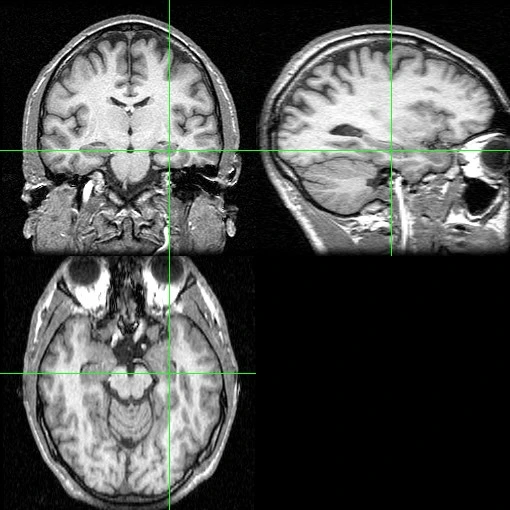
The hippocampus is a structure deep within the brain involved in important memory processes. It works with other regions; it is not a little cupboard containing a complete video archive of a person’s life. Its development provides one part of an explanation, not a single location where every kind of memory begins.
The image above is a real anatomical MRI with the hippocampus indicated. It is included to show location. It is not an infant study participant, an activation map or a photograph of a memory being created. A structural scan and a functional measurement answer different questions.
Functional MRI measures blood-oxygenation changes associated with neural activity. It does not read a baby’s thoughts or reveal a memory’s content frame by frame. Interpreting it requires a task, comparisons, motion handling and statistical analysis.
Yale’s earlier research also investigated statistical learning in young infants. That work examined learning regularities rather than remembering one particular event. Its importance is conceptual: an immature structure can already be functioning, while the abilities it supports continue to change.
Three stages that should not be collapsed into “forgetting”
1. Encoding: forming an initial trace
Encoding concerns what happens when information is first registered. A task can reveal evidence that an experience influenced the nervous system without showing that all its details were encoded. Attention, the information available and the demands of the task all shape what can be learned.
Imagine noticing a visitor’s face without registering the colour of their shoes. Later failure to report the shoes would not establish that a detailed shoe memory had been erased. Before explaining why something was forgotten, a study needs a reason to think the relevant information was encoded.
2. Stabilization and retention: what happens afterward
A newly formed trace may change over time. Researchers distinguish initial encoding from processes that support persistence. Demonstrating the first stage does not guarantee the second, and a short-delay test cannot establish a memory’s eventual lifespan.
This is the central time-scale problem in interpreting infant research. An experiment that runs over minutes can reveal something important about present capacity. To explain adult recollection, additional evidence must bridge years of development.
3. Retrieval: accessing information later
Retrieval concerns using stored information when it is needed. An unsuccessful attempt to recall something does not, by itself, tell a researcher whether the trace is gone, altered or unavailable under those test conditions.
Conversely, uncertainty about retrieval cannot be turned into certainty that every missing memory survives. “We cannot rule out a remaining trace” and “the complete memory is still there” are different claims. The latter requires evidence the former does not provide.
What newer research adds in 2026
Developing mouse circuits are not simply empty networks
A Nature Communications study published on 21 April 2026 examined connections among CA3 pyramidal neurons in the mouse hippocampus. Researchers studied several postnatal age groups using recordings from multiple cells and anatomical methods.
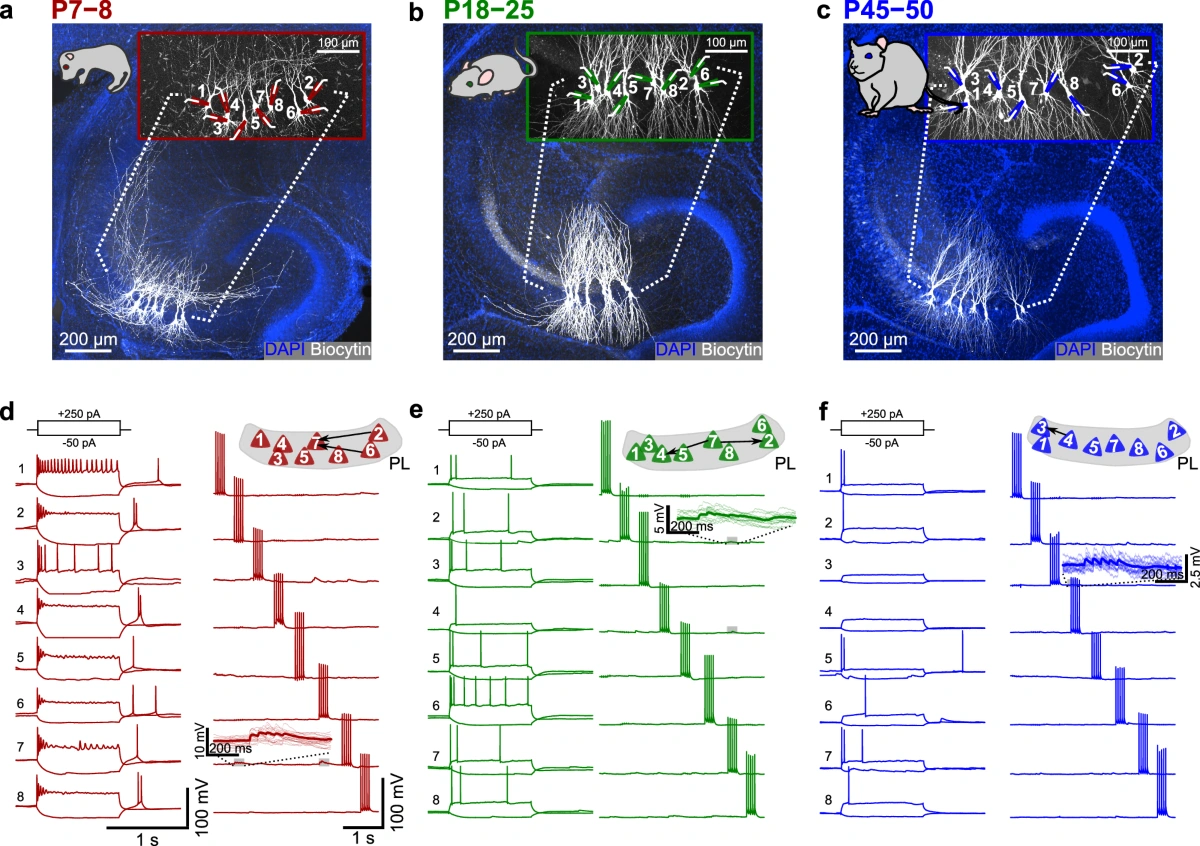
In the original figure, the top panels show labelled cells and their arrangement in tissue. The traces below show electrical recordings. The P labels refer to postnatal mouse ages, not human ages. These are measurements of a circuit at different developmental stages, not images of a child forgetting an experience.
Early networks had dense local connectivity. Later networks were sparser and more structured, and individual synaptic connections also changed in strength. The team used biologically informed models to explore implications for storing patterns and retrieving them from incomplete cues.
This is a useful challenge to the idea of an infant memory system as a blank sheet that merely fills up. Development can reorganize a network that is already active. But the study concerns mouse circuits and models: it did not test human childhood recollections or recover a person’s forgotten first birthday.
An October review discusses lasting, inaccessible traces
Cristina Alberini’s Infantile Amnesia: The Forgetting that Shapes our Identity was first posted as a Review in Advance on 1 October 2026. It discusses a view in which early learning can establish long-lasting latent memories and schemas that influence later learning.
A review synthesizes and interprets research; it is not a newly completed human experiment. The accessible abstract presents the author’s framework, and the advance publication may change before its final version. It should not be described as proof that all infant memories remain permanently recoverable.
How childhood studies connect the short and long timescales
Following children over time provides a different approach from scanning infants or asking adults about the past. Patricia Bauer and Marina Larkina’s prospective study of early-life events began with conversations about events when children were three and tested subgroups again at ages five through nine.
The design makes it possible to compare earlier documented event reports with later recall. Its value is that a researcher does not have to infer the entire history of a memory from an adult’s present account. It helps establish that the accessibility of early events can change during childhood itself.
Even a prospective study has boundaries. The events selected, the questions asked and the criteria used for recall matter. Findings from a particular sample do not establish one fixed age at which every child’s early memories disappear.
What the evidence does—and does not—show
| Research | Useful conclusion | Conclusion to avoid |
|---|---|---|
| Awake-infant fMRI, 2025 | Hippocampal activity can relate to later memory-linked looking behaviour during infancy. | All early experiences survive intact into adulthood. |
| Mouse CA3 circuit study, 2026 | Memory-network organization changes substantially during development. | The same mechanism has been shown to cause human infantile amnesia. |
| Prospective childhood research | Later recall can be compared with earlier documented event reports. | Everyone loses all memories at one precise birthday. |
| October 2026 review | A latent-memory framework helps organize current research questions. | A review recovered forgotten human memories experimentally. |
The most persuasive explanation will need several kinds of evidence to fit together: developmental neuroscience, carefully interpreted behaviour and follow-up over time. A headline built around one brain region or one experiment is unlikely to capture the whole problem.
Can photographs prove an early memory is genuine?
A family photograph is evidence that a scene was recorded, subject to the usual questions about its date and context. It does not establish the source of your present mental image. You might remember being there, remember seeing the photograph later, know the story from relatives, or combine several sources.
A useful distinction is between remembering an event and knowing that an event happened. “My parents told me we visited that house” and “I independently recall standing inside it” make different claims. Both can matter to a family, but they should not be merged when evaluating evidence.
If you are documenting family history, keep those sources separate. Record the photograph’s date, who supplied the story and which details a person volunteered before seeing the photograph. That preserves uncertainty instead of converting a plausible reconstruction into a verified recollection.
None of the infant studies described here establishes a reliable method for recovering a complete hidden autobiography. Their findings should not be used to promise access to forgotten events or to infer a specific childhood incident from someone’s present personality.
Why early experiences still matter without adult recall
Being unable to narrate a moment years later is not equivalent to having been unaffected by it. The studies ask how learning operates and what becomes accessible at later stages. They do not suggest that infancy is an interval in which interaction has no significance.
It is also unnecessary to turn every early experience into a test of permanent storage. A shared game can be valuable at the time it happens. A child does not need to produce a detailed adult account of that afternoon for the interaction to have been real and meaningful.
For readers who prefer Arabic, Horus Valley also has an Arabic explanation of infantile amnesia. The central distinction is the same: evidence of early learning should be considered separately from evidence of lifelong conscious recall.
Sources and image credits
- Yates and colleagues, Hippocampal encoding of memories in human infants, Science, 2025. Author-hosted full paper and public data documentation.
- Vargas-Barroso and colleagues, Developmental emergence of sparse and structured synaptic connectivity in the hippocampal CA3 memory circuit, Nature Communications, 2026.
- Alberini, Infantile Amnesia: The Forgetting that Shapes our Identity, Review in Advance, 1 October 2026. Discussion here is limited to the accessible abstract and publication information.
- Bauer and Larkina, The onset of childhood amnesia in childhood, Memory, 2014, first published online in 2013.
- MRI: Michael Firbank, Wikimedia Commons, released into the public domain. Mouse-study figure: Vargas-Barroso and colleagues, Figure 1, CC BY 4.0; resized and converted to WebP only. The main image is an editorial illustration, not a research photograph.
You may also like
 Science
Can Octopus Arms Think for Themselves? What the Science Shows
How octopus arms process information, what segmented nerve cords reveal, and why local control does not prove nine…
 Science
The Lost Ahramat Nile Branch: How Did Ancient Egyptians Transport Stone to the Pyramids?
The lost Ahramat Branch of the Nile may help explain how ancient Egyptians reached pyramid sites. Explore the…
 Science
How Did a Human Brain Turn Into Glass at Herculaneum?
How did a Roman victim’s brain become glass-like? Explore the Herculaneum evidence, the 2025 thermal study, original microscopy…