
Can Octopus Arms Think for Themselves? What the Science Shows
How octopus arms process information, what segmented nerve cords reveal, and why local control does not prove nine independent minds.
Contents
- Can octopus arms think for themselves?
- What makes an octopus arm difficult to control?
- What the 2025 nerve-cord study found
- Repeating neuronal segments
- Segments do not operate as isolated boxes
- A spatial map of the sucker
- What the squid comparison adds
- How octopus suckers “taste by touch”
- Evidence that the central brain still participates
- Does an octopus really have nine brains?
- What scientists observed—and what remains an inference
- What this could mean for soft robots
- How to read the next octopus-intelligence headline
- Sources and image credits
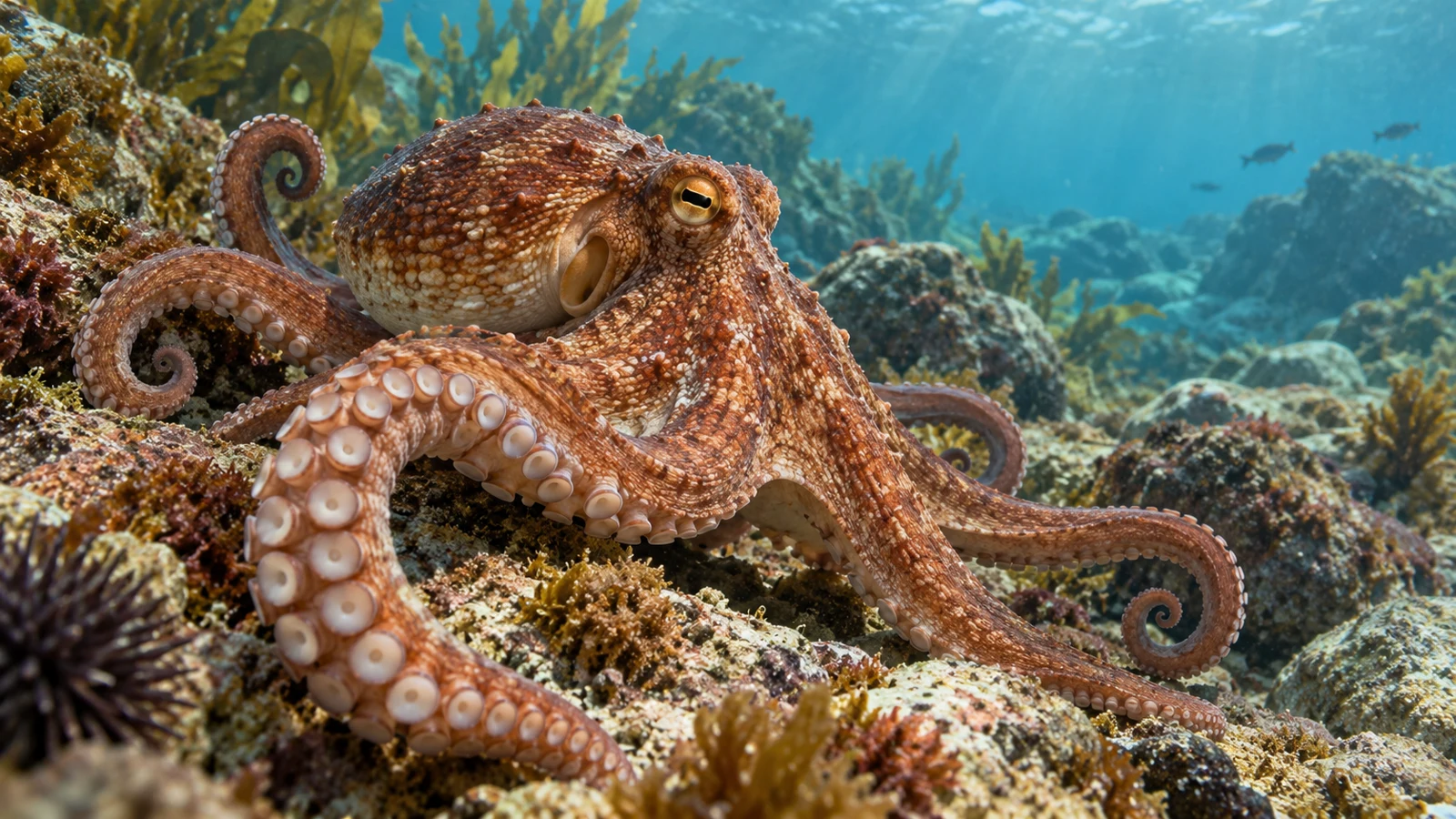
Octopus arms can process sensory information and control aspects of movement locally, but that does not mean each arm has a separate thinking mind. The animal has a central brain as well as extensive neural machinery in its arms. Understanding how those parts work together is more useful than counting supposedly independent brains.
A study published in Nature Communications on 15 January 2025 revealed an important piece of that machinery: repeated groups of neurons along the arm’s main nerve cord, with an orderly relationship to the suckers. The discovery offers a structural explanation for extraordinary dexterity. It does not demonstrate eight additional conscious selves.
This guide separates the anatomy, evidence for local control, and questions that remain open. It draws on the original research, earlier experiments on arm control, and studies of the octopus’s remarkable ability to detect chemicals through contact.
Can octopus arms think for themselves?
The answer depends on what “think” means. If it means handling incoming signals and contributing to a movement without the central brain specifying every small adjustment, the arms have substantial local processing capacity. If it means forming independent conscious intentions, the evidence discussed here does not establish that.
Consider the difference between adjusting a grip and deciding what an animal wants to achieve. A flexible limb needs to respond to contact as its shape changes. That problem can involve local circuits even while the wider animal coordinates a purposeful action. Local processing and central control can coexist.
“Semi-autonomous” is therefore a useful description, provided it is understood as a statement about control. It is not a claim that an arm lives a separate mental life. An arm can contribute information and movement to the same animal rather than simply obeying a detailed command or acting as an unrelated organism.
| Claim | More careful interpretation |
|---|---|
| Each arm has a brain. | Each arm contains extensive neural circuitry; calling it a brain can conceal important anatomical differences. |
| The arms can act independently. | Local control is substantial, but independence is not absolute and depends on the task. |
| Segmentation proves that arms think. | Segmentation describes neural organization; it does not test conscious thought. |
| The central brain is unnecessary. | Experiments show that central control can use information originating in individual arms. |
What makes an octopus arm difficult to control?
A human arm has a skeleton and joints that constrain the ways it can move. An octopus arm is a flexible muscular structure. It can bend at different positions, lengthen, shorten and twist. Its suckers add many smaller contact points that must interact with the environment.
Imagine trying to write instructions for picking up an unfamiliar object with a soft rope covered in independently adjustable gripping surfaces. A single command such as “move forward” would not describe every contact, deformation or change in grip. The problem becomes larger when several arms interact with different surfaces at once.
That example is an analogy, not an experimental model of octopus behaviour. Its purpose is to show why distributing parts of a control problem could be useful. The actual animal’s solution has to be established through anatomy, recordings and behavioural experiments.
What the 2025 nerve-cord study found
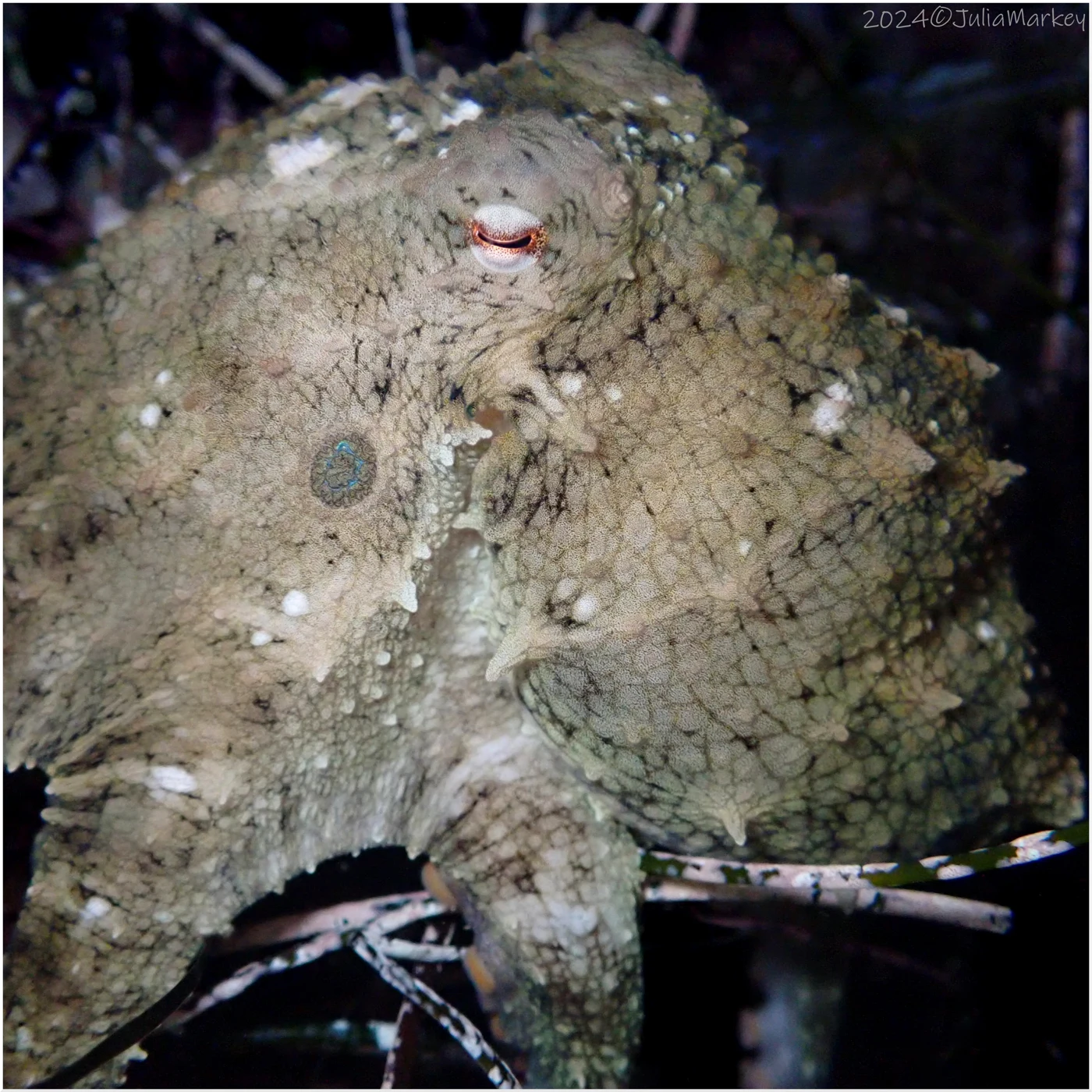
Cassady S. Olson, Natalie Grace Schulz and Clifton W. Ragsdale examined the arm nervous system of the California two-spot octopus, Octopus bimaculoides. Their peer-reviewed study focused on the axial nerve cord, or ANC: a major neural structure extending along the arm.
Repeating neuronal segments
Lengthwise tissue sections revealed columns of neuronal cell bodies separated by boundaries called septa. The pattern was less apparent in cross-sections. This distinction matters: a structure that looks continuous from one viewing direction can reveal a repeated organization when examined along its length.
The study used molecular and cellular labelling and anatomical tracing to investigate that organization. Readers can inspect the researchers’ original Figure 1, including its microscopy and explanatory panels. The colours and labels identify experimental features; they are not the arm’s natural appearance.
Segments do not operate as isolated boxes
Nerves leaving neighbouring boundaries followed different paths into arm muscles. Taken together, connections from multiple segments covered the musculature. The arrangement suggests cooperation between neighbouring modules rather than a simple chain of identical, self-contained controllers.
This is an important difference from the popular image of an animal divided into separate decision makers. Even within one arm, the relevant organization includes connections across boundaries. A boundary in anatomy does not automatically mean a boundary in information processing.
A spatial map of the sucker
The authors also described a correspondence between nerve organization and locations around an individual sucker, which they called suckerotopy. Their original Figure 3 shows the tracing and spatial organization behind that description.
A map in this context is an anatomical relationship. It does not mean that a researcher found a miniature picture of the sucker inside the nerve cord. Nor does it establish what the animal subjectively experiences. It identifies an organization that can guide more precise questions about sensory information and movement.
What the squid comparison adds
The researchers compared the octopus with the longfin inshore squid, Doryteuthis pealeii. Squid have eight arms and two additional tentacles. Those tentacles include a stalk and a sucker-bearing club, giving the study a useful comparison between different appendage regions.
Segmentation was associated with sucker-bearing structures, while the same clear pattern was not found in the sucker-free tentacle stalk. That supports a link between the neural arrangement and the demands of flexible appendages equipped with suckers.
The comparison strengthens a functional interpretation, but it does not prove a complete evolutionary history. Shared features, differences between regions and possible functions are separate lines of reasoning. A comparative study can narrow explanations without directly observing how the structure first evolved.
How octopus suckers “taste by touch”
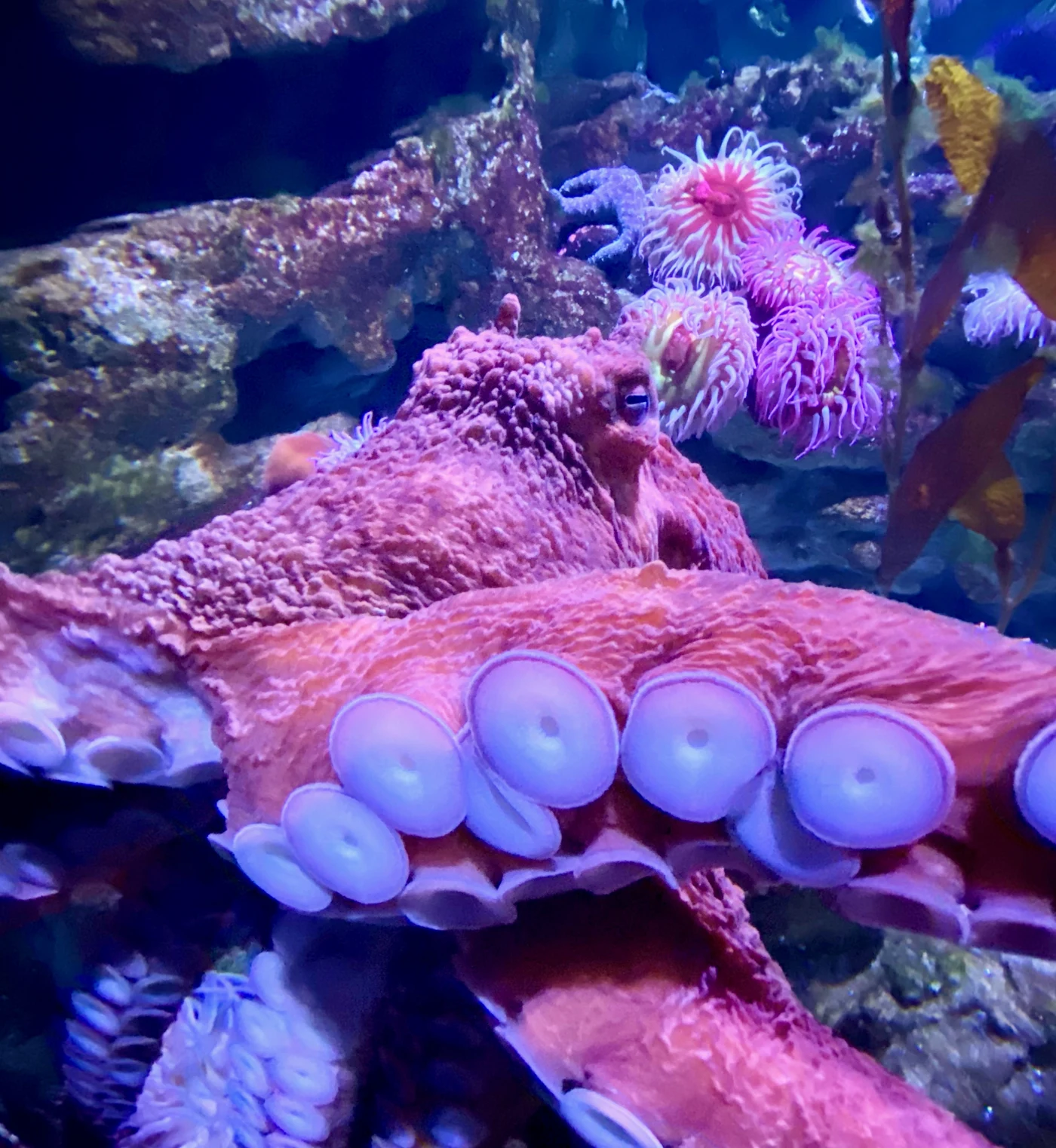
A sucker is more than a suction device. Work by Lena van Giesen and colleagues identified specialized chemotactile receptors involved in detecting chemicals through contact. Their 2020 Cell study investigated the molecular basis of this sensory system.
Some relevant substances dissolve poorly in water. Contact-dependent detection helps explain why touching a surface can provide information that looking at it cannot. The researchers also distinguished sensory cells responding to chemical and mechanical stimulation.
“Taste by touch” is a helpful shorthand rather than a claim that an octopus sucker functions exactly like a human tongue. It refers to a specialized sensory system with its own receptors and ecological role. The comparison helps readers imagine the information being collected without making the two systems identical.
This also clarifies why the arm-control story is about more than movement. A limb interacting with an object receives information as well as applying force. Explaining dexterity therefore requires understanding how sensory signals relate to muscular action, not just locating a large number of neurons.
Evidence that the central brain still participates
Earlier behavioural research provides a useful counterweight to claims of complete arm independence. A 2020 study by Tamar Gutnick and colleagues used learning tasks involving individual arms in Octopus vulgaris. It found that the central nervous system could use peripheral information about movement and touch for directed behaviour.
The published study concluded that substantial local capacity coexists with central control. It was a different investigation, in a different species, from the 2025 anatomical work. The two should not be described as one experiment.
Together, they make a better reading strategy possible. When a headline says an arm “decides,” ask what the measured behaviour was, what information reached the central nervous system, and whether the experiment distinguished local processing from whole-animal coordination.
Does an octopus really have nine brains?
“Nine brains” is memorable, but a memorable count is not a precise description of a nervous system. It combines one central brain with the neural machinery in eight arms and gives all nine items the same label. That makes a complicated arrangement sound simpler than it is.
It is clearer to describe the relevant parts: a central brain, major nerve cords in the arms, and additional peripheral circuitry associated with muscles and suckers. Which component matters most depends on the question being asked.
Neuron counts also require care. A number quoted for one species, size or anatomical definition should not automatically become a universal figure for every octopus. The present article does not need an exact total to explain why local circuitry is important.
What scientists observed—and what remains an inference
| Evidence | What it supports | What it does not establish |
|---|---|---|
| Repeated neuronal groups in tissue sections | A segmented anatomical organization in the studied nerve cord | The thoughts of an individual segment |
| Traced paths between nerves and muscles | Specific structural connections | Every signal used during natural behaviour |
| Orderly connections around a sucker | A spatial arrangement of innervation | A conscious body image |
| Comparison with squid appendages | An association with sucker-bearing structures | An identical system in every cephalopod |
| Single-arm learning tasks | Central use of peripheral sensory information in the tested tasks | A complete account of control in every situation |
These distinctions prevent an appealing explanation from becoming stronger than its evidence. Anatomy identifies possible pathways. Recording activity can show when a pathway is engaged. Carefully changing the system and measuring behaviour can help test what contribution a pathway makes.
No single technique answers all three questions. A beautiful microscope image is not a recording of an animal choosing between options, and a successful behavioural task does not by itself reveal every underlying connection.
What this could mean for soft robots
The engineering appeal is straightforward: a flexible machine with many possible shapes also needs a way to coordinate motion and respond to contact. Biological structures can suggest where an engineer might distribute sensing and control rather than routing every small adjustment through one controller.
However, inspiration is not a finished device. Reproducing a useful principle requires defining a task, building a model or mechanism, and measuring whether it works. The 2025 anatomy study should not be presented as proof that a particular robot is faster, safer or ready for medical use.
It also cautions against copying the simplest version of the story. If neighbouring biological segments contribute different connections, a design based on identical independent modules may miss an important feature. That is a research question for engineers, not a performance result from the octopus study.
How to read the next octopus-intelligence headline
- Check the date. The segmentation paper was published in January 2025; it is not a discovery first announced in 2026.
- Check the species. Results from one octopus species or one squid comparison need an explicit basis before being generalized.
- Check the method. Microscopy, neural recordings and behavioural tasks provide different kinds of evidence.
- Check the verb. Sensing, responding, learning and conscious thinking are not interchangeable claims.
- Check the image. A wildlife photograph can show external anatomy; it cannot reveal microscopic nerve segmentation.
The most useful question is not whether an octopus has eight additional human-like minds. It is how one animal coordinates a flexible body whose sensory and motor processing is distributed across several connected structures. Segmented nerve cords give scientists a more detailed place to investigate that question.
Sources and image credits
- Olson, Schulz and Ragsdale: Neuronal segmentation in cephalopod arms, Nature Communications, 15 January 2025. Original figures are linked rather than reproduced.
- Gutnick and colleagues: Use of Peripheral Sensory Information for Central Nervous Control of Arm Movement by Octopus vulgaris, Current Biology, 2020.
- Van Giesen and colleagues: Molecular Basis of Chemotactile Sensation in Octopus, Cell, 2020.
- Species photograph: Julia Markey, California two-spot octopus. Sucker photograph: Betty Wills (Atsme), New England Aquarium. Both photographs are licensed under CC BY-SA 4.0; resized and converted to WebP, with that licence retained for the image versions. Neither photograph documents the study’s experimental specimens.
You may also like
 Science
Why Can’t We Remember Being Babies? What Memory Research Shows
Why our first years are hard to recall, what infant brain scans reveal, and why forming a memory…
 Science
The Lost Ahramat Nile Branch: How Did Ancient Egyptians Transport Stone to the Pyramids?
The lost Ahramat Branch of the Nile may help explain how ancient Egyptians reached pyramid sites. Explore the…
 Science
How Did a Human Brain Turn Into Glass at Herculaneum?
How did a Roman victim’s brain become glass-like? Explore the Herculaneum evidence, the 2025 thermal study, original microscopy…