
How Did a Human Brain Turn Into Glass at Herculaneum?
How did a Roman victim’s brain become glass-like? Explore the Herculaneum evidence, the 2025 thermal study, original microscopy figures, and the scientific debate.
Contents
- What Was Actually Found at Herculaneum?
- What Does “Glass” Mean in Science?
- Vitrification, Fossilization and Charring: Why the Difference Matters
- From the Victim’s Discovery to the 2025 Study: A Timeline
- What Evidence Connects the Material to Neural Tissue?
- How to Read the Micrographs Without Overinterpreting Them
- What Did the February 2025 Study Add?
- Was the Temperature Exactly 510°C?
- The Proposed Scenario: Brief Intense Heating, Then Rapid Cooling
- Did Lava Flow Into the Room and Turn the Brain Into Glass?
- Why Do Scientists Disagree About the Interpretation?
- Is This the Oldest Preserved Human Brain in the World?
- Could Scientists Recover Memories or Revive the Tissue?
- Why Does the Discovery Matter Beyond Its Unusual Headline?
- How to Read a “Brain Turned to Glass” Headline Critically
- Original Sources and Image Credits
How could the remains of a human brain have turned into glass? At Herculaneum, the Roman town buried by the eruption of Mount Vesuvius in AD 79, researchers described a shiny black substance found inside one victim’s skull as vitrified neural tissue. A study published in February 2025 proposed a thermal explanation for how it formed. Beneath the striking headline lie several questions worth examining: What do scientists mean by glass? How do they identify a sample’s origin? And where do laboratory measurements end and reconstructions of ancient events begin?
This is a story about fragments and laboratory measurements, not a complete, transparent brain retaining someone’s thoughts. It becomes more revealing when read as a scientific investigation involving evidence and criticism, and when we separate the date the victim was discovered from the dates the research was published. The sources cited here were reviewed on October 27, 2026; the principal new study dates to 2025, while earlier work dates to 2020.
What Was Actually Found at Herculaneum?
In an official statement dated March 3, 2025, the Herculaneum Archaeological Park reported that the remains of a young man, approximately 20 years old, were discovered in 1961. He was lying on a wooden bed in a room within the College of the Augustales. On the basis of the archaeological setting, he has often been identified as a possible caretaker or guard. Yet the park also states that research into his identity and reason for being there continues. “Guard” should therefore be treated as an inference, not a confirmed biography.
That distinction may seem small, but it changes how we tell the story. We know the discovery location, the position of the remains and aspects of the archaeological context. The man’s occupation and what he was doing in his final moments require further evidence. A body’s position cannot provide a recording of what happened, and a plausible hypothesis should not become a complete personal history.
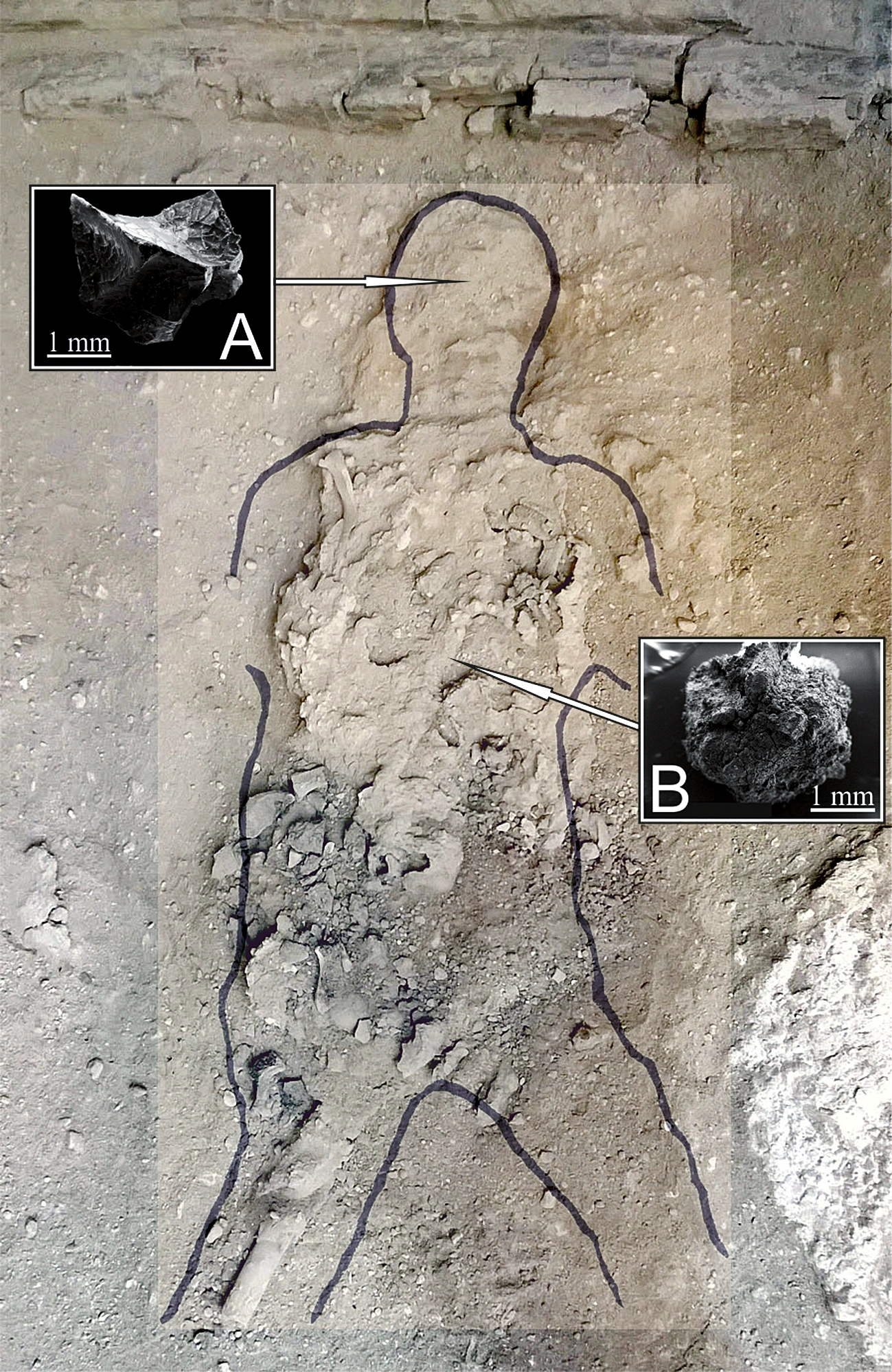
The archaeological figure shows the victim’s location and two small samples associated with the skull and spinal column, according to the authors of the 2020 paper. Finding a substance inside a bony cavity can help establish where it came from, but does not replace compositional analysis. Where the sample was found is a different question from what it consists of and how it formed.
What Does “Glass” Mean in Science?
Under the International Union of Pure and Applied Chemistry (IUPAC) definition, glass is an amorphous material in the glassy state, below its glass-transition temperature. What matters here is the arrangement and behavior of the material, not whether it is transparent or shaped like a windowpane. A glassy substance may look dark, and shininess alone does not prove that a material is glass.
For a simple analogy, imagine one group of people standing in regularly spaced rows and another whose members stop at irregular positions. This is an illustration of order, not a literal model of atoms. An amorphous material lacks long-range crystalline order; establishing its state takes more than looking at its surface or describing its texture.
In the Herculaneum case, researchers use the term “organic glass” in reference to the substance’s proposed origin and composition. “Organic” does not mean it is alive, nor does it make the material equivalent to ordinary silicate window glass. Similarly, a fragment that resembles obsidian does not automatically qualify as volcanic obsidian: visual resemblance is not chemical identity.
Vitrification, Fossilization and Charring: Why the Difference Matters
These terms are sometimes used interchangeably, although they point to different processes. When reading an archaeological news report, ask whether the writer is describing appearance, composition or a mechanism of preservation. Confusing these levels can turn a headline into a series of conclusions that have not actually been tested.
| Term | Basic idea | What is not enough to prove it? |
|---|---|---|
| Vitrification | Formation of an amorphous, glassy state | A black or glossy appearance alone |
| Fossilization | Broadly, preservation and alteration of remains through geological processes | The remains simply feeling hard |
| Charring | Heat-induced transformation of organic matter, leaving carbon-rich residue | Assuming any carbon-rich remnant is glass |
| Mummification or desiccation | Preservation in which water loss or treatment restricts decay | Assuming every ancient brain was preserved the same way |
For a different kind of materials-science question, see our article about the Roman Lycurgus Cup and its changing colors (in Arabic). That case concerns the manufacture and optical properties of a glass object; this one concerns the identity and thermal history of archaeological remains.
From the Victim’s Discovery to the 2025 Study: A Timeline
Putting the key dates in sequence helps avoid a common error: suggesting that everything was discovered when a news story appeared. The archaeological remains predate modern laboratory analyses, and each research paper addresses a particular question and adds a different kind of evidence.
| Date | What happened? | How to interpret it |
|---|---|---|
| 1961 | The victim was discovered inside the building, according to the archaeological park | The starting point for the archaeological context, not the date vitrification was established |
| 2020 | Researchers published the vitrification hypothesis and analyses of the remains, including micrographs | Evidence that needs to be evaluated against alternatives |
| 2020 | A critical research comment challenged aspects of the initial evidence | Scientific objections form part of the case’s history |
| February 27, 2025 | A study investigated the substance’s thermal behavior and proposed how it formed | A refinement of the explanation, not a direct observation of the eruption |
| March 3, 2025 | The archaeological park issued a statement about research and restoration related to the room | The archaeological context remains under investigation |
What Evidence Connects the Material to Neural Tissue?
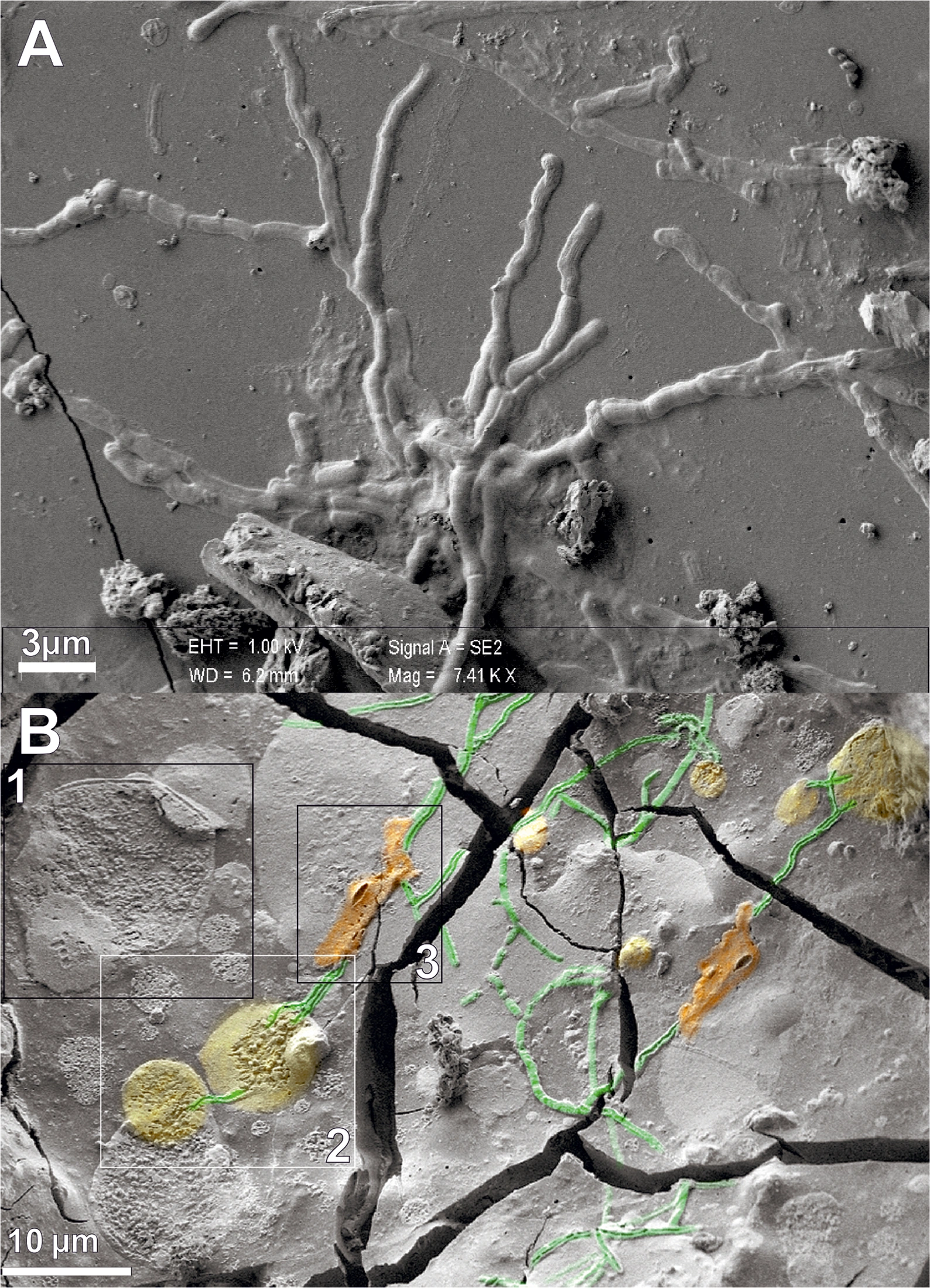
In a 2020 paper published in PLOS ONE, the research team described microscopic structures that they interpreted as axons and cell bodies in remains associated with the brain and spinal cord. Their analysis used electron microscopy and elemental measurements, with image analysis and comparisons to the shapes and dimensions of known neural structures.
The phrase “the team interpreted” is important. An image records surface features of a sample; identifying those features is a separate analytical step. Observing delicate branching tubes is evidence to consider alongside other results. It does not automatically mean that every line in the image is a nerve fiber, or that the original tissue’s functions have survived.
How to Read the Micrographs Without Overinterpreting Them
Begin with the scale bars, then read the panel labels and the authors’ captions. In the reproduced figure, panel A shows structures the authors interpret as brain axons; panel B includes material they associate with the spinal cord, with colors added to distinguish features. The green and yellow are explanatory coloring, not the natural colors of cells preserved since Roman times.
The figure also combines different magnifications and sampling locations. Do not compare the apparent length of a structure in one panel with another without checking each scale. Nor does an added color establish chemical identity. Reading the original figure carefully makes it useful evidence without pretending it is a photograph of a functioning brain or a map of its owner’s thoughts.
What Did the February 2025 Study Add?
The 2025 study in Scientific Reports investigated the thermal behavior of the fragments using calorimetry alongside microscopic and spectroscopic analyses. Its authors concluded that the glassy material formed after exposure to a temperature well above 510°C (950°F), followed by very rapid cooling. This is an inference about the material’s history based on sample properties and experiments, not a surviving temperature reading from the ancient room.
The important advance was a shift from describing the material’s appearance toward testing how it behaves under heating and cooling. But a successful test that narrows the possibilities does not turn every detail of the reconstructed event into a direct observation. The material’s identity, its thermal history and the local conditions it experienced are related but distinct questions, each requiring its own evidence.
Was the Temperature Exactly 510°C?
No. The number is neither a setting on an ancient furnace nor an exact measurement of every location in the town. It belongs within the research team’s thermal argument, which distinguishes laboratory observations from estimates of conditions during the eruption. Claiming that “the entire town reached precisely 510°C” would imply a certainty and geographical scope that the study does not establish.
The Proposed Scenario: Brief Intense Heating, Then Rapid Cooling
A statement from Roma Tre University describes the researchers’ hypothesis: a very hot, dilute ash cloud arrived first, then dissipated quickly enough for rapid cooling, before subsequent volcanic deposits buried the area. The team also suggested that the bones of the skull and spine may have helped create the conditions that allowed these remains to persist.
The scenario becomes easier to understand when divided into stages: intense heat exposure, the rapid end of that exposure, cooling, and finally burial. Their order is central to the hypothesis. “Extreme heat” alone does not determine what happens to a material; exposure duration, the rate of heat transfer and the environment all matter.
This also explains why the case cannot simply be generalized to other victims or treated as the expected way tissue survives any volcanic eruption. An exceptional local event does not imply identical conditions throughout Herculaneum. For each retelling, it helps to ask: Which stage is supported by a deposit or a physical sample, and which stage was reconstructed to explain the combined clues?
Did Lava Flow Into the Room and Turn the Brain Into Glass?
The US Geological Survey explains that pyroclastic flows are moving mixtures of hot gas, ash and rock fragments; turbulent ash clouds may accompany denser currents. They are not the same as the familiar image of a river of molten lava. The distinction matters when discussing a short-lived hot cloud followed by material that buried the site.
Replacing that explanation with “lava poured over the brain and cast it into glass” tells a different, misleading story. Conceptual illustrations can introduce a topic, but their captions need to remain clear: artwork visualizes a possibility, while the proposed physical mechanism depends on deposits, samples and scientific analysis.
Why Do Scientists Disagree About the Interpretation?
In a 2020 research comment, Alexandra Morton-Hayward and colleagues challenged the adequacy of the evidence presented in the initial report. Their critique emphasized the need for accessible raw data and detailed methods, scrutiny of protein origins, and consideration of contamination and misinterpretation. It also discussed limitations in the temperature and preservation-mechanism arguments.
That criticism must be understood in its historical order: it preceded the 2025 study. It should not be portrayed as a subsequent assessment of experiments that had not yet been published. At the same time, a new paper does not automatically settle every earlier concern. A thermal experiment can add valuable evidence while the identity and history of the material still benefit from independent verification.
Cases like this do not demand a choice between unconditional belief and accusations that scientists fabricated the results. A more productive approach separates the claims: Is the substance glassy? Is it derived from neural tissue? What conditions could have produced it? The strength of the evidence may differ across those questions, and that difference is itself useful information.
| Question | Evidence needed | Leap to avoid |
|---|---|---|
| What does the sample look like? | Clear images, descriptions and scale | Assuming shininess proves vitrification |
| What is it made of? | Compositional analysis, comparison samples and contamination controls | Treating one detected element as definitive proof of origin |
| How does it respond to heat? | Documented experiments and measurements | Assuming lab results directly record the eruption |
| How did it form historically? | Connecting sample results to archaeological and volcanological context | Assuming one compatible scenario is the only possible one |
| Can the conclusion be reproduced? | Independent testing and reviewable data | Assuming many news reports equal independent replication |
Is This the Oldest Preserved Human Brain in the World?
Ancient preserved brains are far more numerous and varied than the Vesuvius case alone. In 2024, University of Oxford researchers compiled records of more than 4,000 preserved human brains from different environments and periods, with some examples dating back roughly 12,000 years. Known preservation mechanisms include drying, freezing and chemical changes, alongside cases whose mechanisms remain uncertain.
“An ancient brain survived” is therefore a different claim from “brain tissue underwent heat-induced vitrification during a volcanic eruption.” According to the research team, the Herculaneum case stands out because of the unusual transformation they propose. Calling it the oldest known brain would ignore a broader archaeological record and change the actual question under investigation.
Could Scientists Recover Memories or Revive the Tissue?
None of the studies discussed here reports an experiment that recovered memories or restarted brain cells. Studying a material’s structure and chemistry is not the same as demonstrating biological function. Even if the microscopic features are accepted as neural in origin, that would tell us something about the possible tissue type, not what its former owner thought.
Consider discovering the remains of a burned book. The paper and ink may reveal what the book was made of and how it was damaged, but that does not guarantee that its words remain legible. This analogy illustrates the gap between preserving structure and recovering information; it is not a scientific model of how memories are encoded. These studies do not support promises of reviving the victim or reconstructing his personality.
Why Does the Discovery Matter Beyond Its Unusual Headline?
First, a single sample brings several disciplines together. Archaeology investigates location and chronology; materials science tests structure and physical behavior; protein analysis can help assess possible biological origin; and volcanology examines environmental scenarios. None can substitute entirely for the others.
Second, the case teaches us how scientific wording should change with the level of evidence. “We observed a shiny substance” is a descriptive statement. “We measured behavior consistent with a glassy state” requires a test. “The substance formed through this sequence during the eruption” is a broader historical explanation. Good science writing makes those levels visible rather than compressing them into a single sensational sentence.
Third, the story leaves testable questions for future research. Would independent teams obtain the same results? Could other specimens provide useful comparisons? And do different analytical techniques converge on a single interpretation? Such questions remain meaningful even if parts of the story are revised later.
How to Read a “Brain Turned to Glass” Headline Critically
- Check the place name: the specimen is associated with Herculaneum, not simply “Pompeii” in a generic headline.
- Separate the date of the eruption, the date the victim was found and the dates of scientific publication.
- Identify whether an image is an original archaeological photograph, a processed micrograph or an illustration.
- Notice the difference between “researchers interpreted” and “scientists directly observed.”
- Do not let a single temperature value replace discussion of exposure time, cooling rate and local context.
- Read the original papers and the critical comment, not just the number of websites repeating the story.
The most careful summary is that researchers have presented evidence and a hypothesis for the formation of remains they interpret as vitrified neural tissue, while assessing the claim requires reading the analyses, their limitations and the scientific discussion around them. The case remains extraordinary when told this way. It also becomes more valuable, because the reader takes away a method for understanding evidence rather than just a memorable headline.
Original Sources and Image Credits
- Giordano et al., Scientific Reports, February 27, 2025: thermal analysis and the proposed vitrification mechanism.
- Petrone et al., PLOS ONE, October 6, 2020: microscopic analysis and the original figures.
- Morton-Hayward et al., 2020: a critical comment calling for stronger evidence and verification.
- Herculaneum Archaeological Park, March 3, 2025: discovery context and research concerning the room.
- Roma Tre University, February 27, 2025: the team’s proposed thermal scenario.
- University of Oxford, March 20, 2024: an archive of preserved human brains.
- IUPAC Gold Book: definition of glass.
- US Geological Survey: an explanation of pyroclastic flows.
The archaeological and microscopic figures are reproduced from Petrone et al. (2020) under the Creative Commons Attribution 4.0 International license (CC BY 4.0). Only file format and display dimensions have been adjusted; the explanatory colors in the microscopy figure were already present in the published original. The featured image is conceptual artwork, not a photograph of the actual specimen.
You may also like
 Science
Why Can’t We Remember Being Babies? What Memory Research Shows
Why our first years are hard to recall, what infant brain scans reveal, and why forming a memory…
 Science
Can Octopus Arms Think for Themselves? What the Science Shows
How octopus arms process information, what segmented nerve cords reveal, and why local control does not prove nine…
 Science
The Lost Ahramat Nile Branch: How Did Ancient Egyptians Transport Stone to the Pyramids?
The lost Ahramat Branch of the Nile may help explain how ancient Egyptians reached pyramid sites. Explore the…