
USPS Change of Address Verification Failed? How to Fix It
USPS Change of Address verification failed? Check the $1.25 online fee, card billing-address match, barcode and IDs, or file free in person.
Contents
- Fast decision guide: what should you do next?
- Why USPS identity verification can fail
- Step 1: Verify you are on the real USPS website
- Step 2: Check the card billing-address requirement
- A quick billing-address example
- Step 3: Check verification messages and distinguish a broken form
- Step 4: If USPS emailed a barcode, take it to the Post Office
- No barcode email, or an expired one?
- Step 5: Which documents should you bring?
- Before leaving for the counter
- How to file a fresh paper Change of Address at USPS
- If verification still fails at the counter
- Special cases: family, business, overseas, military and another person
- Family move versus individual move
- Business or authorized agent
- Moving abroad or already outside the United States
- Military addresses
- What if you already have a confirmation code?
- Use the right code for an ACTIVE or PENDING request
- A verification success email is not the same as mail already arriving
- If your address is new construction or USPS cannot find it
- A moving-day checklist that prevents another verification delay
- Three illustrative scenarios: choose the next step
- Scenario A: the card charge appears, then USPS says verification failed
- Scenario B: a parent and adult child with different surnames move together
- Scenario C: the application passed, but a bank card did not arrive
- Do not confuse these three USPS-related codes
- What if somebody filed a move in your name?
- Official USPS references and what each one confirms

If USPS could not verify your identity for a Change of Address (COA), do not keep paying and resubmitting the same application. First check whether you received an email asking for in-person verification with a barcode. If you did, follow that email, bring acceptable identification to the specified Post Office, and complete the verification there. If you never reached that stage, check your card billing-address match and the exact error before deciding whether to retry. USPS explicitly offers a free in-person PS Form 3575 route for eligible moves. See USPS Standard Forward Mail & Change of Address.
This U.S.-specific guide follows USPS guidance checked on November 1, 2026. The genuine USPS screenshots below show public instructions and an empty management form. They help identify the correct next step; no personal identity check, card payment or change-of-address submission was performed.
Fast decision guide: what should you do next?
| What happened | Best next step |
|---|---|
| Card payment or billing-address verification failed | Check whether the billing address exactly matches your old or new address, as USPS requires; verify that a request was not already submitted before paying again. |
| You received a USPS email with a barcode after online verification failed | Use that email’s listed deadline and instructions; take your barcode and accepted original ID to the participating Post Office. |
| USPS says it cannot verify your documents at the counter | Ask which document or address proof failed and return with acceptable originals; verification must succeed for forwarding to be activated. |
| You got a USPS confirmation code but mail is not forwarding | Check the effective date and forwarding setup window; use the official management page for an existing order, not a brand-new application. |
| You received a notice about a move you never requested | Use the USPS dispute route immediately; do not confirm or approve an unauthorized request. |
A pending change-of-address request is not proof that forwarding is active. Verify the stage of your request before you rely on it for sensitive documents, medication, bills or time-sensitive mail.
Why USPS identity verification can fail
USPS has strengthened identity checks to reduce fraudulent mail redirection. For an online COA, it may verify a mobile number and a payment card in addition to the information in the change-of-address request. The USPS Change of Address FAQ explains that the card issuer’s address matching and extra authentication can block a request. A block does not, by itself, mean you committed fraud or supplied a false identity.
- Card details: the billing address on the card does not match the old or new address, or the card’s authentication fails.
- Contact verification: a verification link or code has not reached the phone, expired, or the online flow does not advance.
- Document proof: photo identification is expired, unacceptable for the transaction, unreadable, or insufficient to establish the old/new address.
- Special move category: a request for another person, a business, a military address, or an international move follows different rules.
- Technical problem: the form freezes, returns a system error or stalls; the presence of an error is not evidence that the card or identity was rejected.
USPS does not publish a complete diagnostic breakdown for every verification rejection. The suggestions below identify official checks and sensible troubleshooting, not secret reasons attributed to USPS systems.
Step 1: Verify you are on the real USPS website
Open usps.com/manage/forward.htm yourself rather than following a sponsored search result, unknown text message, third-party move concierge, or email link you cannot independently confirm. From that page, follow the official Change Your Address link to moversguide.usps.com. Review the browser address bar before entering a card or identifying information.
The current online identity-verification fee is $1.25. An eligible in-person paper COA using USPS PS Form 3575 is free. USPS warns that third-party change-of-address websites can charge $40 or more and that USPS generally cannot refund charges collected by those sites. Some older moving guides still show $1.10 or even $1.05; those amounts should not be copied into a current how-to article. If you believe you paid a non-USPS website, contact your card issuer about the charge and consider whether your personal information was exposed. Official fee and scam warning.
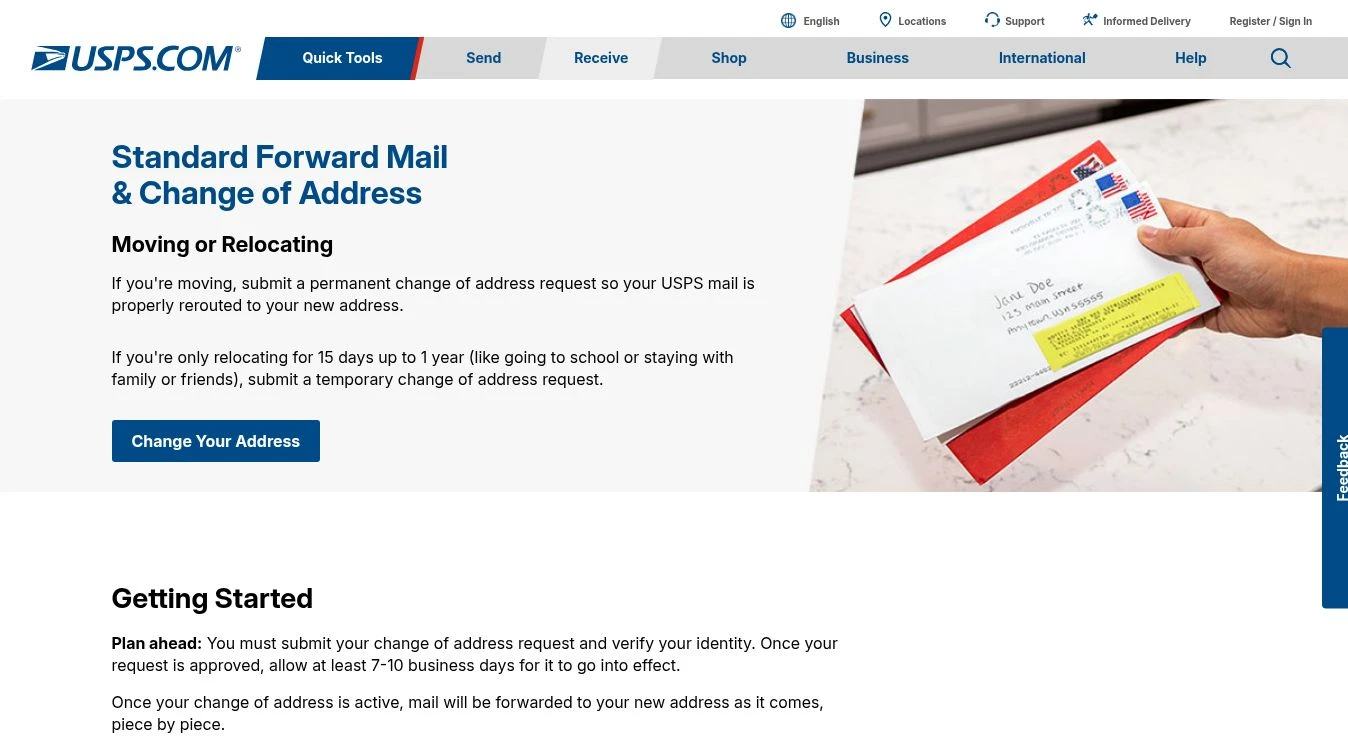
What to look for: the official starting page is titled “Standard Forward Mail & Change of Address.” Its “Change Your Address” button leads to the USPS Mover’s Guide. The screenshot shows the public entry page, not a completed application or evidence that a particular move was approved.
Step 2: Check the card billing-address requirement
USPS says the billing address of the credit or debit card used for online identity verification must match either the old address or the new address in your COA application. This is a validation requirement, not a recommendation to change a bank’s records to an address where you do not live. Use the cardholder’s actual registered billing information and make sure the ZIP code, unit/suite and street details are accurate.
- Compare the billing address saved with your card issuer to both addresses in the USPS application. Pay special attention to apartment/suite numbers and ZIP codes.
- Correct typos in your own COA information if the application still allows corrections. Do not invent a matching address just to force the transaction through.
- Do not assume an approved or pending card authorization means your identity verification passed. Check whether USPS issued an actual COA confirmation or in-person verification instruction.
- If you recently updated your banking address and the two records still do not match, ask your bank what address it currently has on file; then choose USPS in-person verification if needed.
- Avoid repeated payment attempts while an earlier request or charge may still be pending. Contact USPS or the card issuer to reconcile unclear transactions.
A card problem is only one possible failure point. If the message instead says your identity could not be verified and supplies a barcode, skip attempts to solve it by switching browsers and follow the specified in-person verification process.
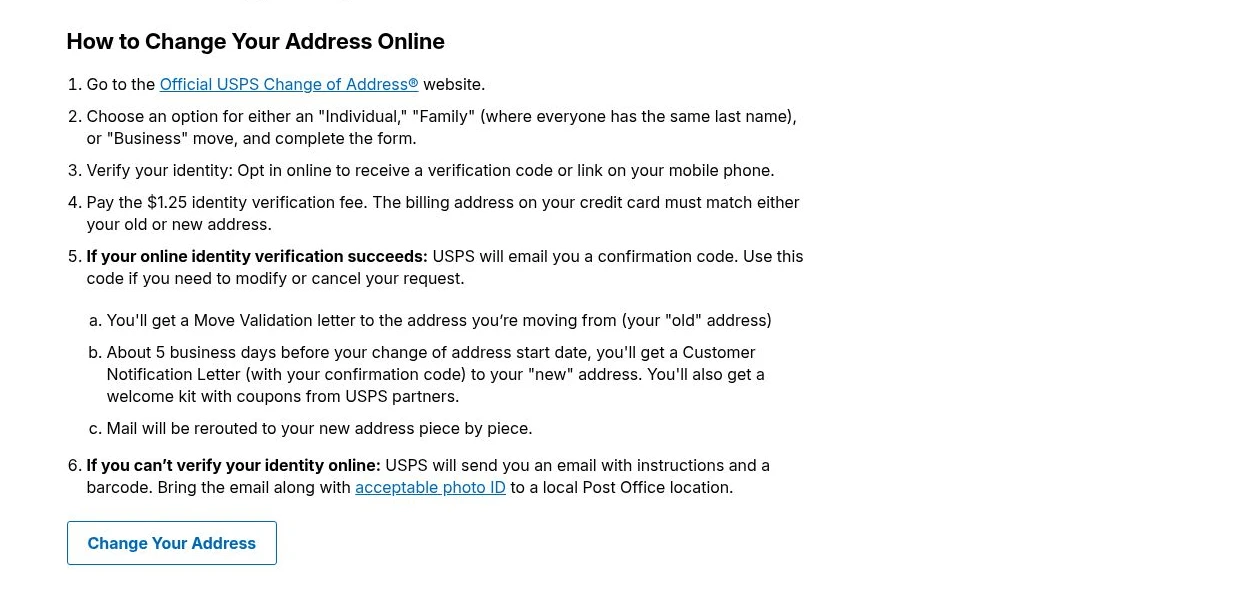
A quick billing-address example
Suppose you are moving from Apartment 4 to Apartment 12, but your bank still has an entirely different address from an older move. Re-entering the new address in USPS does not update the bank’s record. Compare the issuer’s actual billing address with both COA addresses first. If neither matches, resolve that record with the issuer or use the supported in-person route. This example illustrates the published address-matching requirement; it is not a claim about USPS’s unpublished rejection rules.
Step 3: Check verification messages and distinguish a broken form
If you never received an expected one-time SMS code or authentication link, confirm that the phone number in the form is your current number, that the device can receive ordinary texts and that your mobile carrier is not blocking relevant messages. Use any resend option actually shown by USPS; do not share a one-time code with a person claiming to be a postal representative. If a screen merely freezes or the Next button fails, record the exact screen and error without exposing your card or identity numbers.
Trying an updated browser, turning off autofill for a retry, or switching between mobile and desktop can help isolate a browser-rendering issue, but USPS does not guarantee these as identity-verification fixes. Do not disable security checks or repeatedly start new requests without checking whether the earlier COA was recorded. When the official site fails repeatedly, the supported fallback is to contact USPS or visit a Post Office with acceptable documents.
Step 4: If USPS emailed a barcode, take it to the Post Office
USPS says that customers who cannot pass online COA verification receive an email with a barcode and instructions for in-person verification. Read the date and location instructions in your specific email, then bring the barcode (on your phone or printed) and your original, current photo ID to the designated location. The retail associate can scan the barcode and examine the documents. The barcode is linked to a verification process, not a universal pass that works after any deadline. USPS online failure instructions.
- Open the message carefully. Confirm that it actually concerns a USPS Change of Address you submitted and that its destination is genuine.
- Note the exact expiration date in your own barcode email. Do not assume every USPS identity-proofing service uses the same deadline.
- Bring acceptable physical ID and, if the ID does not show the old or new address, a qualifying secondary document as described below.
- Tell the counter clerk: “My online USPS Change of Address identity verification failed. I received this barcode and need to complete the in-person verification.”
- Ask how and when the result will be confirmed. Keep the email and any receipt or transaction information until you see confirmation.
Important distinction: USPS also provides in-person identity verification for Login.gov and other agencies, but those services can have different accepted IDs, barcode validity rules, and confirmation times. Login.gov publishes a seven-day barcode deadline for its own flow; that rule should not be pasted into every USPS Change of Address guide. Follow the instructions for the service named on your specific email. Login.gov’s separate rules.
No barcode email, or an expired one?
- Search your email and junk folders for the request you actually submitted. A reminder to finish a form is different from an identity-verification barcode or a confirmation of a completed request.
- If the barcode is missing or expired, explain that exact problem to USPS before starting another paid request. Ask whether the existing request can be completed or whether you must begin a new one.
- Keep a private note of the application date, the displayed error and any USPS reference. Do not post your barcode, confirmation code, full address or ID online.
There is no genuine customer barcode in this article: a barcode can identify a private request. The screenshot above shows USPS’s public instructions for this branch of the process.
Step 5: Which documents should you bring?
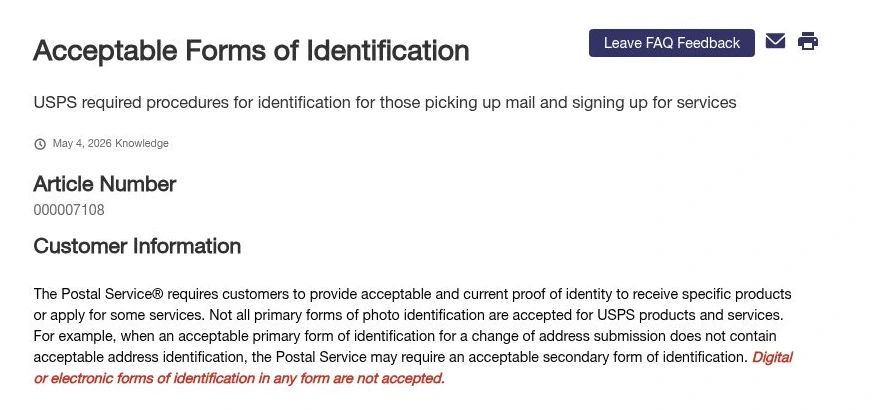
USPS requires acceptable current identification for change-of-address verification. A state-issued driver’s license or state non-driver ID containing the appropriate address is a straightforward option. A U.S. passport or military ID may be acceptable as a primary photo ID, but because these often lack a qualifying residential address, you may also need an acceptable secondary proof of address. The USPS Acceptable Forms of Identification page is the decisive reference for what the chosen service and location will accept. Digital versions of identification are not accepted for these services.
- Primary photo ID: for example, an unexpired state driver’s license, state identification card, passport or qualifying U.S. government ID, subject to USPS rules.
- Possible address evidence: a current lease or mortgage, voter or vehicle registration, or home/vehicle insurance policy that connects your name to the relevant address.
- Name or status differences: legal name changes, an agent submitting for a child or an executor acting for a deceased person can trigger additional documentary requirements.
- Physical documents: bring originals, and check the email for anything more specific before leaving for the Post Office.
A utility bill or phone screenshot is not a substitute for a document unless USPS expressly recognizes that type for the specific transaction. A secondary document should display the qualifying old or new address, where required; presenting several unrelated documents does not guarantee verification.
Before leaving for the counter
- Check that the photo ID is current and that its name matches the request; gather relevant legal name-change or authorized-agent documentation if applicable.
- Bring the email or letter for this request, plus the physical ID and any qualifying address evidence. A photo of a document on your phone does not replace accepted physical identification.
- Use the locations in your verification email when supplied. Otherwise, check the official Post Office locator and the location’s retail hours and relevant services.
- Ask the associate to identify the next required step for the existing request before filing another one.
How to file a fresh paper Change of Address at USPS
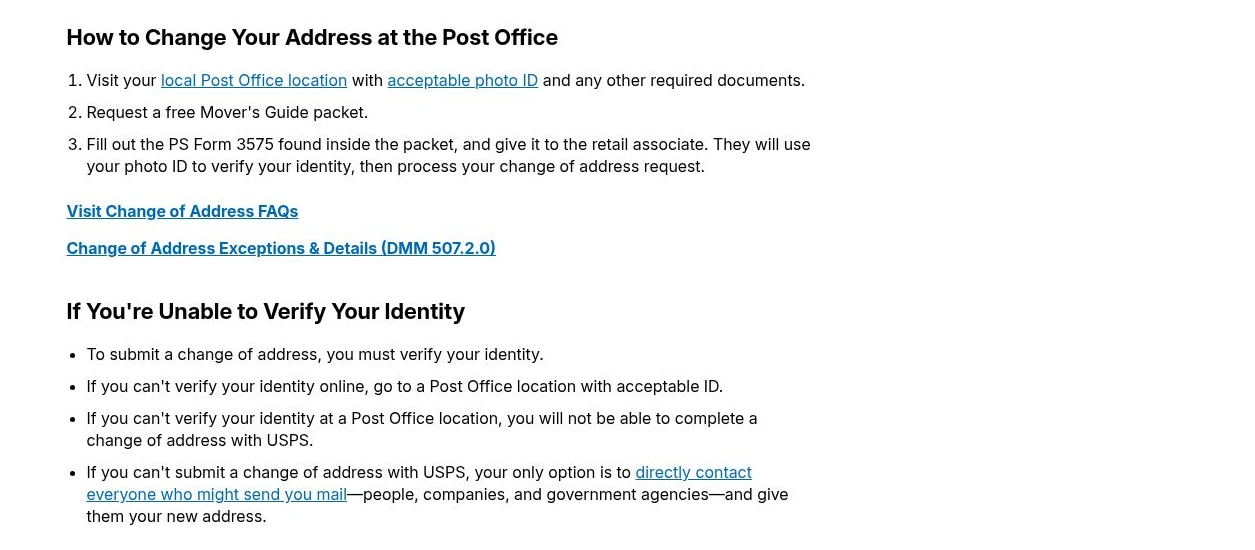
If you choose the in-person route rather than continuing an online COA, visit an eligible USPS retail location, request the free Mover’s Guide packet, complete PS Form 3575, and provide the requested original identity documents to the associate. Hand the completed form to the counter staff for identity verification and processing. This is not a generic PDF you should download from a third-party site or mail unauthenticated in the hope that USPS will activate forwarding automatically. USPS: How to Change Your Address at the Post Office.
If you mailed the paper form without completing the required authentication, USPS may send a letter instructing you to finish identity verification online or in person. In other words, mailing an unsigned or unverified form is not a workaround. Before starting a second order, ask the associate what happened to your previous online request so you do not accidentally create duplicate or conflicting orders.
If verification still fails at the counter
Ask the associate to identify which category is blocking completion: ID type, expiration, name, old/new address evidence, barcode validity, or an issue with the existing request. Do not ask them to override identity checks. The responsible next action is to obtain the missing eligible documentation, check the status of any prior request, and return if instructed. If you still cannot verify your identity, USPS states it cannot complete the change of address.
The practical fallback in that situation is direct sender notification. Tell banks, healthcare providers, insurers, employers, schools, government agencies, online merchants and personal contacts your new address independently. USPS forwarding is never a substitute for updates to organizations that issue sensitive documents or prohibit forwarding. This is particularly important for credit cards, identification documents and certain financial or medical mail. USPS forwarding limits.
Special cases: family, business, overseas, military and another person
Family move versus individual move
Choose Family only where the whole household has the same last name and is moving together. Different surnames or only some members moving may require separate individual requests. A family request filed incorrectly can need cancellation and replacement. That is not a payment-identity failure; it is a move-type mismatch. Use the USPS situation table.
Business or authorized agent
Businesses may need a letter on company letterhead signed by an authorized leader or other evidence of agency. A parent filing for a minor, a guardian, a person acting under a power of attorney, or an executor handling a deceased person’s mail may need role-specific documents and an in-person submission. A death certificate by itself is not enough proof that someone is authorized to manage the deceased person’s mail. Do not use an individual online COA to impersonate the recipient.
Moving abroad or already outside the United States
USPS directs international moves out of the United States to in-person filing and identity verification before departure. It also states that identity proofing for these COA needs must occur in the 50 states or Puerto Rico. If you are already outside the country and cannot attend in person, do not assume an online workaround exists. Contact your senders directly, and ask USPS about any options specific to your documented circumstances. Mail forwarding to a foreign address is not the same as domestic USPS COA.
Military addresses
For a military move, start with your command: USPS says AMPS relocation information is shared with it. If you still need a USPS COA, use the online route; the standard paper PS Form 3575 is not available for military address changes. For an online request moving from a military address, USPS says the email address must end in .gov, .mil or .edu. Its current forwarding page also says in-person identity verification is available only in the 50 states and Puerto Rico. If you are already outside that area, do not assume an overseas postal counter can complete it. USPS military and overseas exceptions.
What if you already have a confirmation code?
If the request succeeded, USPS issues a confirmation code and later sends a Move Validation Letter to the old address and a Customer Notification Letter to the new address. A confirmation code is different from the barcode sent after failed identity verification. Keep your confirmation details secure. For an existing COA, go directly to managemymove.usps.com with the confirmation code and your new ZIP code to review, change or cancel the order.
USPS permits limited editing of an existing request. Some changes are restricted when they alter the address used for the original card-based identity check, and it limits edits per day. If you lost your confirmation code, USPS says to visit a Post Office rather than treating another payment as a way to recover the old order.
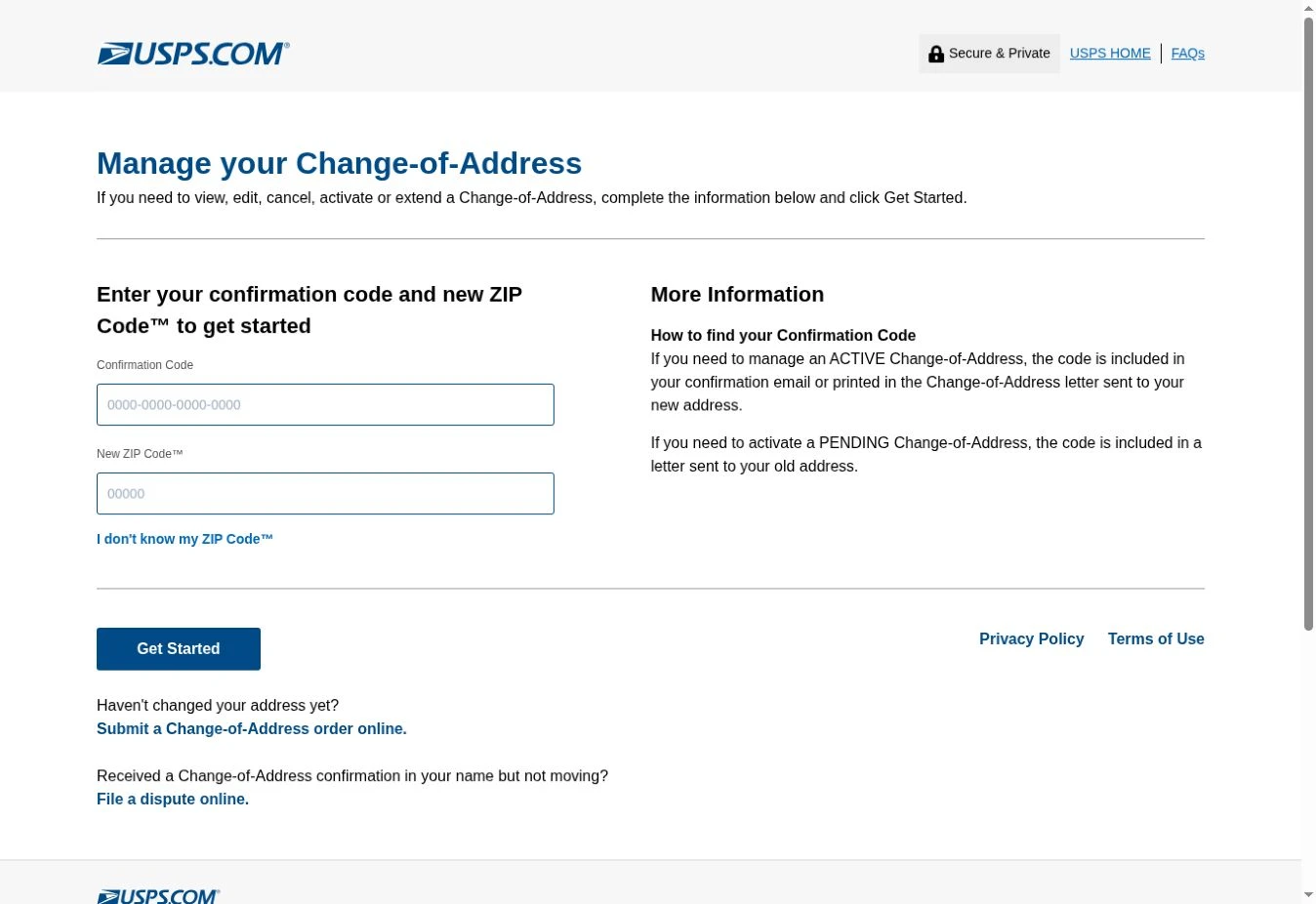
Use the right code for an ACTIVE or PENDING request
On the current Manage My Move screen, enter the confirmation code and new ZIP code, then select Get Started. The page says the code for an ACTIVE change of address is in the confirmation email or letter sent to the new address. For a PENDING request requiring activation, it directs you to the letter sent to the old address. Read the letter’s instructions carefully; a code is not automatically proof that forwarding is already active.
The empty values visible in the screenshot are form placeholders, not usable confirmation codes. This public screen was inspected without entering a customer code, submitting a request or testing a private order’s status.
A verification success email is not the same as mail already arriving
USPS advises allowing at least 7–10 business days for a properly verified COA to take effect, after which mail is forwarded as it arrives. It does not promise that every item is eligible for forwarding or that each carrier delivers on the same schedule. First-Class Mail forwarding is generally free; Periodicals are generally forwarded for 60 days, while some sender-restricted financial or government items cannot be redirected. If your forwarding start date is recent, check the date before treating a short wait as a failed verification.
A useful timeline: apply ahead of your move; pass verification; save the confirmation code; allow for USPS processing; update senders directly; check a genuine forwarded piece after the effective date. If the online request failed and you never completed in-person verification, do not start the timeline from the payment attempt.
If your address is new construction or USPS cannot find it
A newly built home can create a different problem: USPS may say an address is not found or not yet verified. That is an address-validation issue, not necessarily a failed identity check. Check the exact street, ZIP and unit number against the local addressing authority. USPS explains a special online path for a house built in the last six months, and recommends notifying the Post Office serving a new construction address when submitting in person. Consult its new-construction FAQ rather than changing address spellings randomly.
A moving-day checklist that prevents another verification delay
- Use the exact legal name and a complete, current old and new address, including apartment or suite.
- Choose Individual, Family or Business based on who is moving—not on what looks easier.
- Confirm your card issuer’s registered billing address before starting an online COA.
- Use the official USPS website, and retain any confirmation email or barcode in a safe place.
- Carry a current physical photo ID and qualifying address proof for a possible in-person visit.
- File ahead of the move if possible, allowing time for verification and for mail forwarding to begin.
- Notify senders of medical, financial and identity-sensitive mail directly rather than assuming USPS will forward every item.
Three illustrative scenarios: choose the next step
Scenario A: the card charge appears, then USPS says verification failed
A renter in Chicago uses a payment card still billed to a previous home. The card may have a pending authorization, but the USPS site does not show a successful COA. The renter checks the card’s registered billing address, reviews whether USPS sent a barcode email, and avoids blindly submitting several paid requests. If identity proofing is required, they visit the designated Post Office with current documents. This is an illustrative scenario, not a reproduced customer case or prediction of USPS’s internal decision.
Scenario B: a parent and adult child with different surnames move together
Selecting Family for both could be inappropriate because USPS ties the family move choice to shared surname rules. They check whether separate individual requests are needed, gather IDs for the actual applicants, and correct the move type before assuming the system rejected their identities. If an agent acts for a minor, the appropriate supporting documents apply.
Scenario C: the application passed, but a bank card did not arrive
A household gets its confirmation code and several regular letters are forwarded, but a bank replacement card never arrives. This is not evidence the identity check failed again: the sender may restrict forwarding. The next step is to update the address with the bank and arrange a new shipment through the bank’s secure channels.
Do not confuse these three USPS-related codes
| Code or document | What it means | Where to use it |
|---|---|---|
| One-time mobile verification code | Checks access to a mobile number during an online flow | Only inside the genuine active USPS form |
| Email barcode for in-person identity verification | Links an online verification failure to a postal counter appointment/visit | At the instructed participating USPS retail location before the email deadline |
| COA confirmation code (typically 16 digits) | Identifies an existing request; read its ACTIVE or PENDING instructions before assuming forwarding has started | Manage My Move or USPS customer support |
What if somebody filed a move in your name?
If you receive a Move Validation Letter or COA confirmation you did not request, do not ignore it. USPS offers a Change of Address Order dispute through Manage My Move. Follow the official dispute option for someone who is not moving and received a validation letter. Secure related accounts and check for signs of identity theft as needed. A fraudulent COA may be used to divert mail, so this is a priority rather than a routine correction.
Scammers also impersonate delivery operators in text messages. If an unexpected message asks you to verify a postal address or pay an unusual fee, independently open the official USPS website. Our related Horus Valley guide explains how to check fake USPS delivery texts without opening their links.
Official USPS references and what each one confirms
- USPS Standard Forward Mail & Change of Address — online and in-person steps, $1.25, billing-address match, failed-verification barcode, expected forwarding timing and exceptions.
- USPS Change of Address: The Basics — paper form, family/agent/overseas situations, customer-notification letters, editing and disputing.
- USPS Accepted Identification — original current ID and qualifying address documentation.
- USPS Post Office locator — find a retail location and check its services.
- Manage My Move — existing COA updates, cancellations and disputes.
- Login.gov in-person identity verification — separate program; do not mistake its ID rules and barcode expiration for a standard COA.
- USPS In-Person Identity Proofing — original unexpired documents, enrollment instructions and the distinction between service-specific proofing requirements.
Editorial note: This guide summarizes publicly available official guidance for U.S. movers; it is not affiliated with USPS and is not individualized legal, postal or identity-verification advice. Fees, eligibility and screenshots may change. Where your USPS email differs from generic guidance, follow the instructions associated with your specific request and confirm any uncertainty directly with USPS.
You may also like
 Services & Guides
How to Freeze Your Credit for Free—and Temporarily Unfreeze It
Freeze your US credit reports for free at Equifax, Experian and TransUnion, then schedule a temporary lift when…
 Services & Guides
V5C Log Book Not Arrived? What to Check Before Applying Again
Still waiting for your V5C? Check the correct DVLA waiting period, your address and green slip before applying…
 Services & Guides
Royal Mail Missed Delivery? Redelivery and Collection Explained
Missed a Royal Mail delivery? Book a redelivery, find the right reference, prepare collection ID and check the…