
V5C Log Book Not Arrived? What to Check Before Applying Again
Still waiting for your V5C? Check the correct DVLA waiting period, your address and green slip before applying again or paying £25.
Contents

If your V5C has not arrived, check which application was made before applying again. For an online replacement, contact DVLA after two weeks. For a new registration, change of keeper, postal application or address change, the published contact point is generally four weeks. Report the missing document before six weeks have passed: GOV.UK warns of a £25 replacement charge if it still has not arrived and you have not told DVLA.
The expected delivery time and the point at which DVLA asks you to contact it are different. Here is how to choose the right next step. This guide covers DVLA applications; official pages and screenshots were checked on 2 November 2026.
How long should a V5C take?
| Your situation | Published expectation / when to contact DVLA |
|---|---|
| Replacement requested online, with details unchanged | Usually 5–7 working days; contact after 2 weeks. |
| Used car registered to you online by the seller | Usually 5–7 working days; new-keeper contact point is 4 weeks. |
| Other new registration or postal V62 application | Usually around 4 weeks; contact if it has not arrived after 4 weeks. |
| V5C address change | Contact if the replacement has not arrived after 4 weeks. |
These timings come from the replacement service, new and used vehicle guidance, postal application guidance and address-change service. A seller’s online keeper change is not the same application as an existing keeper ordering a duplicate.
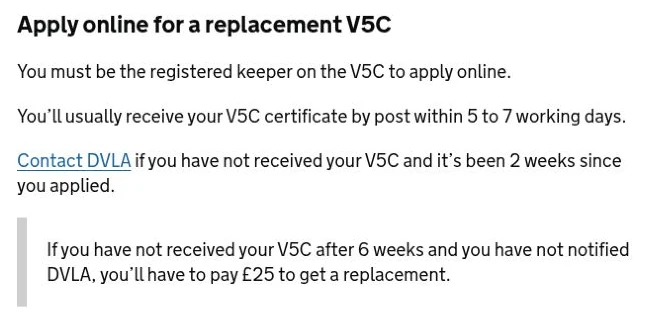
Applied by phone? GOV.UK currently gives conflicting contact timings: the replacement service says two weeks for a phone duplicate, while the general contact page groups phone and postal applications at four weeks. Check with DVLA using your application details; do not let the six-week notification deadline pass.
1. Check what was actually submitted
If you bought the car, ask the seller how and when they registered it to you. “The paperwork is done” does not tell you whether it was submitted online, posted later or never sent. Ask for the confirmation they received and check the address supplied.
If you applied yourself, find the confirmation, payment receipt or proof of posting. Count from the relevant submission date. Before paying for another application, establish whether the first one is still being processed or whether DVLA has already issued the document.
2. Make sure DVLA has the right address
An online duplicate goes to the address DVLA has on record. Ordering another unchanged duplicate will not fix an old address. Use the official V5C address-change guidance for your circumstances, particularly if your log book is also missing.
Updating your driving licence does not update the V5C. They are separate records; vehicle-tax Direct Debit details may also need updating when you move.
3. Bought a used car? Check the green slip
For a used vehicle registered by post, GOV.UK explains that a missing new V5C is dealt with using form V62 plus the green new keeper slip. The slip must come from the most recent V5C. Without that latest slip, the stated fee is £25—so do not assume everyone must pay again.
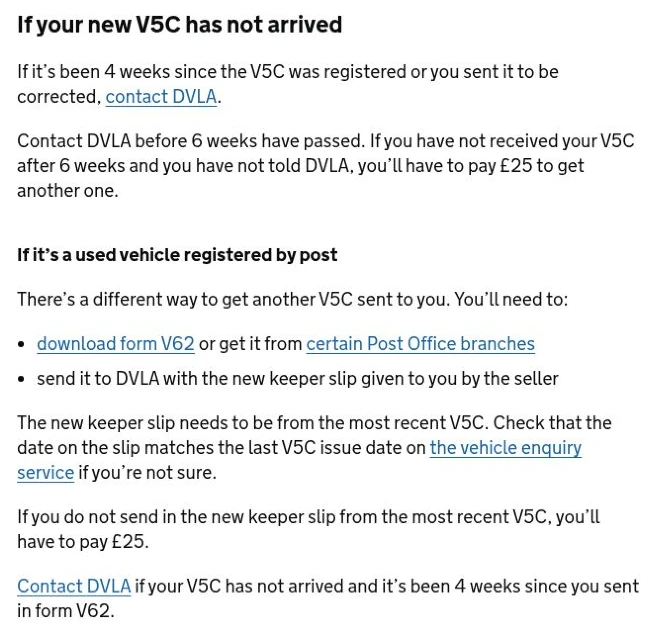
If you are unsure about the slip, compare its date with the last V5C issue date shown by the official vehicle enquiry service. That is a useful document check, not a postal tracking result: an issue date does not confirm delivery to your address.
Download V62 from its official publication page. DVLA says the form is print-only and must be posted, not completed digitally or emailed. Follow the current form’s instructions and include a fee only where required. If a V62 application has already been sent, contact DVLA after four weeks without a V5C.
4. Contact DVLA with a clear timeline
Use the vehicle registration and V5C contact page once the relevant waiting period has passed. Have these details ready:
- The vehicle registration number and your name and postcode.
- The application type, submission date and any confirmation or receipt.
- Whether your address changed, and whether you have the latest green slip.
You can keep the enquiry simple: “My V5C has not arrived. The application was submitted on [date] by [method]. Please confirm whether it has been issued and what I need to do next.” Keep a record of the contact and any instructions before sending another application.
If a delivery message asks for payment, open the official service independently. Our guide to fake delivery texts explains how to check unfamiliar links.
Sources and image notes
DVLA replacements; new and used vehicles; postal applications; address changes; form V62; vehicle enquiry; contact DVLA. The two screenshots show public guidance, not an application or a completed check. The featured image is illustrative.
You may also like
 Services & Guides
Royal Mail Missed Delivery? Redelivery and Collection Explained
Missed a Royal Mail delivery? Book a redelivery, find the right reference, prepare collection ID and check the…
 Services & Guides
Universal Credit Identity Verification Failed? Documents and Next Steps
Cannot verify your identity for Universal Credit online? Check the next official step, online versus jobcentre evidence, missing…
 Services & Guides
USPS Change of Address Verification Failed? How to Fix It
USPS Change of Address verification failed? Check the $1.25 online fee, card billing-address match, barcode and IDs, or…