
How Two Electrons Pushed X-Rays Beyond a Predicted Limit
How helium’s correlated electrons produced a weak X-ray signal beyond a predicted cutoff—and why higher photon energy does not mean higher total output.
Contents
- What high-harmonic generation normally does
- What changed in the helium experiment?
- Read the actual spectrum before reading the headline
- What “two electrons working together” means
- Does 280 eV mean twice the old limit?
- What does this have to do with attosecond science?
- Why a weak signal can still be scientifically valuable
- What should future work establish?
- The useful conclusion
- Original sources and figure credit
Scientists generated a weak band of higher-energy X-rays from helium that extended beyond the cutoff expected from the familiar single-electron description of high-harmonic generation. Their proposed explanation involves two correlated electrons returning to the same ion together, allowing a photon to carry more energy than the usual one-electron pathway predicts under those conditions.
The result expands the description of a particular laser-driven process. It does not mean conservation of energy failed or that the laws of physics were suspended. The energy comes from the driven system; the important change is how electron interactions let that energy appear in the emitted light.
The Nature Photonics paper was published on 7 August 2026. TU Wien announced it on 11 August, and UC San Diego published an account on 27 August. Renewed October coverage should not be mistaken for an experiment first announced in October.
What high-harmonic generation normally does
In the standard simplified picture, a sufficiently strong laser field removes an electron from an atom, accelerates it and can drive it back towards its parent ion. Recombination can release energy as a photon at a much higher frequency than the driving light.
The TU Wien explanation describes this as a well-established route to extreme-ultraviolet and X-ray light. Under specified driving conditions, the usual model predicts a characteristic upper range for strong emission. Beyond that cutoff, the signal becomes much weaker.
A model is a deliberately manageable account of a system. Treating one electron as active can capture important behaviour without representing every possible interaction equally. If a process depends critically on two electrons, extending the description is more informative than announcing that all previous physics was wrong.
The word “limit” therefore needs its qualifier: a single-electron cutoff for a particular process and set of conditions. It is not a universal prohibition on producing a photon above that energy by any possible method.
What changed in the helium experiment?
The researchers used a UV-driving laser and gas-phase helium. Helium’s two-electron structure makes it a useful system for examining the role of electron correlation. The UC San Diego account explains that the electrons are released sequentially and can recombine with the same ion at the same instant, releasing their combined energy in one photon.
This is a conceptual explanation of the pathway, not a photograph of two tiny balls following neatly visible tracks. Electrons are quantum objects, and the interpretation combines experimental spectra with theoretical analysis.
The crucial observation was an additional, weak plateau in the emitted spectrum. The paper reports that the ordinary cutoff region was around 120–140 electronvolts in the displayed comparison, while the secondary extension reached approximately 280 electronvolts. The unusual extension was not observed in argon or neon under the compared experimental conditions.
That comparison matters because the result is not merely “a laser produced X-rays”. It is a particular spectral feature appearing in one system and not in the comparison gases, which helps researchers investigate the mechanism responsible.
Read the actual spectrum before reading the headline
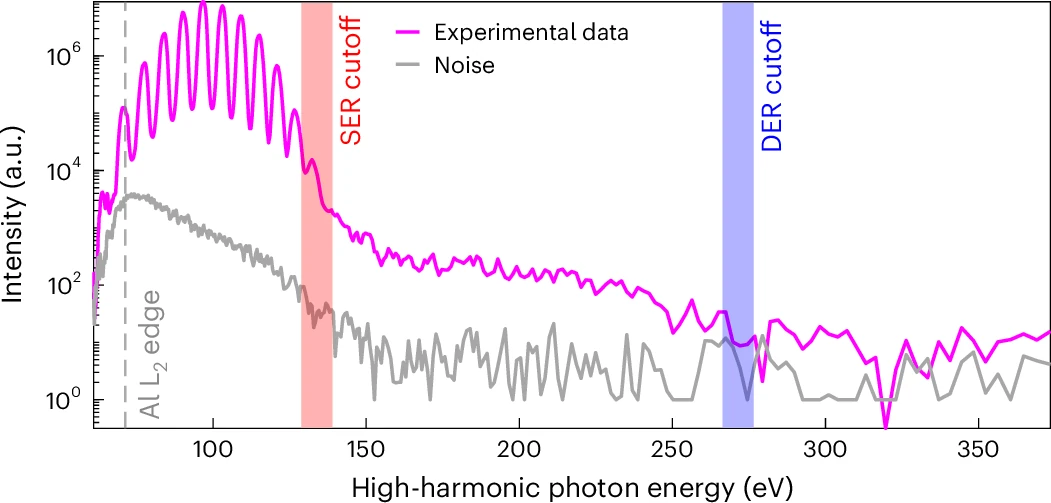
The reproduced research figure shows photon energy along the horizontal axis and intensity on the vertical axis. The magenta curve represents experimental data; the grey curve indicates noise. The red and blue highlighted regions identify the conventional and extended cutoff areas respectively.
The vertical scale is logarithmic. Moving from one labelled power of ten to the next represents a multiplicative change, not an equal small addition. A high-energy part of the spectrum can therefore be real while being far weaker than the main signal.
| Feature | What it tells you | What it does not tell you |
|---|---|---|
| Signal extends farther to the right | Higher-energy photons were detected | That the entire output became brighter |
| Secondary signal is weak | The extra pathway contributes less intensity | That it is automatically unimportant or unreal |
| Data are compared with a noise curve | Detection must be judged against background | That every plotted high-energy point is equally certain |
| The result differs between gases | Material and electron interactions matter | That any laser and gas combination will behave the same way |
This distinction between photon energy and total intensity is the easiest place for a headline to go wrong. The experiment is not evidence that every X-ray source can simply double its useful output.
What “two electrons working together” means
Correlation means the electrons’ behaviour cannot be described adequately as two unrelated copies of the same one-electron problem. Their interaction changes which processes are possible and how likely those processes are to contribute to the measured signal.
A loose analogy is two contributions arriving at the same moment rather than one. The analogy helps explain why a combined event can differ from a single contribution, but it should not be taken literally as a pair of classical runners meeting at a finish line.
The paper identifies double-electron recombination as the most consistent explanation for the extended plateau. The interpretation is supported by calculations and by how the signal changes with experimental conditions. It is stronger than an unexplained extra glow, while still belonging to a research account with assumptions and open questions.
The original figure page lets readers inspect the spectrum in its publication context. A stylised atom or luminous beam illustration cannot substitute for this measurement.
Does 280 eV mean twice the old limit?
Using 140 eV as a comparison gives 280 ÷ 140 = 2. Using 120 eV gives approximately 2.33. Those calculations show why an exact “twice the limit” statement needs a specified reference value rather than one universal multiplier.
These are arithmetic comparisons of the approximate plotted energies, not a new measurement. The conventional cutoff depends on the driving conditions; the paper discusses how the extended process scales under those conditions.
More importantly, neither ratio gives the increase in total emitted power, useful photon flux or device efficiency. Two different questions—how energetic a detected photon can be and how many such photons are produced—should not be merged into one performance claim.
The same reading habit applies to many scientific graphs. First establish what each axis measures. Then check whether the headline’s number is a measured value, a ratio chosen by the writer or an extrapolation beyond the displayed data.
What does this have to do with attosecond science?
An attosecond is one billionth of a billionth of a second. Light pulses on that scale allow researchers to investigate extraordinarily rapid electron dynamics. Anne L’Huillier explains the connection between high harmonics and such pulses in her 2023 Nobel banquet speech.
The 2023 physics prize recognised experimental methods for producing attosecond pulses to study electrons. It did not award a prize in advance to this 2026 experiment. References to a “Nobel limit” are contextual shorthand, not a formal name for a fundamental law.
The new work explores how the emitted light can also reveal the relationship between electrons. In that sense, light generation can serve as both a source and a diagnostic: the shape and extent of the spectrum carry information about the process that produced them.
Why a weak signal can still be scientifically valuable
A measurement can be useful because it identifies a mechanism, even when it is not yet the brightest or most efficient way to make a source. A small but distinctive feature may help distinguish competing descriptions of a system.
The practical question then becomes whether researchers can measure it reliably, understand its dependence on conditions and connect it to the underlying dynamics. Improving the source for an application is a related but additional task.
UC San Diego describes the possibility of using such spectral features as probes of correlated electron behaviour, including questions relevant to quantum materials. These are research directions. The paper does not demonstrate a finished quantum computer, a clinical scanner or an immediately deployable new technology.
For another example of why measured light needs interpretation, see our article on unusual colours associated with white dwarfs. The systems are different, but in both cases the informative question is what the light reveals about the process or material producing it.
What should future work establish?
For a general reader, the most useful follow-up questions concern reproducibility and scope. Can other groups obtain the same spectral feature under comparable conditions? How does the interpretation hold up as experimental parameters change? Can the signal become a reliable diagnostic in a more complex system?
Those questions distinguish a demonstrated laboratory finding from a broad technological promise. A mechanism observed in helium is not automatically a result for every molecule or solid. Extending it requires new experiments and appropriate theory.
Nor does a source-development result translate directly into medical advice about radiation exposure. This experiment concerns how light is generated and analysed under specialist laboratory conditions, not the safety of an individual imaging procedure.
The useful conclusion
The experiment shows why a successful simplified model can still have an important boundary. When two-electron dynamics contribute, a spectrum can extend beyond what a one-electron account predicts. The new information comes from testing that boundary, not abandoning the requirement to explain where the energy came from.
Keep three distinctions in view: August publication versus October recirculation, higher photon energy versus higher total output, and a measured spectrum versus an illustration. Together, they explain the finding more accurately than saying that scientists broke physics.
Original sources and figure credit
Reviewed 29 October 2026. We have not independently repeated the experiment or analysed its raw data. The cover is an artistic illustration, not an image of electron trajectories or the actual apparatus. The embedded spectrum is Figure 2 from Wang and colleagues, reproduced under the paper’s Creative Commons Attribution 4.0 licence; web-format conversion does not change its scientific content.
You may also like
 Science & Technology
UK Polar Vortex: Does a Weakening Vortex Mean Snow?
Does a weakening polar vortex mean UK snow? Understand the November signal, the limits of snow maps and…
 Science & Technology
Artemis II Explained: What It Achieved and Why It Didn’t Land on the Moon
What Artemis II achieved, why it did not land on the Moon, what NASA learned from Orion’s heat…
 Science & Technology
Can Capella-2 See Through Walls? What SAR Satellites Really Show
Capella-2 cannot see into homes. Learn why Tokyo’s radar image looked transparent, what SAR really detects, the meaning…