
Scientists Discover the First Green Star: Why White Dwarfs Can Be Pink, Purple and Green
Scientists identify a white dwarf predicted to appear green. Discover how sodium, carbon and planetary debris make dead stars pink, purple and green.
Contents
- What did scientists actually discover?
- The green white dwarf: WD J1330+6435 at a glance
- Why are stars normally red, white or blue?
- How can sodium make a star look green?
- Where did the metals in the white dwarf come from?
- Why can other white dwarfs appear pink or purple?
- How do astronomers calculate a star’s true colour?
- Why the images online are illustrations, not direct photos
- Are green stars really impossible? What changed?
- How common are colourful white dwarfs?
- What this discovery tells us about dead stars and lost planets
- What the study does—and does not—prove
- Could the Sun eventually become a colourful white dwarf?
- Where to read the original research
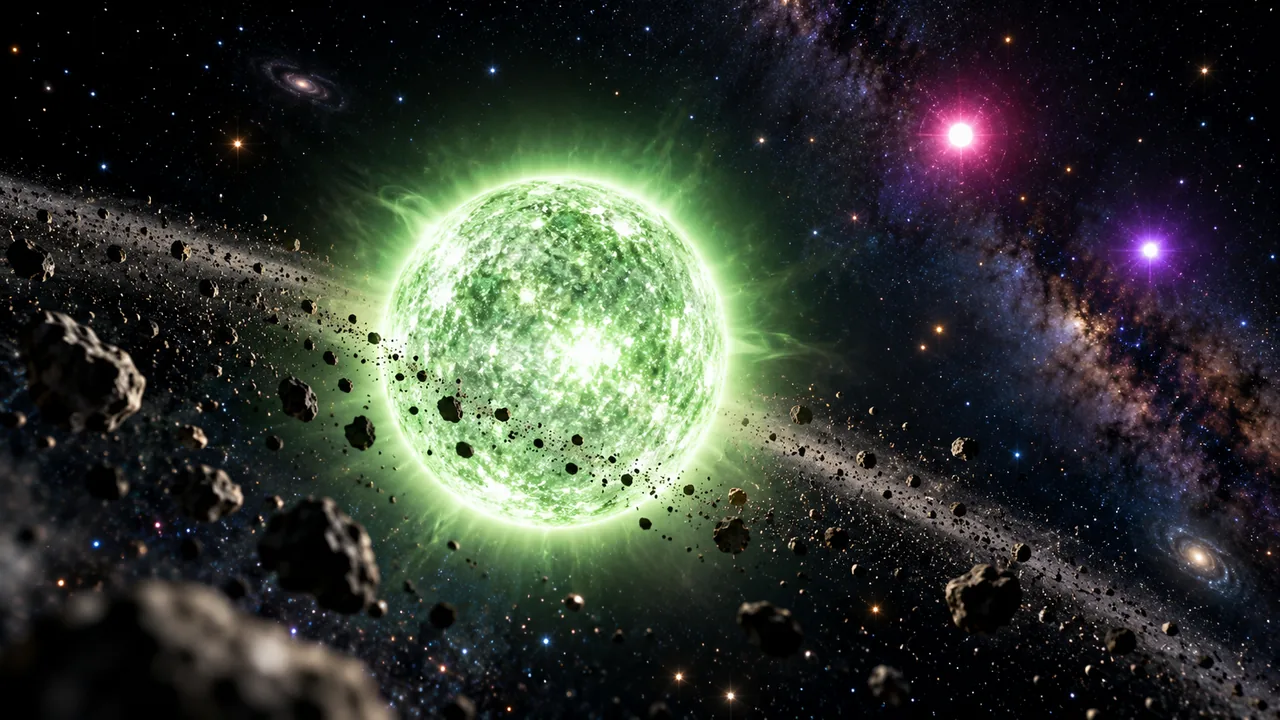
A white dwarf star can look green—even though astronomers long believed that naturally green stars did not exist. A peer-reviewed 2026 study identifies WD J1330+6435 as a remarkable example: its atmosphere, contaminated by rocky planetary debris, filters starlight so that a nearby observer would perceive a pale chartreuse-green disk. The discovery does not mean that astronomers photographed a luminous green ball through a telescope. They reconstructed the expected colour from measured spectra, atmospheric physics and a model of human vision.
The same research shows why other white dwarfs can appear pink, purple, cyan or yellow. Their colours reveal how extreme density changes the absorption of light, how carbon can rise from a star’s interior and how the remains of destroyed planetary systems can settle into stellar atmospheres. The findings were published in RAS Techniques and Instruments in October 2026.
What did scientists actually discover?
Researchers Mark A. Hollands, Boris T. Gänsicke, Pier-Emmanuel Tremblay and Detlev Koester examined how the detailed spectra of white dwarfs translate into colours perceived by human eyes. Their study, “Any colour you like: The diverse chromaticities of white dwarfs”, demonstrates that the usual rule—stellar colour largely tracks temperature—can fail when very dense atmospheres contain certain metals or carbon molecules.
The headline object is WD J1330+6435, a cool white dwarf in the constellation Draco, approximately 280 light-years from Earth according to the Reuters report. Its modeled spectrum is greenish because sodium absorbs a broad swath of orange and related wavelengths, while other elements, including calcium, modify the remaining visible light. The published model gives an effective temperature of approximately 4,240 kelvin, or about 3,967°C.
The “first green star” is a statement about the predicted appearance of a known white dwarf under conditions where its stellar disk could be resolved—not a newly observed green point of light in the night sky.
The green white dwarf: WD J1330+6435 at a glance
| Property | What the evidence supports |
|---|---|
| Designation | WD J1330+6435 |
| Object type | Cool, metal-polluted white dwarf |
| Approximate distance | About 280 light-years (reported by Reuters) |
| Estimated effective temperature | 4,240 K, about 3,967°C |
| Predicted visual appearance | Pale chartreuse green |
| Main optical mechanism | Strong pressure-broadened sodium absorption; calcium contributes |
| Method | Observed spectrum + stellar-atmosphere models + human colour-vision calculations |
| Important limitation | Colour inferred, not directly seen as a resolved stellar disk |
Why are stars normally red, white or blue?
Most stars emit a broad spectrum resembling the radiation of a heated object. Cooler stellar surfaces tend to look red or orange; intermediate temperatures look white or yellowish-white; hotter surfaces shift toward blue-white. The Sun, for example, emits across the visible spectrum and would appear broadly white when viewed outside Earth’s atmosphere. Its yellow appearance from the ground can be influenced by atmospheric scattering and viewing conditions.
A conventional stellar spectrum is broad and smooth enough that changes in temperature dominate its perceived colour. A narrow emission or absorption feature typically cannot turn the whole star green. That is why astronomers have traditionally said that there are no naturally green stars in the same sense that there are red or blue stars.
The new finding does not overturn the physics of thermal radiation. Instead, it shows that extreme absorption across wide wavelength ranges can reshape the outgoing spectrum so dramatically that the resulting colour differs from what temperature alone predicts.
How can sodium make a star look green?
In ordinary laboratory conditions, sodium has well-known yellow-orange absorption features. But the atmosphere of a cool white dwarf is extraordinarily dense. Interactions between sodium atoms and surrounding particles broaden the absorption across a much larger region of the visible spectrum. The light reaching an observer is therefore not simply the spectrum of a 4,240 K radiator.
- The white dwarf cools and retains an exceptionally dense outer atmosphere.
- Rocky material from its former planetary system falls into the star, adding trace elements such as sodium, calcium and lithium.
- Pressure effects broaden sodium absorption, removing substantial orange-to-red light; calcium also absorbs at shorter wavelengths.
- The remaining distribution of visible wavelengths is integrated by the human visual system as a pale, yellowish green.
The study reports that the strongest remaining flux is near roughly 500 nanometres, but the exact perceived colour depends on the whole spectrum, not one wavelength. Researchers also acknowledge noise in the measured spectrum, which introduces some uncertainty in the precise shade. The broader conclusion that this star could appear green is supported by more than one model.
Where did the metals in the white dwarf come from?
White dwarfs are stellar remnants. After a Sun-like star exhausts the fuel sustaining fusion in its core, it sheds its outer layers and leaves behind a compact, slowly cooling core. The remnant has immense gravity and no longer generates energy through ordinary core hydrogen fusion.
Many white dwarfs show traces of elements heavier than hydrogen and helium. Because these elements would often sink through the atmosphere on astrophysical timescales, their presence can indicate relatively recent or ongoing delivery of material. One leading explanation is that asteroids, comets or fragments of rocky planets were gravitationally disturbed, broken apart and accreted by the remnant.
Such pollution can provide a chemical record of former planetary systems. It is not proof that an intact planet currently orbits WD J1330+6435, and it does not mean the star literally swallowed an entire planet. The evidence points to rocky debris whose elements altered the atmospheric spectrum.
Why can other white dwarfs appear pink or purple?
Green is only one outcome. The Warwick researchers found several distinct routes to unusual stellar colours. A major pathway involves carbon dredge-up: convection in a cooling white dwarf can bring carbon from deeper layers into a helium-dominated atmosphere. Carbon molecules then absorb broad sections of visible light, producing pink, purple or salmon-coloured appearances in the models.
For instance, WD J1011+2845, about 48 light-years away, is described by the researchers as a candidate for one of the reddest stellar appearances. Its strong molecular-carbon absorption removes much of the blue-to-green light, leaving a deep salmon-pink hue. Other cool white dwarfs with hydrogen and helium mixtures can develop a cyan or pale-blue cast through collision-induced absorption.
| Predicted colour | Main physical explanation | Example or context |
|---|---|---|
| Chartreuse green | Broad sodium absorption in dense, metal-polluted atmosphere | WD J1330+6435 |
| Pink / salmon | Carbon molecules absorb blue, green and yellow light | WD J1011+2845; carbon-rich remnants |
| Purple | Carbon molecular absorption with different temperature and abundance | Other carbon-rich white dwarfs |
| Yellow | Metals from accreted rocky debris modify the spectrum | Some polluted cool white dwarfs |
| Cyan / pale blue | Hydrogen–helium collision-induced absorption | Cool mixed-atmosphere white dwarfs |
| White / blue-white | Broad thermal spectrum with relatively modest distortions | Many ordinary white dwarfs |
How do astronomers calculate a star’s true colour?
A telescope often records light as a spectrum: a measurement of intensity at different wavelengths. This is more informative than a single photograph because dark absorption bands and broad changes in the spectral shape identify physical processes and chemical species.
- Collect the spectrum. Observe how much light the star emits at each visible wavelength.
- Model the atmosphere. Account for temperature, gravity, composition and the unusual broadening of absorption in dense matter.
- Apply human-eye sensitivity. Integrate the spectrum through standard colour-matching functions, rather than treating a camera’s false-colour image as direct evidence.
- Calculate chromaticity. Convert the integrated response into a reproducible position in a colour space, then make a carefully qualified illustration.
- Evaluate uncertainties. Consider observational noise, model limitations, brightness adaptation and display differences.
This method answers a specific question: if the stellar disk could be resolved and viewed under suitable conditions, what colour would a human observer perceive? It does not claim that a person standing on Earth can pick out the star’s green tint. A white dwarf is far too small and faint in angular size for that kind of direct colour perception.
Why the images online are illustrations, not direct photos
Photographs of astronomical objects are often processed for contrast, combined from multiple filters or rendered with assigned colours. In this case, the green-star images circulated with the news are artist impressions or colour-accurate simulations based on the published models. They should not be described as telescope photographs that directly captured a green stellar disk.
Even a physically accurate colour rendering on a monitor cannot reproduce the extreme brightness of a nearby stellar surface, and screen calibration affects the apparent shade. The useful scientific evidence is the underlying spectrum and atmospheric model—not the saturation of an illustration shared on social media.
Are green stars really impossible? What changed?
The longstanding “no green stars” rule is a good approximation for normal stars with broad, blackbody-like spectra. A star whose emission peaks in the green region still sends enough red and blue light to stimulate multiple kinds of colour-sensitive cells, so it generally looks whitish rather than vividly green.
The white dwarf is an exception because its dense atmosphere removes particular wavelength bands on an unusually broad scale. The authors therefore describe a physically plausible green stellar appearance, rather than a contradiction of colour science. The claim is carefully framed: to their knowledge, this is the first known star for which a genuinely green appearance is credibly predicted.
How common are colourful white dwarfs?
The researchers examined the chromaticity distribution of a volume-limited sample of nearby white dwarfs within 20 parsecs (about 65 light-years). They found that most members of the representative sample still look broadly white, with a median correlated colour temperature near 6,800 K. Unusual colours are therefore notable exceptions, not the new normal.
The sample-based finding is important because very hot, bright white dwarfs are easier to detect than cooler, fainter remnants. Examining a defined nearby population helps avoid drawing conclusions from only the most conspicuous objects. Reports summarizing the research describe unusual colours in about one in 30 objects in the studied sample; this should not be read as an exact fraction for every white dwarf in the Milky Way.
What this discovery tells us about dead stars and lost planets
The scientific value extends beyond an attractive colour. A white dwarf atmosphere acts as a chemical laboratory under conditions impossible to reproduce easily on Earth. Spectra help test how atoms and molecules behave at extreme density, while metal pollution provides clues to the composition of disrupted rocky bodies.
For planetary scientists, this offers an indirect way to investigate systems that have survived—or been transformed by—the death of their host star. For stellar physicists, it provides a test of models for dense helium atmospheres, pressure broadening, carbon transport and collision-induced absorption. For the public, it is a reminder that familiar astronomical labels such as “white dwarf” describe a general category, not every possible visual appearance.
What the study does—and does not—prove
| Supported by the research | Not established by the research |
|---|---|
| Some white dwarfs have spectra consistent with green, pink and purple visual appearances | A green stellar disk has been photographed directly from Earth |
| Dense atmospheres and chemical composition can strongly change perceived colour | All stars can naturally become green through ordinary temperature changes |
| Rocky debris can pollute white dwarf atmospheres | A complete living planet was necessarily swallowed by WD J1330+6435 |
| The nearby sample is mostly white on average | Most white dwarfs are bright green or purple |
| Spectroscopy can model a star’s appearance to human vision | Every display image precisely reproduces what an astronaut would see |
Could the Sun eventually become a colourful white dwarf?
The Sun is expected to end its evolution as a white dwarf after expanding into a red giant and shedding its outer layers. Whether that future remnant would ever show unusual colours depends on its cooling history, atmospheric composition and any debris it later accretes. The new study does not predict that the Sun will become green, nor does it suggest such a transformation is imminent.
Over billions of years, white dwarfs cool and their atmospheres evolve. Some may be polluted by planetary debris; others may develop different visible signatures through carbon mixing or hydrogen–helium interactions. These are physical possibilities rather than a forecast for our Solar System.
Where to read the original research
- Hollands et al., “Any colour you like: The diverse chromaticities of white dwarfs,” RAS Techniques and Instruments (2026) — peer-reviewed study and technical discussion.
- Research preprint on arXiv — freely accessible abstract and manuscript.
- University of Warwick: astronomers reveal the true colours of white dwarfs — institutional explanation and credited scientific illustrations.
- Reuters: Newly identified green star leaves astronomers amazed — independent reporting and contextual details.
The bottom line: WD J1330+6435 is not a green point of light anyone has watched through a backyard telescope. It is a known white dwarf whose measured and modeled spectrum indicates a remarkable green appearance if viewed up close. The finding broadens our picture of what dead stars can look like—and turns stellar colour into another clue about the chemistry of vanished planetary worlds.
You may also like
 Artificial Intelligence
Why Do We Deny AI Consciousness Even When It Behaves Like a Human? What a 2026 Study Reveals
A study of 1,092 UK participants found that people rate human agents as more conscious than AI even…
 History
The Mystery Yak of Denisova Cave: How Ancient DNA Revealed a Lost Ice Age Species
Twenty ancient nuclear genomes uncovered Yak X, an extinct bovine distinct from modern yaks. Explore its connection to…
 HEALTH
Can Scientists Kill Harmful Gut Bacteria Without Harming Good Bacteria?
A 2026 study found argyrin B could target C. difficile in mice while preserving much of the gut…