
James Webb Finds Metal-Rich Gas Around the Milky Way’s Black Hole: What It Means
James Webb observations reveal metal-rich gas near Sagittarius A*. Here is what the finding means, how infrared spectroscopy works, and what it does not prove.
Contents
- The short version
- What did James Webb actually discover?
- What does “metal-rich” mean in astronomy?
- Where is Sagittarius A*?
- How can Webb identify elements without touching the gas?
- Why does the gas composition matter to a black hole?
- Why is Sagittarius A* relatively quiet?
- Where did the heavy elements come from?
- Does this explain the origin of Earth’s metals?
- Are the gas and stars the same age?
- What the result does—and does not—tell us about past black-hole activity
- Five headline claims that need a more careful reading
- Why this is a good test for Webb’s capabilities
- What researchers will study next
- What is confirmed, and what remains an interpretation?
- Directly supported by the observations and study
- Scientific interpretation supported by the result
- Claims the study does not establish by itself
- Related Horus Valley science coverage
- The bottom line
- Sources and image credits
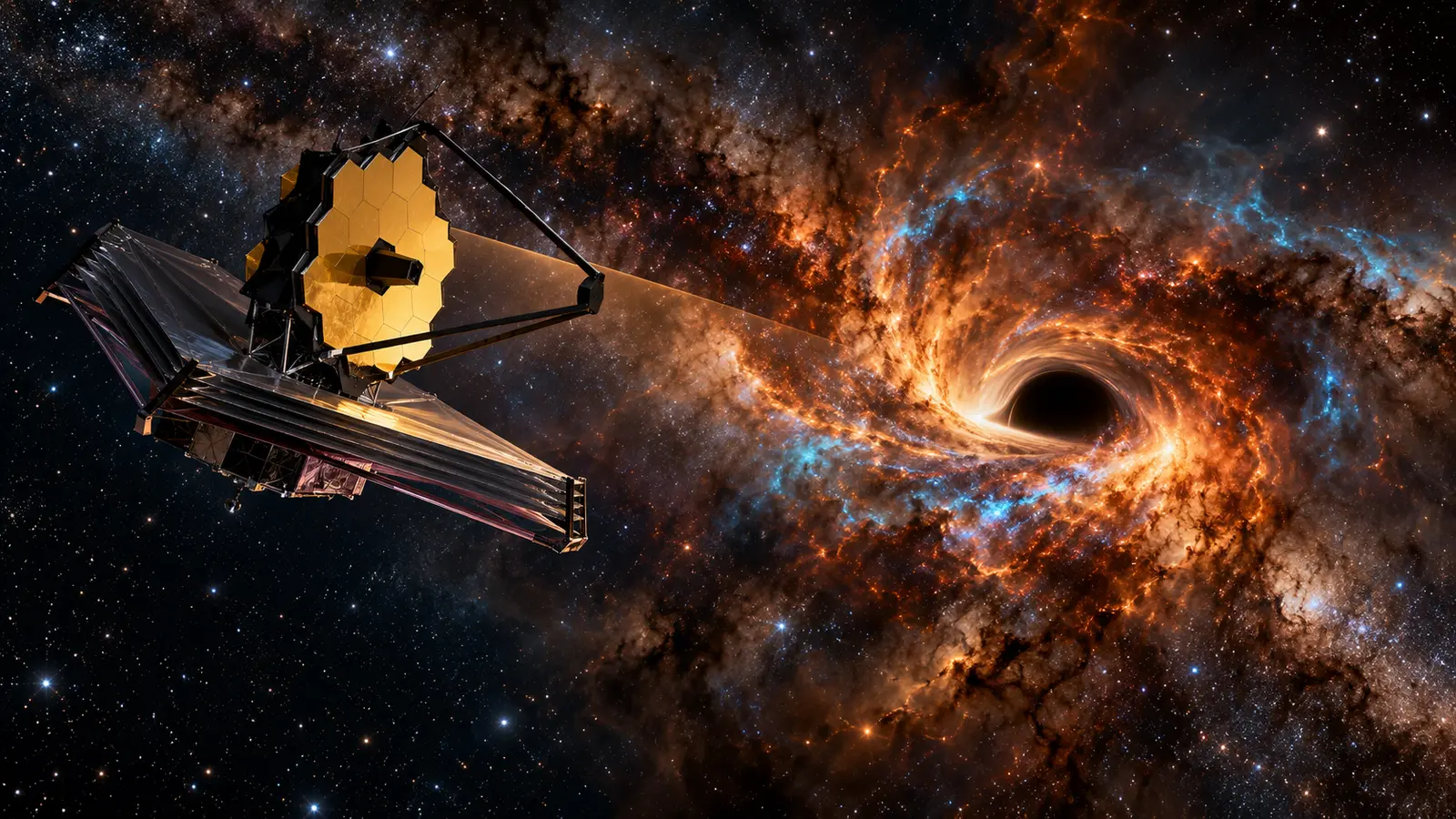
The James Webb Space Telescope has given astronomers a closer look at the material orbiting Sagittarius A*, the supermassive black hole at the centre of the Milky Way. A new study reports that gas in this extreme region is rich in “metals”—the astronomical term for elements heavier than hydrogen and helium—and that its composition resembles that of many nearby stars.
The result does not mean Webb photographed the black hole swallowing gold, nor does it prove that the material will soon fall into the event horizon. Its importance is more subtle: the chemistry of the gas can help researchers understand what is available to feed Sagittarius A*, how that gas cools and moves, and why our galaxy’s central black hole is currently much less active than the brightest supermassive black holes in the universe.
This article explains what the study actually found, how infrared spectroscopy revealed the composition, what “metal-rich” means in astronomy, where the elements may have come from, and which conclusions remain tentative. The study was published in The Astronomical Journal in October 2026. Last reviewed: October 24, 2026.
The short version
- Researchers used James Webb observations to study several gas clouds near Sagittarius A*.
- The gas contains a significant mixture of elements heavier than hydrogen and helium, which astronomers call metals.
- Its chemical composition is similar to that of many stars orbiting near the black hole, suggesting that the gas and stars may have formed from related material.
- Exploding stars are a likely source of the enrichment, because stellar explosions release heavy elements into surrounding space.
- Metals can change how gas cools, and cooling affects how easily gas can lose energy and move inward toward a black hole.
- The result helps explain the environment around Sagittarius A*, but it does not by itself reveal the black hole’s complete feeding history or predict a future flare.
What did James Webb actually discover?
The study, led by Nicole M. Ford and colleagues, analysed infrared data from the James Webb Space Telescope to investigate the ionization structure and metal enrichment of the Galactic Center Minispiral. This minispiral is not a solid spiral arm like the Milky Way’s large-scale arms. It is a collection of ionized gas structures moving through the crowded central region around Sagittarius A*.
The observations allowed the team to distinguish the infrared signatures of multiple gas clouds and estimate their chemical composition. The gas was found to be rich in metals, and the mixture was similar to the composition of many stars orbiting close to the black hole. That similarity is consistent with the gas and stars having formed from related material or being shaped by the same local history.
The finding was reported by McGill University’s research newsroom, which describes the work by researchers at McGill’s Trottier Space Institute. The paper is titled “Ionization Structure and Metal Enrichment of the Galactic Center Minispiral Observed with JWST”.
The wording matters. The researchers are not claiming to have collected a physical sample of gas, placed it in a laboratory and weighed its elements. They inferred the composition from the way the gas emits and absorbs light at specific infrared wavelengths.
What does “metal-rich” mean in astronomy?
In everyday language, a metal might mean iron, aluminium, copper or gold. In astronomy, the word has a broader definition. Any element heavier than hydrogen or helium is usually called a metal, even if it is not metallic in the ordinary sense.
Carbon, oxygen, nitrogen, neon, silicon, iron and many other elements therefore count as metals in an astronomical discussion. Some of these elements are essential ingredients in planets, rocks, atmospheres and living organisms, but the term metal-rich does not automatically mean that the gas contains solid metal or valuable deposits.
Astronomers often use metallicity to describe the abundance of these heavier elements relative to hydrogen. Metallicity is a way to study the chemical history of a star, a cloud or a galaxy. A region that formed from gas enriched by earlier generations of stars can have a different metallicity from a region made mostly of more primordial material.
That distinction prevents one of the most common misunderstandings about this result:
“Metal-rich gas” means chemically enriched gas, not a cloud of liquid metal or a black hole surrounded by a mineable supply of gold.
Where is Sagittarius A*?
Sagittarius A, usually written Sgr A, is the compact radio source associated with the supermassive black hole at the centre of the Milky Way. It sits in a dense environment containing stars, dust, ionized gas, magnetic fields and remnants of earlier stellar activity.
The region is difficult to study with ordinary visible-light telescopes because dust blocks much of the view toward the Galactic Center. Infrared observations are especially valuable because some infrared wavelengths can pass through dusty regions more effectively, while also revealing the heat and chemical fingerprints of the gas.
Sgr A* is close enough, by astronomical standards, to be studied in much greater detail than most other supermassive black holes. That makes it a nearby laboratory for questions that are difficult to answer in distant galaxies: how gas moves around a black hole, how stars affect their surroundings, and why some black holes accrete material rapidly while others remain relatively faint.
How can Webb identify elements without touching the gas?
The answer is spectroscopy. Atoms and ions interact with light at characteristic wavelengths. When a gas cloud is heated or energized, its particles can emit light in narrow spectral lines. The pattern of those lines contains information about which elements are present, how the gas is ionized and what physical conditions surround it.
James Webb is built to observe infrared light with high sensitivity and detailed spectral capability. Its instruments can separate light from crowded structures and detect signatures that would be difficult to measure through the dust and glare of the Galactic Center.
In this study, the researchers used the infrared signatures of several gas structures rather than treating the entire central region as one uniform cloud. That matters because the Galactic Center is not chemically or physically simple. A single broad measurement could mix different clouds, temperatures, radiation fields and motions.
The process is an inference, but it is a rigorous scientific inference. Researchers compare observed spectral lines with physical models, account for ionization conditions and estimate which chemical mixture best explains the data. The result is not a direct photograph of atoms; it is a composition estimate supported by the light emitted by the gas.
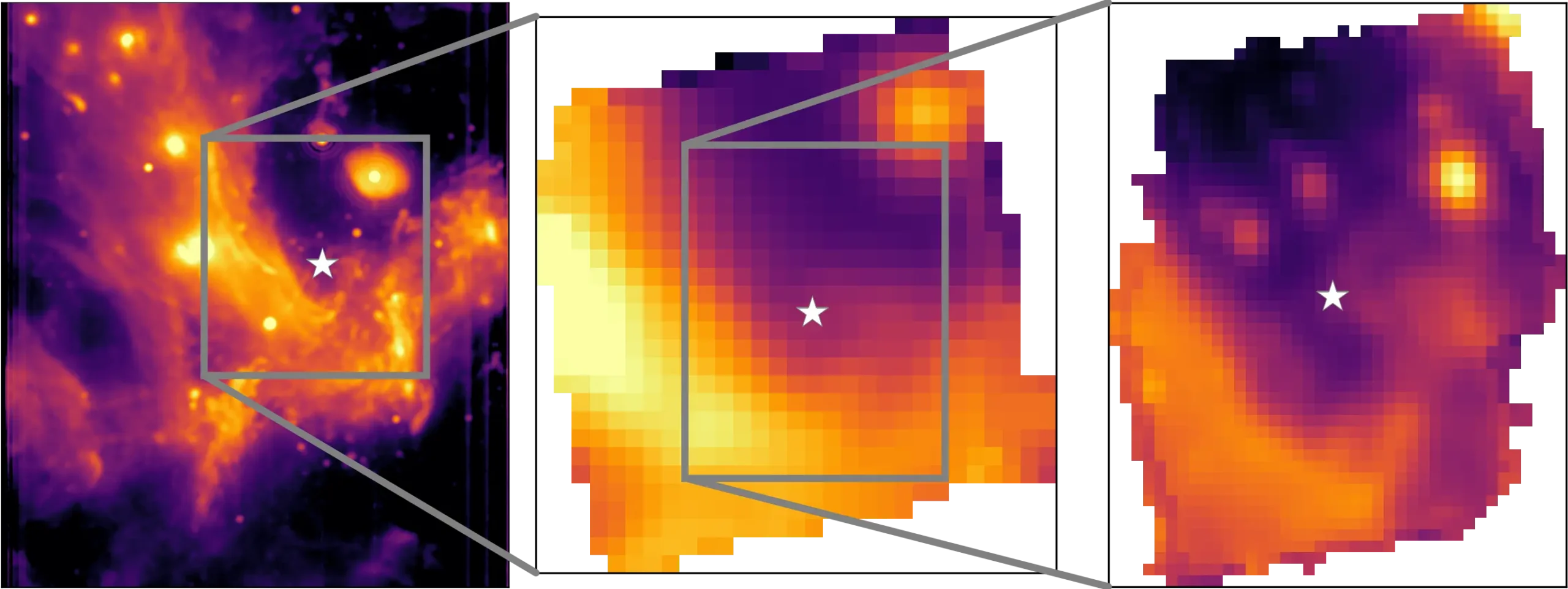
Official source image: infrared views of gas structures near the centre of the Milky Way. The white star marks the approximate location of Sagittarius A. Credits: JWST, NASA, STScI, CSA, ESA and ESO/VLT; source: McGill University.*
Why does the gas composition matter to a black hole?
A black hole’s gravity is not enough by itself to make every nearby object fall in. Material also needs to lose energy and angular momentum in the right way. Gas can orbit a black hole for a long time, collide with other gas, interact with magnetic fields, or be pushed outward by radiation and stellar winds.
Cooling is one part of that complicated process. Atoms and ions in a gas can radiate energy through spectral lines. The presence and abundance of heavier elements can change how efficiently the gas cools under particular conditions. Cooler gas may be able to change its pressure, density and motion, which can influence how easily some material moves inward.
This is why the chemical composition around Sgr A* is not merely a catalogue of elements. It is part of the physical story of accretion—the process by which material loses enough support to move toward a black hole.
The relationship is not a simple rule that “more metals always means faster feeding.” Cooling also depends on temperature, density, radiation, magnetic fields, turbulence and the geometry of the gas. The study provides an important input for those models; it does not reduce the feeding process to one chemical measurement.
Why is Sagittarius A* relatively quiet?
Supermassive black holes in other galaxies can power extremely bright active galactic nuclei when large amounts of gas reach their inner regions. Sagittarius A* is much less luminous today. It is still surrounded by material and produces flares, but it is not currently consuming gas at the dramatic rate associated with the most active quasars.
The researchers point out that understanding this low activity requires looking at the properties of the available gas, dust and stars. If the material remains too hot, too turbulent, too diffuse or too strongly supported by magnetic fields, only a small fraction may reach the black hole. If it cools and loses energy in a different way, the flow can change.
The new Webb observations therefore address one piece of a much larger puzzle. Knowing the chemistry of the gas helps researchers build more realistic simulations, but it does not identify one single reason for Sgr A*’s low present-day activity.
Where did the heavy elements come from?
The likely answer is earlier generations of stars. Stars manufacture many elements through nuclear fusion and stellar evolution. When massive stars end their lives in supernova explosions, they can eject newly created material into the surrounding gas. Stellar winds can also return enriched material to space before the final explosion.
Over time, repeated stellar births and deaths can make a region chemically richer. The Galactic Center has experienced many generations of stars in a dense environment, so it is reasonable to expect its gas to contain material processed by earlier stellar activity.
The McGill report says that the metal enrichment probably resulted from stars that exploded and released material around the black hole. The similarity between the gas and many nearby stars supports the idea that the gas and stellar population share a local chemical history.
That is a strong scientific interpretation, but it is still important to use the right level of certainty. The observations do not identify one named supernova as the source of every element in the gas. They also do not show that all heavy elements in the region were made in exactly the same type of event. Different elements can have different production histories, and the chemical mixture may reflect many sources over long periods.
Does this explain the origin of Earth’s metals?
Only indirectly. The study may improve understanding of how heavy elements are distributed around supermassive black holes and how chemically enriched gas behaves in galactic centers. That can contribute to the broader story of how galaxies recycle material into new stars and planets.
But it would be an overstatement to say that Webb traced the iron, carbon or gold in Earth directly to this particular gas near Sgr A*. The Solar System formed from a different parcel of material, and the elements in it were produced and mixed through a long history of stellar processes before the Sun and planets formed.
The useful connection is conceptual and astrophysical: the elements found on Earth were made by earlier cosmic processes, and observations of enriched gas in the Milky Way help researchers understand how those ingredients move through galaxies.
Are the gas and stars the same age?
Not necessarily. Similar chemical composition does not mean that every star and every gas cloud formed on the same day or from one single event. It means the material may have been chemically connected or exposed to the same enrichment history.
The gas could have been released, mixed, ionized and reshaped after the nearby stars formed. Stellar winds, supernova remnants, radiation and cloud collisions can all alter the appearance and motion of gas long after the original material was created.
This is one reason the study is valuable: it compares the present gas with the surrounding stellar population and gives researchers a way to test models of how the central region evolved. The chemical similarity is a clue, not a complete timeline.
What the result does—and does not—tell us about past black-hole activity
The Webb study complements another study led by Mayura Balakrishnan and published in The Astrophysical Journal. That work examined whether emission from the gas could preserve a reliable record of earlier ultraviolet activity from Sgr A*.
According to McGill’s summary, the gas emission is strongly shaped by local conditions. That makes it difficult to isolate the black hole’s influence and use the gas alone as a dependable history of past outbursts.
This is a useful scientific limitation rather than a failure. It tells researchers that the gas is affected by its immediate environment and that a bright or unusual emission pattern cannot automatically be treated as a historical recording of the black hole.
The two studies point toward a more careful approach: combine chemical measurements, gas motion, stellar observations, dust properties, X-ray data, radio observations and long-term simulations. No single image or spectrum can reconstruct the complete activity history of a crowded galactic nucleus.
Five headline claims that need a more careful reading
| Simplified headline | More accurate interpretation |
|---|---|
| Webb found gold around a black hole | Webb data indicate gas enriched in elements heavier than hydrogen and helium; “metals” is the broad astronomical term |
| Sagittarius A* is eating the metal-rich cloud now | The gas is orbiting in the central region; the study does not predict that the whole cloud will fall into the black hole |
| The black hole made the metals | Earlier stars and stellar explosions are the likely source of much of the enrichment |
| Webb photographed the event horizon | The observations measure infrared emission from surrounding gas structures, not a direct photograph of atoms crossing the horizon |
| The study proves why Sgr A* is quiet | Chemistry is one factor in a complex accretion environment; simulations and additional observations are still needed |
This distinction between a result and its popular headline is especially important for science coverage. The exciting part is not that the study creates a dramatic new danger or predicts a cosmic event. It gives researchers a more detailed measurement of the material available in one of the most extreme environments in the Milky Way.
Why this is a good test for Webb’s capabilities
James Webb is often associated with photographs of distant galaxies, star-forming regions and exoplanet atmospheres. The Sgr A* study shows another side of the observatory: high-resolution infrared spectroscopy in a crowded, dusty and rapidly changing environment.
The central region of the Milky Way contains bright stars and complicated gas structures packed into a relatively small area on the sky. Webb’s ability to distinguish infrared features helps astronomers separate overlapping sources and ask chemical questions that broad images alone cannot answer.
The observation also demonstrates why a telescope image should not be judged only by how visually dramatic it looks. A spectral line that appears as a small feature in the data can reveal the presence of an element, the ionization state of the gas or the temperature of a cloud. The scientific value may be hidden in measurements that are not obvious in a colour composite.
What researchers will study next
The next step is to compare the observations with simulations of gas evolving around Sgr A* over longer timescales. Those simulations can test whether the measured chemical mixture, cloud motions and cooling behaviour are consistent with different histories of stellar feedback and black-hole feeding.
Researchers will also want to compare the Milky Way’s central environment with the centres of other galaxies. Sgr A* is close enough for detailed study, but it is not necessarily typical. A central black hole in a gas-rich, actively merging galaxy may receive material under very different conditions.
Future observations can help answer several questions:
- How uniform is the metal enrichment across the different gas clouds?
- Do the chemical signatures change with distance from Sgr A*?
- Which elements are most useful for tracing stellar winds, supernovae or other enrichment sources?
- How do magnetic fields and turbulence alter the path of the gas?
- Can the same diagnostic methods be applied to the less detailed spectra of distant galactic nuclei?
These questions show why the result is more than a one-day space headline. It can become a reference point for later work on black-hole accretion and galactic chemical evolution.
What is confirmed, and what remains an interpretation?
The following distinction is the safest way to understand the paper:
Directly supported by the observations and study
- Infrared observations were obtained with the James Webb Space Telescope.
- The target included gas structures in the Galactic Center Minispiral near Sagittarius A*.
- The measured emission lines allow researchers to estimate the gas composition and ionization structure.
- The gas is enriched in elements that astronomers classify as metals.
- The composition resembles that of many nearby stars.
Scientific interpretation supported by the result
- Earlier stars and explosions probably supplied much of the heavy material.
- The gas and nearby stars may share a connected chemical history.
- The chemical composition can affect the cooling behaviour relevant to accretion models.
- The observations can improve models of how material reaches or fails to reach Sgr A*.
Claims the study does not establish by itself
- That a major flare is imminent.
- That the entire gas structure will be swallowed.
- That one specific supernova produced all the detected elements.
- That the gas is a direct sample of the event horizon.
- That the observation traces the exact origin of Earth’s individual elements.
Related Horus Valley science coverage
This topic fits naturally beside Horus Valley’s existing explainers about unusual cosmic observations, but it has a different search intent. Our article about the most distant fast radio burst ever localized focuses on a brief radio signal and its host galaxy. The guide to the first green-looking white dwarf explains colour, temperature and stellar atmospheres.
The new article focuses specifically on JWST spectroscopy, metal enrichment and the feeding environment of Sagittarius A*. Linking the topics can build a useful science cluster without making the pages compete for the same query.
The bottom line
James Webb has revealed that gas orbiting near the Milky Way’s central black hole is chemically enriched and resembles the composition of many nearby stars. The likely explanation is a long history of stellar evolution and explosions that supplied heavy elements to the Galactic Center.
The discovery matters because gas chemistry affects the physics of cooling and accretion. It may help explain why Sagittarius A* is currently a relatively quiet supermassive black hole and improve models of how black holes interact with their host galaxies.
But the careful conclusion is narrower than the headline. Webb did not photograph gold falling into a black hole, identify one source for every element, or predict an upcoming cosmic catastrophe. It measured the chemical fingerprints of gas—and those fingerprints give astronomers a better starting point for understanding how the centre of our galaxy works.
Sources and image credits
- McGill University: The gas around Milky Way’s central black hole is rich in metals, published October 19, 2026.
- The Astronomical Journal: Ionization Structure and Metal Enrichment of the Galactic Center Minispiral Observed with JWST, DOI 10.3847/1538-3881/ae994d.
- NASA Science: James Webb Space Telescope mission.
- McGill University’s official JWST image page, including credits for the infrared visual: JWST, NASA, STScI, CSA, ESA and ESO/VLT.
The featured image is a clearly labelled editorial illustration. The inline infrared panel is the official visual supplied with the McGill research report and is included for documentation, not as a decorative replacement for the study’s data.
You may also like
 Science & Discoveries
NASA Found a Giant Musical Symbol in Space: The Science Behind the Cosmic Treble Clef
NASA’s Treble Clef is a distant radio phoenix, not music in space. Learn how black-hole plasma and galaxy-cluster…
 Science & Discoveries
2026 El Niño Explained: What NASA Satellites Reveal About Winter 2026–27
NASA satellites reveal a powerful 2026 El Niño. Decode the ocean maps, NOAA winter 2026–27 forecast, UK and…
 Science & Discoveries
Why Some Ancient Roman Buildings Have Survived for 2,000 Years
The real science behind Roman concrete, the Pantheon, volcanic ash, hot mixing and self-healing cracks—and why ancient buildings…