
Why Some Ancient Roman Buildings Have Survived for 2,000 Years
The real science behind Roman concrete, the Pantheon, volcanic ash, hot mixing and self-healing cracks—and why ancient buildings have endured for 2,000 years.
Contents
- The Pantheon: a 2,000-year engineering experiment
- 1. Roman concrete was a system, not a single recipe
- 2. Volcanic ash created a durable mineral binder
- 3. The surprise inside Roman concrete: tiny white lime fragments
- What the self-healing experiment actually showed
- 4. Fresh evidence from Pompeii supports hot mixing
- 5. Why the Pantheon dome has not collapsed
- 6. Why some Roman harbors survived seawater
- 7. Roman concrete versus modern concrete: what is the real difference?
- 8. The hidden factor: the buildings that did not survive
- 9. Could Roman concrete make construction more sustainable?
- 10. How engineers can use the ancient lessons today
- Three enduring myths about Roman buildings
- The deeper lesson: longevity was engineered at several scales
- Scientific research and primary references
Why are parts of ancient Rome still standing after nearly two millennia, while many buildings built much later have disappeared? The answer is not a single miracle ingredient. Roman engineers combined carefully chosen materials, structural geometry, practical construction methods and long-term maintenance. Their concrete sometimes developed beneficial mineral reactions over time—but not every Roman building survived, and modern concrete is not simply inferior.
The Pantheon offers the most dramatic example: its vast unreinforced concrete dome has endured since the second century CE. Other survivors include sections of aqueducts, harbor works, bridges and monumental walls. Researchers are now examining the chemistry of these structures to understand which ancient ideas could help make future infrastructure more durable.
The Pantheon: a 2,000-year engineering experiment
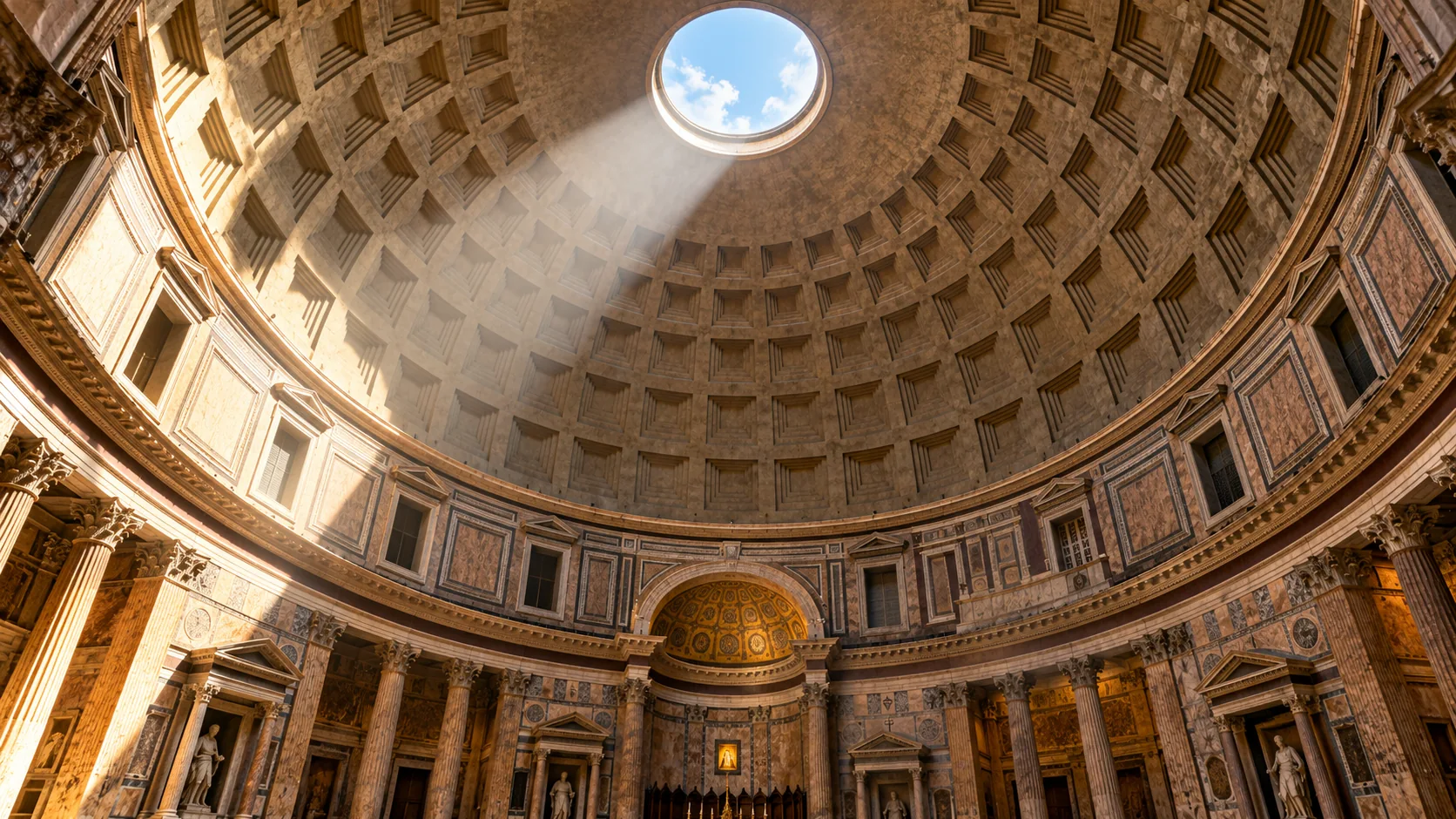
The present Pantheon was built under Emperor Hadrian in the early second century CE. According to the Italian Ministry of Culture, the rotunda supports a concrete dome approximately 43.3 metres in diameter. The building has survived earthquakes, changes in use, centuries of weathering and countless repairs. Its conversion into a Christian church in 609 CE also helped protect it from the abandonment and material scavenging that destroyed many other ancient monuments. Italian Ministry of Culture: Pantheon.
The dome is not a uniform block of concrete. Its thickness decreases toward the oculus, while the builders used progressively lighter aggregates higher up. The round opening removes mass from the most elevated part of the structure, and the thick supporting drum transfers enormous compressive forces down toward the foundations. The coffers contribute some weight reduction, although they are not the principal reason the dome stands.
1. Roman concrete was a system, not a single recipe
Roman opus caementicium typically used a lime-based binder mixed with aggregates such as volcanic material, stone or broken brick. Many recipes relied on pozzolanic reactions: silica- and alumina-rich materials react with lime in the presence of water to form binding phases. The exact ingredients varied across regions, periods and building types. Marine concrete and land-based masonry therefore should not be treated as chemically identical.
| Component | Role in the structure | Important qualification |
|---|---|---|
| Lime | Provides calcium-bearing binder chemistry | Different preparation methods change reactions |
| Volcanic ash or other pozzolans | Can react with lime to form durable cementitious phases | Not every Roman site had the same volcanic material |
| Stone, brick and rubble aggregate | Creates bulk, controls weight and supports loads | Size and density varied by location in a structure |
| Water and curing conditions | Enable reactions and influence pore structure | Excess water and poor workmanship can weaken concrete |
| Geometry and maintenance | Distribute stresses and limit deterioration | Chemistry alone cannot explain survival |
2. Volcanic ash created a durable mineral binder
The Romans exploited the reactivity of volcanic ash, especially pozzolanic material associated with the Bay of Naples. Unlike ordinary inert sand, suitable volcanic ash can react with lime and water. These reactions help bind the aggregate together and may produce cementitious phases that remain stable in demanding environments. The chemistry is complex: it depends on the ash composition, available calcium, temperature, moisture and time.
In Roman maritime structures, researchers have documented mineral transformations involving aluminium-rich tobermorite and phillipsite. Their work suggests that interactions among volcanic components, seawater and the concrete matrix could strengthen certain ancient harbor concretes over long periods. That finding applies to particular marine materials—not to every Roman road, wall or dome. Jackson and colleagues, American Mineralogist (2017).
3. The surprise inside Roman concrete: tiny white lime fragments
A major 2023 study published in Science Advances examined conspicuous white inclusions known as lime clasts. These had sometimes been dismissed as poorly mixed material. Using microscopy and chemical mapping, the research team instead found evidence consistent with a technique called hot mixing, in which quicklime was incorporated with other ingredients before or during water addition. The exothermic reactions can produce distinctive calcium-rich fragments within the hardened material. Read the peer-reviewed study.
The researchers proposed that the fragments could act as reservoirs of reactive calcium. When a small crack lets water enter, calcium-bearing material may dissolve and later precipitate as calcium carbonate, filling part of the crack. This is a plausible self-healing mechanism in some lime-clast-containing concrete—not proof that every ancient structure repairs every kind of damage.
What the self-healing experiment actually showed
The researchers prepared Roman-inspired modern mixtures, deliberately introduced cracks and passed water through them. In their experiments, mixtures containing reactive lime clasts could seal cracks approximately 0.5 millimetres wide, while comparison samples without quicklime did not show the same response under the tested conditions. The reported healing occurred within about two weeks in the laboratory. This is evidence for a material mechanism, not a promise that ancient monuments can repair structural failures without intervention.
The crucial distinction: mineral precipitation can seal certain fine cracks, but it cannot automatically reverse foundation movement, severe earthquakes, corrosion or large structural fractures.
4. Fresh evidence from Pompeii supports hot mixing
Research published in 2025 examined materials at a Roman construction site in Pompeii, including dry raw ingredients and unfinished building work. The investigators reported direct archaeological and chemical evidence consistent with mixing quicklime with other dry components before water was added. This strengthened the case that hot mixing was a real Roman construction practice rather than merely a modern interpretation of old concrete fragments. MIT: Pompeii offers insights into ancient Roman building technology.
The discovery also shows why historians and materials scientists need to work together. Written ancient descriptions—such as those of Vitruvius—do not necessarily capture every technique used across a vast empire. Archaeological evidence can reveal regional practices, on-site variations and processes that ancient authors did not explain in detail.
5. Why the Pantheon dome has not collapsed
Concrete generally performs well under compression and much less well when subjected to significant tension. Roman builders responded with geometry and mass. The Pantheon’s hemispherical dome channels much of its load into compression, while its thick cylindrical drum and foundations provide resistance. Using lighter aggregate higher in the dome reduced dead load where it mattered most.
- Graduated aggregate: denser material lower down and lighter material near the crown reduced the load.
- Thinning dome: the shell becomes substantially thinner toward the opening.
- Oculus: the central opening reduces material at the crown while admitting daylight.
- Heavy supporting drum: massive walls and internal voids work together to handle the dome’s forces.
- Long-term stewardship: adaptation, restoration and continuing use protected the monument.
This is why describing the Pantheon as “standing because of volcanic ash” misses most of the engineering story. Materials science and structural design were inseparable.
6. Why some Roman harbors survived seawater
Salt water can damage many modern reinforced-concrete structures, particularly when chloride ions reach embedded steel and accelerate corrosion. Ancient Roman harbor concrete usually lacked the steel reinforcement that creates this particular vulnerability. Certain Roman marine binders also underwent long-term mineral changes that could improve the matrix. But Roman harbors did deteriorate in many locations; erosion, waves, settlement and reuse all affected survival.
The comparison is not apples to apples: modern bridges and ports often carry greater loads, use slenderer sections, incorporate reinforcement and must satisfy very different design requirements. A thick ancient breakwater is not a direct substitute for a modern prestressed highway bridge.
7. Roman concrete versus modern concrete: what is the real difference?
| Question | Ancient Roman concrete | Modern Portland-cement concrete |
|---|---|---|
| Main binder | Often lime plus pozzolanic materials | Typically Portland cement, sometimes with supplementary cementitious materials |
| Steel reinforcement | Usually absent | Common in structural applications |
| Typical design strategy | Massive sections, arches, vaults and compression | Can be slender, reinforced, prestressed and engineered for high loads |
| Crack response | Some mixes may seal fine cracks through mineral reactions | Some mixes exhibit autogenous healing; engineered self-healing is under development |
| Speed and consistency | Varied by site and workmanship | Industrial production enables standardized quality control |
| Durability | Exceptional in some surviving examples | Can be excellent when properly designed, built and maintained |
Modern concrete is not a failed copy of Roman concrete. It is optimized for different construction speeds, safety codes, strength requirements, budgets and architectural possibilities. It also includes high-performance mixes, supplementary cementitious materials and deliberate durability design. The important question is which ancient processes are worth adapting—not whether the world should abandon modern cement.
8. The hidden factor: the buildings that did not survive
The surviving Pantheon is remarkable, but it is also part of a survivorship bias. Many Roman buildings were demolished, recycled for stone, damaged by war, weakened by poor foundations or destroyed by earthquakes and floods. Archaeologists see a mixture of ruins and preserved structures, not a uniformly indestructible civilization.
Continuing use matters. The Pantheon’s conversion into a church protected its fabric, while many abandoned temples lost their roofing and masonry. Even celebrated monuments have undergone repair, restoration and alterations. Durability means resisting deterioration over time; it does not mean requiring no maintenance.
9. Could Roman concrete make construction more sustainable?
Researchers hope to use insights from lime chemistry, pozzolanic reactions and crack sealing to create longer-lived construction materials. If infrastructure needs fewer major repairs or replacements, its lifetime environmental impact may fall. But sustainability must be measured through a full life-cycle assessment that considers raw materials, fuel, emissions, transport, construction, maintenance and service life.
It would be misleading to claim that Roman-style concrete is automatically low-carbon. Producing quicklime releases carbon dioxide from limestone and requires heat. Some modern low-clinker and blended-cement approaches may have more immediate practical benefits, depending on local materials and design. Roman-inspired technologies still need independent testing, standards and large-scale validation before widespread structural use.
10. How engineers can use the ancient lessons today
- Match materials to exposure: coastal structures, freeze-thaw environments and dry inland sites require different strategies.
- Design for water management: control infiltration, drainage and harmful chemical exposure.
- Reduce unnecessary cracking: geometry, reinforcement, curing and joints matter as much as binder choice.
- Explore reactive mineral inclusions: research may turn lime-clast chemistry into practical crack-sealing systems.
- Test the whole service life: compare maintenance intervals, embodied emissions and structural performance—not just early strength.
- Protect existing heritage: restoration must respect original materials and avoid incompatible repairs.
Three enduring myths about Roman buildings
| Myth | What evidence actually supports |
|---|---|
| Roman concrete is stronger than all modern concrete | Strength and durability are different properties; modern concretes can achieve much higher specified strengths |
| Seawater always makes Roman concrete stronger | Beneficial mineral reactions were documented in particular marine mixes; exposure can also be destructive |
| Roman structures are maintenance-free | Surviving monuments have often benefited from centuries of adaptation and conservation |
The deeper lesson: longevity was engineered at several scales
Roman construction succeeded when chemistry, structural form, workmanship and human care reinforced one another. Volcanic ash helped create durable binders; hot mixing may have preserved reactive lime fragments capable of sealing small cracks; large arches, domes and thick walls directed loads into compression; and continued use protected important buildings from abandonment.
Scientists have not discovered a magical lost formula that guarantees 2,000 years of service. They have uncovered a series of testable mechanisms that could inform better infrastructure. The Pantheon is therefore more than an ancient monument: it is a continuing case study in how thoughtful materials and design can extend the useful life of a building.
Scientific research and primary references
- Italian Ministry of Culture — Pantheon history, dimensions and preservation.
- Seymour et al. (2023), Science Advances — Hot mixing and lime-clast mechanisms.
- MIT News — Why Roman concrete was so durable.
- MIT (2025) — Archaeological evidence from Pompeii.
- Jackson et al. (2017), American Mineralogist — Marine concrete mineral chemistry.
- Nature Reviews Materials — Self-healing Roman concrete.
You may also like
 Science & Discoveries
James Webb Finds Metal-Rich Gas Around the Milky Way’s Black Hole: What It Means
James Webb observations reveal metal-rich gas near Sagittarius A*. Here is what the finding means, how infrared spectroscopy…
 Science & Discoveries
NASA Found a Giant Musical Symbol in Space: The Science Behind the Cosmic Treble Clef
NASA’s Treble Clef is a distant radio phoenix, not music in space. Learn how black-hole plasma and galaxy-cluster…
 Science & Discoveries
2026 El Niño Explained: What NASA Satellites Reveal About Winter 2026–27
NASA satellites reveal a powerful 2026 El Niño. Decode the ocean maps, NOAA winter 2026–27 forecast, UK and…