
NASA Found a Giant Musical Symbol in Space: The Science Behind the Cosmic Treble Clef
NASA’s Treble Clef is a distant radio phoenix, not music in space. Learn how black-hole plasma and galaxy-cluster collisions create its remarkable shape.
Contents
- What exactly did NASA discover?
- Why does the image resemble a treble clef?
- How to read NASA's Treble Clef image, step by step
- Why scientists subtract a smooth model from the X-ray image
- The two-act explanation: black-hole eruption, then cluster collision
- Act one: a supermassive black hole energizes the plasma
- Act two: the cluster merger revives an old radio source
- What is a radio phoenix, and how is it different from a radio jet?
- A useful calculation: why the radio signal fades so quickly at higher frequencies
- Why was this object difficult to identify before 2026?
- Why more than one radio telescope matters
- How large is the Treble Clef compared with our galaxy?
- What is known, what is inferred, and what remains unknown?
- Findings supported directly by the observations
- Interpretations with substantial support, but not a complete reconstruction
- Questions that future measurements could resolve
- Is NASA detecting actual music or sound from the black hole?
- How to examine the original evidence yourself
- Why the cosmic Treble Clef matters beyond a beautiful image
- The bottom line
- Original sources and further reading
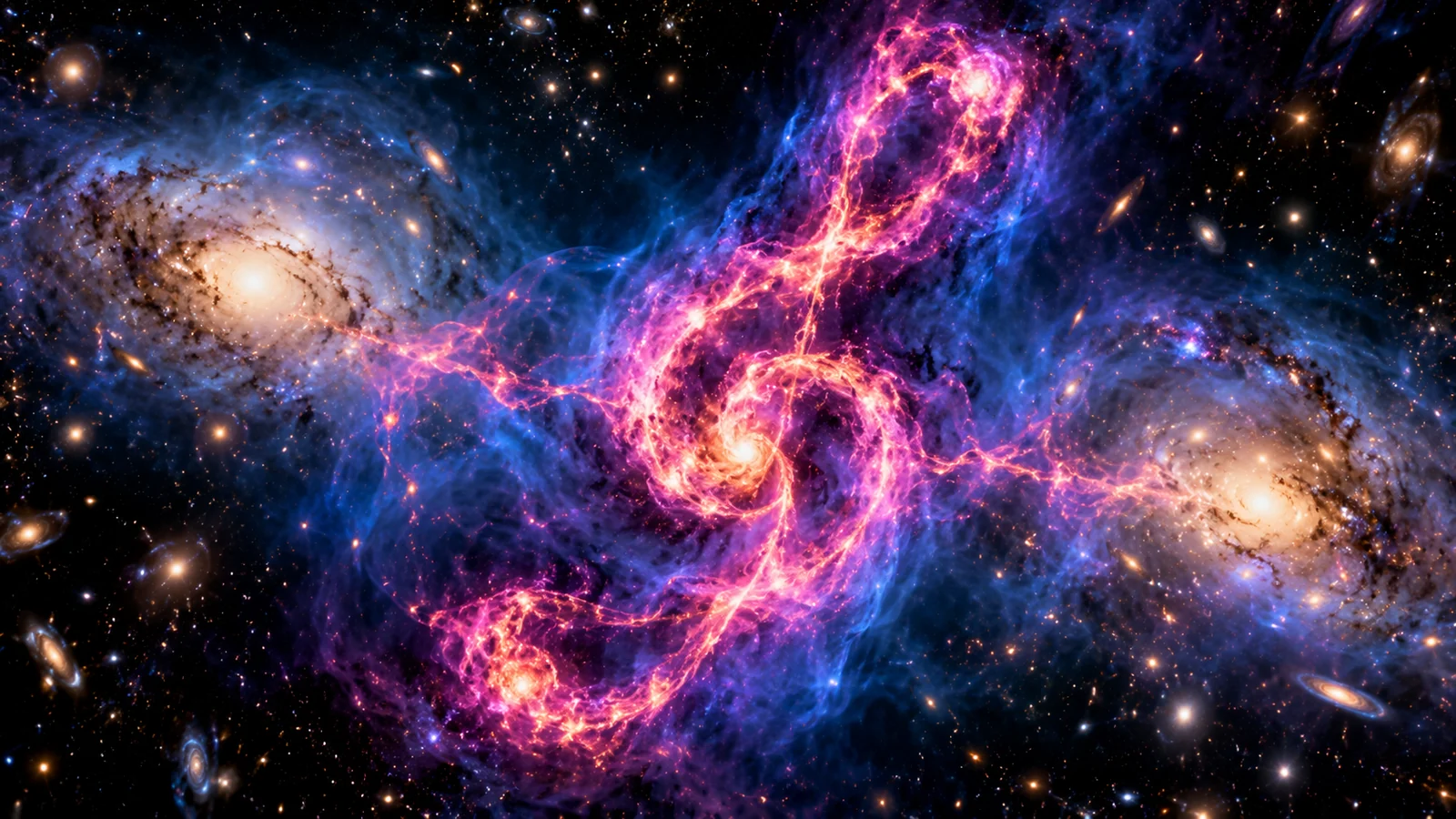
A giant pink shape resembling a musical treble clef appears to curl through a cloud of blue gas in a newly released NASA image. It looks almost too neat to be real. But the object is not a musical symbol and it is not producing an audible melody. It is an unusual source of radio emission inside two merging galaxy clusters, about 1.55 billion light-years from Earth.
On October 14, 2026, NASA’s Chandra X-ray Observatory released a detailed explanation of the object, catalogued as VLSS J0318.9+5755. A research team led by astronomer Andrea Botteon argues that the shape is a radio phoenix: old clouds of energetic particles, probably originating in a past supermassive-black-hole outburst, that have become detectable again as the surrounding galaxy clusters collide. The published observations establish a merging cluster and an unusually steep-spectrum radio structure; the exact way the merger revived the electrons remains a physical interpretation under investigation. NASA’s original announcement and the peer-reviewed journal record provide the primary evidence.
The important discovery is not that space contains a musical note. It is that astronomers can read the history of a black hole and a violent cluster collision from a faint, oddly shaped source of radio waves. The real NASA composite image can be inspected, wavelength by wavelength, in the Chandra interactive photo album. The featured artwork for this article is an illustration rather than telescope data.
What exactly did NASA discover?
Astronomers identified a massive, merging galaxy-cluster system that hosts strikingly filamentary radio emission. When presented in pink or red as part of a multiwavelength image, the radio emission bends into a shape that reminds viewers of the treble clef used at the beginning of a musical staff. The nickname is memorable; the physics is the story.
The location has the catalogue name VLSS J0318.9+5755. It lies in the constellation Camelopardalis, near the apparent plane of our Milky Way. NASA lists its distance as approximately 1.55 billion light-years and the image’s field of view as around six million light-years across. Those are two different measurements: distance to the target and the approximate physical width represented by the image. The radio filaments do not necessarily span the entire image width. Chandra’s published fast facts provide these numbers.
The shape was noticed in radio surveys before the October announcement. This was not a case of a completely unknown object suddenly appearing in one photograph. Earlier observations had left questions about its nature, while new X-ray observations made the larger system easier to interpret. The 2026 study combined observations across several radio frequency bands with Chandra and eROSITA X-ray measurements to examine both the plasma and the cluster hosting it.
| Published fact | What it means | What it does not mean |
|---|---|---|
| About 1.55 billion light-years away | We observe a distant cluster through light and radio signals that have traveled for a very long time | The cluster is 1.55 billion light-years wide |
| Composite view covers roughly 6 million light-years | The frame spans a huge region of cosmic space | Every colored filament extends across that whole width |
| Two galaxy clusters are merging | Hot gas and other evidence indicate an interacting system | We watched the collision happen in a human lifetime |
| A bright, curved low-frequency radio source | Relativistic electrons and magnetic fields produce detectable radio emission | There is a physical glowing musical staff or a sound audible in space |
Why does the image resemble a treble clef?
Humans are very good at recognizing familiar shapes, even in patterns that were not designed to resemble anything. That tendency is called pareidolia. The same mental process can make clouds look like animals or the Moon’s surface look like a face.
The treble clef is therefore a nickname for the radio emission’s projected shape, not a new kind of cosmic object. NASA even notes that some people see a dragon instead of a musical symbol. What we see is a two-dimensional projection of a complex three-dimensional arrangement of plasma, magnetic fields, and gas. Different viewing angles could produce different outlines.
The visual comparison also comes with a technical catch: the striking pink line is not how the region would look to the unaided human eye. Radio frequencies are invisible to human eyes. The research team assigned visible colors to measurements so separate components could be displayed together. That choice helps people interpret the evidence, but the colors should not be mistaken for literal visual appearance.
How to read NASA’s Treble Clef image, step by step
The fastest way to move beyond the headline is to open Chandra’s original image page and compare the separate wavelength views. Rather than memorizing the image’s colors, ask which instrument measured each feature and what physical process those measurements trace.
- Start with the composite image. Identify the central oval of hot gas and the curling radio filaments. This view places multiple datasets into one spatial context.
- Select Radio. Concentrate on the curved, filamentary structure. This emission is associated with energetic electrons spiraling in magnetic fields, a process called synchrotron radiation.
- Select X-ray. The extended X-ray emission reveals extremely hot gas held within the gravity of a galaxy cluster. The gas is not the radio clef itself.
- Select Infrared. This adds a different view of sources in and through the heavily crowded Galactic field, rather than another picture of the same hot gas.
- Return to the composite, and compare where the emissions overlap or appear offset. Those relationships are more informative than the musical resemblance.
NASA attributes the radio data to the European LOFAR network, the X-rays to Chandra and eROSITA, and the infrared contribution to surveys using the United Kingdom Infrared Telescope. The colors in the published composite are part of the processing: X-rays are shown mainly in blue, the radio emission in red or pink, and infrared sources in other visible tones. NASA’s credit and wavelength explanation identifies the datasets.
| Dataset | Telescope or survey | What it traces in this story | Common misreading |
|---|---|---|---|
| Low-frequency radio | LOFAR; additional follow-up radio facilities in the research | Aged, energetic electrons interacting with magnetic fields | The shape is a literal luminous music symbol |
| X-rays | Chandra and eROSITA | Multimillion-degree intracluster gas and signs of a merger | The blue region is cold gas or liquid water |
| Infrared | United Kingdom Infrared Telescope datasets | Sources visible in infrared through a difficult region of sky | Every white dot belongs to the distant cluster |
| Processed residual X-rays | Analysis of Chandra data | Departures from a smooth oval gas model | The subtracted image is an unaltered photograph |
Why scientists subtract a smooth model from the X-ray image
A central technical detail is easy to miss when looking only at a dramatic press image. Hot gas in a relatively relaxed cluster often has a roughly smooth, oval-shaped distribution in X-rays. The scientists fitted or modeled that broad symmetric component and examined what remained after it was removed. This is called a residual image.
In the Treble Clef system, the residuals are relatively bright on the left and right and fainter near the middle, a pattern consistent with a collision axis roughly across the image. NASA says the two clusters may have passed through each other a few hundred million years ago and are now separating. This reconstruction is not a movie of the event; it is a proposed history inferred from the present distribution of gas and other measurements.
That distinction matters. A residual map is powerful because it can reveal structures otherwise hidden beneath a bright, smooth background. But it also depends on the model subtracted. Researchers must check whether the result persists under reasonable choices of model and is compatible with independent evidence.
The two-act explanation: black-hole eruption, then cluster collision
The proposed sequence is best understood as two connected events separated by immense spans of time, not a single black hole firing a treble-clef-shaped jet into empty space.
Act one: a supermassive black hole energizes the plasma
A galaxy near a cluster center can host a supermassive black hole. Matter falling toward an active black hole can power jets or outflows of particles and magnetic fields. As high-energy electrons spiral in magnetic fields, they radiate energy across radio frequencies. Such emission is called synchrotron radiation.
The research team’s interpretation is that an earlier outburst injected or displaced a substantial population of energetic particles into the surrounding intracluster environment. The outburst did not need to emit light in the exact shape of a musical note. That outline can emerge later as plasma is stretched, bent, compressed, and viewed from Earth.
Once the original supply of energetic particles diminishes, the electrons radiate away energy and the signal can fade, especially at higher observing frequencies. The remnant plasma may then be difficult to identify in surveys that are not optimized for low-frequency radio emission.
Act two: the cluster merger revives an old radio source
Galaxy clusters contain hundreds of galaxies as well as enormous quantities of hot diffuse gas and dark matter. As two clusters merge, their gas can be disturbed by bulk flows, compression, turbulence, and shocks. Those large-scale motions can also interact with pre-existing magnetized plasma left by an earlier black-hole outburst.
In the radio-phoenix scenario, compression raises the strength of the magnetic field and can increase the energy of the radiating electrons, making an old radio source bright enough to detect again. The Treble Clef’s twisted filaments are consistent with complex movements of the intracluster medium. However, the researchers present the detailed shaping and revival mechanism as an interpretation, and they call for more low-frequency measurements.
This is why calling the discovery proof that a collision made a musical note would be misleading. The evidence points toward an old black-hole-related plasma population and a merging environment; it does not uniquely reconstruct every stage of the system’s history.
What is a radio phoenix, and how is it different from a radio jet?
A radio jet typically refers to a collimated stream associated with an active galactic nucleus. A radio phoenix is an older population of synchrotron-emitting particles whose radio glow has been renewed, often through compression in the surrounding cluster environment. The phoenix name evokes something that becomes visible again after seeming to fade.
Astronomers also study radio halos and radio relics in clusters. These labels describe distinct morphological and physical classes, but the boundaries can be challenging when observations are limited. Halos are generally large and diffuse toward cluster interiors; many relics trace cluster outskirts and shock-related regions; phoenix sources can look irregular and filamentary and often have unusually steep radio spectra.
The study reports a candidate central radio halo as well as the dramatic Treble Clef filaments. Candidate does not mean confirmed. It is possible to say that the system may host both without claiming that the faint central halo has been conclusively established.
| Radio feature | Typical location or shape | Working physical explanation | Key uncertainty |
|---|---|---|---|
| Active radio jet | Narrow structure extending from an active galactic nucleus | Black-hole-powered outflow | Orientation and how the jet interacts with gas |
| Radio phoenix | Irregular, often filamentary old radio plasma | Fossil electrons revived by compression | Exactly when and how the plasma was revived |
| Radio relic | Often elongated toward a cluster’s outer regions | Cluster shocks and associated particle acceleration | Shock geometry and electron supply |
| Radio halo | Large diffuse emission near cluster interior | Turbulence and particle acceleration or reacceleration | Which acceleration model dominates in a given cluster |
A useful calculation: why the radio signal fades so quickly at higher frequencies
The original paper reports exceptionally steep radio behavior in parts of the structure, with a spectral index alpha greater than four between 400 and 650 megahertz. The relationship usually written for a simple synchrotron power-law spectrum is S(ν) ∝ ν−α, where S is flux density and ν is frequency. Under that definition, a higher alpha means the source gets fainter very rapidly as observing frequency increases. Botteon and colleagues, Astronomy & Astrophysics.
We can turn that statement into a transparent illustrative calculation, without pretending to have measured a new telescope result. For alpha equal to four, the estimated flux-density ratio is S(650) / S(400) = (650/400)−4 ≈ 0.143. In plain English, a region producing 100 arbitrary units of flux density at 400 MHz would produce approximately 14.3 units at 650 MHz if it followed that simple power law exactly over that interval.
That is a decline of about 85.7%. If alpha is greater than four, the drop would be steeper still. In a real source, alpha can vary from place to place, and the spectrum can curve. The calculation illustrates the meaning of an extreme spectral slope; it does not claim every pixel has the same value or that the researchers directly measured a 100-to-14.3-unit change.
| Hypothetical spectral index | Calculated S(650 MHz) / S(400 MHz) | Relative drop across the interval |
|---|---|---|
| 1 | 0.615 | About 38.5% |
| 2 | 0.379 | About 62.1% |
| 3 | 0.233 | About 76.7% |
| 4 | 0.143 | About 85.7% |
Why this matters: a survey optimized for much higher frequencies could miss aged plasma that remains conspicuous to sensitive low-frequency arrays. This is one reason LOFAR and its planned developments are especially important for studying cluster radio sources.
Why was this object difficult to identify before 2026?
The Treble Clef lies close to the plane of the Milky Way, in a part of the sky rich in foreground stars, interstellar dust, and gas. Astronomers sometimes refer to such obscured extragalactic directions as part of the Zone of Avoidance, because traditional optical studies have difficulty looking through our own galaxy. The name does not imply a region that telescopes must avoid for safety.
The original study explains that the object had been noticed in earlier radio observations and was once considered a possible pulsar. That historical identification did not hold up as investigators gathered more evidence. A pulsar is a rotating neutron star with distinctive emissions, whereas a merging galaxy cluster is an immense collection of galaxies and hot gas. The distinction is not a minor change of subtype; it is a completely different physical scale.
X-rays are valuable here because hot intracluster gas produces diffuse emission detectable by X-ray observatories. Radio observations can detect synchrotron structures that are difficult to see optically. Infrared observations help distinguish sources through dust. By combining these complementary wavelengths, the team built a more convincing physical picture than any single visible-light image could provide.
Why more than one radio telescope matters
The study did not rely only on LOFAR’s recognizable shape. Its abstract reports combining low-frequency survey observations with follow-up measurements from the upgraded Giant Metrewave Radio Telescope (uGMRT) and the LOFAR Low Band Antenna Sky Survey (LoLSS), allowing a spatially resolved study of the radio spectrum.
An image tells researchers where emission is found. Multiple frequency measurements show how its strength changes with frequency. Those two pieces of information help distinguish a recently powered jet from old electrons whose spectrum has steepened through radiative losses. This is an example of why multiwavelength astrophysics is more than making a colorful picture.
How large is the Treble Clef compared with our galaxy?
NASA reports that the published picture spans about six million light-years from side to side. The Milky Way’s stellar disk is often described as roughly a hundred thousand light-years across, though the precise definition of a galaxy’s edge varies. On that rough comparison, the whole image covers a width on the order of 60 Milky Way disks placed side by side. That is a scale comparison, not a measurement of the treble-clef filaments themselves.
The image spans about 14.5 arcminutes on the sky, according to the Chandra photo metadata. Dividing six million light-years by 14.5 gives approximately 414,000 light-years per arcminute across this particular image at the adopted scale. This is a useful orientation exercise, not a universal conversion between angular size and distance: the conversion changes with how far away an object is and with the cosmological model.
The cluster is about 1.55 billion light-years from Earth. That number helps place it in cosmic context, but it does not tell us that the black-hole outburst happened precisely 1.55 billion years ago. Cosmological distance conventions differ, and the cluster’s gas and plasma went through their own history before the radiation we see today was emitted. The merger is reconstructed as having a major passage a few hundred million years before the state observed in the image, based on modeling reported by NASA.
What is known, what is inferred, and what remains unknown?
Responsible science reporting should keep three layers separate: the measured signal, the modeled explanation, and unanswered questions. Many headlines collapse all three into a single confident statement, which makes the story seem simpler than the research actually is.
Findings supported directly by the observations
- Radio telescopes detected unusually shaped, filamentary emission at the catalogue position VLSS J0318.9+5755.
- X-ray data reveal hot intracluster gas consistent with a massive galaxy-cluster environment.
- The gas distribution and analysis indicate an ongoing or recent merger of two clusters.
- Radio spectral measurements include extremely steep regions, consistent with an aged electron population.
Interpretations with substantial support, but not a complete reconstruction
- The plasma may have been injected by a previous active supermassive black hole.
- The merger may have compressed or reenergized that fossil plasma, creating a radio phoenix.
- Shock fronts or large-scale gas flows may help explain its present-day brightness and twisting filaments.
Questions that future measurements could resolve
- Which shock or flow, if any, was primarily responsible for reenergizing each section of the structure?
- How old was the original radio plasma when the cluster interaction revived it?
- Is the diffuse radio signal near the cluster center a genuine radio halo?
- What is the detailed three-dimensional geometry behind the striking projected shape?
- Will higher-resolution and lower-frequency observations reveal additional faint plasma unseen in current data?
The paper specifically identifies high-resolution, very-low-frequency observations with LOFAR2.0 as a promising way to investigate the source further. This is a proposal for scientific follow-up, not an announcement that LOFAR2.0 has already proved a final model.
Is NASA detecting actual music or sound from the black hole?
No. The Treble Clef is a visual analogy, not a recording of sound waves or a musical composition from another galaxy. Radio waves are electromagnetic radiation. Audible sound consists of mechanical pressure variations moving through a material medium such as air. The radio observations described in this study are not an audio recording.
Space is not uniformly empty: clusters contain hot, thin plasma in which disturbances and pressure waves can propagate. However, that fact does not mean the specific radio filaments shown here are sound waves, or that anyone could hear them unaided. Some observatories produce sonifications, in which measured data are deliberately mapped into audible tones. Such a translation can be scientifically and educationally useful, but the sound is a representation of the data rather than a microphone recording from space.
The distinction matters especially for online images or videos with dramatic soundtracks. The music may be an illustration, while the source data are radio brightness, X-ray counts, and infrared measurements. Always check what the observatory says the visual or audio material actually represents.
How to examine the original evidence yourself
A reader can perform a useful source-checking exercise without any specialist software. It will not reproduce the astronomers’ research analysis; it simply makes the published evidence easier to evaluate.
- Open the NASA Chandra photo album for the Treble Clef.
- Find the View Wavelengths controls, then compare the radio-only, X-ray-only, infrared-only, and composite versions.
- Note which structure creates the treble-clef shape. Ask whether the same shape is present in the hot-gas X-ray view.
- Read the Fast Facts section to distinguish distance from image width and note the object’s catalogue designation.
- Open the research-paper abstract and find the phrases radio phoenix, steep spectrum, and merging galaxy cluster.
- Compare the study’s language of speculation and interpretation with headlines that may sound much more definite.
- Explore the Chandra team’s short explanatory video for a public-facing walkthrough of the same observations.
A good result from this exercise is not an attempt to ‘spot’ a black hole as a visible black dot. It is understanding which measurements show the merger, which show the aged radio electrons, and where the physical model connects them.
Why the cosmic Treble Clef matters beyond a beautiful image
The object illustrates one of the deeper challenges of astronomy: the universe is full of past events whose remains outlive the events themselves. Black-hole activity can change the state of surrounding plasma, and a later galaxy-cluster collision can reshape that material. Modern telescopes may then capture the layered record of processes separated by many millions of years.
It also expands a larger question about galaxy-cluster energy. Clusters contain immense gas reservoirs, and collisions can redistribute thermal energy, magnetic fields, and cosmic-ray particles. Understanding that energy exchange helps researchers interpret clusters as evolving systems rather than static collections of galaxies. The unusually steep spectrum and peculiar shape make the Treble Clef a particularly useful target for further radio observations.
And there is a lesson for science communication. The name attracts attention, but the evidence earns it. An image can provide a memorable first impression; a thoughtful reading of the wavelengths, measurement scale, and uncertainty reveals what astronomers actually discovered.
The bottom line
NASA’s newly explained cosmic Treble Clef is not music in space. It is an unusually shaped radio source within a merging galaxy-cluster system about 1.55 billion light-years away. The leading explanation is that an earlier supermassive-black-hole outburst left fossil plasma that later became bright again as clusters collided. That combination may have created the sinuous filaments now nicknamed after a musical symbol.
The story is stronger when told with its uncertainty intact: the observations identify aged radio emission and a merger; the full details of how the plasma was revived remain open. Compare the real wavelength images, read the primary study, and the strange pink symbol becomes something more valuable than a cosmic curiosity: a window into how the universe recycles energy on enormous scales.
Original sources and further reading
- NASA Science — Chandra Breaks Down the Treble Clef’s Galaxy Cluster Collision (October 14, 2026).
- NASA Chandra X-ray Center — Treble Clef photo album, wavelength views, image scale and credits.
- Botteon et al. — The Treble Clef radio phoenix and its old nonthermal filaments, Astronomy & Astrophysics (2026).
- Author preprint and technical abstract on arXiv.
- Chandra explanatory videos and animations.
For a different kind of distant cosmic radio phenomenon, compare our previous Horus Valley report, Astronomers Detect the Most Distant Fast Radio Burst Ever Found. A fast radio burst is a brief transient flash, while the Treble Clef is an extended source linked to an aged particle population and a cluster merger. They are not the same phenomenon.
You may also like
 Science & Discoveries
James Webb Finds Metal-Rich Gas Around the Milky Way’s Black Hole: What It Means
James Webb observations reveal metal-rich gas near Sagittarius A*. Here is what the finding means, how infrared spectroscopy…
 Science & Discoveries
2026 El Niño Explained: What NASA Satellites Reveal About Winter 2026–27
NASA satellites reveal a powerful 2026 El Niño. Decode the ocean maps, NOAA winter 2026–27 forecast, UK and…
 Science & Discoveries
Why Some Ancient Roman Buildings Have Survived for 2,000 Years
The real science behind Roman concrete, the Pantheon, volcanic ash, hot mixing and self-healing cracks—and why ancient buildings…