
How to Check If a Black Friday Deal Is Actually a Good Deal
Check Black Friday price history, exact models and checkout totals. Includes real discount examples and key differences for US, UK and EU shoppers.
Contents
- The quick check: five questions before you buy
- 1. Match the product before comparing prices
- 2. Read price history as a record, not a prediction
- 3. Understand what the crossed-out price means
- United States: check whether the former price was genuine
- United Kingdom: test the usual price and the full cost
- European Union: look for the relevant prior price
- Two real examples: a smaller saving and a disguised increase
- Example A: the advertised 40% reduction was about 14%
- Example B: a “24% discount” actually cost more
- 4. Compare the total you will actually pay
- Subscriptions and bundles need a second calculation
- 5. Check returns and the seller before trusting the saving
- Do countdowns or a missing old low mean you should wait?
- Save this deal-check note
- Sources and image credits

A Black Friday deal is worth considering when the exact product costs less than its credible recent price and competing offers, after unavoidable charges, and the seller and return terms are acceptable. The crossed-out price and percentage badge cannot establish that on their own. Check the model, price history and final total before deciding.
A genuine reduction can still be a poor purchase if it is the wrong version, requires an unwanted subscription, or exceeds your budget. This guide gives you a repeatable check for US, UK and EU shopping, plus two documented historical examples of misleading discounts. It is a buying method, not a list of currently available offers.
The quick check: five questions before you buy
- Is this the exact model, capacity, condition and bundle I intended to buy?
- What did the same offer cost over the past few months, rather than just yesterday?
- What do at least two other credible sellers charge for the same item now?
- What is the payable total after delivery, taxes where applicable, mandatory charges and a coupon I can actually use?
- Would I still choose this product and seller if the discount badge and countdown disappeared?
The UK Competition and Markets Authority’s Black Friday shopping guidance recommends checking at least two other sites and using price tracking. Treat this as a short research task before spending, rather than a race to beat the timer.
1. Match the product before comparing prices
Copy the manufacturer’s model identifier from the product details, not just a title such as “55-inch smart TV” or “wireless headphones.” The US Federal Trade Commission’s online-shopping guidance recommends noting the model and product details and comparing the total cost.
- For a laptop: processor model, memory, SSD capacity, display, keyboard layout and operating system.
- For a TV: the complete model suffix, screen size, model generation and included accessories.
- For storage or phones: capacity, generation, condition and regional variant.
- For bundles: exactly what is included, which accessories you need, and whether membership is required.
An exclusive model number does not automatically mean an inferior product. It does mean you should compare its specifications rather than assume a familiar series name makes two listings equivalent. If you cannot establish the match, label that comparison uncertain.
On a marketplace, also note who sells the item. The platform hosting the page, the seller of record and the company delivering the parcel can be different. A cheaper listing is not a like-for-like alternative if it has a materially different condition or seller arrangement.
2. Read price history as a record, not a prediction
Search the exact product in a price-history service that covers your retailer and country. Keepa provides Amazon price-history charts and price-drop alerts. Other services have different retailer and market coverage. You do not need to install an extension just to compare the information available on a service’s website.
- Select the correct country, currency and product variant.
- Check which line represents the offer you want: for example, Amazon’s own price versus a new third-party offer or a used item.
- Look over a few months when available. Distinguish a recurring promotional price from a short-lived outlier.
- Check gaps and the date of the latest observation. Missing history is missing evidence, not evidence of a stable price.
- Verify delivery, coupons, membership eligibility and stock directly on the retailer page. A tracked price may not describe your final offer.
This is an editorial checking method, not a claim that every tracker has the same controls or captures every promotion. Record the service, date range and offer type alongside any price you use. An alert tells you a threshold was reached; you still need to check whether the resulting purchase is worthwhile.
For example, suppose a product spends most of three months near $120, briefly reaches $100, then appears at $110. Calling it a new record low would be wrong. Calling it a useful price may be reasonable if current comparable offers are $125 and you need it now. These figures are illustrative, not a live product history.
Avoid the opposite mistake too: one old clearance price does not prove today’s offer is bad. The earlier item might have been used, unavailable locally or sold without the accessories you need. Compare evidence that describes the same purchase.
3. Understand what the crossed-out price means
Look for the words beside it: “was,” “list price,” “RRP,” “manufacturer’s recommended price” or a named competitor comparison. They describe different reference points. A product can be below its recommended price while still costing its ordinary market price.
The UK Advertising Standards Authority’s Black Friday advertising guidance stresses evidence for price comparisons. It also explains why “up to” claims need to fairly represent the promotion. A headline maximum discount does not tell you the saving on your selected item.
United States: check whether the former price was genuine
The FTC’s guides on former-price comparisons, 16 CFR 233.1 distinguish a bona fide former price from an inflated figure created to advertise an apparent reduction. Do not import the EU’s 30-day reference-price test into a US offer as though it were the same nationwide rule. State requirements may also matter.
United Kingdom: test the usual price and the full cost
The CMA’s guidance on urgency and price-reduction claims warns against comparisons that no longer reflect an item’s usual price. Its price-transparency guidance, updated in January 2026 separately addresses mandatory fees, taxes and charges, including drip pricing. An EU-style 30-day label is not a universal checklist for UK compliance.
European Union: look for the relevant prior price
For covered announcements of price reductions on goods, the EU framework generally uses the trader’s lowest price over at least the preceding 30 days as the prior-price reference. The European Consumer Centre’s discount guidance also distinguishes recommended-price comparisons from discounts. Exceptions and national implementation matter, including some perishable goods, newly marketed goods and progressive reductions; a loyalty offer or service should not automatically be treated as the same case.
The European Commission’s March 2026 report on its sales-practices sweep said 30% of the 314 online traders checked referenced discounts incorrectly. That is a finding about the screened traders, not a measured rate for every retailer or every Black Friday offer.
Two real examples: a smaller saving and a disguised increase
The following cases come from the European Commission’s published 2022 Black Friday sweep. The screenshots were captured from its official sweep page on 31 October 2026. They are historical examples, not current shop offers or a Horus Valley product-price test.
Example A: the advertised 40% reduction was about 14%
In the first case, the seller advertised €23.99 against €39.99. The Commission identified €27.99 as the relevant lowest prior price. The large badge therefore overstated the saving against that reference.
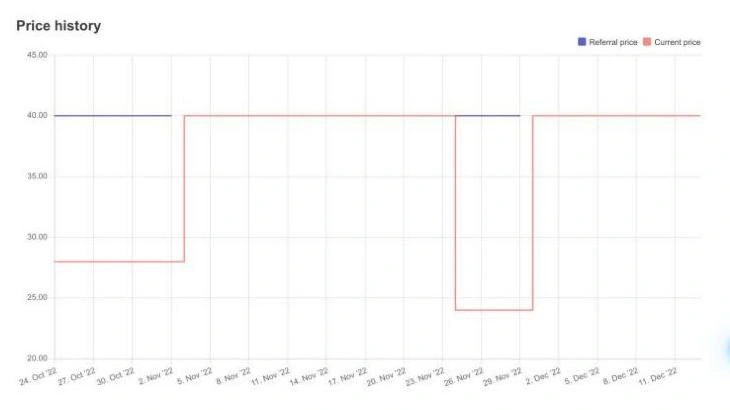
Recalculate it: (€27.99 − €23.99) ÷ €27.99 × 100 ≈ 14.3%. The saving is €4 against that baseline. Changing the denominator changes the message, even though the amount charged today stays the same. This is why the original reference matters as much as the arithmetic.
Example B: a “24% discount” actually cost more
In the second case, a product previously priced at €19.48 rose to €21.66, but the retailer compared it with an artificial €28.81 reference and advertised a 24% discount. The Commission described an increase of about 11% disguised as a reduction.
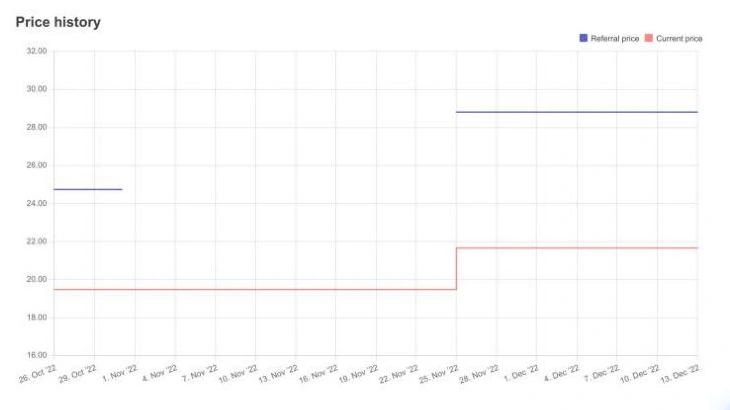
The customer would pay €2.18 more than the earlier €19.48 price. Our check is €2.18 ÷ €19.48 × 100 ≈ 11.2% higher. Neither the badge nor the word “sale” changes that cash difference. For help choosing the right baseline, see our guide to common percentage-calculation mistakes.
4. Compare the total you will actually pay
Keep two separate figures: the checkout total and any conditional benefit you might receive later. Include compulsory delivery, relevant taxes, unavoidable fees and any membership you would have to buy solely for this offer. Subtract a coupon only after you confirm eligibility and application.
A promise of cashback or a future gift card is not the same as reducing today’s payment. It might still have value to you, but record it separately, with its restrictions. Compare domestic offers first; cross-border purchases can add currency conversion, import charges and inconvenient returns.
Illustrative comparison: assume three offers for the identical new item from sellers you have checked. All figures below already include applicable taxes; the example is arithmetic, not a live offer or a claim about any retailer.
| Offer | Payable now | Conditional benefit |
|---|---|---|
| A: £89 item + £8 delivery | £97 | None |
| B: £95 item, delivery included | £95 | None |
| C: £99 item with £10 future voucher | £99 | £10 on a later eligible purchase |
Offer B is £2 cheaper now than A. C requires £4 more today than B, even if its future voucher might be useful. Do not describe C as a £89 purchase unless you explain the separate future condition. If B’s seller or return arrangement is unacceptable, its price alone does not settle your decision.
Subscriptions and bundles need a second calculation
Suppose a £70 accessory is “free” only with a £12 monthly plan for 12 months that you would not otherwise buy. The commitment is £144, before any other charges. That does not prove the plan is poor value, but it does show why valuing the gift alone is incomplete. Check the minimum term and renewal conditions before comparing it with an outright purchase.
5. Check returns and the seller before trusting the saving
Read the return deadline, who pays return shipping, any lawful deductions, and whether an extended Christmas window covers your item. Keep a dated copy of the listing and order terms. A retailer’s optional change-of-mind promise is separate from statutory rights when goods are faulty.
In the UK, GOV.UK explains that sale purchases retain the same refund rights as full-price purchases. For many distance purchases, customers can notify cancellation within 14 days of receiving the item and then have another 14 days to return it, with exceptions. Do not assume an in-store change-of-mind purchase has identical rules.
For EU purchases from traders, Your Europe explains the minimum two-year legal guarantee for faulty or misdescribed goods. That is different from a seller’s commercial warranty or a promise to accept an unwanted gift. Check the specific rules and exceptions for your country, purchase channel and item. In the US, inspect the applicable retailer policy and legal protections rather than assuming the UK or EU terms apply.
If a shop is unfamiliar, check the business identity and independent evidence before entering card details. Our website-scam checking guide covers that separate task. A real price reduction and a trustworthy seller are two different questions.
Do countdowns or a missing old low mean you should wait?
Not necessarily. The CMA flags misleading timers and scarcity claims; it does not say every deadline or stock warning is false. A timer is not evidence that the price is unusually low. Likewise, price history cannot guarantee a cheaper offer tomorrow.
Use a decision you can defend with today’s information:
- Buy: you need the exact item, its comparable total is competitive, the history supports the value, and the seller and terms pass your checks.
- Watch: the current price is ordinary or the evidence is incomplete, and you can comfortably wait. Set a target and recheck when notified.
- Skip: you are buying mainly because of the badge, cannot verify the model or seller, or the purchase requires a commitment you do not want.
An affordable, well-matched purchase need not be the lowest price ever recorded. The aim is to make an informed choice about what you receive and pay, rather than win a prediction contest about the next sale.
Save this deal-check note
- Exact model, variant, condition and seller.
- Price-history source, market, date range and offer type.
- Current price and totals at two comparable sellers.
- Your payable total and any separate conditional reward.
- Delivery date, return deadline and return costs.
- Your maximum acceptable price and reason to buy now.
If those six lines reveal that the only impressive number is the crossed-out price, pause. If they show a suitable product at a competitive total from a seller you trust, you have a stronger reason to buy than a percentage badge alone.
Sources and image credits
Reviewed on 31 October 2026. No live bargain, future price, product test or saving guarantee is claimed. The two euro cases are attributed historical regulatory examples; the dollar and sterling scenarios are labeled illustrations. This article contains no affiliate purchase links.
- FTC: online shopping
- US eCFR: former-price comparisons
- CMA: Black Friday shopping checks
- CMA: urgency and price-reduction claims
- CMA: price transparency
- ASA/CAP: Black Friday advertising claims
- European Commission: sweeps and the two 2022 price histories
- European Commission: March 2026 sweep findings
- European Consumer Centre: discounts and reduced prices
- GOV.UK: refunds and returns
- Your Europe: legal guarantees
- Keepa: Amazon price-history service
Featured photograph: SumUp on Unsplash, used under the Unsplash License. The photograph illustrates online shopping, not a verified offer. Inline screenshots: © European Union, European Commission, under CC BY 4.0; cropped from the published 2022 sweep graphs and converted to WebP. See the Commission reuse notice. Source and historical date are retained in the captions.
You may also like
 Technology & How-To
Is Tesla Discontinuing the Cybertruck? What We Know
Tesla plans a Cybertruck production wind-down in Texas around mid-2027. See what is confirmed, what remains unknown, and…
 Technology & How-To
Are AI Toys Safe for Kids? Privacy Risks and Parent Checks
Are AI toys safe for kids? Explore the evidence, privacy risks, age advice and practical parent checks for…
 Technology & How-To
iPhone Trust This Computer Not Showing? Windows and Mac Fixes
Restore the iPhone computer-trust prompt with checks for unlocking, Apple Devices or Finder, USB data cables and targeted…