
Is Tesla Discontinuing the Cybertruck? What We Know
Tesla plans a Cybertruck production wind-down in Texas around mid-2027. See what is confirmed, what remains unknown, and steps for buyers and owners.
Contents
- What exactly did Musk announce?
- Confirmed announcement versus unanswered questions
- Why Cybercab is part of the decision
- If you have a Cybertruck reservation or order
- If you already own a Cybertruck
- Check the warranty supplied with your vehicle
- Treat parts availability and warranty as different questions
- Check recalls by VIN
- Should the announcement change a purchase decision?
- What would settle the remaining uncertainty?
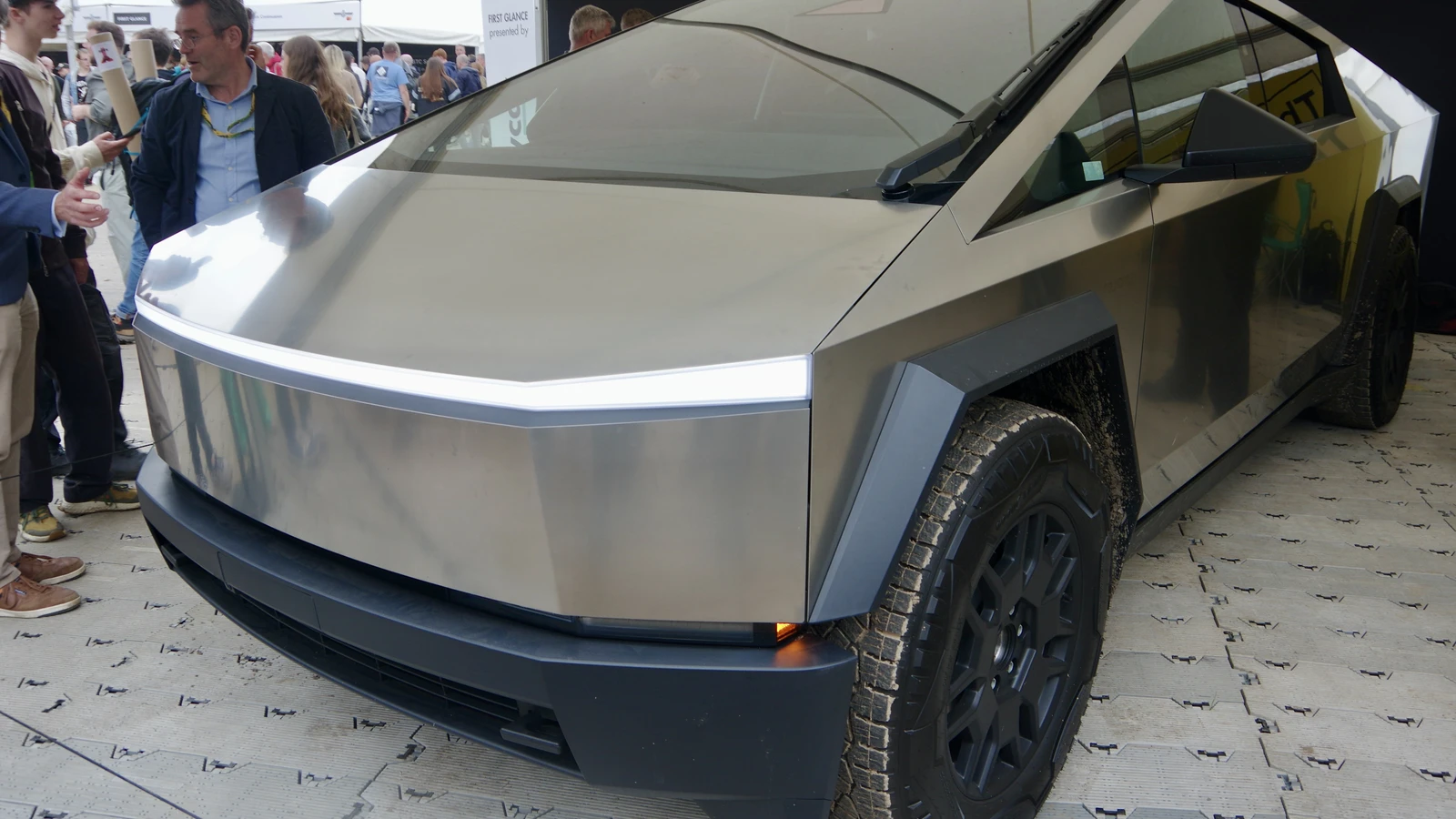
Tesla plans to wind down Cybertruck production at Gigafactory Texas around the middle of 2027 to make room for increased Cybercab production, according to Elon Musk’s 6 November announcement reported by Reuters. That establishes a planned change at the Texas factory—not a confirmed worldwide discontinuation date or an immediate end to deliveries.
For buyers and owners, the next questions are practical: what happens to an outstanding order, can a reservation be cancelled, and where should you check warranty coverage and recalls? Those questions need separate answers; the production announcement does not settle all of them.
Checked 7 November 2026. This guide focuses on the US market. Order agreements, warranty coverage and consumer rights can differ elsewhere.
What exactly did Musk announce?
The announcement identifies three things: Cybertruck production at Gigafactory Texas, an approximate mid-2027 timeframe, and the intention to create room for more Cybercabs. Reuters’ report says Musk did not specify whether Cybertruck production would move to another facility or end altogether.
Because the statement was dated 6 November 2026, its reference to the middle of “next year” means 2027. It gives no final assembly date, last-order deadline or guaranteed delivery window for an individual customer.
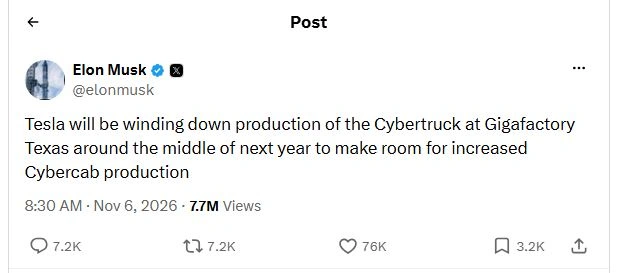
The supplied screenshot shows the wording of the 6 November post on X. Its text is consistent with the Reuters account. The original post could not be retrieved directly during this review; the screenshot is included as supplied, not presented as an independently captured page.
Confirmed announcement versus unanswered questions
| Question | What the available evidence says | What to avoid assuming |
|---|---|---|
| Is production changing? | A wind-down is planned at Gigafactory Texas around mid-2027. | That production has already stopped. |
| Is the model permanently discontinued everywhere? | The announcement does not specify another factory or a worldwide final-production decision. | That a Texas timetable proves the outcome at every possible location. |
| Will my order be delivered? | The announcement contains no order-specific commitment. | That every reservation guarantees a truck before the wind-down. |
| Does this change my warranty? | Tesla publishes warranty terms separately; check the document supplied with your vehicle. | That a production headline creates new coverage or automatically ends existing coverage. |
| Will used prices rise or fall? | The announcement establishes no resale-value outcome. | That scarcity guarantees appreciation or that a price fall is certain. |
Why Cybercab is part of the decision
Musk’s stated reason is to make room for increased Cybercab production. Tesla’s Q3 2026 update provides useful company context: it lists both Cybertruck and Cybercab as being in production in Texas and says Cybercab robotaxi rides began in Austin on 3 September.
The same document lists installed annual capacity above 125,000 for each vehicle, while explicitly warning that installed capacity is not the current production rate. Those figures should not be described as annual sales, actual output or a promise that the factory will manufacture that many vehicles.
The factory announcement also does not mean a Cybertruck becomes a Cybercab through a software update. They are separate products. Changes in manufacturing priorities should not be read as new capabilities for vehicles already on the road.
If you have a Cybertruck reservation or order
Start with your Tesla Account and the agreement attached to your own transaction. A general production statement cannot tell you whether a vehicle has been assigned to your order, whether a delivery appointment is confirmed or which payment terms apply.
Tesla’s US Cybertruck FAQ says that, before delivery, a reservation may be cancelled with a full refund of the pre-order payment. Its published cancellation route is:
- Sign in to your Tesla Account.
- Open the Cybertruck order and select Manage.
- Choose Request to Cancel.
- Select the reason, add any feedback and submit the cancellation.
- Confirm with Yes, Cancel.
The FAQ says the refund goes to the account used for the order. It does not give a processing time in that passage. Keep the confirmation and payment record, and contact Tesla if your account status or agreement differs from the general guidance.
The pre-order refund should not be treated as a blanket promise about separate finance arrangements, insurance, accessories or third-party expenses. Check each agreement before cancelling related services. Nor should an approximate production timeframe be treated as a reason to pay a third party for a supposedly guaranteed slot: Tesla’s FAQ states that reservations cannot be transferred.
If you already own a Cybertruck
Check the warranty supplied with your vehicle
Tesla’s US warranty overview currently lists basic vehicle coverage of four years or 50,000 miles, whichever comes first. For Cybertruck, it lists battery and drive-unit coverage of eight years or 150,000 miles, whichever comes first, with a minimum 70% battery-capacity retention over the warranty period.
Tesla explicitly says the warranty supplied with the vehicle is authoritative. These headline limits are therefore a starting point, not confirmation that a particular repair is covered. Purchase date, mileage, the affected component and the applicable terms matter.
Keep your vehicle’s warranty document and repair records. If a repair is needed, ask Tesla to identify the diagnosis, coverage decision, estimate and expected parts availability for that specific job. A production announcement is not a repair quotation.
Treat parts availability and warranty as different questions
TeslaNorth reports that Cybertruck lead engineer Wes Morrill said parts and service support would continue. That is relevant reassurance, but the reported statement gives no delivery time for a particular component or universal support end date. It should not be expanded into a promise that every part will always be in stock.
A vehicle can have a warranty claim to resolve and still need an individual repair timetable. Ask about both, especially if damage affects whether you can safely use the truck. Do not postpone an urgent safety concern while waiting for further production news.
Check recalls by VIN
Use Tesla’s VIN recall search and the NHTSA recall checker for your specific vehicle. A general list of Cybertruck recalls does not establish which remedies your truck needs or whether previous work has been completed.
NHTSA explains that a VIN search can identify unrepaired safety recalls, but may not yet include every VIN in a newly announced campaign. It also does not show recalls already repaired. Keep service documentation and follow the instructions for the actual campaign rather than interpreting an empty result as a complete vehicle-health assessment.
Should the announcement change a purchase decision?
Use the news to identify questions to resolve before paying, rather than to predict a bargain or a collectible. For a new truck, obtain the configuration, final price, delivery arrangements and cancellation terms in writing. For a used truck, check the vehicle’s condition, applicable remaining coverage, service history, insurance quotation and VIN-specific recalls.
For example, a seller may describe a truck as a future “last-year model.” That description does not prove its build date, establish a final model year or guarantee resale value. Verify the vehicle documents and evaluate the actual asking price and condition.
For a different Tesla project, our Roadster guide discusses its own development claims and timetable. Roadster announcements do not determine Cybertruck order terms or production plans.
What would settle the remaining uncertainty?
Watch for a Tesla product notice specifying a final order date, an exact production schedule, any alternative manufacturing location and arrangements for outstanding orders. Until those details are supplied, an approximate Texas wind-down should remain an approximate Texas wind-down in reporting.
The useful distinction is between what has been announced and what a buyer or owner still needs confirmed for their own vehicle. The first is a factory plan; the second depends on order records, contracts and service information.
Featured photograph: Cybertruck at the Goodwood Festival of Speed, 12 July 2024, by David Merrett, via Wikimedia Commons, CC BY 2.0. Cropped and converted to WebP. Historical reference photograph, not an image of the production announcement. The X screenshot was supplied to Horus Valley and converted to WebP without changing its text.
You may also like
 Technology & How-To
Are AI Toys Safe for Kids? Privacy Risks and Parent Checks
Are AI toys safe for kids? Explore the evidence, privacy risks, age advice and practical parent checks for…
 Technology & How-To
iPhone Trust This Computer Not Showing? Windows and Mac Fixes
Restore the iPhone computer-trust prompt with checks for unlocking, Apple Devices or Finder, USB data cables and targeted…
 Technology & How-To
Chrome Keeps Showing Fake Virus Notifications? Stop Them Safely
Stop deceptive Chrome website notifications on Windows, Mac and Android. Identify the sender, revoke permission and check whether…