
Tesla Roadster 2026 Revealed: Flying Technology, Specs, Price and 2028 Release Date
Tesla unveiled a Roadster prototype with SpaceX-inspired thrusters. Explore the flying demo, performance claims, versions, price uncertainty and 2028 production target.
Contents
- What happened at the October 2026 Tesla Roadster reveal?
- Tesla Roadster 2026 specifications: confirmed, claimed and unknown
- Performance, Thrust and Rocket: the three configurations
- How does the Tesla Roadster “fly”?
- 1. Cold-gas thrusters create force without a combustion flame
- 2. Suction fans help the car grip the ground
- 3. Why a jump is not the same as practical flight
- How fast is the new Roadster really?
- Roadster price and reservation deposits: what buyers should know
- When will the Tesla Roadster be released?
- Is the flying Tesla Roadster street legal?
- What happened to Tesla’s original 2017 Roadster promises?
- What do engineers still need to prove?
- How does the Roadster compare with other electric hypercars?
- Should you reserve a Tesla Roadster now?
- The bottom line
- Sources and further reading
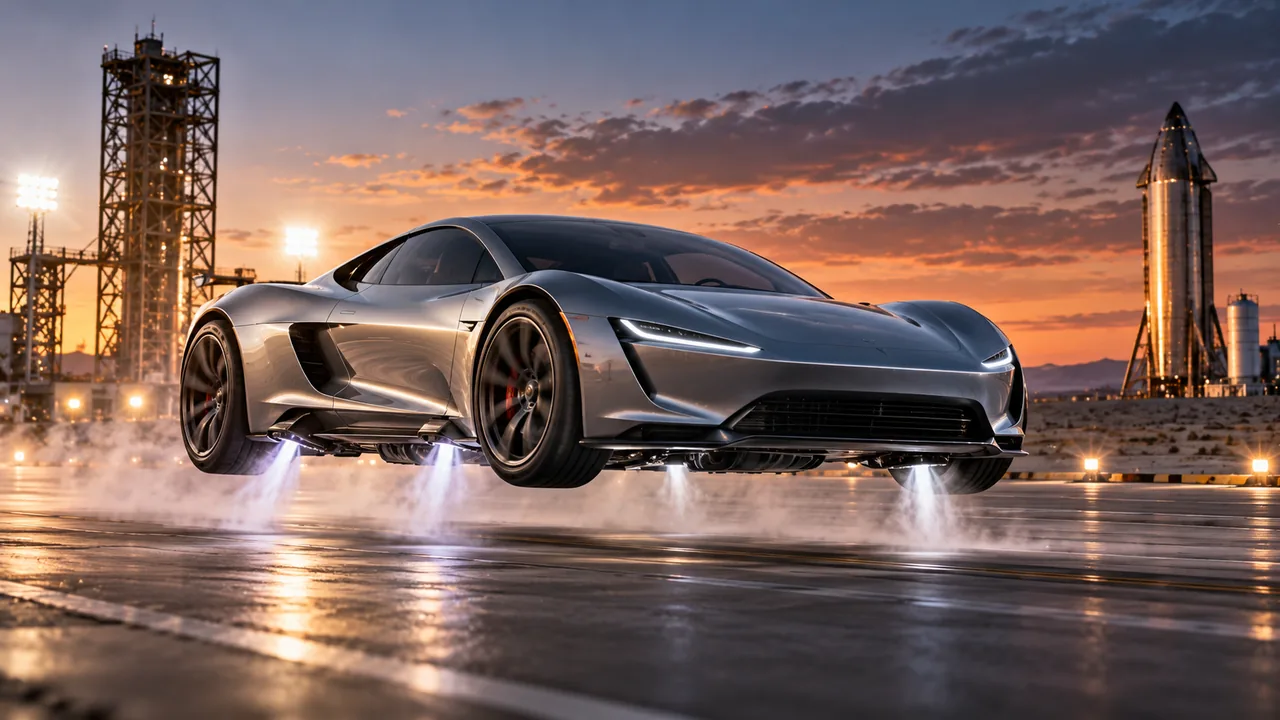
Tesla has unveiled a radically redesigned second-generation Roadster, including an experimental version that can briefly leave the ground. At a demonstration at a SpaceX facility in Texas on October 15, 2026, the electric sports-car prototype used powerful fans and cold-gas thrusters to accelerate, move through the air and perform unusual maneuvers. Tesla is targeting production in 2028—not immediate customer deliveries. This guide separates what was demonstrated, what Tesla claims, and what remains unproven.
The headline-grabbing phrase “flying Tesla” needs context. A short powered hop is not the same as an aircraft that can take off, navigate, land and operate legally in ordinary airspace. The invitation-only Rocket variant is not approved for public roads, and production specifications may change. The clearest starting points are Tesla’s official Roadster page, Reuters’ October 15 report and Associated Press coverage.
What happened at the October 2026 Tesla Roadster reveal?
The event brought the Roadster back into the spotlight almost nine years after Tesla showed its previous next-generation concept in 2017. Demonstrations featured a remotely operated prototype and a combination of suction and thrust technology. Reports described an inverted ramp maneuver, a brief aerial movement and very rapid acceleration. Those displays are evidence of a functioning demonstration setup, but they are not independent certification of a road-ready production car.
Tesla said the vehicle would enter production in 2028. This is a target, not a guaranteed delivery date. A reservation should not be interpreted as a firm production slot. The company has previously revised the Roadster timetable several times.
Tesla Roadster 2026 specifications: confirmed, claimed and unknown
| Item | October 2026 information | How to interpret it |
|---|---|---|
| Reveal | October 15, 2026, Texas demonstration | Event occurred |
| Production target | 2028 | Company target; not a guaranteed delivery |
| Acceleration | Sub-one-second 0–60 mph demonstrated or claimed for thrust-equipped prototype | Not an independently certified production-car test |
| Top speed | More than 230 mph cited in reporting | Claim; final variant-specific figures may change |
| Driving range | Around 300 miles discussed in coverage | Not an EPA or WLTP certified range |
| Rocket flight | Brief thrust-assisted aerial maneuvers | Not evidence of ordinary aviation capability |
| Base price | No definitive final production MSRP confirmed at reveal | Do not treat reservation deposit as purchase price |
| Road legality | Rocket configuration not approved for public roads | Subject to regulations and final configuration |
A prototype can demonstrate an engineering principle without establishing repeatable durability, crash safety, consumer usability or a regulatory path. The gap between a stunt and a production specification matters most for acceleration, range and the proposed flight features.
Performance, Thrust and Rocket: the three configurations
Tesla’s Roadster website distinguishes a road-focused Performance version, a Thrust upgrade and an invitation-only Rocket version. The propulsion hardware, seating and legality differ substantially. The terms should not be collapsed into a single set of standard features.
| Feature | Performance | Thrust | Rocket |
|---|---|---|---|
| Positioning | Road-focused sports car | High-performance, track-oriented | Experimental, flight-capable concept |
| Seating | Two | Two according to Tesla regional page | One |
| Cold-gas thrusters | Not described as standard | Rear-mounted thrusters | Multiple directional thrusters |
| Fan suction system | Yes, per Tesla description | Yes | Yes |
| Flight capability | Not advertised | Not described as full flight | Short aerial maneuvers claimed |
| Availability | Reservation-based | Limited availability | Invitation only |
| Road approval | Production homologation still pending | Final regional rules apply | Not approved for public roads |
How does the Tesla Roadster “fly”?
The system is best understood as short-duration powered movement, rather than a conventional flying car. Tesla combines high-pressure gas expelled through nozzles with a fan-based system that can generate strong downward force when the car is close to the ground. Each technology solves a different problem.
1. Cold-gas thrusters create force without a combustion flame
A cold-gas thruster releases pressurized gas through a nozzle. By Newton’s third law, expelling gas in one direction pushes the vehicle in the opposite direction. Thrusters positioned around a car can, in principle, create forward, upward or rotational forces. This is related to reaction-control systems used in aerospace engineering, although a road car faces very different weight, packaging and safety constraints.
The amount of force depends on gas pressure, nozzle design and mass-flow rate. The stored gas is finite: the vehicle cannot sustain the same thrust indefinitely without refilling. Public reporting describes substantial tank capacity and long replenishment times for the most extreme configuration, but these figures are not a substitute for final Tesla documentation.
2. Suction fans help the car grip the ground
The fan system reduces air pressure beneath the vehicle and can create downforce even at low speed, unlike conventional aerodynamic wings that generally become more effective as airflow increases. More downforce can improve tire grip, allowing stronger acceleration, braking and cornering. A suction system can also help explain the inverted-ramp stunt. Its effectiveness depends on road clearance, sealing, surface conditions and mechanical reliability.
3. Why a jump is not the same as practical flight
An aircraft must manage sustained lift, stability, navigation, energy use and safe landing. A car that hops over obstacles with stored gas demonstrates a different, much narrower capability. Even if a prototype can rotate or hover briefly, it does not automatically meet aircraft certification standards or public-road safety requirements.
A demonstrated aerial stunt is not proof that the production Roadster will be able to fly to work—or that the feature will be legal where you live.
How fast is the new Roadster really?
Tesla’s event emphasized an exceptionally fast 0–60 mph run, with reporting describing an approximately 0.8-second prototype result. Such numbers are extraordinary and require careful context: the timing method, rollout, surface preparation, tire compound, use of thrusters and repeatability all affect comparisons. There is no independent standardized production-car test yet.
For perspective, 60 mph is about 26.82 meters per second. Reaching it in 0.8 seconds implies average acceleration of roughly 33.5 m/s², or 3.4 times Earth’s gravity, before considering how acceleration changes throughout the run. That is a calculated average, not a measured force profile. Sustaining that level of acceleration raises important questions about occupant restraint, comfort and safety.
| 0–60 mph time | Average acceleration | Approximate average g-force |
|---|---|---|
| 1.6 seconds | 16.8 m/s² | 1.7 g |
| 1.0 second | 26.8 m/s² | 2.7 g |
| 0.8 second | 33.5 m/s² | 3.4 g |
| 0.6 second | 44.7 m/s² | 4.6 g |
These calculations assume a change from rest to 60 mph and divide speed by time. They do not represent a constant acceleration curve, account for measurement rollout, or predict whether the car can repeat the result in consumer conditions.
Roadster price and reservation deposits: what buyers should know
Tesla did not establish a single final retail price for every production configuration at the reveal. Media reports cite reservation payments ranging from thousands of dollars to much larger amounts for special versions. A deposit is not the same thing as the vehicle’s final price. Pricing, eligibility, refund terms and delivery timing should be checked on the current Tesla reservation page for the buyer’s country.
- Open Tesla’s official Roadster page and select your country before reviewing availability.
- Identify which version you are reserving; Performance, Thrust and Rocket do not have identical equipment.
- Read the reservation agreement and refund conditions carefully before paying.
- Confirm whether local taxes, import duties and registration costs are excluded from any quoted amount.
- Avoid third-party “guaranteed delivery” offers or unofficial reservation transfers.
If a page asks for a deposit but does not give a guaranteed delivery date, treat that as a significant financial and timing uncertainty. Do not assume a deposit locks in a final specification or price.
When will the Tesla Roadster be released?
Tesla’s current target is 2028 production. Production start and first customer delivery are not necessarily the same date. Validation, crash testing, manufacturing ramp-up, regional approvals and supply-chain constraints can all affect timing. The Roadster has already experienced multiple delays since its earlier unveiling, so consumers should avoid making firm travel or financial plans around an unconfirmed delivery month.
Is the flying Tesla Roadster street legal?
The Rocket version is explicitly described by Tesla as not approved for public roads. This is a central distinction, not a minor disclaimer. Local motor-vehicle rules may also affect other variants if thrusters, high downforce or unusual vehicle geometry are included. Operating a vehicle in airspace raises a separate set of aviation questions. Tesla has not established that buyers can legally use aerial maneuvers on public streets or over populated areas.
A road approval in one country would not automatically mean approval in the US, UK, EU or Australia. Prospective owners should wait for finalized specifications and regulator decisions rather than assuming all demonstration features will be available everywhere.
What happened to Tesla’s original 2017 Roadster promises?
The 2017 reveal promoted ambitious performance and a very long driving range. The 2026 concept places much more emphasis on suction, thrust and theatrical maneuvers, while reported range expectations are lower. Because Tesla has not provided a fully homologated specification sheet, comparisons should distinguish old promotional targets from current claims and verified tests.
| Topic | 2017-era Roadster promotion | October 2026 status |
|---|---|---|
| Delivery | Earlier delivery expectations | Production now targeted for 2028 |
| Acceleration | Very rapid electric acceleration | Thruster-assisted sub-second claims and demonstration |
| Range | Around 620 miles originally promoted | Reports discuss roughly 300 miles; not certified |
| Special feature | SpaceX package discussed later | Fans and cold-gas thrusters demonstrated |
| Consumer proof | Concept and promotional specifications | Prototype display; production validation pending |
What do engineers still need to prove?
- Repeatability: Can the car deliver rapid acceleration many times without excessive heat, wear or depleted gas?
- Energy and refill logistics: How frequently must pressurized gas be replenished, and what infrastructure is required?
- Safety: How are occupants and nearby pedestrians protected from extreme acceleration and thruster exhaust?
- Road surfaces: How well does the suction system work over potholes, standing water and debris?
- Certified range: What distance will independently standardized tests show for each configuration?
- Regulation: Which features can be sold, registered, insured and legally operated in each country?
How does the Roadster compare with other electric hypercars?
Electric hypercars from established manufacturers have demonstrated exceptional performance, but apples-to-apples comparisons require independent measurements under similar conditions. The Roadster’s potential differentiator is not simply an electric motor; it is the proposed integration of high-pressure thrust and suction technology. Those features could produce unusual short bursts of performance while introducing complexity and operational limitations absent from conventional EVs.
A buyer comparing cars today should prioritize independently verified acceleration, actual charging performance, warranty, service access and confirmed availability—not an isolated promotional demonstration. Until production tests are published, a definitive “fastest car” ranking would be premature.
Should you reserve a Tesla Roadster now?
The Roadster may appeal to collectors who accept a long development horizon and the uncertainty of a limited-production halo car. It is a much less straightforward choice for someone who needs predictable delivery, an established service network for the specific model, a fixed price or legal use of every advertised feature.
Before paying, compare the reservation contract with your risk tolerance. If you want a vehicle to drive soon, waiting for production specifications, safety approvals and independent road tests is the more evidence-based approach.
The bottom line
The October 2026 Roadster reveal is an important engineering demonstration, not the arrival of a consumer-ready flying car. Tesla showed an experimental machine using suction fans and cold-gas thrusters, and says production is planned for 2028. The crucial unanswered questions concern repeatability, certification, price, range, delivery and which features will reach buyers. The strongest interpretation is that Tesla has demonstrated intriguing technology while leaving major commercial and regulatory hurdles unresolved.
Sources and further reading
- Tesla — Roadster official product and reservation page (configuration descriptions and regulatory caveats).
- Reuters — Tesla unveils next-generation Roadster, October 15, 2026.
- Associated Press — Roadster demonstration and production questions, October 2026.
- TechCrunch — SpaceX-powered Roadster demonstration, October 15, 2026.
- Car and Driver — Roadster reveal and acceleration claims.
You may also like
 Technology & How-To
NHS App Prescription Not Showing? Check GP Approval, Pharmacy Status and Tracking
Find out why a prescription or medicine is missing from the NHS App in England. Separate repeat requests,…
 Technology & How-To
Google Wallet Not Working After Switching Phones? Fix Card Setup and Tap to Pay
Google Wallet transferred but tap to pay fails? Separate card verification, bank approval, NFC, screen lock and device…
 Technology & How-To
iCloud Family Sharing Not Working? Why You Still See 5GB and How to Fix It
Still seeing 5GB after joining an iCloud family plan? Check the account, invitation, sharing settings, personal plan and…