
How Did Chauvet Cave Art Survive for 37,000 Years?
Discover how Chauvet Cave art survived, what UV fluorescence reveals about calcite coatings, and why water can both preserve and damage ancient drawings.
Contents
- Why the 37,000-year figure needs context
- Isolation helped preserve an entire archaeological setting
- What is the calcite coating?
- How ultraviolet fluorescence reveals a hidden surface
- Does the coating protect the drawings or hide them?
- What the UV study establishes—and what it does not
- Why the floor matters as much as the famous animals
- Can visitors enter the original cave?
- A better way to read the discovery
- Original sources
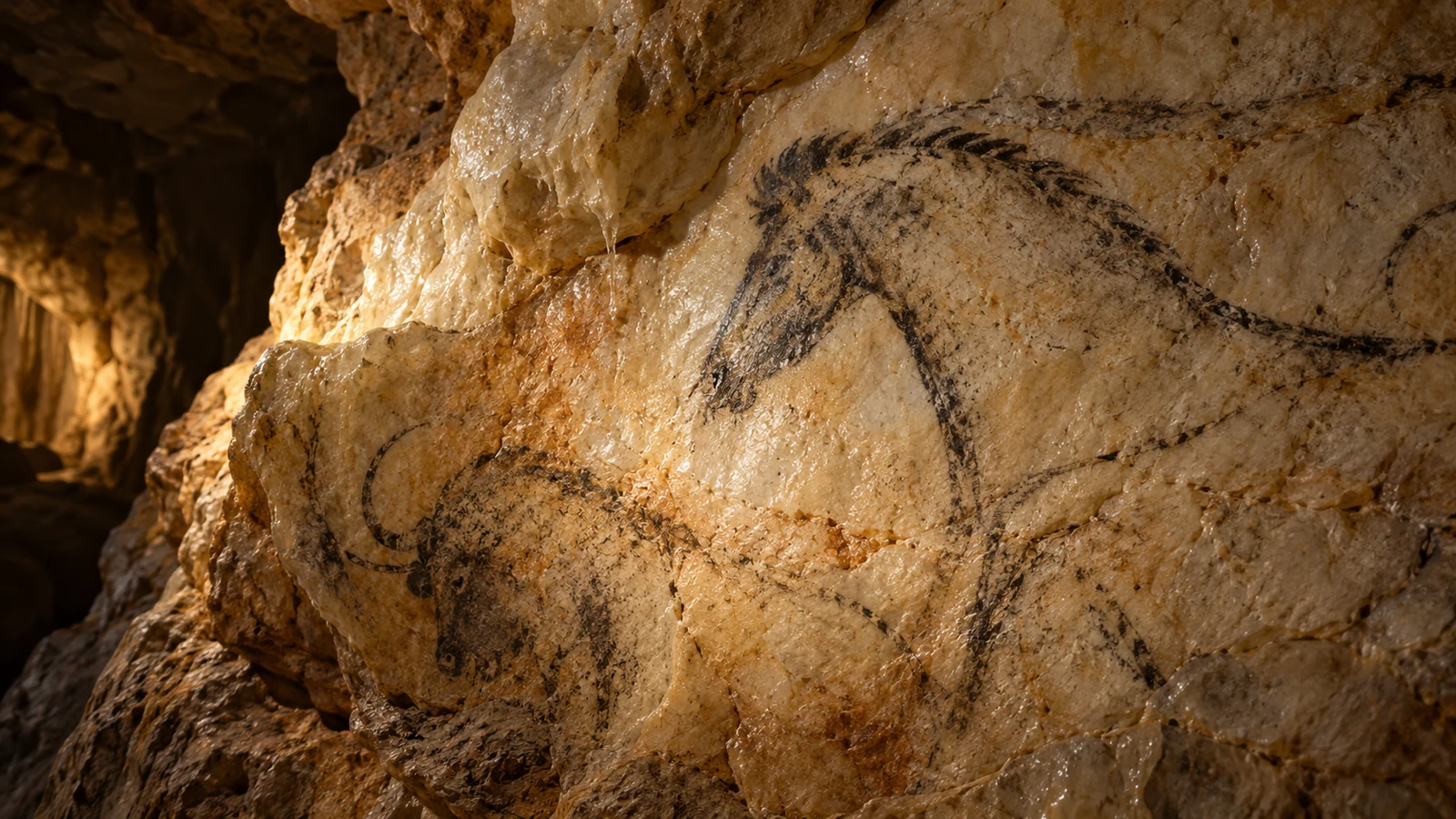
Chauvet Cave’s drawings survived through a combination of isolation, a comparatively stable underground environment and the changing relationship between pigments, rock and water. A 2026 study adds a closer view of one part of that story: thin calcite coatings over some drawings, investigated using ultraviolet fluorescence without taking samples from the paintings.
There is no single protective trick that explains every panel. Mineral deposits can cover or help shelter a surface, while flowing water can also remove pigment. Understanding that difference is more useful than imagining that the entire cave was sealed in a perfectly protective coat of natural varnish.
The research was published online on 29 September 2026 in ACS Omega and publicised by the American Chemical Society on 28 October. It concerns an ancient artwork’s changing surface, not a newly discovered cave or a new date for all its drawings.
Why the 37,000-year figure needs context
Chauvet-Pont d’Arc lies in the Ardèche region of southern France. Its walls preserve sophisticated depictions of animals, alongside other traces of people and animals moving through the cave. The site was rediscovered in 1994 and entered the UNESCO World Heritage List in 2014, according to UNESCO’s site record.
“37,000 years” is a useful approximation for the oldest drawing phase discussed in the current release. It does not mean every charcoal mark, mineral deposit and footprint has the same age. The French Ministry of Culture’s dating account gives a calendar interval of approximately 37,000–35,000 years for early black drawings and a later interval for other black marks.
That distinction matters because a decorated wall is not one event frozen on one date. People made marks; water moved through rock; minerals accumulated; entrances changed. Different methods investigate different parts of that sequence. Measuring a layer above charcoal is not automatically the same operation as dating the charcoal itself.
Isolation helped preserve an entire archaeological setting
UNESCO identifies the cave’s long isolation and stable interior conditions as major reasons for its exceptional preservation. The protected record includes far more than recognisable animals on the walls: the floor and other surfaces also hold archaeological information.
Think of preservation as protecting relationships. A charcoal line, nearby mineral deposit and footprint can each tell a story, but their positions relative to one another may tell more. Moving through the cave carelessly could damage evidence that is less obvious than a large animal drawing.
This is why an attractive photograph and a successful conservation plan have different requirements. A photographer might want to stand directly in front of a panel. Researchers have to consider what lies between the walkway and the wall, how equipment is positioned and whether approaching a surface would disturb other traces.
For the UV investigation, the ACS account describes measurements made from a protective walkway roughly 2.5 metres from the wall because of fragile prehistoric ground and footprints. Distance was part of the research design, not simply an inconvenience.
What is the calcite coating?
Calcite is a form of calcium carbonate. In a limestone cave, water can transport dissolved material and leave mineral deposits behind. Over an artwork, such deposits can become a thin, sometimes translucent layer rather than an obvious thick crust.
The study abstract indexed by PubMed describes the challenge: the limestone support and the calcite coating have similar crystal structures, yet the researchers need to distinguish their contributions to the measured signal. Organic impurities within the carbonate materials help make that distinction possible using fluorescence.
An everyday analogy is a transparent layer on a window. You may still see what is behind it, but the layer changes how the surface interacts with light. That analogy helps explain visibility; it is not a claim that cave calcite behaves chemically like manufactured glass or varnish.
The important point is that the visible drawing and the present-day outer surface need not be the same layer. A technique that can investigate both without removing material gives conservators information a normal photograph cannot provide.
How ultraviolet fluorescence reveals a hidden surface
Fluorescence occurs when a material absorbs light and emits light that can be measured. For this study, researchers used ultraviolet illumination and recorded the resulting emission with a portable spectroscopic arrangement.
The ACS research announcement describes blue fluorescence associated with the calcite coating and localised orange signals that could reflect heating by hot charcoal or other burning material. The orange interpretation is a possible explanation, not direct footage of how an artist used a torch.
The workflow can be understood as four linked tasks:
- Illuminate a selected surface under controlled conditions.
- Measure the light emitted from that area.
- Compare contributions from the support, coating and drawing.
- Interpret the pattern alongside the panel’s archaeological and geological context.
This is not the same as shining a household blacklight at a wall and reading an unambiguous answer. The paper describes modelling the fluorescence signals to obtain information about the translucent layer and its spatial variation. Instrument readings need an interpretation that accounts for the materials present.
Does the coating protect the drawings or hide them?
It can be part of either process, depending on the location and what is happening there. Calling calcite a natural varnish captures the idea of a covering layer, but can become misleading if it implies every deposit is beneficial or every panel is sealed equally well.
The French Ministry of Culture’s preservation explanation describes both pigment loss from water flow and lines partly hidden by calcite. Its examples demonstrate why the condition of one panel cannot be assumed from another.
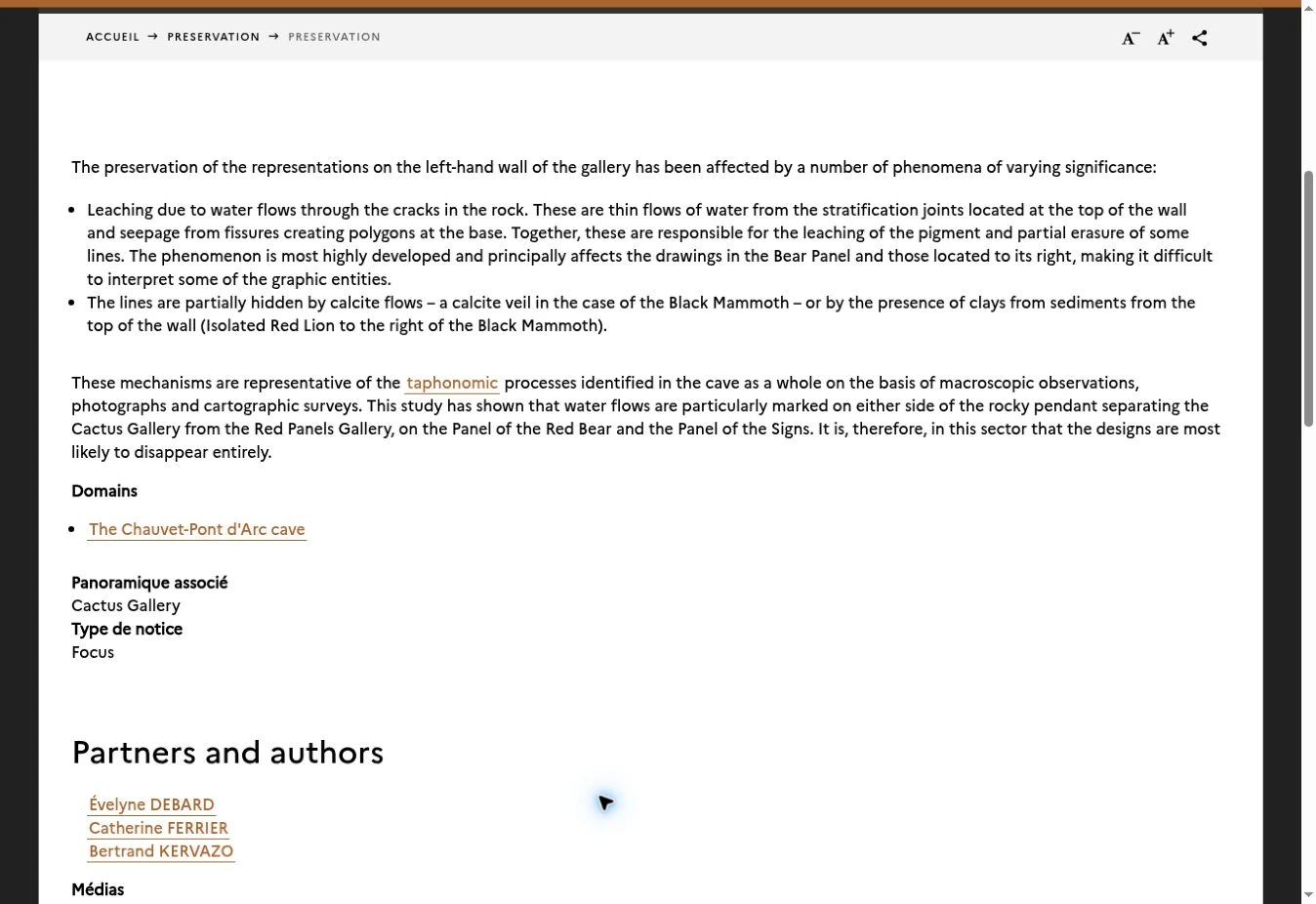
There are three questions to keep separate. Is a mineral layer present? Does it obscure a drawing? What effect has it had on preservation over time? Establishing one of these does not automatically settle the others.
The same distinction appears in other material-history questions. Our guide to why Roman concrete lasts so long examines how material structure matters. A striking survival story still needs a specific mechanism and evidence, rather than treating great age as proof that all examples behave alike.
What the UV study establishes—and what it does not
The strongest claim is methodological: the research demonstrates a way to investigate otherwise difficult-to-distinguish carbonate layers at a valuable and fragile archaeological site. The abstract reports spatial differences in the coatings and signals suggesting local thermal alteration.
Those findings do not establish the artist’s identity, a complete account of the drawings’ purpose or one uniform age for the entire cave. They also do not establish that calcite alone explains tens of thousands of years of survival. The investigation adds evidence to a larger conservation history.
Nor should “noninvasive” be read as permission for unrestricted illumination or visitor access. It describes the approach used by trained researchers under site-specific constraints. Applying a method safely requires decisions about equipment, exposure and access; copying its headline is not a conservation protocol.
Our explanation here is based on the paper’s public abstract, the ACS release and the official French conservation and dating pages. We have not independently analysed the spectra, inspected the cave or reviewed inaccessible supplementary material.
Why the floor matters as much as the famous animals
A cave painting attracts attention because its subject is recognisable. A footprint or a faint charcoal trace may be less spectacular, but it can preserve information about how the space was used. Protecting only the biggest drawings would preserve an incomplete record.
That gives the 2.5-metre measurement distance a wider significance. It shows how the object of research shapes the apparatus: equipment has to reach the question without physically reaching every surface. The constraint encourages remote measurement, but also limits where and how observations can be made.
For a reader assessing future discoveries, this is a useful question to ask: what had to remain untouched for the measurement to be possible? The answer often explains more about a conservation breakthrough than a dramatic claim that a machine revealed a hidden secret.
Can visitors enter the original cave?
The original is not open to general public visits. UNESCO describes restricted access and preventive monitoring as central to its protection. A replica offers a different kind of access, while the French Ministry’s virtual presentation lets readers explore the site and its research online.
A replica, a virtual tour and a photograph of the original should be identified correctly. Each can be valuable, but none should silently stand in for another when explaining evidence. The cover accompanying this article is a conceptual illustration, not a photograph of an actual Chauvet panel. The embedded image is an actual screenshot of the official preservation page.
A better way to read the discovery
The interesting story is not that an ancient painting had one miraculous shield. It is that a layered surface can preserve both artwork and a record of what happened afterwards—and that scientists can investigate some of those layers while protecting the site.
When reading the next cave-art headline, check the date of the study, what was measured, which layer supplied the evidence and whether the interpretation is a direct observation or a proposed explanation. Those checks help keep the artistry and the science equally visible.
Original sources
Reviewed 29 October 2026. The oldest-art age is approximate and refers to a drawing phase, not every mark in the cave.
You may also like
 History & Archaeology
280 Ice Age Engravings Found in a Spanish Cave: What Archaeologists Discovered
Researchers have documented 280 motifs, including 55 animal engravings, in Spain’s Font Major Cave. Explore the 2019 discovery,…
 History & Archaeology
Aloe in Egyptian Mummification: What the New Evidence Shows
A new study links Aloe-derived compounds to Egyptian embalming materials. Explore the samples, plant-name uncertainty, and what the…
 History & Archaeology
Weni’s Tomb at Saqqara: Wooden Figures and the Bronze-Tool Mystery
Weni’s newly announced Saqqara tomb contains rare wooden figures and bronze tools. Explore the evidence, their locations, and…