
Why Ancient Roman Concrete Lasts for Thousands of Years — The Science Behind Its Durability
Discover why some ancient Roman concrete survives for millennia, what hot mixing and self-healing experiments really show, and how it compares with modern concrete.
Contents
- What exactly was Roman concrete?
- The three durability mechanisms researchers investigate
- 1. Pozzolanic reactions create a durable binding matrix
- 2. Hot mixing leaves reactive lime clasts
- 3. Water can sometimes trigger crack-filling minerals
- What did the self-healing experiment actually show?
- What changed with the Pompeii evidence?
- Roman concrete versus modern concrete: a useful comparison
- Why the Pantheon survived—and why that does not prove everything
- How seawater concrete differs from inland concrete
- Five claims worth checking before sharing a viral post
- A practical method for evaluating the next Roman-concrete headline
- Could Roman-inspired concrete reduce construction emissions?
- What remains uncertain?
- The takeaway
- Original research and authoritative sources
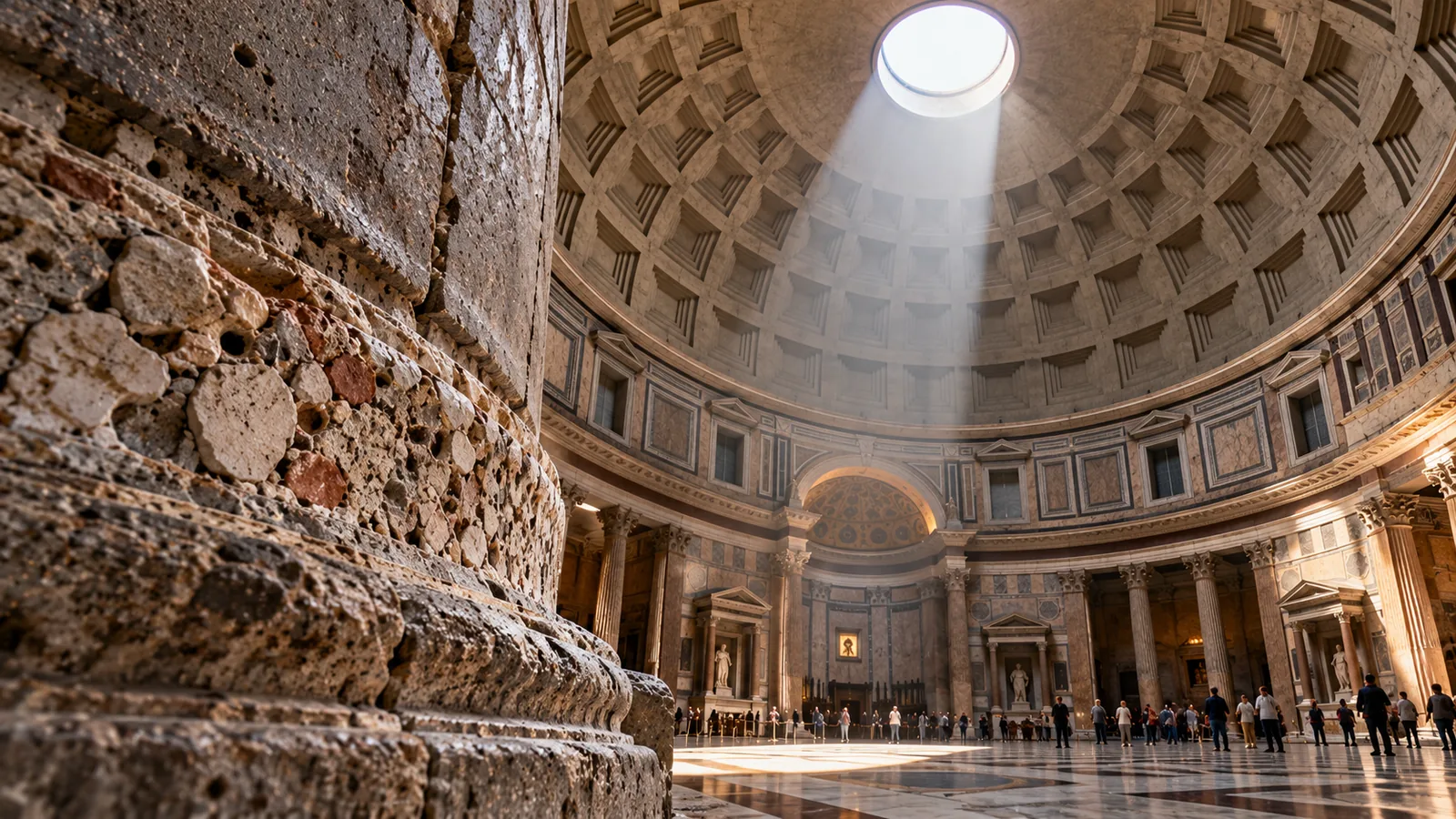
The Pantheon’s enormous unreinforced concrete dome has survived for nearly two millennia. That achievement is real—but the popular claim that ancient Roman concrete was simply “better than modern concrete” misses the chemistry, engineering, and survivorship bias. Recent materials research identifies several mechanisms that can help explain the durability of some Roman structures, while also revealing what the evidence cannot prove.
Key finding: Researchers studying Roman mortar found evidence of hot mixing with quicklime. Their Roman-inspired laboratory samples sealed deliberately introduced cracks through mineral precipitation. Separately, field evidence from Pompeii has strengthened the interpretation of ancient mixing practices. These results are promising, not a universal recipe for immortal concrete.
What exactly was Roman concrete?
Roman concrete, often called opus caementicium, typically combined a lime-based binder, water, aggregates such as stone or broken pottery, and—in many formulations—volcanic ash or other pozzolanic materials. The exact ingredients and methods varied by region, period, intended use, and access to raw materials. It was not one standardized material that every Roman builder produced identically.
The Romans also used different construction systems for walls, foundations, vaults, and maritime structures. A surviving dome, an ancient harbor block, and a buried wall should not be treated as interchangeable samples of one concrete formula.
The three durability mechanisms researchers investigate
1. Pozzolanic reactions create a durable binding matrix
Volcanic ash can react with calcium-bearing lime compounds in the presence of water to form additional cementitious binding phases. That chemistry helps explain why selected Roman mixes performed well in demanding environments. The specific minerals formed depend on the starting materials and conditions; volcanic ash alone does not guarantee durability.
2. Hot mixing leaves reactive lime clasts
In a 2023 Science Advances paper, researchers analyzed lime-rich inclusions in ancient mortar and reported evidence consistent with adding quicklime during a heat-producing mixing process. Instead of dismissing every white lime fragment as sloppy workmanship, they proposed that some fragments could remain a reservoir of calcium that becomes useful when water enters a crack. Read the original research and experimental methods.
3. Water can sometimes trigger crack-filling minerals
The proposed self-healing process is chemical, not magical: water passing through a crack may dissolve calcium-bearing material; dissolved ions can then precipitate as calcium carbonate, partially or completely sealing the opening under suitable conditions. It is a conditional mechanism, not evidence that a damaged Roman wall can recover all its original strength or repair every type of structural failure.
What did the self-healing experiment actually show?
The 2023 team produced modern, Roman-inspired hot-mixed specimens, deliberately split them, and monitored water passing through approximately 0.5 mm cracks. Over a 30-day water-flow test, the lime-clast-containing samples showed crack filling and water flow eventually ceased, unlike the comparison mix without those inclusions. The mineral filling was identified as calcite. That is a laboratory observation of sealing performance; it is not a 2,000-year controlled field trial, nor proof that every ancient Roman concrete formulation self-heals.
The distinction matters: watertightness, compressive strength, crack resistance, and whole-building longevity are different outcomes. A crack can become less permeable without restoring the full load-bearing capacity of the original member.
What changed with the Pompeii evidence?
A December 2025 MIT report described analysis of a newly identified construction context in Pompeii. Materials and the organization of the ancient worksite offered additional evidence for how Roman builders prepared ingredients and used hot-mixing methods. This strengthens the manufacturing story, but it does not mean archaeologists recovered a single universal Roman recipe. See MIT’s report on the Pompeii findings.
Roman concrete versus modern concrete: a useful comparison
| Question | Roman materials | Modern Portland-cement concrete |
|---|---|---|
| Was there one universal recipe? | No; ingredients varied by project and location | No; engineered mixes vary by exposure and design |
| How is strength specified? | Usually inferred from surviving samples and reconstruction | Measured and specified using standardized tests |
| Does it use steel reinforcement? | Historic Roman concrete generally did not use modern steel rebar | Often reinforced or prestressed for tensile demands |
| Can cracks seal? | Some lime-rich formulations show plausible mineral crack filling | Autogenous and engineered self-healing can also occur |
| Can we claim a longer lifespan? | Selected structures have lasted centuries or millennia | Modern lifespan depends on design, maintenance and environment |
Modern concrete is designed for very different tasks, including slender high-rise structures, long-span bridges, and high tensile demands managed by steel reinforcement. Modern materials can achieve compressive strengths that should not be casually compared with ancient masonry. Conversely, corrosion of embedded steel can create failure modes that a massive unreinforced Roman wall did not face.
Why the Pantheon survived—and why that does not prove everything
The Pantheon’s longevity reflects more than a binder formula. Its massive geometry, the distribution of material through the dome, the way loads are carried, construction quality, historical repairs, and centuries of changing exposure all matter. A structure that survives becomes highly visible; the Roman buildings that collapsed, were dismantled, or were heavily rebuilt are less prominent in viral comparisons. This is survivorship bias.
A better scientific question is not “Were Romans better engineers than we are?” but “Which identifiable material processes and structural choices improved performance under which conditions?” That question can be tested and can inform modern construction.
How seawater concrete differs from inland concrete
Roman harbor concretes may undergo long-term mineral changes through interaction with seawater and volcanic material. These processes are not identical to the lime-clast hot-mixing mechanism studied in inland mortar. When reading a headline about “seawater strengthening Roman concrete,” check whether the sample came from a marine installation, a wall, or a laboratory reproduction. A finding about one environment should not automatically be transferred to another.
Five claims worth checking before sharing a viral post
| Viral claim | Evidence-based interpretation |
|---|---|
| “Roman concrete repairs any crack.” | Selected formulations can fill certain cracks under suitable water and chemical conditions. |
| “Every Roman recipe used volcanic ash.” | Formulations and materials differed by region and purpose. |
| “Modern concrete always crumbles after 50 years.” | Service life varies widely with design, exposure, workmanship and maintenance. |
| “The Pantheon proves ancient concrete is stronger.” | Longevity does not directly measure standardized compressive or tensile strength. |
| “Scientists have completely rediscovered the secret.” | Researchers have identified important mechanisms; many details and applications remain under study. |
A practical method for evaluating the next Roman-concrete headline
- Identify the specimen: ancient wall, marine harbor, excavated mortar, or modern laboratory reproduction?
- Find the measured outcome: crack sealing, water flow, mineral composition, compressive strength, or actual long-term service?
- Check the timescale: a 30-day laboratory experiment is not the same as 2,000 years of continuous observation.
- Read the control comparison: did the researchers compare against an otherwise similar mix without the proposed ingredient?
- Look for limits: what crack width, temperature, water exposure, sample size and mix formulation were used?
Applied to the 2023 study, this checklist produces a precise conclusion: a carefully prepared modern mix inspired by Roman practices showed promising water-activated crack sealing in laboratory conditions. That is useful evidence for materials engineering, but not a blanket guarantee for all structures.
Could Roman-inspired concrete reduce construction emissions?
Potentially—but a lower-carbon claim needs a full life-cycle assessment. Extending the useful life of a structure could reduce replacement and repair needs. Yet the climate impact of a new mix also depends on raw-material extraction, fuel for lime production, transport, processing, cement content, and real-world maintenance. Hot mixing by itself is not proof of a lower-carbon product.
Engineers also need to assess workability, consistency, strength development, durability in local exposure conditions, code compliance, and safety. Do not attempt home experiments with quicklime: its reaction with water releases heat and the material is caustic. Structural concrete recipes belong in qualified laboratories and approved engineering practice.
What remains uncertain?
- How broadly the observed lime-clast mechanism applies across the many regions and centuries of Roman construction.
- Whether modern Roman-inspired mixes can consistently meet current building standards at industrial scale.
- How much laboratory crack sealing translates into long-term structural performance in real exposure conditions.
- Which combination of ancient processing and modern additives provides the best durability and environmental trade-off.
The takeaway
Roman concrete’s legacy is not an unbeatable ancient formula. It is a set of durable construction practices whose chemistry can now be investigated with modern instruments. The strongest evidence supports specific mechanisms—especially pozzolanic binding and, in some mixes, lime-clast-assisted crack filling—while reminding us that a building’s survival depends on far more than its binder.
Original research and authoritative sources
You may also like
 Science
Why Can’t We Remember Being Babies? What Memory Research Shows
Why our first years are hard to recall, what infant brain scans reveal, and why forming a memory…
 Science
Can Octopus Arms Think for Themselves? What the Science Shows
How octopus arms process information, what segmented nerve cords reveal, and why local control does not prove nine…
 Science
The Lost Ahramat Nile Branch: How Did Ancient Egyptians Transport Stone to the Pyramids?
The lost Ahramat Branch of the Nile may help explain how ancient Egyptians reached pyramid sites. Explore the…