
Why Your Heating System Turns On and Off Too Frequently — Causes and Fixes
Learn when heating short cycling is normal, how to diagnose frequent furnace or boiler starts safely, and when to call a professional.
Contents
- Quick answer: what does short cycling mean?
- First: identify which heating system you have
- US gas furnace with ducts
- UK combi, system or regular boiler
- Heat pump or hybrid system
- The 20-minute observation: a safe test before changing settings
- Eight common reasons a heating system turns on and off too frequently
- 1. Dirty air filter or blocked airflow in a furnace
- 2. Thermostat position, programming or sensor problems
- 3. Heating equipment is oversized for the building
- 4. Restricted circulation in a wet central-heating system
- 5. Boiler flow temperature and control settings
- 6. Faulty ignition, flame sensing or safety devices
- 7. Multi-zone controls and too many closed valves
- 8. Poor maintenance, worn components or control faults
- Troubleshooting table: symptom, likely cause and safest next step
- What to check yourself: safe steps for US homes
- What to check yourself: safe steps for UK homes
- Can short cycling increase your heating bill?
- Why a boiler may cycle even when nothing is broken
- When the thermostat is the problem—and when it is not
- The difference between furnace, boiler and heat-pump cycling
- When to stop troubleshooting immediately
- What to tell the technician: a short service log
- How to reduce avoidable cycling over the long term
- A note on temperature settings and hot-water safety
- The bottom line
- Authoritative sources and further reading
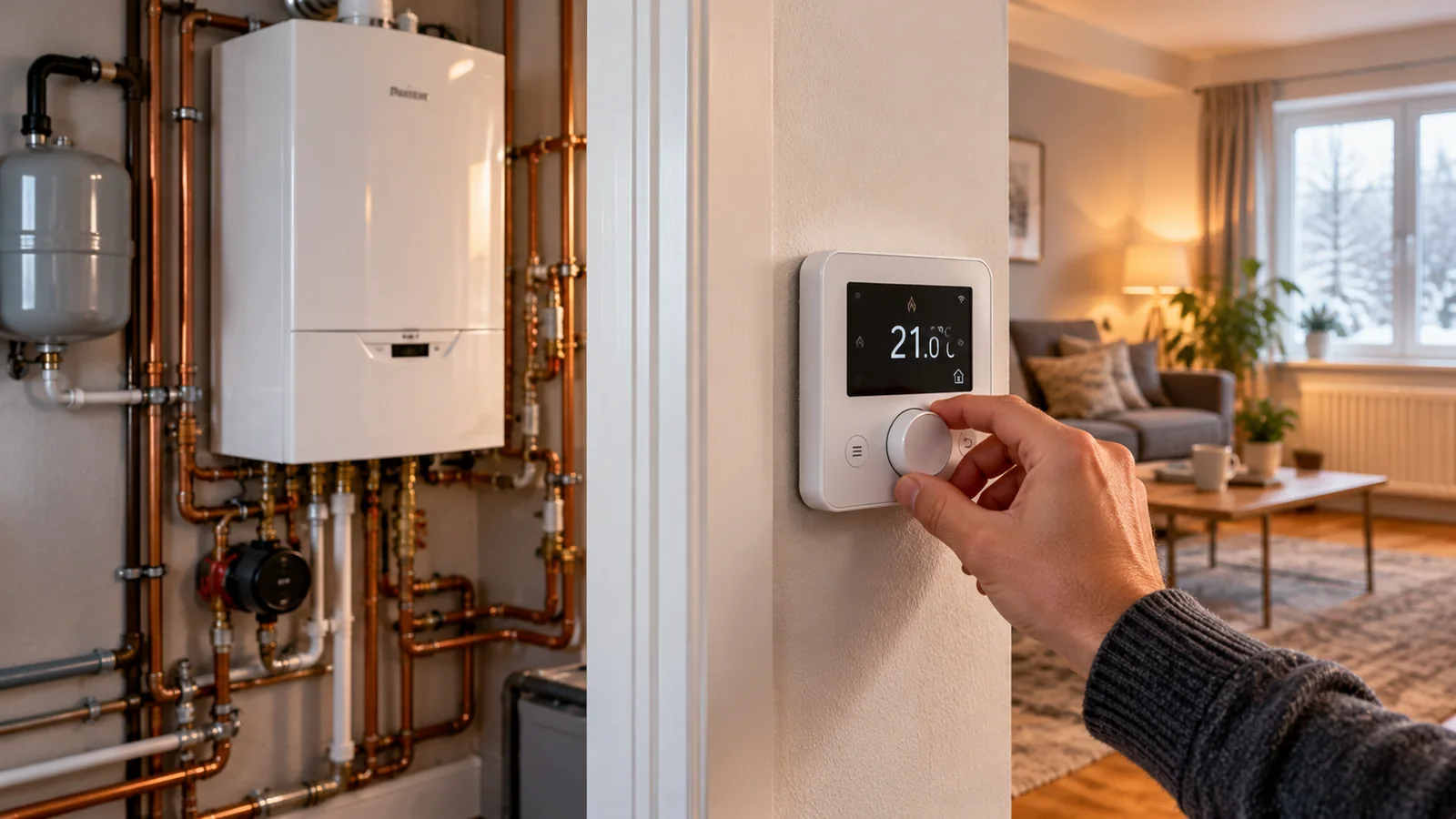
Your heating starts, stops after a short spell, and starts again before the house feels comfortable. Is that normal thermostat control—or a problem called short cycling? The answer depends on whether you have a US forced-air furnace, a UK gas boiler, a heat pump, or a multi-zone system. Start by observing what actually switches off: the burner, compressor, circulation pump, or indoor fan. They do not always run together.
A heating system should switch off when the required temperature is reached, and some equipment deliberately modulates its output. However, repeated brief starts followed by premature shutdown, poor comfort, unusual noise or fault codes deserve attention. There is no single universal number of minutes that defines short cycling for every heating model. This guide gives a safe, repeatable way to narrow down the cause without opening sealed combustion or electrical equipment.
Quick answer: what does short cycling mean?
Short cycling describes repeated starts and stops that are unusually frequent or brief for the system and conditions. A furnace burner that cuts out before the thermostat is satisfied is different from a boiler intentionally switching its burner while its circulation pump continues. An inverter heat pump can modulate rather than fully shut off. The combination of timing, room temperature, equipment type and fault signs matters more than a single stopwatch reading.
| What you observe | Possible interpretation | First safe check |
|---|---|---|
| Heating stops after target temperature is reached | Normal thermostat control may be working | Compare actual room temperature and setpoint |
| Burner shuts off but blower continues | Normal fan run-on may remove residual heat | Observe whether thermostat still calls for heat |
| Burner repeatedly starts for brief periods while room stays cold | Possible limit, airflow, sensor or control issue | Check accessible filter, vents and fault display |
| Boiler burner cycles but radiators remain warm | May reflect burner modulation or heating-water temperature control | Check room comfort and manufacturer instructions |
| Heat pump repeatedly starts and stops in mild weather | May involve minimum capacity, zoning or controls | Log pattern and ask installer if persistent |
| Clicking, lockouts, gas smell, smoke or CO alarm | Potential safety issue | Stop troubleshooting and seek urgent help |
First: identify which heating system you have
US gas furnace with ducts
A gas furnace heats air and distributes it through ducts. The thermostat requests heat, the burners fire, and the blower distributes warm air. The blower can continue after burners shut down; this does not necessarily mean the furnace is short cycling. Restricted airflow can contribute to overheating and a protective limit shutting the burner off, but diagnosing that limit requires a technician.
UK combi, system or regular boiler
A boiler heats water for radiators or underfloor heating. The burner, circulating pump, room thermostat and hot-water demand may operate on different schedules. In a combi boiler, opening a hot tap can change what the boiler is doing. In a system or regular boiler, a separate cylinder and its thermostat add another control. Observe whether the burner flame symbol changes or the entire boiler locks out.
Heat pump or hybrid system
Heat pumps use a compressor rather than a combustion burner. Variable-speed models can run for long periods at reduced output. Rapid cycling can involve thermostat settings, airflow, oversized capacity, minimum compressor output or zone controls. Hybrid systems may switch between a heat pump and a furnace/boiler, so a change in sound is not automatically a fault. For the distinct issue of prolonged operation, see our guide to heat pumps running constantly in winter.
The 20-minute observation: a safe test before changing settings
This is a home observation protocol, not a certified diagnostic test. The goal is to capture useful facts for a service professional without defeating safety controls. Only observe if the heating system is otherwise safe and there is no smell of gas, smoke, electrical burning or active carbon monoxide alarm.
- Write down the thermostat setpoint and measured room temperature. Place a separate thermometer away from windows and radiators if available.
- Record the outdoor temperature, approximate time, heating mode and whether a hot-water tap or another zone is demanding heat.
- Watch for up to 20 minutes without opening the appliance cover. Record each burner/compressor start and stop, and note whether the fan or pump continues.
- Check whether the room reaches the thermostat target. Record any error code exactly as shown; do not repeatedly reset a lockout.
- If the system is a forced-air furnace, check the user-accessible filter and that supply and return grilles are not blocked. Follow the filter manufacturer’s instructions.
- Compare the pattern with the equipment manual. If cycles remain unusually brief, comfort is poor or codes recur, arrange a qualified inspection.
Example log (illustrative, not measured): At 18:00, setpoint 21°C, room 18.5°C, outdoor 5°C. Burner starts at 18:01, stops at 18:03, restarts at 18:06 and stops at 18:08. Blower continues between burner events. Room remains at 18.5°C. This is more concerning than the same equipment reaching 21°C and resting until the room cools.
Eight common reasons a heating system turns on and off too frequently
1. Dirty air filter or blocked airflow in a furnace
A clogged filter makes a forced-air system work harder to move air. Restricted airflow can cause temperature limits to intervene or reduce comfort. ENERGY STAR recommends checking air filters regularly and maintaining clear indoor and outdoor equipment. Check the correct filter size and airflow direction; do not run a system without a filter as a workaround.
2. Thermostat position, programming or sensor problems
A thermostat near a radiator, sunny window, draft, lamp or warm appliance may sense a temperature that does not represent the room. Frequent schedule changes, overlapping smart-home automations or a thermostat configured for the wrong equipment type can also cause unexpected switching. Start with the displayed target and actual temperatures, schedules and location. Energy Saving Trust explains why thermostats need free airflow and should be kept away from heat sources. Do not alter installer-only wiring settings yourself.
3. Heating equipment is oversized for the building
An oversized fixed-output furnace or boiler may deliver heat faster than the system can distribute or the building needs, especially in mild weather. This can create repeated short firing periods. Oversized heat pumps may also cycle when their minimum output exceeds demand. ENERGY STAR notes that oversized equipment can short-cycle and experience additional wear. Sizing must be assessed against the actual building heat loss and equipment specifications—not guessed from floor area alone.
4. Restricted circulation in a wet central-heating system
In radiator and underfloor systems, closed valves, trapped air, sludge, a blocked strainer or pump problems can reduce heat transfer. The boiler may reach its internal water-temperature limit quickly and stop firing while rooms remain cold. Uneven radiator temperatures and gurgling may provide clues, but they do not prove a particular fault. Homeowners should not open pressurised or sealed parts; have a qualified heating engineer check circulation and balancing.
5. Boiler flow temperature and control settings
The boiler flow temperature is the temperature of water sent to radiators, not the room thermostat setting. If the boiler heats a small water volume to its target quickly, the burner may pause even while the room still needs heat. Reducing flow temperature can improve condensing-boiler efficiency in appropriate systems, but it must be done carefully. Energy Saving Trust warns that conventional/system boilers with separate hot-water cylinders must retain suitable cylinder-heating temperatures to control Legionella risk. Do not apply combi-boiler advice blindly to a cylinder system.
6. Faulty ignition, flame sensing or safety devices
A furnace or boiler that attempts ignition and shuts down, displays a fault, or enters lockout may have a combustion, flame-detection, pressure-switch or other safety problem. These require trained diagnosis. Never bypass a flame sensor, limit switch, pressure switch or flue safety device, and never keep resetting a lockout to force heating.
7. Multi-zone controls and too many closed valves
Smart radiator valves, zone thermostats and underfloor loops can close when individual rooms reach target. On some systems this leaves too little active load or flow for the boiler or heat pump. The resulting behaviour can look like short cycling. A heating engineer may need to assess minimum flow, bypass arrangements, buffer volume or zoning strategy. Do not permanently open or bypass valves without knowing the system design.
8. Poor maintenance, worn components or control faults
Faulty temperature sensors, damaged wiring, blocked condensate paths, failing motors or poor commissioning can all affect cycling. The correct repair depends on the fault code and model. A seasonal service is especially useful if cycling has changed recently. ENERGY STAR’s maintenance guide includes thermostat checks, electrical checks and inspection by a contractor.
Troubleshooting table: symptom, likely cause and safest next step
| Symptom | Possible causes | Safe next step |
|---|---|---|
| Furnace burner stops but blower stays on | Normal fan delay or protective high-temperature limit | Check filter and vents; seek service if repeated before room warms |
| Furnace clicks or locks out repeatedly | Ignition, flame sensing or safety control fault | Stop repeated resets; call licensed HVAC technician |
| Boiler fires briefly; radiators uneven | Restricted circulation, valves or balancing | Check room settings; request heating engineer |
| Boiler fires often when hot water is used | Normal domestic-hot-water demand or a control issue | Note whether behaviour only occurs at taps |
| Rooms reach target, then system rests | Expected thermostat response | No repair needed if comfort and operation are normal |
| Heat pump starts and stops rapidly in mild weather | Minimum output, oversizing or zoning | Record pattern; ask installer to review |
| Thermostat seems satisfied too quickly | Heat source, sun, drafts or poor sensor placement | Check placement and schedules |
| Gas smell, CO alarm or smoke | Possible emergency | Leave area and contact emergency/gas service |
What to check yourself: safe steps for US homes
- Confirm the thermostat is in the correct HEAT mode and compare room temperature to the setpoint.
- Review programmed setbacks and smart-home automations; avoid changing several settings at once.
- For a forced-air furnace, replace or clean the user-serviceable filter according to the manual.
- Ensure furniture, rugs and stored boxes are not blocking accessible supply or return vents.
- Look for a visible fault code or blinking status light without opening a sealed panel.
- Record whether only the burner stops or the whole system shuts down.
- If repeated short firing persists or comfort is poor, book a licensed HVAC professional.
If you have a heat pump, do not assume advice for a gas furnace applies to its compressor, refrigerant system or defrost controls. The ENERGY STAR maintenance guidance recommends professional pre-season service and unobstructed equipment.
What to check yourself: safe steps for UK homes
- Check the programmer, room thermostat and thermostatic radiator valve settings.
- Determine whether the boiler is heating radiators, a hot-water cylinder or a hot tap when the burner fires.
- Note any manufacturer fault code, room comfort and whether radiators heat evenly.
- If the boiler has a user-visible pressure display, compare it with the manufacturer’s normal range; do not add water unless you understand the documented procedure.
- Avoid changing gas, combustion, installer or hot-water hygiene settings.
- If frequent short firing persists or a fault repeats, use a Gas Safe registered engineer for gas boilers.
The Energy Saving Trust heating-controls guide explains how programmers, room thermostats, radiator valves and boiler controls interact. A UK gas boiler must be serviced or repaired by an appropriately registered professional. In the UK, check an engineer’s registration at Gas Safe Register.
Can short cycling increase your heating bill?
It can, but the amount varies. Repeated starts can add losses and mechanical wear in some systems, while a correctly modulating boiler may intentionally switch its burner as part of normal control. The stronger evidence of trouble is frequent starts combined with poor comfort, high energy consumption, error codes or abnormal equipment behaviour. Avoid promises of a fixed percentage saving from one thermostat adjustment.
For a simple comparison, imagine a heater with a 12 kW input rating that fires for 3 minutes, six times in an hour. Its burner-on time is 18 minutes, or 0.3 hours. At a constant 12 kW input during firing, that corresponds to 12 × 0.3 = 3.6 kWh of input energy over the hour. This illustrative arithmetic is not a bill estimate: real boilers modulate, startup conditions vary, and actual fuel use must be measured.
Two homes with the same number of burner starts can use very different amounts of energy because equipment capacity, weather, insulation, room temperatures and system efficiency differ. Compare bills or meter data during similar outdoor temperatures rather than treating cycle count as a direct energy meter.
Why a boiler may cycle even when nothing is broken
Some boilers have anti-cycling delays, pump overrun and burner modulation. The circulation pump may keep moving warm water after the flame symbol disappears. A combi boiler may briefly respond to hot-water demand or a comfort/preheat setting. When the home remains comfortable, there are no errors and the behaviour matches the manual, frequent changes on the display are not necessarily evidence of a dangerous fault.
Conversely, if the burner stops after a very short time while rooms remain cold, repeated ignition attempts or safety lockouts should not be dismissed as normal modulation. A qualified engineer can use model-specific diagnostics to distinguish these scenarios.
When the thermostat is the problem—and when it is not
A thermostat measures local air temperature. A sensor beside a sunny window may tell the boiler to stop early; a sensor in a cold draft may keep demanding heat. A smart thermostat can also run schedules, geofencing and learning features. First look at the actual temperature displayed, its setpoint, and the timing of changes. If the thermostat says heating is still required but the burner stops repeatedly, the issue may lie in the appliance or its protection logic rather than the thermostat itself.
Never short thermostat wires, bridge terminals or bypass safety controls to “prove” the thermostat is faulty. A professional can check wiring, control compatibility, anticipator or cycle-rate settings where applicable.
The difference between furnace, boiler and heat-pump cycling
| System | What switches on and off | Common benign explanation | Concern worth investigating |
|---|---|---|---|
| US gas furnace | Burner and blower, often at different times | Blower runs after burner stops | Burner stops before room warms; repeated lockout |
| UK gas boiler | Burner, pump and hot-water controls | Modulation, anti-cycle delay or hot-water call | Rapid firing with cold rooms or fault code |
| Air-source heat pump | Compressor and indoor/outdoor fans | Variable-speed modulation or defrost | Frequent hard starts, poor comfort, lockouts |
| Hybrid system | Heat pump and backup furnace/boiler | Designed changeover between heat sources | Unexpected repeated switching and high bills |
When to stop troubleshooting immediately
- Smell of gas: leave the area, avoid flames and electrical switches, and call the local gas emergency service from a safe place.
- Carbon monoxide alarm: evacuate and contact emergency services; do not re-enter until professionals clear the building.
- Smoke, sparking or burning electrical smell: stop use where safe and call for urgent assistance.
- Repeated lockout or flame failure: do not defeat protective devices or keep resetting the appliance.
- Loss of heat in dangerous cold: prioritise vulnerable occupants and arrange urgent professional help.
Carbon monoxide is odourless. Symptoms can include headache, dizziness, weakness, nausea and confusion. The US CDC explains the risks. Maintain functioning CO alarms in accordance with local requirements and manufacturer guidance; an alarm is not a substitute for proper installation and service.
What to tell the technician: a short service log
| Observation | Illustrative entry | Why it helps |
|---|---|---|
| Equipment | Gas furnace / 8-year-old model | Identifies applicable controls |
| Setpoint and actual temperature | 21°C requested; 18°C actual | Shows unsatisfied heating demand |
| Start-stop pattern | Three burner starts in 15 minutes | Describes symptom without guessing cause |
| Blower or pump | Blower stays on after flame stops | Distinguishes component operation |
| Filter and vents | Filter replaced; returns unobstructed | Documents safe checks |
| Fault display | Error code photographed | Supports model-specific diagnosis |
| Outdoor conditions | 6°C, windy | Adds heat-load context |
Ask for a written explanation of the cause, the safety checks performed, and whether any part replacement is actually required. For suspected oversizing, ask how the contractor assessed building heat loss and equipment output rather than accepting a guess.
How to reduce avoidable cycling over the long term
- Service the system on the schedule recommended by the manufacturer and local safety rules.
- Replace or clean accessible air filters as specified; keep vents clear.
- Use appropriate thermostat placement and sensible, consistent schedules.
- Ask a professional to review zoning, water flow and heat output if many rooms or radiator valves close.
- Check insulation and draughts; lower heat loss can improve comfort, though equipment control may need reassessment.
- When replacing equipment, request a documented load calculation and correct sizing, not simply a bigger unit.
A note on temperature settings and hot-water safety
Room thermostat settings, boiler radiator-flow temperatures and stored domestic hot-water temperatures are different controls. Energy Saving Trust suggests many households find 18–21°C a reasonable comfortable room temperature range, but individual needs differ. Lowering a boiler’s radiator-flow temperature may help efficiency in suitable systems; however, its 2026 guidance specifically warns against unsafe settings for conventional boilers that heat separate hot-water cylinders. Never reduce stored-hot-water hygiene settings simply to stop cycling.
The bottom line
If your heating turns on and off frequently, do not immediately assume a faulty thermostat or an expensive broken boiler. First identify which component is switching, whether the room reaches its target, and whether any error or safety warning appears. Check only safe user-accessible items, record the pattern and use a qualified professional for persistent short cycling, lockouts, combustion faults, refrigerant problems or unsafe operation. The right fix depends on the system and the evidence—not a universal minutes-per-cycle rule.
Authoritative sources and further reading
- ENERGY STAR — Clean heating and cooling, sizing and maintenance
- ENERGY STAR — Heating and cooling maintenance guide
- Energy Saving Trust — Economical heating controls (2026)
- Energy Saving Trust — Thermostats and heating controls
- Energy Saving Trust — Boiler flow temperature (2026)
- Gas Safe Register — Find a registered engineer
- CDC — Carbon monoxide poisoning
You may also like
 Home & Living
Why Do Ceiling Fans Collect Dust Even When They Are Spinning?
A physics-backed explanation of dust buildup on spinning ceiling fan blades, plus safe cleaning methods and practical ways…
 Home & Living
How to Make a Bubbling Halloween Cauldron Safely: Fog Effects and Simple Alternatives
Create an impressive Halloween cauldron with dry ice outdoors, a water mister, or no-fog LED effects. Compare options,…
 Home & Living
How to Tell If Your Home Has Hidden Water Leaks Before They Cause Damage
Learn how to spot hidden water leaks with a two-hour meter test, toilet dye test, room-by-room inspection, leak…