
Why Your Energy Bill Is Higher Even When You Use Less Electricity
Using less electricity but paying more? Learn how unit rates, standing charges, estimated readings, direct debits and time-of-use tariffs affect your bill.
Contents
- The simple equation behind almost every energy bill
- 1. Your price per kWh increased
- 2. Fixed daily charges can outweigh modest energy savings
- 3. The October 2026 UK price cap has changed — but it is not a cap on your bill
- 4. You were billed for more days
- 5. Your meter readings were estimated or corrected
- 6. Your monthly direct debit changed, not necessarily your usage
- 7. Peak-hour electricity costs more on certain plans
- 8. Delivery charges, taxes, credits and previous balances changed
- How to audit a higher bill in 15 minutes
- A quick calculation you can copy
- How to tell whether an appliance is secretly using electricity
- What to do if the supplier’s bill is wrong
- Ways to reduce the bill without sacrificing essential heating or cooling
- The bottom line
- Official sources and further reading
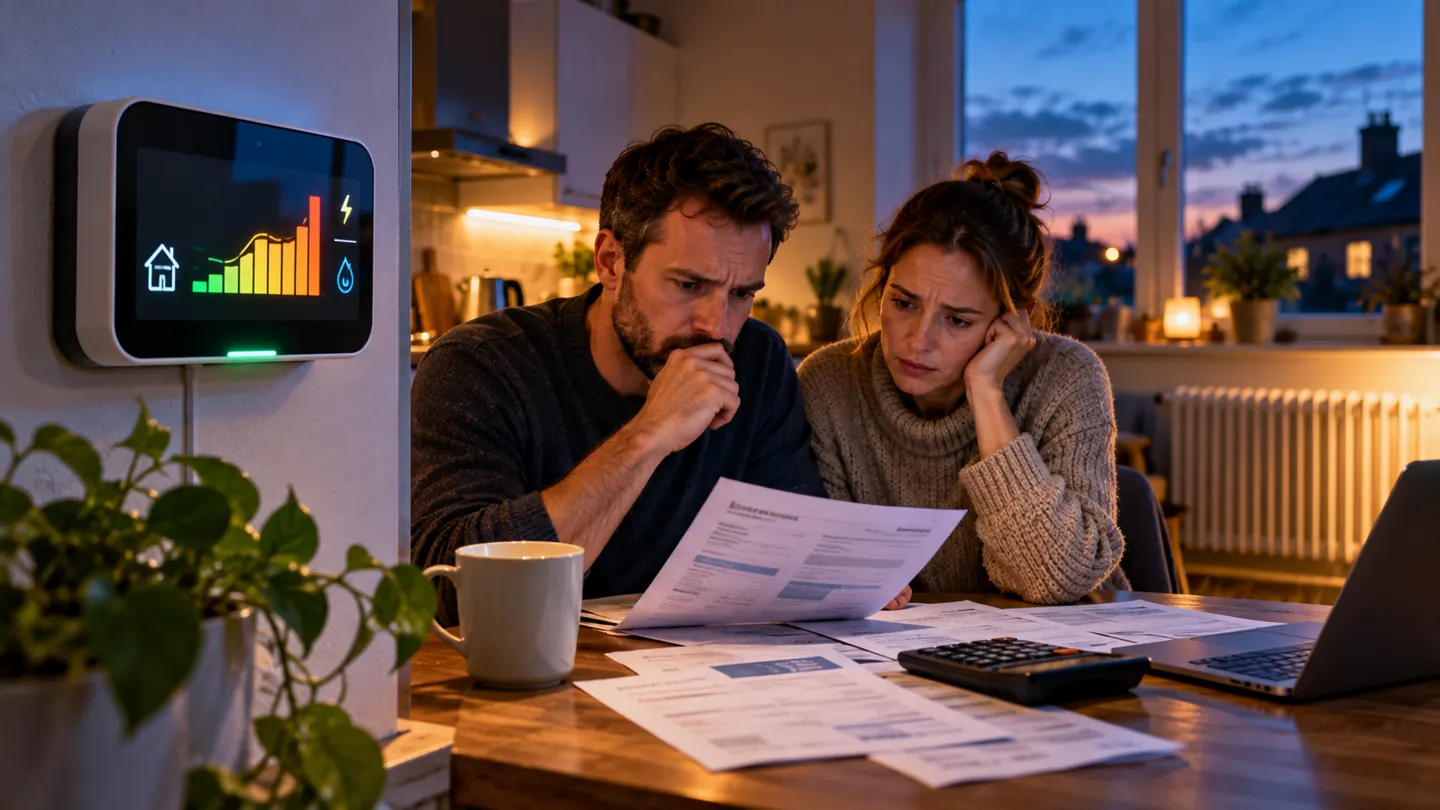
Updated October 17, 2026. You used fewer kilowatt-hours this month, yet your electricity bill increased. That is entirely possible without a faulty meter. The amount you pay depends on more than consumption: unit prices, fixed daily charges, billing periods, time-of-use tariffs, taxes, previous balances and estimated readings can all change the final figure.
This practical guide explains how to identify the real cause, calculate the difference using your own numbers and challenge a bill when the supplier has made a mistake. It covers Great Britain and the United States; tariff structures and consumer protections differ, so always check your own provider.
The simple equation behind almost every energy bill
For a straightforward single-rate tariff, the starting point is energy used (kWh) × price per kWh + daily fixed charge × number of days. Then add any applicable taxes, fees and previous balance, and subtract credits and payments. A direct debit amount is not necessarily the same as the energy cost for that particular month.
| Component | Earlier 30-day bill | Later 30-day bill |
|---|---|---|
| Electricity consumed | 300 kWh | 260 kWh |
| Unit price | £0.22/kWh | £0.29/kWh |
| Energy charge | £66.00 | £75.40 |
| Daily standing charge | £0.50 | £0.55 |
| Fixed charge for 30 days | £15.00 | £16.50 |
| Total before other adjustments | £81.00 | £91.90 |
In this example, consumption falls by 13.3% but the charge rises by £10.90 (about 13.5%). The price increase outweighs the savings. These figures are deliberately illustrative, not the October 2026 Ofgem tariff.
1. Your price per kWh increased
A kilowatt-hour (kWh) measures energy, not time. If the price of each kWh rises, the same appliance costs more to run. Your rate can change after a fixed-rate contract ends, a variable tariff is revised, a promotional discount expires or a utility adjusts regulated charges. In the US, some plans include variable supply charges, seasonal rates or separately priced delivery service.
Compare the actual unit rate printed on both bills, not just the total amount due. For a bill spanning a rate-change date, look for two separate usage periods. If the bill combines them, request a breakdown.
2. Fixed daily charges can outweigh modest energy savings
In Great Britain, a standing charge is generally payable for each day the account is active, even when no electricity is used. It helps fund network and supplier costs. In the US, similar charges may appear as a customer charge, basic service fee, meter charge or minimum bill; structures vary by utility.
For example, a 31-day month with a 55p daily standing charge costs £17.05 before a single kWh is consumed. A 28-day month at the same rate costs £15.40. The longer billing period alone creates a £1.65 difference.
3. The October 2026 UK price cap has changed — but it is not a cap on your bill
For 1 October–31 December 2026, Ofgem sets the typical annual dual-fuel direct-debit price-cap figure at £1,723, compared with £1,663 in the previous quarter. That represents the cost of typical assumed usage over a year at capped rates, not the maximum any household can be charged. Actual unit prices and standing charges depend on region, meter and payment method. The cap protects qualifying standard variable tariffs, not all fixed deals.
| Charge | July–September 2026 | October–December 2026 |
|---|---|---|
| Electricity unit rate | 26.11p/kWh | 26.32p/kWh |
| Electricity standing charge | 57.19p/day | 54.83p/day |
| Gas unit rate | 7.33p/kWh | 7.97p/kWh |
| Gas standing charge | 29.04p/day | 29.68p/day |
| Typical annual dual-fuel price-cap figure | £1,663 | £1,723 |
These are national averages from Ofgem’s official rate tables. They are not universal regional prices. Ofgem notes that electricity VAT is removed from 1 October 2026 to 31 March 2027, while gas remains subject to 5% VAT during that period. Comparisons with earlier periods therefore require care.
Notice that the electricity standing-charge average falls in October even though the overall dual-fuel price-cap figure rises. Do not assume every line of your electricity bill increased simply because the headline cap did.
4. You were billed for more days
A bill covering 35 days will often be higher than one covering 28 days, even if your average daily usage fell. To compare fairly, divide kWh and variable charges by the number of days in each billing period. Then check whether both bills cover the same fuel, meter and tariff.
5. Your meter readings were estimated or corrected
An estimated reading can understate one month and produce a catch-up bill when an actual reading arrives. A smart meter may also temporarily stop sending readings even though it continues measuring usage. A large catch-up amount does not automatically mean you suddenly consumed that much electricity.
- Find the previous and current readings on the bill, noting whether each is marked actual, smart, customer-submitted or estimated.
- Check the serial number on the bill against the meter at the property.
- Record a fresh reading and take a dated photograph if the display is accessible and safe.
- Ask the supplier to explain any corrected estimate and how usage was allocated across different unit rates.
- If the meter seems faulty, request the supplier’s official meter-testing or dispute process.
6. Your monthly direct debit changed, not necessarily your usage
UK suppliers often spread predicted annual costs across 12 payments. Your monthly direct debit can rise because your account is in debt, your projected winter consumption increased or the supplier changed its annual forecast. Compare actual energy charges with the amount collected. A payment adjustment is not proof of a usage increase.
Ask for the supplier’s forecast, account balance, credit history and proposed payment calculation. A credit balance is not automatically an overcharge; part of it may be intended to cover higher winter consumption.
7. Peak-hour electricity costs more on certain plans
Time-of-use, Economy 7 and some smart tariffs charge different prices depending on when electricity is consumed. You may use fewer total kWh but shift more usage into expensive peak periods. The US Energy Information Administration explains that electricity supply costs often rise during peak-demand hours, and some utilities pass that signal to customers through time-based rates.
| Period | Off-peak kWh at 15p | Peak kWh at 35p | Energy charge |
|---|---|---|---|
| Previous month | 180 | 120 | £69.00 |
| Current month | 80 | 180 | £75.00 |
The household drops from 300 to 260 kWh, yet variable charges rise by £6. Review the peak/off-peak meter registers or usage graph, and verify that the supplier has assigned the correct tariff windows.
8. Delivery charges, taxes, credits and previous balances changed
US electricity bills may separate generation or supply from transmission and distribution. There can also be fuel-adjustment clauses, public-benefit charges, municipal taxes and minimum charges. In either country, a one-off discount or government support credit disappearing can make a bill look higher even when energy consumption falls.
A previous unpaid balance, late fee or reversal of an earlier estimated credit can also inflate the amount due. Look for a line labelled balance brought forward, adjustment, credit or payment received. Do not mistake the account balance for this month’s consumption cost.
How to audit a higher bill in 15 minutes
- Put the last two or three bills side by side. Record billing start/end dates and total days.
- Write down electricity kWh, gas kWh if relevant, unit rates and fixed daily charges for each period.
- Check whether meter readings are actual or estimated and whether tariff changes occurred mid-bill.
- Calculate the energy component as kWh multiplied by the applicable rate, separating peak and off-peak usage if needed.
- Calculate the fixed component as the daily charge multiplied by billed days.
- Add taxes and fees; subtract credits; then reconcile payments and previous balances separately.
- Compare daily usage (kWh ÷ days), not just total monthly kWh.
- If the numbers do not reconcile, contact the supplier with the bill dates, readings and your calculation.
A quick calculation you can copy
Electricity charge = (peak kWh × peak unit rate) + (off-peak kWh × off-peak unit rate) Fixed charge = daily standing/customer charge × billed days Current-period cost = electricity charge + fixed charge + applicable taxes/fees − current-period credits Amount due = current-period cost + previous balance − payments already receivedKeep the currency and units consistent: convert pence to pounds before adding (£0.2632, not £26.32, for 26.32p). Some bills contain additional tiered charges or demand charges, so the simplified formula may need extra lines.
How to tell whether an appliance is secretly using electricity
If your kWh per day actually rose, inspect heating, air conditioning, electric water heaters, dehumidifiers, tumble dryers, old freezers, portable heaters and EV charging. A 1.5 kW heater running four extra hours uses 6 kWh; at 30p/kWh that is £1.80 for that day before fixed charges. A plug-in energy monitor can help with suitable plug-connected devices, but do not use one beyond its electrical rating.
If a smart meter shows unexpected consumption, switch off nonessential appliances one at a time and observe the trend. Never tamper with the meter, service cables or electrical panel. Ask an electrician or your utility for help with persistent unexplained load.
What to do if the supplier’s bill is wrong
- Contact customer support in writing, identify the disputed line and attach readings or photos.
- Request an itemised recalculation showing all rates, dates, adjustments and tax treatment.
- Keep paying any undisputed portion if your supplier advises this is possible, and ask about payment support if needed.
- Follow the formal complaints process if the supplier cannot resolve the issue.
- In Great Britain, check the Energy Ombudsman escalation rules; in the US, contact your state public utility commission or local consumer regulator when appropriate.
If you are in England, Scotland or Wales, Ofgem’s consumer advice explains tariffs, bills and complaint routes. In the United States, find your state’s utility regulator through the National Association of Regulatory Utility Commissioners directory. Northern Ireland has a separate electricity market and regulator, so the Great Britain Ofgem price cap should not be applied to its bills.
Ways to reduce the bill without sacrificing essential heating or cooling
- Compare available tariffs based on your actual annual kWh and your household’s peak-hour pattern, not a headline monthly estimate.
- Check whether a cheaper off-peak plan is genuinely suitable before shifting appliance schedules.
- Lower unnecessary standby loads and replace inefficient lighting with LEDs.
- Fix heating and cooling schedules; improve draught-proofing and insulation where safe and affordable.
- Check that the hot-water cylinder, immersion heater or electric space heater is not running longer than intended.
- Submit accurate readings when your supplier requests them and keep evidence of tariff changes.
Do not turn off medically necessary equipment or maintain unsafe indoor temperatures just to reduce consumption. Households struggling to pay should ask their supplier about hardship arrangements, energy-efficiency support or available assistance schemes.
The bottom line
A lower kWh figure means you used less electricity. It does not guarantee a lower bill unless the rates, fixed charges, billing days, adjustments and payments are comparable.
Start with the line items, not the total due. The most useful comparison is daily kWh + unit rate + fixed charges. Once you separate these, most apparent bill mysteries become a straightforward calculation.
Official sources and further reading
- Ofgem: energy price cap unit rates and standing charges, October–December 2026.
- Ofgem: how the price cap and standing charges work.
- US Energy Information Administration: electricity prices and factors affecting prices.
- House of Commons Library: energy standing charges.
- NARUC: state utility regulator directory.
You may also like
 Technology & How-To
NHS App Prescription Not Showing? Check GP Approval, Pharmacy Status and Tracking
Find out why a prescription or medicine is missing from the NHS App in England. Separate repeat requests,…
 Technology & How-To
Google Wallet Not Working After Switching Phones? Fix Card Setup and Tap to Pay
Google Wallet transferred but tap to pay fails? Separate card verification, bank approval, NFC, screen lock and device…
 Technology & How-To
iCloud Family Sharing Not Working? Why You Still See 5GB and How to Fix It
Still seeing 5GB after joining an iCloud family plan? Check the account, invitation, sharing settings, personal plan and…