
Why AI Data Centers Use So Much Electricity and Water
Explore why AI data centers need so much power and water, with IEA and Berkeley Lab figures, cooling explanations, practical solutions and common myths corrected.
Contents
- Introduction: The hidden infrastructure behind an AI answer
- What exactly is an AI data center?
- Why AI chips need so much electricity
- The overlooked cost of moving and storing data
- Why heat becomes a second engineering problem
- Why some data centers use water
- What the latest global electricity numbers actually say
- Why the United States is a useful case study
- What company water disclosures reveal—and what they do not
- Does every AI question use a bottle of water?
- Direct versus indirect water footprints
- Power Usage Effectiveness and Water Usage Effectiveness
- Why location and climate change the answer
- Can AI data centers run on renewable energy?
- Practical ways operators can reduce electricity demand
- Practical ways operators can reduce water demand
- What users and businesses can do
- A checklist for evaluating dramatic AI energy headlines
- What happens next?
- Bottom line
- Sources and further reading
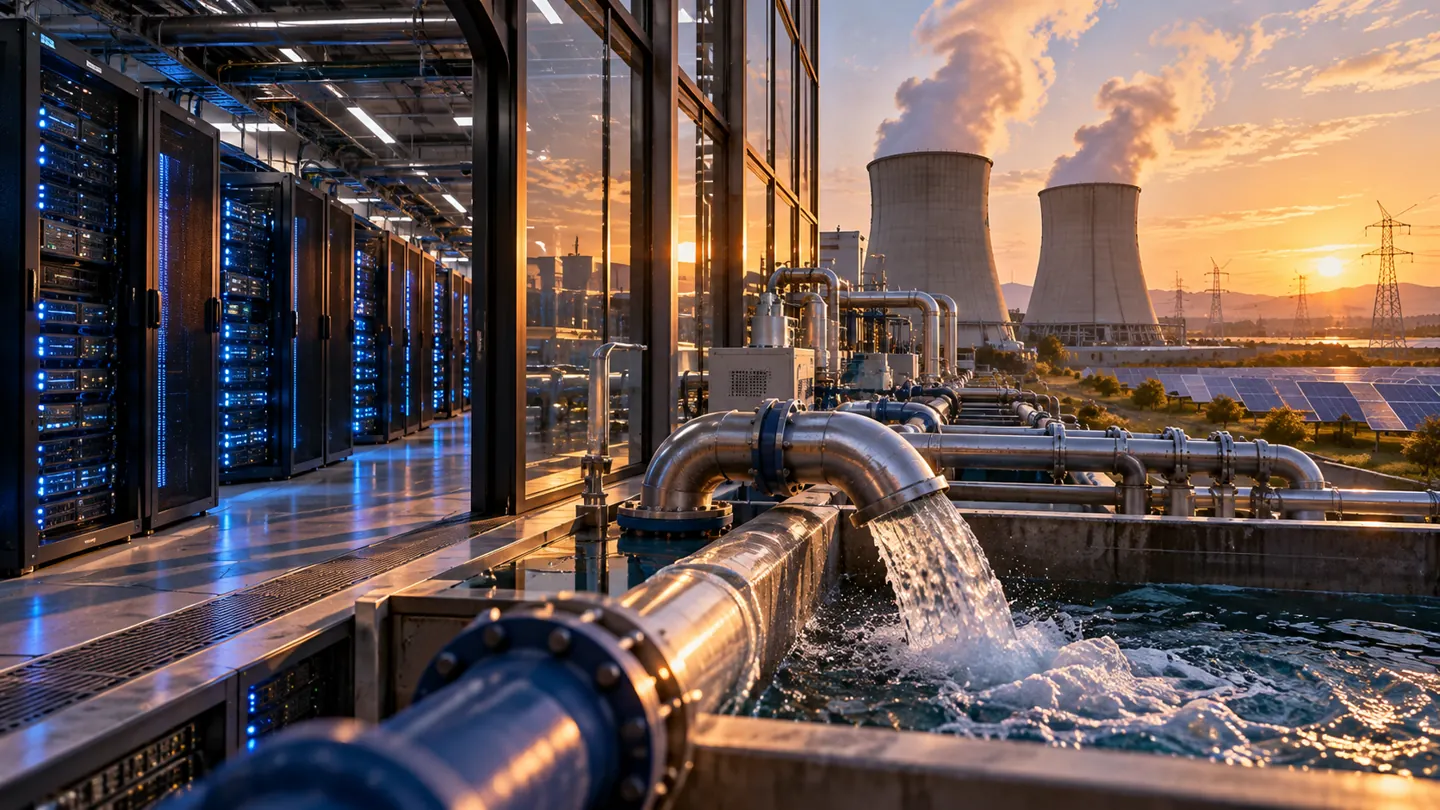
Introduction: The hidden infrastructure behind an AI answer
A question to an AI assistant looks like a small digital event. Behind it, however, a request may travel through network equipment to a data center where specialized chips perform millions or billions of mathematical operations. Those chips draw electricity and release heat. Keeping them operating safely requires additional power, cooling equipment, and—at some facilities—water. The environmental footprint of AI therefore extends beyond the screen. It depends on the model, the hardware, how efficiently servers are used, the local electricity supply, and the design of the cooling system.
This guide explains the physical mechanisms, puts widely quoted numbers in context, distinguishes measured consumption from forecasts, and shows how to assess claims about the energy and water cost of AI without falling for misleading per-prompt estimates.
What exactly is an AI data center?
A data center is a building or campus containing servers, storage devices, networking equipment, electrical distribution, backup systems, and cooling infrastructure. Not every data center runs AI: conventional cloud services, websites, streaming platforms, and enterprise software use many of the same facilities. AI-oriented sites often contain dense clusters of graphics processing units (GPUs) or other accelerators connected by high-speed networks.
Training a large model means repeatedly processing enormous datasets to adjust its parameters. Inference means running an already trained model to produce answers, images, audio, or other outputs. Training can be an intensive project concentrated over a period of time; inference may run continuously across millions of user requests. Both consume resources, but their profiles are different. A facility's electricity bill also includes non-AI services, so total data-center figures must not be mislabeled as electricity used by AI alone.
Why AI chips need so much electricity
Modern AI workloads involve massive matrix multiplication and frequent movement of information between chips and memory. Accelerators can perform many operations in parallel, but that throughput requires electrical power. Their high-bandwidth memory, interconnects, storage, and network switches add to the total. More capable models can demand more computation per response, particularly when they process long documents, high-resolution images, video, or many reasoning steps.
A useful distinction is instantaneous power versus energy over time. A 1,000-watt device operating for one hour uses 1 kilowatt-hour (kWh). A 100-megawatt facility operating at that level for a full day uses 2,400 megawatt-hours, or 2.4 gigawatt-hours. These are illustrative arithmetic examples, not measurements of a particular AI campus. The energy cost of a request varies with the model, token count, batch size, chip generation, utilization, and system overhead.
The overlooked cost of moving and storing data
Computing chips are only part of the system. During distributed training, accelerators exchange intermediate results through high-speed networks. Large models may need to load weights from memory, and retrieval systems may access databases or document stores. Network equipment, memory and storage each consume electricity. Some systems keep resources available for low-latency responses even when demand fluctuates.
Low utilization can make energy per useful output worse: servers may still consume significant power while idle. Conversely, efficient scheduling, batching, model compression, and better hardware can reduce energy per task. It is therefore inaccurate to assume that a model with twice as many parameters automatically uses exactly twice the electricity for every request.
Why heat becomes a second engineering problem
Nearly all the electrical energy consumed by computing hardware ultimately becomes heat. High-performance chips packed tightly into racks create concentrated thermal loads. If temperatures rise beyond safe limits, equipment may throttle performance or shut down. Data centers therefore use fans, pumps, heat exchangers, chillers, cooling towers, or direct-to-chip liquid-cooling loops. These systems also need electricity.
The exact arrangement matters. Air-cooled rooms may use substantial fan and refrigeration power. Liquid cooling can remove heat more efficiently from dense chips, but liquid cooling does not automatically mean the facility consumes fresh water: a closed internal loop can transfer heat to a separate dry cooler, cooling tower, or other heat-rejection system. The final design determines the water footprint.
Why some data centers use water
Water is often used because evaporation removes heat efficiently. In an evaporative cooling tower, some water evaporates as warm water transfers heat to the air. Other water may be discharged as blowdown to control dissolved minerals, while replacement water is added. A facility using air-side economization or dry cooling can use much less on-site water, although energy requirements may differ depending on climate.
It is important to distinguish water withdrawal, water consumption, and water discharge. Withdrawal is water taken from a source; consumption is the portion not returned to that source in the relevant accounting period, often largely through evaporation; discharge is water released after use. Reclaimed wastewater, non-potable supplies, and potable drinking water are not interchangeable categories. Local scarcity matters as much as headline volume: a gallon consumed in a drought-stressed basin has different consequences from a gallon consumed where water is abundant.
What the latest global electricity numbers actually say
The International Energy Agency estimated that all data centers—not AI alone—consumed about 415 terawatt-hours (TWh) of electricity worldwide in 2024, around 1.5% of global electricity use. In its 2025 Energy and AI report, the IEA projected roughly 945 TWh by 2030 in a base case. The IEA's subsequent Key Questions on Energy and AI analysis updated its central outlook to around 950 TWh in 2030, from an estimated 485 TWh in 2025. These are scenario projections, not guaranteed outcomes.
The IEA identifies AI as a major growth driver, but ordinary cloud computing and other digital workloads also contribute. Its analysis says demand for AI-focused data centers grows faster than overall data-center demand. Forecasts can change if deployment, chip efficiency, model architecture, electricity infrastructure, or economic conditions change. Comparing a measured 2024 total with a modeled 2030 estimate without labeling the difference is misleading.
Why the United States is a useful case study
Data-center demand is geographically concentrated, so national and regional grids can experience pressure even when the global share remains modest. A June 2026 update from Lawrence Berkeley National Laboratory estimated U.S. data centers used 192 TWh in 2024, or about 4.7% of U.S. electricity. Its reference-case projection for 2028 was 464 TWh. The report estimated data centers could reach 11.8% of U.S. electricity by 2030 in its central scenario, with a range of 9.5% to 15.3%.
These numbers are not a prediction that every region will experience the same growth. Transmission capacity, local generation, permitting, and the location of clusters matter. A large campus can create significant local demand even if its contribution to national energy use looks relatively small. Grid operators must plan for peak power, not merely annual energy totals.
What company water disclosures reveal—and what they do not
Google's 2025 Environmental Report provides a concrete example of company-level accounting. It reported 2024 water consumption of approximately 7.787 billion U.S. gallons across its data centers, alongside withdrawal of about 9.866 billion gallons. The report also separates offices and other facilities and discusses local water conditions. These are reported company totals, not a measurement of water consumed by one AI prompt or one model.
Google also reported a 27% increase in data-center electricity demand in 2024 while stating that data-center energy-related emissions fell 12% that year. The difference illustrates why electricity demand and emissions are related but not identical: the carbon intensity of supplied electricity matters. Corporate reports should be read alongside their accounting boundaries, reporting year, and independent assurance statements.
Does every AI question use a bottle of water?
No universal per-prompt number can be treated as a reliable fact. Such estimates require assumptions about the model, response length, location, cooling technology, time of day, electricity mix, allocation of training costs, and whether indirect water use at power plants is counted. A short text answer on an efficient server is not equivalent to generating a long video or running a complex multi-step workflow.
A headline claiming that every prompt consumes a fixed amount of water usually conceals these variables. Researchers can produce useful estimates under stated assumptions, but those estimates should not be presented as a universal meter reading. A better question is: what system boundary was measured, for which workload, over what period, and with what uncertainty?
Direct versus indirect water footprints
On-site cooling is only one pathway. Electricity generation may also use water, especially at some thermal power plants, while wind and solar photovoltaic systems generally have different operational water profiles. Semiconductor manufacturing and equipment supply chains involve additional water and energy. Consequently, two studies may report very different numbers because one counts only cooling-tower evaporation and another also counts upstream electricity and hardware production.
Neither accounting method is automatically wrong, but comparing them without matching boundaries is. The same applies to carbon emissions: operational emissions from purchased electricity differ from the embodied emissions associated with construction, chips, and equipment. Transparent reporting should separate these categories.
Power Usage Effectiveness and Water Usage Effectiveness
Power Usage Effectiveness (PUE) is the ratio of total facility energy to energy used by IT equipment. A PUE of 1.20 means that for each 1 kWh used by computing equipment, the whole facility uses 1.20 kWh. Lower is generally better, but PUE alone does not indicate whether the computing workload is useful, nor does it measure water consumption.
Water Usage Effectiveness (WUE) is commonly expressed as liters of site water consumption per kilowatt-hour of IT energy. Lower WUE can indicate reduced direct water use, but definitions and reporting boundaries need checking. PUE and WUE can trade off: a design that saves electricity through evaporation may consume more water than a dry-cooling alternative. A credible comparison includes local climate, grid emissions, water stress, and workload efficiency—not just one metric.
Why location and climate change the answer
A cool climate may permit more hours of free cooling, while a hot climate can increase refrigeration needs. Humidity affects how well evaporative systems work. Water availability, drought risk, electricity prices, and local grid carbon intensity all influence the best engineering choice. A center built near abundant low-carbon electricity may have a different footprint from an otherwise similar site dependent on fossil-heavy power.
Local communities may also face competing needs for water and electricity. Responsible site selection therefore involves public consultation, transparent demand projections, and attention to utility investment and resource constraints. The most efficient design in one region is not necessarily the most sustainable in another.
Can AI data centers run on renewable energy?
They can purchase renewable electricity or enter long-term power agreements, and some operators invest in on-site solar, wind, storage, or other low-carbon generation. But annual renewable-energy matching is not the same as receiving carbon-free electricity during every operating hour. A center may still draw from a grid with fossil generation when wind or solar output is low.
The IEA expects renewables and natural gas to meet significant portions of additional data-center electricity demand through 2030, with regional variation. Improving the grid's supply, expanding transmission, and managing flexible loads can be as important as improving chips. Claims of being “100% renewable” should explain whether they mean annual certificate matching, hourly matching, or physical direct supply.
Practical ways operators can reduce electricity demand
The first opportunity is to avoid unnecessary computation: select an appropriately sized model, cache repeated outputs where suitable, shorten prompts without losing essential context, and use efficient retrieval rather than repeatedly processing entire documents. Model quantization, distillation, optimized inference kernels, and modern accelerators can improve performance per watt. Batching requests can increase utilization, although latency-sensitive applications need careful scheduling.
At facility level, operators can improve airflow management, contain hot and cold aisles, optimize temperatures within safe limits, deploy efficient power distribution, and use heat recovery where practical. Measuring real workload energy matters: a facility with excellent PUE can still waste electricity if its servers are poorly utilized.
Practical ways operators can reduce water demand
Water reduction strategies include selecting cooling systems appropriate to the local basin, using reclaimed or non-potable water where safe, improving cycles of concentration in cooling towers, fixing leaks, and monitoring water use continuously. Dry cooling can lower direct water consumption, although it may require more electricity in some conditions. Hybrid systems can switch operating modes as weather changes.
Companies should report site-level withdrawal, consumption, water source, and basin stress wherever feasible. Community-level transparency helps residents evaluate trade-offs and compare promises with actual outcomes. Water replenishment programs can be useful, but they should not be mistaken for evidence that a facility consumes no water.
What users and businesses can do
Individual users cannot directly control the cooling system behind a hosted AI model, but they can avoid wasteful workflows. Choose a lightweight model for straightforward tasks when possible. Reuse verified answers instead of regenerating the same material repeatedly. Avoid sending very long documents when a relevant excerpt is sufficient. Businesses can ask vendors for model-level or service-level energy disclosures, data-center locations, emissions accounting methods, and responsible water practices.
Do not assume that every AI use is environmentally worse than the non-AI alternative. AI can replace some travel, speed up engineering, or improve energy-system operations, while in other cases it creates additional demand. A fair comparison measures the full task and its alternative, not just the electricity used by one server.
A checklist for evaluating dramatic AI energy headlines
Before sharing a statistic, identify the year and whether the number is measured or forecast. Check whether it covers all data centers, AI-focused data centers, or one company's facilities. Separate power (MW) from energy (MWh or TWh). Look for direct versus indirect water boundaries. Ask whether the result is global, national, regional, or facility-specific. Check whether a per-query figure is modeled or measured. Finally, read the original research rather than relying on an unsourced social-media graphic.
For example, “data centers used 415 TWh globally in 2024” and “AI used 415 TWh” are not equivalent claims. Similarly, a 2030 scenario of 950 TWh should not be described as today's consumption. These distinctions make the discussion more useful for readers, policymakers, and communities.
What happens next?
Future demand depends on two competing forces. AI use may expand rapidly into search, software, business workflows, scientific research, video generation, and autonomous systems. At the same time, better chips, model architectures, cooling, scheduling, and software may reduce energy required per unit of work. Efficiency improvements can be partly offset if lower costs stimulate much more usage—a phenomenon often called rebound demand.
The IEA's updated outlook underscores uncertainty rather than certainty. Infrastructure bottlenecks can slow near-term growth, while new investment and energy-intensive applications could increase longer-term demand. Better measurement and public reporting are essential to distinguish real progress from optimistic marketing.
Bottom line
AI data centers consume substantial electricity because they perform intensive computation at scale, move large volumes of data, and must continuously remove the heat generated by their hardware. Some consume significant water because evaporative cooling is effective, but water use varies widely with the cooling system and location. Global data-center demand is rising, yet the headline numbers usually include far more than AI alone.
The responsible response is neither to dismiss environmental concerns nor to repeat sensational per-prompt claims. It is to measure carefully, compare consistent boundaries, build efficient infrastructure, protect local resources, and make AI systems deliver more useful work per unit of electricity and water.
Sources and further reading
International Energy Agency, Energy and AI (2025): https://www.iea.org/reports/energy-and-ai International Energy Agency, Key Questions on Energy and AI (updated outlook): https://www.iea.org/reports/key-questions-on-energy-and-ai/executive-summary Lawrence Berkeley National Laboratory, United States Data Center Energy Usage Report: 2025 Update (published June 2026): https://datacenters.lbl.gov/publications/united-states-data-center-energy-2025 U.S. Department of Energy, Data Center Energy Demand report: https://www.energy.gov/articles/doe-releases-new-report-evaluating-increase-electricity-demand-data-centers Google, 2025 Environmental Report overview: https://blog.google/company-news/outreach-and-initiatives/sustainability/environmental-report-2025/ Google Sustainability, water stewardship and reports: https://sustainability.google/commitments/water/
You may also like
 Technology & How-To
NHS App Prescription Not Showing? Check GP Approval, Pharmacy Status and Tracking
Find out why a prescription or medicine is missing from the NHS App in England. Separate repeat requests,…
 Technology & How-To
Google Wallet Not Working After Switching Phones? Fix Card Setup and Tap to Pay
Google Wallet transferred but tap to pay fails? Separate card verification, bank approval, NFC, screen lock and device…
 Technology & How-To
iCloud Family Sharing Not Working? Why You Still See 5GB and How to Fix It
Still seeing 5GB after joining an iCloud family plan? Check the account, invitation, sharing settings, personal plan and…