
What Happens to Your Body After 24 Hours Without Sleep? A Science-Based Timeline
Discover what 24 hours without sleep does to attention, mood, memory and physical performance, plus a safe recovery plan backed by sleep research.
Contents
- What counts as 24 hours without sleep?
- The timeline: what changes as wakefulness continues
- 1. Attention and reaction time become less dependable
- 2. Memory, learning and decision-making suffer
- 3. Mood and emotional regulation can change
- 4. Microsleeps can occur without warning
- 5. The body’s stress, appetite and metabolic signals shift
- 6. Coordination and physical performance may decline
- Is 24 hours awake the same as being drunk?
- Can 24 hours without sleep cause hallucinations?
- Why you might feel a “second wind” late at night
- What makes the effects worse—or less predictable?
- What to do if you have already been awake for 24 hours
- How much recovery sleep do you need?
- A practical recovery plan for the next 48 hours
- When to seek medical advice
- What about students, shift workers and new parents?
- Students facing an exam
- Shift workers
- New parents and caregivers
- Common myths about pulling an all-nighter
- The bottom line
- Sources and further reading
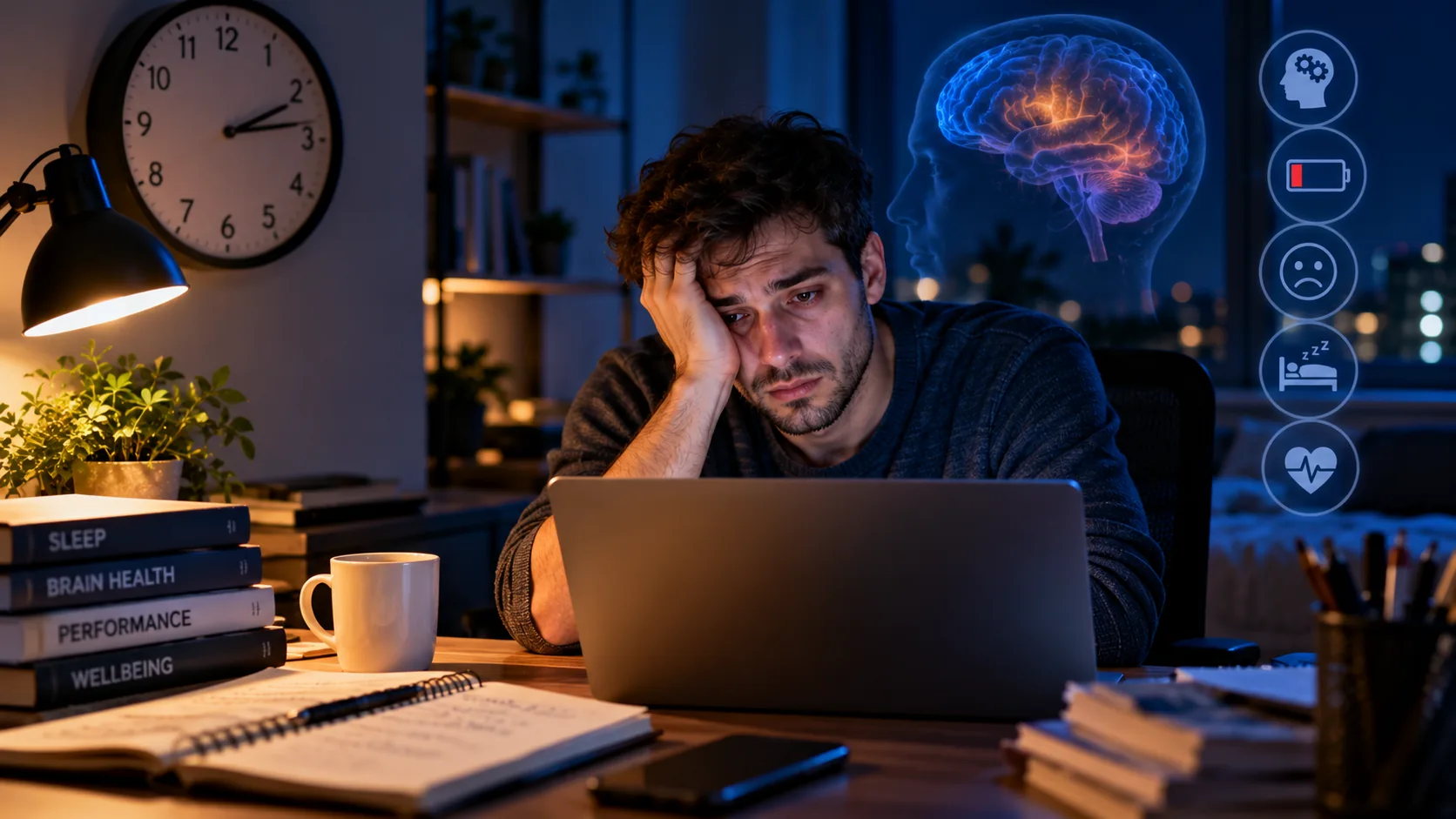
Staying awake for 24 hours does more than make you feel tired. Your brain becomes less reliable at detecting mistakes, your reaction time slows, your mood can change, and brief involuntary lapses of attention—called microsleeps—may occur. Yet the effects are not identical for everyone, and there is no universal hour-by-hour biological countdown. This evidence-based guide explains what researchers know, what remains uncertain, and how to recover safely.
A single all-nighter is not the same as chronic sleep restriction or a diagnosed sleep disorder. The risks are particularly important if you must drive, operate machinery, make clinical decisions, or care for someone else.
What counts as 24 hours without sleep?
If you woke at 7 a.m. on Monday and did not sleep again until 7 a.m. Tuesday, you have been awake for 24 continuous hours. The body’s circadian clock still cycles during that period, so you may feel briefly more alert at certain times even as sleep pressure builds. That temporary second wind is not proof that your performance has recovered.
The timeline: what changes as wakefulness continues
| Time awake | Common experiences | Important qualification |
|---|---|---|
| 0–8 hours | Usually normal alertness after adequate prior sleep | Shift work, illness and previous sleep debt change the baseline |
| 8–16 hours | Growing sleep pressure; concentration may fluctuate | Circadian timing affects how alert you feel |
| 16–20 hours | Slower responses, reduced vigilance, more errors | Individual responses vary considerably |
| 20–24 hours | Pronounced fatigue, attention lapses and possible microsleeps | Some people underestimate their own impairment |
| After 24 hours | Further wakefulness generally raises safety concerns | No fixed symptom or hallucination threshold applies to everyone |
This timeline is illustrative, not a clinical staging system. Research often compares groups under controlled laboratory conditions, while real-world symptoms depend on sleep history, medication, caffeine, illness, and time of day.
1. Attention and reaction time become less dependable
The most consistent measurable effect of sleep loss is poorer vigilant attention: the ability to notice and respond quickly to a signal over time. On a psychomotor vigilance test (PVT), sleep-deprived participants commonly show slower reactions and more lapses. That matters during long, monotonous activities such as motorway driving, monitoring equipment or reviewing detailed work.
A person may answer a question normally one moment and miss an obvious cue the next. This fluctuation is one reason self-assessment is unreliable: feeling “mostly fine” does not establish that it is safe to drive.
2. Memory, learning and decision-making suffer
Sleep supports learning and memory consolidation. After prolonged wakefulness, it becomes harder to sustain working memory, filter distractions and weigh competing information. Tasks requiring flexible judgment may be more vulnerable than familiar, automatic routines.
- You may reread the same paragraph without retaining it.
- You may overlook a detail you would normally catch.
- You may choose an impulsive shortcut instead of comparing alternatives.
- You may feel confident about a decision despite making more mistakes.
3. Mood and emotional regulation can change
Irritability, anxiety, frustration and unusually strong emotional reactions are common after sleep loss. Research suggests insufficient sleep can disrupt how emotional signals are processed and regulated. Some people instead feel flat, detached or briefly euphoric. These reactions are not diagnostic of a mental-health condition, but they can complicate conflict, work and judgment.
4. Microsleeps can occur without warning
A microsleep is a very brief episode of sleep that may happen while someone appears to be awake. Eyes may close or attention may simply drop out. It can last only seconds—long enough to miss a traffic light or drift out of a lane. You cannot reliably prevent microsleeps through willpower, loud music or opening a window.
Safety rule: If you are struggling to keep your eyes open, drifting across lanes, missing exits or unable to remember the last stretch of road, stop driving somewhere safe. Caffeine is not a substitute for sleep.
5. The body’s stress, appetite and metabolic signals shift
Acute sleep loss can alter sympathetic nervous-system activity, stress hormones, glucose handling and appetite-related signals. But the magnitude and direction depend on study design, timing and individual factors. One sleepless night does not automatically cause diabetes, permanent hormone damage or a weakened immune system. Long-term associations between habitual short sleep and health conditions should not be confused with the effects of one isolated night.
6. Coordination and physical performance may decline
Fine motor control, balance, endurance perception and consistency can worsen when tired. You might fumble simple tasks or make more mistakes using tools. Maximum strength does not necessarily drop dramatically after one night in every study, so it is more accurate to say that reliability and safety suffer than to claim every physical ability collapses.
Is 24 hours awake the same as being drunk?
You may have seen the claim that 24 hours awake is equivalent to a blood-alcohol concentration (BAC) of 0.10%. A widely cited experimental study by Dawson and Reid found performance impairment after sustained wakefulness comparable on certain measures to alcohol intoxication. However, the analogy is task-specific and approximate: it does not mean your actual BAC rises, nor does it establish a precise legal equivalence for every person.
The practical lesson is simpler: substantial sleep loss can impair performance enough to create a serious accident risk, even when no alcohol is involved.
Can 24 hours without sleep cause hallucinations?
Perceptual distortions and hallucinations have been reported during prolonged sleep deprivation, but there is no reliable 24-hour cutoff. More severe symptoms are generally associated with longer wakefulness, vulnerability or other contributing conditions. If someone becomes confused, severely agitated, experiences hallucinations, or cannot stay awake in a dangerous situation, seek prompt medical help rather than treating the symptoms as a normal milestone.
Why you might feel a “second wind” late at night
Sleepiness is shaped by two interacting processes: homeostatic sleep pressure, which builds while awake, and the circadian alerting signal, which changes across the day. In the evening, the circadian system may briefly counter rising sleep pressure. That can make an exhausted person feel surprisingly alert before a strong wave of sleepiness returns. It does not erase the underlying deficit.
What makes the effects worse—or less predictable?
| Factor | Why it matters | Practical response |
|---|---|---|
| Prior sleep debt | Several short nights can compound impairment | Do not assume a single recovery night fixes a long deficit |
| Time of day | Biological night brings greater sleepiness for most people | Avoid high-risk tasks overnight |
| Sleep apnea or other sleep disorders | May reduce baseline alertness | Seek assessment for persistent symptoms |
| Sedating medication or alcohol | Can intensify impairment | Check labels and medical advice; do not combine with driving |
| Caffeine | May briefly improve alertness but can delay recovery sleep | Use cautiously, not as permission to drive |
| Individual variation | Some people are more vulnerable than others | Judge risk by the task, not confidence alone |
What to do if you have already been awake for 24 hours
- Stop safety-critical activities. Arrange a lift, taxi or public transport instead of driving yourself.
- Prioritise an opportunity to sleep. Choose a dark, quiet, comfortably cool room and silence nonessential notifications.
- Hydrate and eat normally. Water and food support comfort, but neither reverses sleep deprivation.
- Avoid using alcohol to fall asleep. It can fragment sleep and create additional risks.
- Limit late caffeine. Its effects can persist for hours and interfere with the recovery sleep you need.
- Resume a regular sleep schedule. If your pattern is repeatedly disrupted, address the cause rather than relying on weekend catch-up.
How much recovery sleep do you need?
There is no one-size-fits-all formula such as “sleep exactly 10 hours to cancel 24 hours awake.” Adults generally need at least seven hours of sleep regularly, and some need more. After an all-nighter, you may sleep longer or more deeply, but performance and circadian rhythm may take additional time to stabilise. Avoid planning demanding or dangerous tasks immediately after one recovery sleep if you still feel sleepy.
A practical recovery plan for the next 48 hours
| When | What to do | What to avoid |
|---|---|---|
| Immediately | Get home safely without driving; make time for sleep | Driving, heavy machinery, risky decisions |
| First sleep opportunity | Sleep in a dark, quiet environment | Alcohol or excessive late caffeine |
| Following day | Keep activity gentle; eat regularly; assess alertness honestly | Assuming all cognitive effects are gone |
| Following night | Aim for a consistent bedtime and sufficient sleep | Repeated all-nighters or drastic schedule swings |
When to seek medical advice
One isolated night awake because of work or travel is different from being unable to sleep despite trying. Talk to a healthcare professional if insomnia persists, daytime sleepiness regularly disrupts life, loud snoring or breathing pauses suggest sleep apnea, or you rely on stimulants to function. Seek urgent medical assessment for severe confusion, hallucinations, chest pain, breathing difficulties or other alarming symptoms. If you have gone days with very little sleep and feel unusually energised, impulsive or agitated, urgent evaluation may also be appropriate.
What about students, shift workers and new parents?
Students facing an exam
An all-night study session may increase the hours spent with notes while reducing attention and memory performance. Prioritising sleep and reviewing high-value material while rested is generally a better strategy than learning entirely new content overnight.
Shift workers
Shift work can force wakefulness during the biological night. Use employer fatigue-management policies, protected sleep time and safe transport options. Persistent difficulty adapting may warrant a clinician’s advice.
New parents and caregivers
Interrupted sleep can accumulate into substantial fatigue even without a single 24-hour stretch awake. Where possible, share care shifts, protect a consolidated sleep opportunity, and avoid drowsy driving. For infant sleep, follow local safe-sleep guidance rather than falling asleep while holding a baby on a sofa or armchair.
Common myths about pulling an all-nighter
- “Coffee makes me safe to drive.” It may temporarily improve alertness but does not guarantee safety or prevent every microsleep.
- “If I feel awake, my reactions are normal.” Self-perceived alertness and measured performance can diverge.
- “One all-nighter permanently damages the brain.” That sweeping claim is not established by evidence about a single night.
- “Everyone hallucinates after exactly 24 hours.” No such universal threshold exists.
- “A short nap always solves it.” Naps can help alertness, but they may be insufficient after major sleep loss and may produce temporary sleep inertia.
The bottom line
After 24 hours without sleep, the most important danger is unreliable attention—not simply feeling exhausted. Slower reactions, microsleeps, reduced judgment and mood changes can make ordinary activities risky. The safest response is to avoid driving and other hazardous tasks, get adequate recovery sleep, and seek help if sleeplessness or excessive daytime fatigue is recurring.
Sources and further reading
- CDC — About Sleep: recommended sleep and health context.
- NHLBI — Sleep Deprivation and Deficiency: effects, causes and treatment.
- NHTSA — Drowsy Driving: driving risks and warning signs.
- Dawson D, Reid K. Fatigue, alcohol and performance impairment. Nature (1997): experimental basis of the often-cited comparison.
- Van Dongen et al. The cumulative cost of additional wakefulness. Sleep (2003): attention and chronic restriction findings.
- CDC/NIOSH — Circadian rhythms and sleep pressure: shift-work fatigue context.
You may also like
 Science & Discoveries
Could Moon Dust Hold Traces of Alien Technology? What Scientists Propose—and Haven’t Found
A lunar technosignature proposal explained: what scientists could search for, why unusual grains are not proof of aliens,…
 Science & Discoveries
James Webb Finds Metal-Rich Gas Around the Milky Way’s Black Hole: What It Means
James Webb observations reveal metal-rich gas near Sagittarius A*. Here is what the finding means, how infrared spectroscopy…
 Science & Discoveries
NASA Found a Giant Musical Symbol in Space: The Science Behind the Cosmic Treble Clef
NASA’s Treble Clef is a distant radio phoenix, not music in space. Learn how black-hole plasma and galaxy-cluster…