
UK Energy Price Cap Explained: Why Your Bill Can Still Be Higher
The UK energy price cap is £1,723 for October–December 2026, but it is not a limit on your total bill. Understand standing charges, kWh, Direct Debits and billing errors.
Contents
- Quick answer: the UK energy price cap is a limit on prices, not total spending
- What is the UK energy price cap in October–December 2026?
- The unusual electricity VAT change in winter 2026
- What do the reference consumption figures actually represent?
- A clear formula to calculate what your energy bill should cost
- Worked example: why a £217 winter month can still be within the cap
- Worked example: low-use homes still pay standing charges
- Worked example: annual consumption above the benchmark
- Nine reasons your bill can still be higher than the headline price cap
- 1. You used more electricity or gas than the typical household
- 2. Your winter heating is seasonal
- 3. Standing charges apply even when consumption is low
- 4. Your regional tariff differs from the average
- 5. Your payment method changes the permitted rates
- 6. A fixed deal may not be protected by the default tariff cap
- 7. Your Direct Debit may include earlier underpayments or a winter forecast
- 8. You were billed using an estimate or a corrected meter reading
- 9. Your bill includes non-consumption adjustments
- A 10-minute audit: check whether your supplier has charged the correct price
- Example: separating a £190 Direct Debit from a £125 usage bill
- How to tell whether you are on the price cap or a fixed deal
- Smart meter or in-home display shows one amount, but the bill shows another
- What to do if the energy bill really is wrong
- Step 1: build a short evidence bundle
- Step 2: ask the supplier to recalculate and explain
- Step 3: escalate if unresolved
- If your bill is correct but unaffordable: support options worth checking
- Warm Home Discount: a £150 bill credit for eligible households
- Other winter help depends on location and circumstances
- Simple changes that help without sacrificing warmth or safety
- Northern Ireland: why the Ofgem headline does not apply in the same way
- Common comparison mistakes that lead to the wrong conclusion
- When will the energy price cap change again?
- A practical checklist before paying, switching or complaining
- Final takeaway: a higher bill is not automatically a cap breach
- Official UK sources and further reading
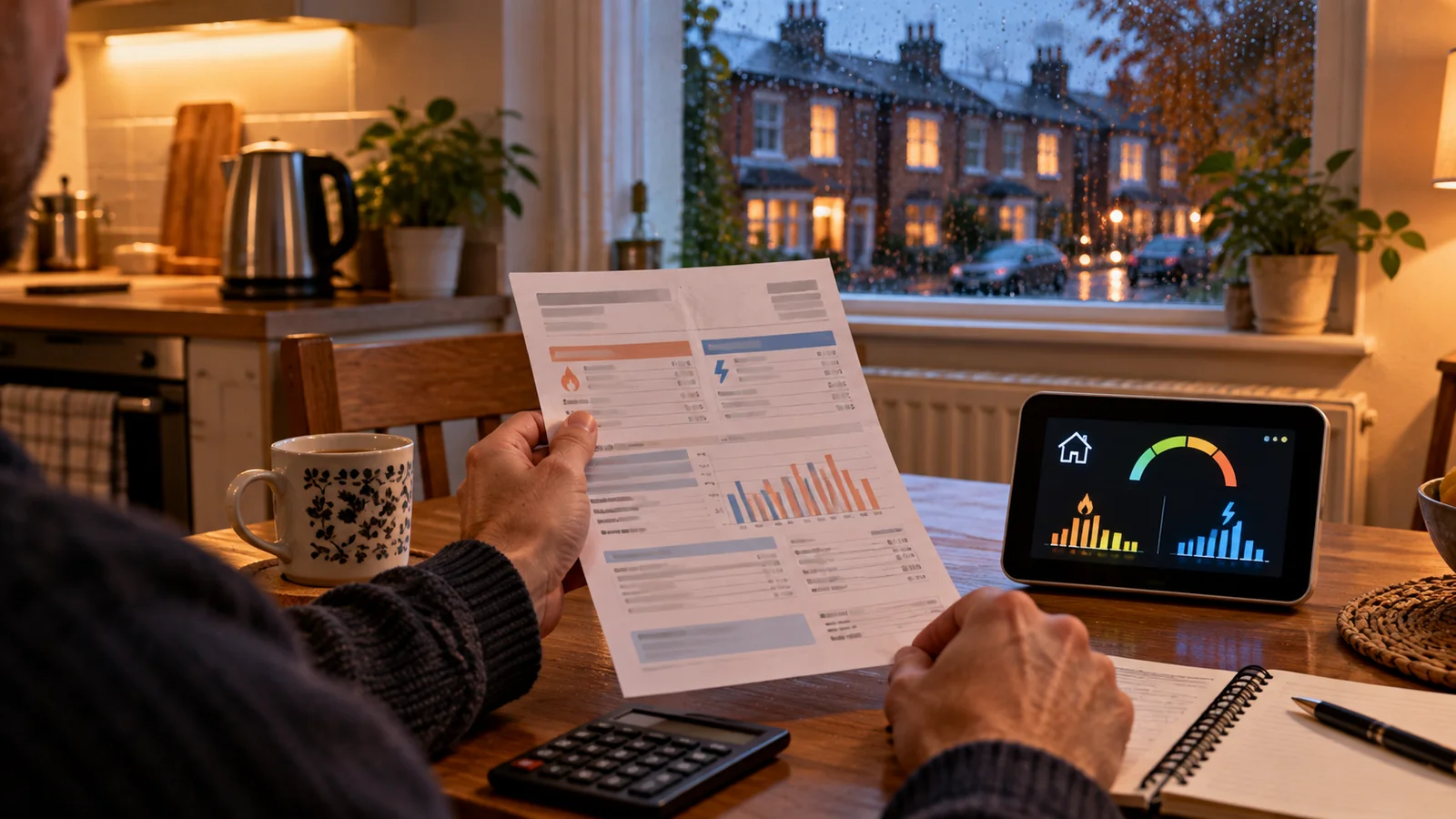
Your energy supplier says the UK energy price cap is £1,723 a year. Yet your latest bill is £240 for a month, your direct debit has jumped to £190, or your annual estimate is well above £2,000. Has the supplier broken the price cap? Not necessarily. The price cap is one of the most misunderstood features of household energy bills in Great Britain.
For 1 October to 31 December 2026, regulator Ofgem sets a benchmark of £1,723 a year for a typical household with gas and electricity paying by Direct Debit on a default variable tariff. The 4% increase from the previous £1,663 level is a useful indicator of changes in regulated prices, but it is not a promise that every household will pay £1,723. What matters to your own bill is the number of kilowatt-hours (kWh) you use, your regional unit rates, daily standing charges, payment method and account history. See Ofgem’s published regional cap tables.
This practical guide explains the autumn 2026 rates, gives fully worked bill examples, shows why bills and direct debits can still be higher than the headline figure, and provides a repeatable method for checking the charges or challenging an error. It primarily covers England, Scotland and Wales. Northern Ireland has a different system and is addressed separately.
Quick answer: the UK energy price cap is a limit on prices, not total spending
What Ofgem caps: the regulated unit rates and daily standing charges on applicable default tariffs. What it does not cap: the total amount of electricity and gas you can use or the final value of your energy bill.
Think of the cap as a price-per-unit safeguard. If you use more units, the total rises just as a water bill rises when more metered water is used. An unusually cold winter, electric heating, additional household members or a long backdated correction can increase the amount due without automatically breaching the cap. Conversely, a small flat with low consumption may have an annual bill well below the widely quoted headline.
| What the number means | What it does not mean |
|---|---|
| £1,723 annually for a benchmark dual-fuel household, Q4 2026 | A legal maximum of £1,723 for every address |
| Illustration based on typical yearly kWh consumption | A prediction of every family’s actual usage |
| A rate cap applying to eligible default tariffs | A guarantee that any fixed tariff is cheapest |
| A Great Britain regulatory figure | The tariff rule for Northern Ireland |
| Prices reviewed in three-month periods | An unchanged fixed price for the entire year |
What is the UK energy price cap in October–December 2026?
Ofgem announced the autumn 2026 rates on 26 August 2026. The annualised typical figure increased from £1,663 for July–September to £1,723 for October–December 2026—about £60 more per year if that rate level applied for a full 12 months to the reference usage. The headline changes quarterly, while households’ actual usage also varies by season. These numbers are taken from the Ofgem announcement for the current period.
| Metric | 1 July–30 September 2026 | 1 October–31 December 2026 |
|---|---|---|
| Typical dual-fuel Direct Debit cap | £1,663/year | £1,723/year |
| Electricity unit price | 26.11p/kWh | 26.32p/kWh |
| Electricity standing charge | 57.19p/day | 54.83p/day |
| Gas unit price | 7.33p/kWh | 7.97p/kWh |
| Gas standing charge | 29.04p/day | 29.68p/day |
These electricity and gas rates are Great Britain averages for a Direct Debit customer on an applicable single-rate default tariff. They are not universal maxima for every region, and they are not the exact rates for customers paying on receipt of bills, using prepayment meters or using certain multi-rate tariffs. Always compare your own rates using the Ofgem postcode and payment-method tables.
The unusual electricity VAT change in winter 2026
A detail that older energy guides may miss is that the UK government removed VAT from electricity bills from 1 October 2026 to 31 March 2027, while the applicable rate on domestic gas remains 5%. Ofgem’s published October–December averages already include that treatment: the electricity figures do not include VAT, whereas the gas figures include 5% VAT. Do not add 5% to the quoted electricity rate again. Ofgem also cautions that direct comparisons with previous periods need to account for the tax change. Source: Ofgem’s 2026 price-cap update.
What do the reference consumption figures actually represent?
To communicate the cap as a yearly amount, Ofgem uses reference consumption rather than assuming that everyone lives in the same kind of home. Following its 2026 review of typical domestic consumption values, the published £1,723 figure is consistent with approximately 2,500 kWh of electricity and 9,500 kWh of gas per year, evaluated against the stated average rates and standing charges. Your actual meter readings—not these reference figures—determine what you owe. Read the regulator’s review of typical consumption values.
A clear formula to calculate what your energy bill should cost
A basic bill can be reconstructed from two charges for each fuel: energy consumed and the fixed daily charge. For a dual-fuel bill the calculation is:
Estimated bill = (electricity kWh × electricity £/kWh) + (electricity standing charge × days) + (gas kWh × gas £/kWh) + (gas standing charge × days). Adjust for your contract’s VAT treatment, discounts, debt repayments and any credits; never count VAT twice.
Use pounds, not pence, in the multiplication. For example, 26.32p becomes £0.2632, and 54.83p becomes £0.5483. A standing charge is payable for each day in the billing period, including days on which a meter records no consumption, unless your tariff specifically has no standing charge.
Worked example: why a £217 winter month can still be within the cap
Consider a hypothetical 30-day household bill on the national average October–December 2026 Direct Debit rates. Assume that the household uses 320 kWh of electricity and 1,350 kWh of gas. The figures below are not a prediction of a particular home’s usage.
| Line item | Calculation | Charge |
|---|---|---|
| Electricity used | 320 × £0.2632 | £84.22 |
| Electricity standing charge | 30 × £0.5483 | £16.45 |
| Gas used | 1,350 × £0.0797 | £107.60 |
| Gas standing charge | 30 × £0.2968 | £8.90 |
| Total before any account adjustments | Sum of above unrounded values | £217.17 |
That is £217.17 for one month at the illustrated consumption—significantly above £1,723 divided by 12 (approximately £143.58)—even though the rates themselves follow the national Ofgem averages. A cold month can consume much more gas than the average month. The annual headline is not a monthly allowance or spending limit.
Worked example: low-use homes still pay standing charges
Even if a home uses zero electricity and gas in a 30-day period, average dual-fuel standing charges in the table add up to approximately £25.35 (£0.5483 + £0.2968, multiplied by 30). A supplier may also send a direct-debit request to maintain an account balance or repay older debt. Do not assume that a statement showing a £25 charge means the meter secretly recorded energy.
Worked example: annual consumption above the benchmark
At the same average rates, a household consuming 4,000 kWh of electricity and 15,000 kWh of gas across a notional 365-day year would face roughly £2,557 in annual energy charges before any account adjustments. This is a static-rate comparison only: Ofgem resets the cap every three months, so the exact amount over an actual year requires the rates for each billing period. Higher annual spending in itself does not mean the supplier has charged an unlawful price.
Nine reasons your bill can still be higher than the headline price cap
1. You used more electricity or gas than the typical household
Size matters, but it is not the only factor. Poor insulation, a gas boiler, an electrically heated property, a heat pump, a tumble dryer, an electric vehicle, working from home and personal heating needs can all change consumption. Ofgem’s typical figure is not tailored to the number of rooms, occupants or heating pattern at your address. The right comparison is your kWh usage against your own past consumption under similar weather conditions, not merely against a national average bill.
2. Your winter heating is seasonal
Heating demand usually increases in cold weather while summer gas use may be much lower. A household with gas central heating might pay more than £200 in one cold month and considerably less during summer, despite having an annual cost near the benchmark. If you pay the exact amount each month, bills will fluctuate; if you pay a fixed monthly Direct Debit, your supplier may spread estimated annual cost across the year.
3. Standing charges apply even when consumption is low
The standing charge contributes to network, supplier and other regulated costs and is normally charged every calendar day for which you have an active supply. On the national October–December averages, electricity and gas together cost around 84.51p per day in standing charges. Regions and payment methods have different charges, which Ofgem explains in its price-cap and standing-charge guidance. If you have a genuine zero-standing-charge market tariff, look carefully at its potentially higher unit rate before deciding it is cheaper.
4. Your regional tariff differs from the average
The electricity network and distribution costs are not the same across Great Britain. Charges for a home in London may differ from those in northern Scotland or the South West, even for the same annual kWh. A supplier must comply with the appropriate regional regulated cap, not reproduce the national average prices printed in an article. For a meaningful comparison, enter your postcode on the official Ofgem rate page and choose the correct fuel, payment type and meter configuration.
5. Your payment method changes the permitted rates
Direct Debit, standard credit (pay on receipt of a bill) and prepayment each have different published schedules. It is therefore misleading to copy the Direct Debit rates into a dispute about a different payment method. On some arrangements, monthly Direct Debit may also be adjusted separately from consumption charges. Always note both how you pay and how the supplier bills energy.
6. A fixed deal may not be protected by the default tariff cap
The Ofgem cap targets default variable tariffs. If you signed a fixed-term energy deal, its agreed unit rates and standing charges generally continue according to the contract, rather than changing automatically whenever Ofgem announces a new headline. Fixed-rate products can offer certainty but are not automatically cheaper than a variable tariff. Check the end date, unit price, standing charge and any early-exit fee before switching. Ofgem explains the difference in its energy-switching guidance.
7. Your Direct Debit may include earlier underpayments or a winter forecast
A Direct Debit is a payment arrangement, not the same thing as a bill for measured consumption. A supplier may set a recurring £190 payment because it forecasts higher winter use, anticipates a shortfall, or is recovering account debt. Your account could even be in credit after paying more than you used in the last month. Ask for the calculation used to set the payment and compare it with your actual usage and account balance before deciding whether the amount is reasonable.
8. You were billed using an estimate or a corrected meter reading
If a meter has not sent readings, the supplier may estimate consumption. Later, a correct reading can reveal underbilling and produce a large adjustment. Other errors include the wrong meter serial number, transposed digits, the wrong tariff start date, incorrect meter-register allocation, duplicate standing charges or a mistaken opening read after moving home. Citizens Advice’s high-bill troubleshooting page recommends comparing actual readings and estimates before assuming a tariff overcharge.
9. Your bill includes non-consumption adjustments
An energy statement may show previous arrears, debt instalments, a one-off correction, government support credits, refunds, or the accumulated account balance. Separately identify charges for energy supplied during these dates from payments and adjustments. The price cap governs eligible tariff charges; it does not turn old debt or a new repayment schedule into energy used this month.
A 10-minute audit: check whether your supplier has charged the correct price
- Find the tariff name. Confirm whether the bill says standard variable/default or fixed, and check its effective dates.
- Record the postcode and payment type. Identify the correct Ofgem region and whether you pay by Direct Debit, standard credit or prepayment.
- Compare electricity and gas separately. Check each unit rate and daily standing charge against the tariff and the relevant Ofgem table.
- Check the billing dates. If a statement straddles 1 October 2026, it may need two sets of rates, with the appropriate electricity VAT treatment.
- Read the kWh and meter records. Compare opening and closing meter readings, whether they were actual/estimated and whether any corrections appear.
- Calculate the number of days charged. Verify whether 28, 30, 31 or more days were included, and whether any days appear twice.
- Recompute energy plus standing charges. Use the rate printed on your bill. Work from unrounded values and round the final totals.
- Compare your result with the billed supply charges. Look at adjustments, discounts and prior debt separately.
- Request a written explanation. If there is a mismatch, provide screenshots and a table showing the dates, meter reads and rates.
For more detailed definitions of tariffs, units and statement lines, refer to Ofgem’s official guide to how electricity and gas bills are calculated. Do not send bank details, meter photos or account numbers to third-party “bill checker” forms you do not trust. Use your supplier’s verified portal and official consumer advice services.
Example: separating a £190 Direct Debit from a £125 usage bill
| Account event | Illustrative amount | What it represents |
|---|---|---|
| Cost of electricity and gas this month | £125.00 | New charges for the measured period |
| Monthly Direct Debit collected | £190.00 | Money paid into the energy account |
| Difference before other items | £65.00 | May increase credit or reduce outstanding debt |
| Opening debit or credit | Check actual statement | Affects account balance, not the current unit rate |
| Updated winter projection | Supplier-specific | May influence future monthly Direct Debits |
A high payment can be a budgeting issue without being a tariff-rule breach. If you have substantial credit and consistently low usage, you can ask the supplier to explain its forecast and reconsider the Direct Debit. If the account is in debt, a lower monthly payment may make the shortfall worse. Challenge the calculation with evidence rather than cancelling the payment without a plan.
How to tell whether you are on the price cap or a fixed deal
| Your supply arrangement | Price-cap treatment | Practical check |
|---|---|---|
| Default/standard variable tariff | Usually covered | Check the relevant regional cap rates |
| Agreed fixed-price contract | Normally not governed by default-tariff cap while fixed | Read your agreed unit rates and contract expiry |
| Prepayment on default tariff | Covered, with prepayment-specific rate tables | Check payment-method-specific Ofgem rates |
| Economy 7 or other multi-rate default | Covered under the applicable multi-rate rules | Compare peak/off-peak rates and consumption split |
| Heat network or heating oil | Not covered by Ofgem domestic gas/electric default cap | Find applicable separate rules and contract |
| Northern Ireland domestic supply | Different regulatory system | Check Utility Regulator Northern Ireland |
People using Economy 7 should not test compliance by comparing only the daytime peak rate with an ordinary single-rate figure. Ofgem’s multi-rate price cap accounts for the relevant tariff design; consumers should check the complete weighted structure and correct table. You also may pay separate fixed charges for both gas and electricity even if only one is used heavily.
Smart meter or in-home display shows one amount, but the bill shows another
An in-home display (IHD) is helpful for seeing current demand and approximated daily costs, but it is not always the definitive record of charges. It may use outdated tariff information, a delayed communication link, a displayed combined gas-and-electricity total, or an unexpected midnight standing charge. Your supplier account and fixed physical meter readings should be checked alongside it. See Ofgem’s smart-meter help page.
- Compare the kWh totals for the same period, not simply a live watts figure with a monthly bill.
- Check whether the IHD screen says gas, electricity or combined cost.
- Look for day/night rate registers and changes after a supplier switch.
- Ask your supplier to confirm that the correct October 2026 VAT and tariff data have been loaded.
- If readings are estimated, ask how to submit a verified meter read and correct the bill.
- Never break seals, bypass equipment or attempt to rewire the meter to diagnose a bill.
What to do if the energy bill really is wrong
Step 1: build a short evidence bundle
Gather the bill, your tariff summary, relevant meter readings, the meter serial number, current supplier name, billing dates, earlier correspondence and screenshots of the official rates for your region. Write one sentence describing the problem precisely: for example, “My electricity was billed at 29.8p/kWh from 1 October although my default Direct Debit tariff documentation states 26.4p/kWh for this region.” Avoid assuming that the supplier must charge the national average.
Step 2: ask the supplier to recalculate and explain
Contact your supplier through its official customer-service or complaint channel. Ask which meter reads were used, which rates were effective on each date, and whether the estimated usage, standing charges, VAT and Direct Debit forecast can be corrected. Request a written revised statement if an error is found. Citizens Advice also covers other possible causes, including incorrect meter allocation and a faulty meter, in its high bill guide.
Step 3: escalate if unresolved
If the supplier cannot resolve the matter, use its formal complaint process and retain a complaint reference. According to Ofgem’s complaints guidance, cases that remain unresolved after eight weeks or reach a qualifying deadlock can usually be taken to the independent Energy Ombudsman. The Ombudsman assesses the specific dispute and may require an appropriate remedy. This is not the same as Ofgem personally investigating your individual bill.
If your bill is correct but unaffordable: support options worth checking
You do not need to wait until you miss a payment to ask for support. Ofgem advises consumers struggling to pay to contact the supplier promptly to discuss an affordable repayment plan, payment break or reduction, review of debt repayments and possible hardship funds. These are not guaranteed cash grants for every customer, but the supplier should explain what help is available. Start with Ofgem’s energy-bill support guidance.
Warm Home Discount: a £150 bill credit for eligible households
The 2026–27 Warm Home Discount scheme offers eligible households a one-off £150 discount, generally credited to an electricity account rather than paid as cash. Eligibility and how people receive it differ across England, Wales and Scotland, and the programme does not cover Northern Ireland. Some qualifying groups receive it automatically, while Scottish applicants may have a different route. Read GOV.UK’s Warm Home Discount overview and England and Wales eligibility rules. Do not assume the discount has been applied unless it appears on your account or your supplier confirms it.
Other winter help depends on location and circumstances
Eligible households may also have access to a winter support programme such as Cold Weather Payments in qualifying locations and conditions, or a Winter Fuel Payment for eligible older people. The rules differ by benefit, age, nation and scheme year. A household should check the government page relevant to its nation instead of relying on a generic nationwide “energy grant” claim on social media.
Simple changes that help without sacrificing warmth or safety
- Check heating controls and room thermostats; avoid turning down essential heat to an unsafe level.
- Bleed radiators and inspect heating schedules as appropriate for your equipment; arrange professional service for gas or electrical faults.
- Seal safe gaps and use approved draught-proofing measures while keeping ventilation and combustion-safety requirements intact.
- Look at the energy label and real consumption of appliances rather than judging only by their age or appearance.
- If on Economy 7 or time-of-use pricing, move suitable loads to cheaper hours only when it is safe and the tariff benefit is confirmed.
- For smart-meter users, compare weekly kWh instead of watching only an approximate in-home-display cost.
Northern Ireland: why the Ofgem headline does not apply in the same way
The well-publicised Ofgem domestic price cap discussed here governs Great Britain: England, Scotland and Wales. Northern Ireland electricity and gas markets follow different regulatory structures, suppliers and consumer protections. If you live in Belfast, Derry/Londonderry or elsewhere in Northern Ireland, do not assume the £1,723 benchmark or GB regional unit-rate tables determine your regulated domestic tariff. Check your supplier’s tariff and the Utility Regulator Northern Ireland for current local information.
Common comparison mistakes that lead to the wrong conclusion
- Dividing the annual cap by 12 and calling that your maximum monthly bill. Winter use is often higher than summer use.
- Comparing a fixed tariff with the default tariff cap. Your fixed deal is governed by its agreed terms.
- Using national averages instead of local rates. Region and payment method change the applicable schedule.
- Adding electricity VAT twice in late 2026. Ofgem’s October–December electricity averages already reflect the temporary VAT removal.
- Mixing up payments and charges. A Direct Debit is a payment, not necessarily this month’s measured cost.
- Ignoring standing charges or multiplying by the wrong number of billing days. Date ranges matter.
- Ignoring corrected estimated readings. An adjustment may cover consumption from another period.
- Assuming Northern Ireland uses Ofgem’s Great Britain rate tables. It does not.
- Assuming the following quarter’s prices are already fixed. Check the latest official Ofgem announcement before making a tariff decision.
When will the energy price cap change again?
Ofgem reviews the default tariff cap every three months. At the time of this article’s editorial check on 17 October 2026, Ofgem lists its next scheduled announcement for 25 November 2026, covering the period from 1 January to 31 March 2027. Forecasts published by suppliers, analysts or comparison services before Ofgem announces a decision are not confirmed cap rates. Keep this article updated whenever Ofgem publishes a new quarter and review any tax changes that affect unit-rate comparisons. See Ofgem’s current quarter announcement and publication schedule.
A practical checklist before paying, switching or complaining
| Question to resolve | What to inspect | Why it matters |
|---|---|---|
| Am I on a default tariff? | Tariff name and renewal date | Determines whether the default cap applies |
| What are my exact unit rates? | Supplier bill and Ofgem region table | Shows whether each rate is appropriate |
| How many kWh did I actually use? | Opening/closing actual reads | Distinguishes use from estimates |
| How many days am I billed? | Bill dates and standing charges | Helps spot duplicate fixed charges |
| Is VAT shown correctly? | Electricity/gas VAT treatment in 2026 | Avoids a major date-specific mistake |
| Why has the Direct Debit risen? | Forecast, account balance, debt | Separates payment planning from metered charges |
| Is my supplier responding? | Complaint reference and written outcome | Preserves rights to escalate a dispute |
Final takeaway: a higher bill is not automatically a cap breach
The October–December 2026 UK energy price cap sets a £1,723 annual benchmark for a typical dual-fuel Direct Debit household in Great Britain. It does not set a personal spending allowance. Cold-weather demand, a higher-usage household, regional rates, daily standing charges, fixed tariffs, debt repayments and corrected estimated readings can all explain a figure above the headline.
The quickest route to a trustworthy answer is to identify the tariff, compare the correct unit rates, reconstruct the kWh and standing charges, and then separate actual energy costs from payments and historic adjustments. If the figures still do not reconcile, ask the supplier for a written correction and use the official complaint route. The price cap gives consumers important rate protection—but reading it correctly is what lets you judge whether your own energy bill is fair.
Official UK sources and further reading
- Ofgem — Energy Price Cap Unit Rates and Standing Charges — current prices and regional tables for default tariffs.
- Ofgem — Changes to the Price Cap, October to December 2026 — the updated rates, VAT change and next review date.
- Ofgem — Energy Price Cap and Standing Charges Explained — coverage and scope of the cap.
- Ofgem — Price Cap Will Rise by 4% from October 2026 — headline figure and context.
- Ofgem — Review of Typical Domestic Consumption Values — why benchmark kWh matter.
- Ofgem — How Your Electricity or Gas Bill Is Calculated — working through bill components.
- Citizens Advice — If You Think You Have Been Charged Too Much — bills, meter reads and errors.
- Ofgem — Complain About Your Energy Supplier — complaint route and Energy Ombudsman.
- Ofgem — Get Help With Your Energy Bills — payment plans and hardship support.
- GOV.UK — Warm Home Discount — benefits and eligibility rules.
- Utility Regulator Northern Ireland — separate regulation outside Great Britain.
You may also like
 Technology & How-To
NHS App Prescription Not Showing? Check GP Approval, Pharmacy Status and Tracking
Find out why a prescription or medicine is missing from the NHS App in England. Separate repeat requests,…
 Technology & How-To
Google Wallet Not Working After Switching Phones? Fix Card Setup and Tap to Pay
Google Wallet transferred but tap to pay fails? Separate card verification, bank approval, NFC, screen lock and device…
 Technology & How-To
iCloud Family Sharing Not Working? Why You Still See 5GB and How to Fix It
Still seeing 5GB after joining an iCloud family plan? Check the account, invitation, sharing settings, personal plan and…