
UK Black Sky Event Explained: Power, Internet and Radio
What is a UK Black Sky event? Understand power and internet disruption, FM radio, official preparation advice and the limits of electricity restoration targets.
Contents
- Why is everyone talking about a Black Sky event?
- What could stop working in a prolonged power cut?
- Why does the advice include an FM radio?
- How long would it take to restore electricity?
- A practical household checklist
- Will a battery backup keep my broadband and landline working?
- What to do if the power actually goes off
- Frequently asked questions
- Is a UK Black Sky event scheduled?
- Will all mobile phones stop working at once?
- Is DAB the same as internet radio?
- Does the Priority Services Register guarantee uninterrupted power?
- Do I need an expensive emergency kit?
- Sources

A UK “Black Sky event” means a severe, extended disruption to electricity and the services that depend on it, including communications and potentially water. The phrase is used in preparedness reporting. A contingency plan is not a prediction that the UK is about to lose power, and it is not an announced date for an internet shutdown.
Information checked: 8 November 2026. This guide separates the recent coverage from the practical advice published by the UK Government, Ofcom and the National Energy System Operator (NESO). It is a preparedness explainer, not a live outage tracker.
Why is everyone talking about a Black Sky event?
A BBC report by David Sillito published on 7 November 2026 examined how widespread power loss could affect daily life and how emergency broadcasting might continue. The report discussed the BBC’s own radio contingency arrangements. That helps explain the renewed interest in the phrase; it does not establish that those arrangements have been activated.
The Government’s Be Ready campaign covers several kinds of emergencies. It encourages households to prepare for three days of disruption. Separately, a government answer to Parliament dated 8 September 2026 said that the likelihood of a large-scale power outage remained low. That is a dated risk assessment, not a guarantee against local faults today.
What could stop working in a prolonged power cut?
| Service | What to consider |
|---|---|
| Home broadband | A router needs power; other equipment and the provider’s network also need to remain operational. |
| Digital landline | A handset connected through a broadband router normally needs a working router, connection and suitable backup power. |
| Mobile phone | A charged battery does not ensure that the local mast or network has service. |
| Water and heating | Pumps, controls and communications may depend on electricity. Effects vary with the system and location. |
| Payments and cash machines | Electronic payments may become unavailable; a stored bank card is not a complete backup. |
| Streaming radio | An app or website needs an internet connection. Receiving an FM broadcast is a different method. |
The government’s phone and broadband outage guidance explains that an incident may affect one network or several, with different effects even on nearby households. Avoid assuming that a neighbour’s working phone proves yours should work, or that one failed app demonstrates a national outage.
Why does the advice include an FM radio?
A battery-powered or wind-up receiver can pick up an FM transmission without your home router or a mobile data connection. This removes one dependency, although it still relies on a station transmitting and a signal reaching you. Keep the frequencies you use written down, and practise tuning the radio before you need it.
The official household checklist specifically includes an FM radio. A website that plays a radio station is streaming audio, even when the same station also broadcasts over FM. Streaming depends on internet access; it is useful for ordinary listening, but it cannot replace an independent receiver when connectivity fails.
A tabletop radio appearing in a photograph should not be assumed to work without mains power. Check the actual receiver’s power options and instructions. The photograph accompanying this article is illustrative; it is not a tested emergency-radio recommendation.
How long would it take to restore electricity?
There is no single restoration time for every possible incident. NESO’s Electricity System Restoration Standard page sets out capability targets for Great Britain: restoring 60% of regional electricity demand within 24 hours and 100% of demand nationally within five days, with compliance arrangements required by 31 December 2026.
As this article is checked on 8 November 2026, that deadline is still ahead. These are system restoration requirements, not a promise that a particular street will regain power after exactly 24 hours or five days. They also concern Great Britain; do not automatically apply them to Northern Ireland’s electricity arrangements.
| Figure you may see | What it means |
|---|---|
| 3 days / 72 hours | The household preparation period in Be Ready guidance. |
| 60% within 24 hours | NESO’s regional electricity-demand restoration capability target. |
| 100% within five days | The Great Britain demand-restoration capability target. |
| 31 December 2026 | The deadline NESO gives for having compliance arrangements in place. |
A practical household checklist
Start by checking what you already own. The government advises building readiness gradually rather than buying everything at once. The table below summarises selected categories; the original checklist follows it.
| Need | Useful preparation |
|---|---|
| Light and warmth | A torch, appropriate spare batteries, warm clothing and blankets. |
| Information | A radio with an independent power source, written station frequencies and important contact details. |
| Food and water | Three days of suitable food and drinking water; include household-specific needs. |
| Phone charging | A charged power bank and the correct cable. Its capacity does not guarantee three days of service. |
| Documents and money | Accessible copies of essential information and some cash for necessary purchases. |
| Additional needs | A plan for medicines, care equipment, infants, pets and anyone who may need help. |
The government’s water guideline is 3 litres per person per day for drinking, with extra needed for other tasks. Worked example: four people for three days would need 4 × 3 × 3 = 36 litres for drinking at that guideline, before allowing for cooking, washing or additional household needs.
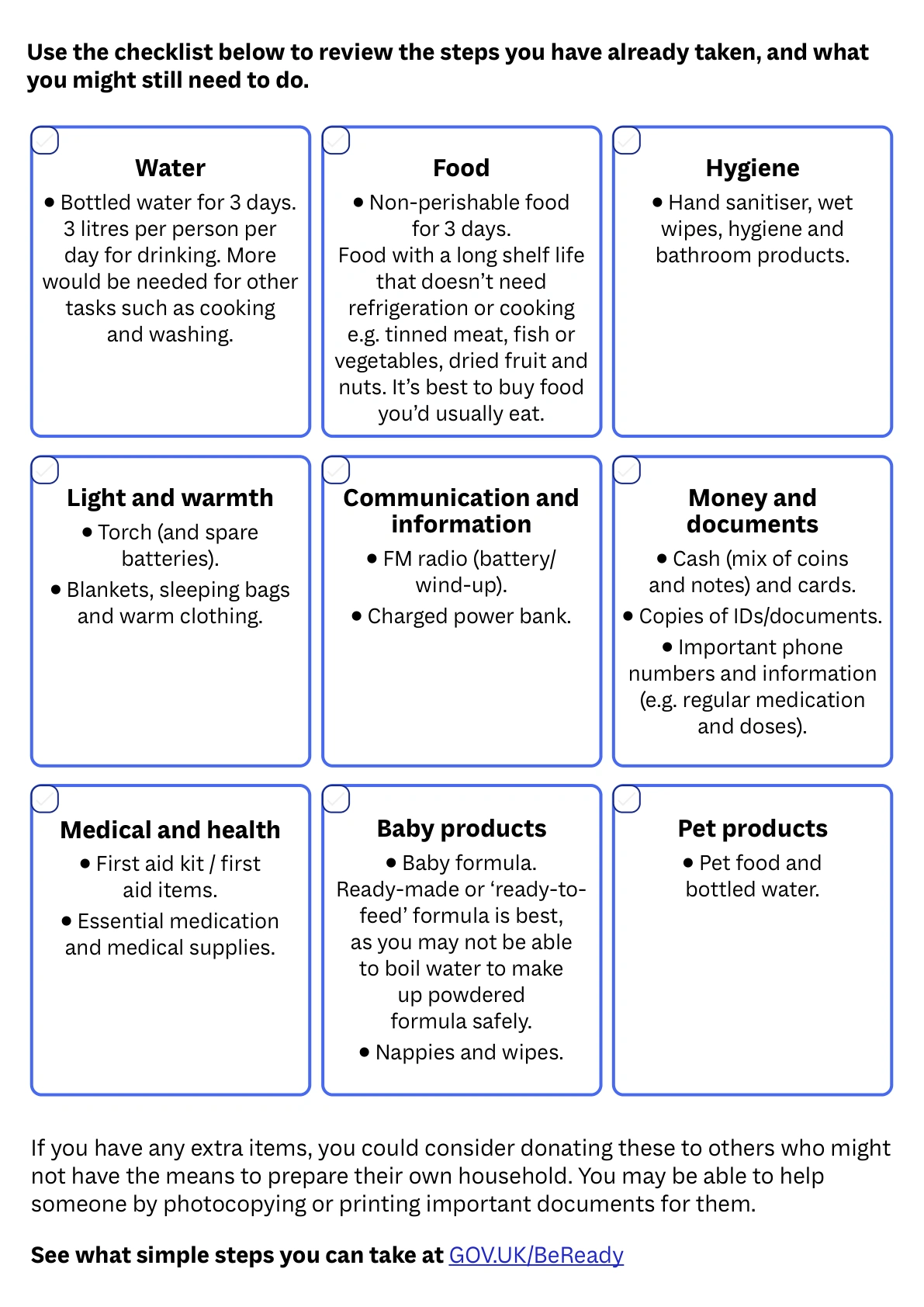
Download the official two-page Be Ready checklist PDF to print or save in advance. The image above is page two of that actual document, not a recreated government notice.
Will a battery backup keep my broadband and landline working?
It can power compatible equipment, but there are several links to check: the router, any separate fibre terminal, the phone equipment and the network outside the home. Ask your provider which items need backup and how long the offered solution is designed to support emergency calls. Powering only the router cannot fix a failure farther along the network.
Ofcom’s digital-landline guidance says customers who depend on their landline and lack a working mobile phone or reliable mobile signal must be offered a free backup solution for emergency access during a power cut. The minimum backup duration is one hour. Contact the provider before an outage; do not interpret this as a free three-day household electricity supply.
What to do if the power actually goes off
- Use your torch and check reliable information from your electricity network operator if connectivity allows. Do not approach fallen or damaged electricity lines.
- Report electricity faults on 105 in England, Scotland and Wales, or 03457 643643 in Northern Ireland. These are power-cut contacts, not substitutes for emergency services.
- For immediate danger, call 999. If your usual mobile network is unavailable, an emergency call may connect through another available network; this cannot work if no usable network is available.
- Use a battery or wind-up radio for information, conserve phone power and follow instructions issued for your area.
- Check on anyone you have agreed to support, where safe. Keep fridge and freezer doors closed and use official food-safety guidance if the interruption continues.
Use Be Ready’s power-cut advice and Ofcom’s communications guidance for the full instructions. Be Ready recommends torches rather than candles. If someone relies on powered medical equipment or a care alarm, agree the outage plan with the relevant care team or equipment provider in advance.
Frequently asked questions
Is a UK Black Sky event scheduled?
The preparedness sources reviewed for this guide do not announce a scheduled Black Sky event. A headline about a contingency plan is insufficient evidence of an impending shutdown. Check the date and source of any specific warning.
Will all mobile phones stop working at once?
Effects can vary by network, location and backup provision. Keeping a phone charged is useful, but it does not guarantee coverage during a widespread infrastructure failure.
Is DAB the same as internet radio?
No. DAB is broadcast radio; an internet station uses a data connection. Government power-cut advice says to try FM and digital broadcast modes for stations that remain available.
Does the Priority Services Register guarantee uninterrupted power?
Registration identifies additional support needs; it should not replace an individual backup plan. Check Priority Services Register eligibility in England, Scotland and Wales. Northern Ireland uses Customer Care Registers.
Do I need an expensive emergency kit?
Begin with existing supplies and a written plan. The official guidance encourages gradual preparation. Choose any additional equipment around the functions your household needs rather than the phrase used in a headline.
For more practical guides and science explainers, visit Horus Valley in English.
Sources
- UK Government: Be Ready household guidance
- UK Government: original Be Ready checklist PDF
- UK Government: power cuts
- UK Government: phone and broadband outages
- NESO: Electricity System Restoration Standard
- Ofcom: digital landlines and backup power
- UK Parliament: government answer on blackout risk, 8 September 2026
- BBC: Black Sky contingency reporting, 7 November 2026; also syndicated by AOL
You may also like
 UK Guides
UK ETA Rejected vs Refused: Can You Reapply or Do You Need a Visa?
UK ETA rejected or refused? Check the difference, when to reapply, when to seek a Visitor visa, current…
 UK Guides
UK Cold Snap November 2026? Met Office Forecast, Warnings and Safety Guide
The Met Office does not currently forecast a nationwide November 2026 big freeze. Check the latest UK weather…
 UK Guides
£100 Energy Payment: Council Tax Bands and Eligibility
Check the £100 Household Energy Payment, Council Tax bands, official postcode search and January 2027 payment arrangements in…