
£100 Energy Payment: Council Tax Bands and Eligibility
Check the £100 Household Energy Payment, Council Tax bands, official postcode search and January 2027 payment arrangements in England.
Contents

Updated 29 October 2026. This guide covers the announced scheme in England.
The £100 Household Energy Payment is a one-off payment announced in the Autumn Budget for eligible households in England in Council Tax bands A to D. Payments are expected to begin from January 2027. Checking your band is useful now, but it does not replace the full eligibility rules or your council’s instructions.
The immediate task is straightforward: identify the correct property, check its band through the official service, and establish which council administers your account. You do not need to pay a third-party website to perform that check.
What has actually been announced
The government’s 28 October energy-bills guidance identifies bands A–D, main homes and Council Tax responsibility as central eligibility conditions. It says most exempt households will be included, while full criteria will follow. Second homes and empty properties are excluded.
The 29 October information letter to councils describes a one-off scheme for this financial year and says detailed delivery guidance will be published shortly. January is the expected starting period, not a guaranteed payment date for every address.
This distinction matters if you are budgeting for a bill. An announcement establishes the policy; local delivery information establishes what happens to your particular account. Do not treat a headline, an unofficial eligibility calculator or an old rebate application as a confirmed instruction to claim today.
How to check your Council Tax band
Open Check your Council Tax band on GOV.UK. This starting page covers properties in England and Wales and directs people in Scotland to the Scottish Assessors service. The postcode checker’s coverage is broader than the England payment scheme, so finding an A–D property in the checker does not establish eligibility everywhere it operates.
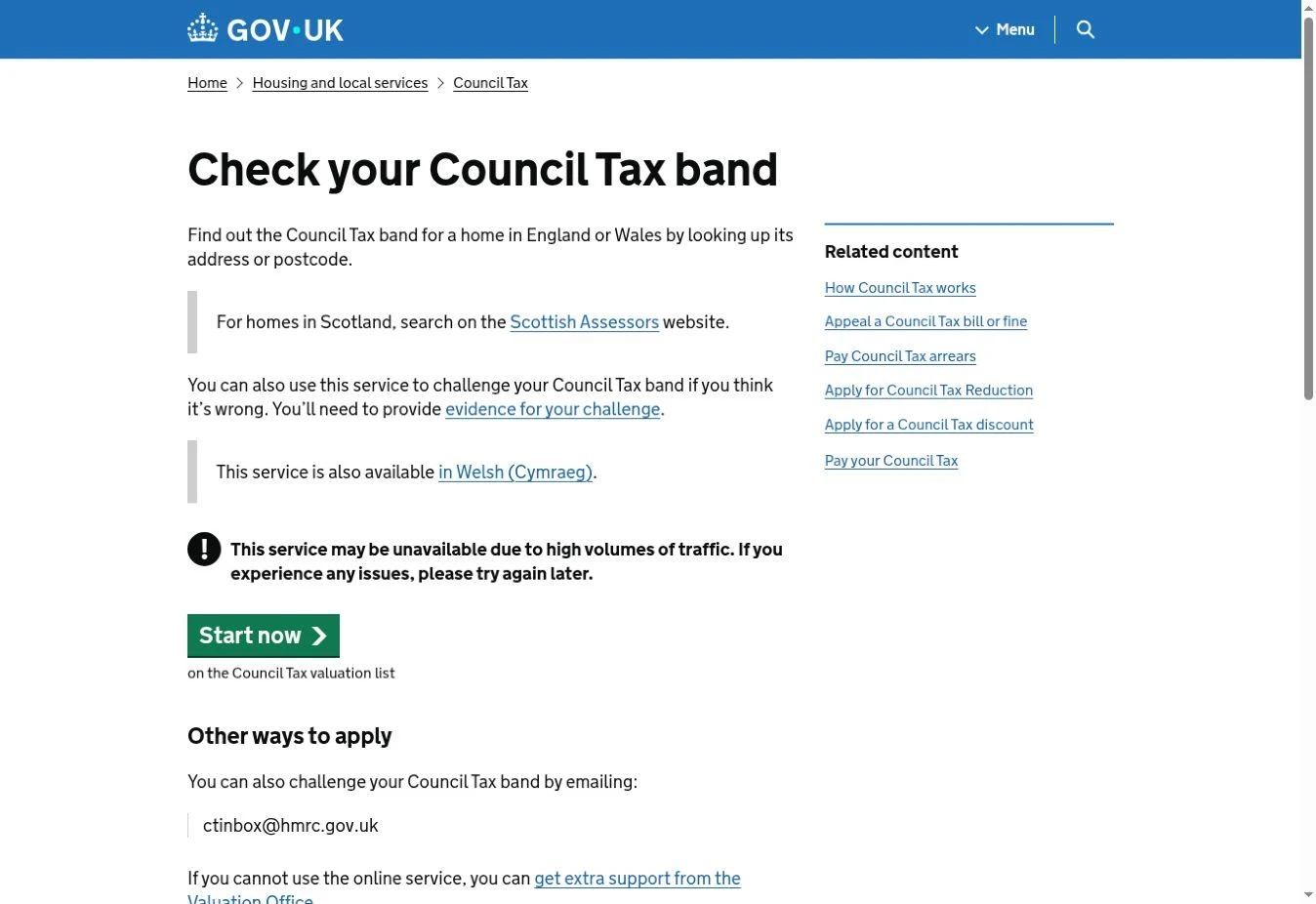
Select Start now to open the official valuation-list search. During our check on 29 October, it opened a page headed Search for a property with a postcode field and an Other search options link. The service displayed a high-demand warning, but the search form was accessible.
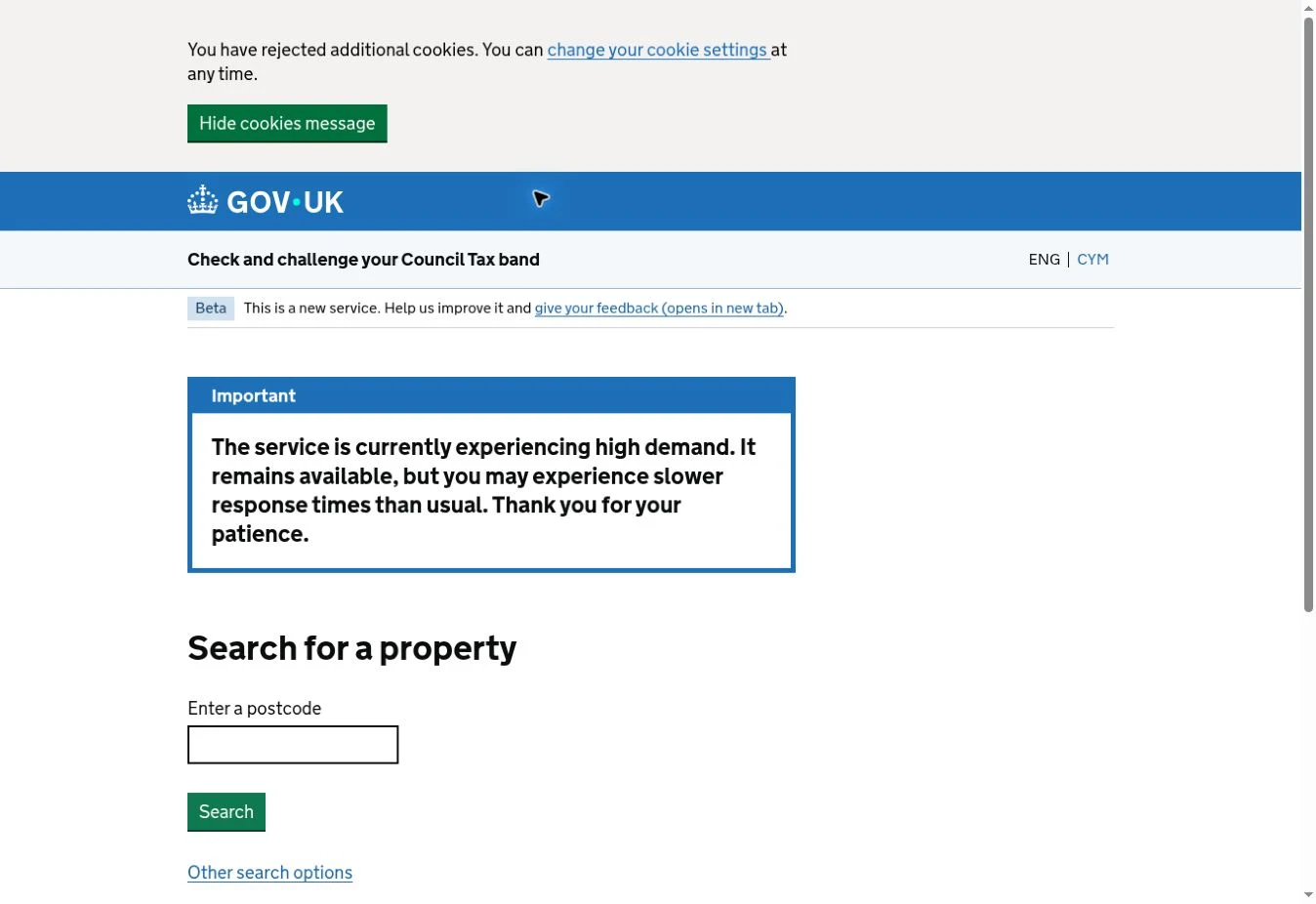
- Enter the postcode for the home you actually occupy.
- Follow the service’s address-selection steps and identify the correct property.
- Read its band and compare the address with your current Council Tax bill.
- Keep a note of the property details and the date you checked them.
- Return to your council’s official website for payment arrangements.
The first two screens were checked live for this guide. We did not enter a private address or submit an application, and the screenshots do not demonstrate that any individual household qualifies.
Choosing the correct property
A building can contain several separately listed flats. Check the full address, not simply the street name or postcode. A neighbour’s band is not a substitute for the entry for your home. If a converted property has an unfamiliar description, compare it with the description on your bill before drawing a conclusion.
For example, a search for a postcode may lead you to several addresses in one building. Finding an A-band flat somewhere in that list says nothing about a different flat. Record the entry that corresponds to the account you are checking.
This is an identification exercise. You should not challenge a property’s valuation merely because you want to receive a payment. The GOV.UK page links to a separate evidence-based process for people who believe their band is wrong.
Direct Debit and other payment methods
The government’s public guidance says eligible Direct Debit households will receive the rebate in their bank accounts without taking action. For households that do not use Direct Debit, councils will invite applications directly. It also warns that only the council should contact people about claiming the rebate.
That does not establish that a national application form is already open, that all councils will use one timetable, or that an immediate payment will follow a bank-details update. Follow the instructions published by the authority responsible for your account.
| Your situation | Practical next step |
|---|---|
| You pay by Direct Debit | Check your band and monitor your council’s official updates; no new application is announced for this route |
| You pay another way | Wait for the council’s published application arrangements |
| You are exempt or receive full Council Tax support | Check the forthcoming detailed rules rather than assuming inclusion or exclusion |
| Your account, address or household circumstances changed | Read the council’s instructions and ask which records it needs |
The table is a navigation aid, not an eligibility decision. A payment method alone does not establish entitlement.
Tenants, exemptions and recent moves
The published headline criteria do not resolve every household arrangement. If your landlord handles Council Tax, you live in an exempt property, or you recently moved, avoid guessing who will receive the money. The October guidance specifically says full eligibility criteria will follow.
Gather the information that will make a later enquiry useful: your current address, Council Tax account details where available, the relevant dates and the exact issue you need clarified. Keep these records private. You do not need to post your account number or tenancy paperwork in a public comment to ask a general question.
Lewisham Council’s announcement repeats the main-home, band and liability conditions and says further criteria and local arrangements will be confirmed. Its page is a useful example of the distinction between a national announcement and an authority’s delivery instructions; residents elsewhere should use their own council’s page.
Find the council that handles your account
Use Find your local council rather than relying on an advert or a social-media profile. Once on the authority’s website, look for Council Tax, cost-of-living support or a Household Energy Payment update.
If you cannot find an application, that does not mean you have missed a deadline. Tunbridge Wells’ 29 October update says it is awaiting detailed government guidance and residents do not need to contact it at this stage. Check what your own authority says before making an unnecessary call.
An effective question, when enquiries are invited, is specific: “I occupy this property as my main home, and my bill shows this band. Which published guidance covers my situation?” That is more useful than asking a council to confirm an eligibility claim based only on a news headline.
Other UK nations and other support schemes
The England rules should not be copied across the UK. The government says Scotland, Wales and Northern Ireland receive funding and their governments decide how to provide comparable support. Check the relevant devolved government’s current announcement before assuming its eligibility rules, timing or application route match England’s.
The Budget document separately provides £100 million for councils in England to offer targeted discretionary help to households affected by rising energy costs. That fund is distinct from the core £100 payment. It does not mean every household above band D automatically receives the same sum.
Other winter schemes also have their own rules. Horus Valley’s Cold Weather Payment guide covers a separate programme. Do not transfer its eligibility conditions to this payment or assume one award guarantees another.
Avoid false claim messages
Treat a message promising instant payment, requesting a processing fee or demanding urgent bank information as a reason to check the source independently. Open your council’s website yourself rather than trusting the link in the message. If necessary, use the contact details printed on your Council Tax bill.
Isle of Wight Council’s announcement specifically warns about unexpected messages requesting applications, personal information, bank details or fees. The presence of the correct payment amount in a message is not evidence that the sender is your council.
Keep the band check, eligibility check and payment instructions separate. A record in the valuation list identifies a property. The scheme rules establish entitlement. Your council’s official instructions explain delivery. Working through those three checks is the most useful preparation while detailed arrangements are published.
You may also like
 UK Guides
UK Digital ID Cancelled: What Happens to Right-to-Work Checks, One Login and eVisas?
The UK cancelled its national Digital ID programme, but One Login, eVisas and right-to-work checks continue. See the…
 UK Guides
UK Student Visa Financial Requirements From 30 November 2026: New Funds and Bank Statement Rules
UK Student visa financial requirements rise on 30 November 2026: London £1,570/month, outside London £1,203/month. Learn tuition calculations,…
 UK Guides
Child Benefit Stopped at 16? How to Restart Payments Before 30 November 2026
HMRC says parents who missed the August 2026 Child Benefit update can restart an eligible claim and may…