
Cold Weather Payment 2026–27: £25 Eligibility, Postcode Checker and Missing Payment Guide
Check the official 2026–27 £25 Cold Weather Payment postcode checker step by step, understand benefit eligibility, and resolve a missing payment safely.
Contents
- Cold Weather Payment 2026–27: essential dates and amounts
- Who qualifies? Start with the benefit, not the temperature
- Pension Credit: the simplest typical case
- Universal Credit: three common mistakes
- Income-related ESA and other legacy benefits
- How the seven-day temperature rule actually works
- Two hypothetical temperature examples
- Check your postcode for the 2026–27 Cold Weather Payment
- England and Wales: follow the official postcode checker screen by screen
- Northern Ireland: the checker uses a separate page
- What the postcode result means—and what it does not
- Why this checker may not display a payment on 1 November 2026
- Why someone in the next town may receive £25 when you do not
- How much could you receive over the winter?
- When will the money reach your bank account?
- Missing Cold Weather Payment: a practical 2026–27 troubleshooting route
- A ready-to-use Universal Credit journal message
- When a child under five joins your household
- Hospital and care-home situations
- Four worked examples: deciding what to do without guessing
- Scotland, Northern Ireland and the rest of the UK: do not mix up three schemes
- Avoid common Cold Weather Payment scams and misleading headlines
- Early-season checklist: seven things to verify
- Sources, method and review date
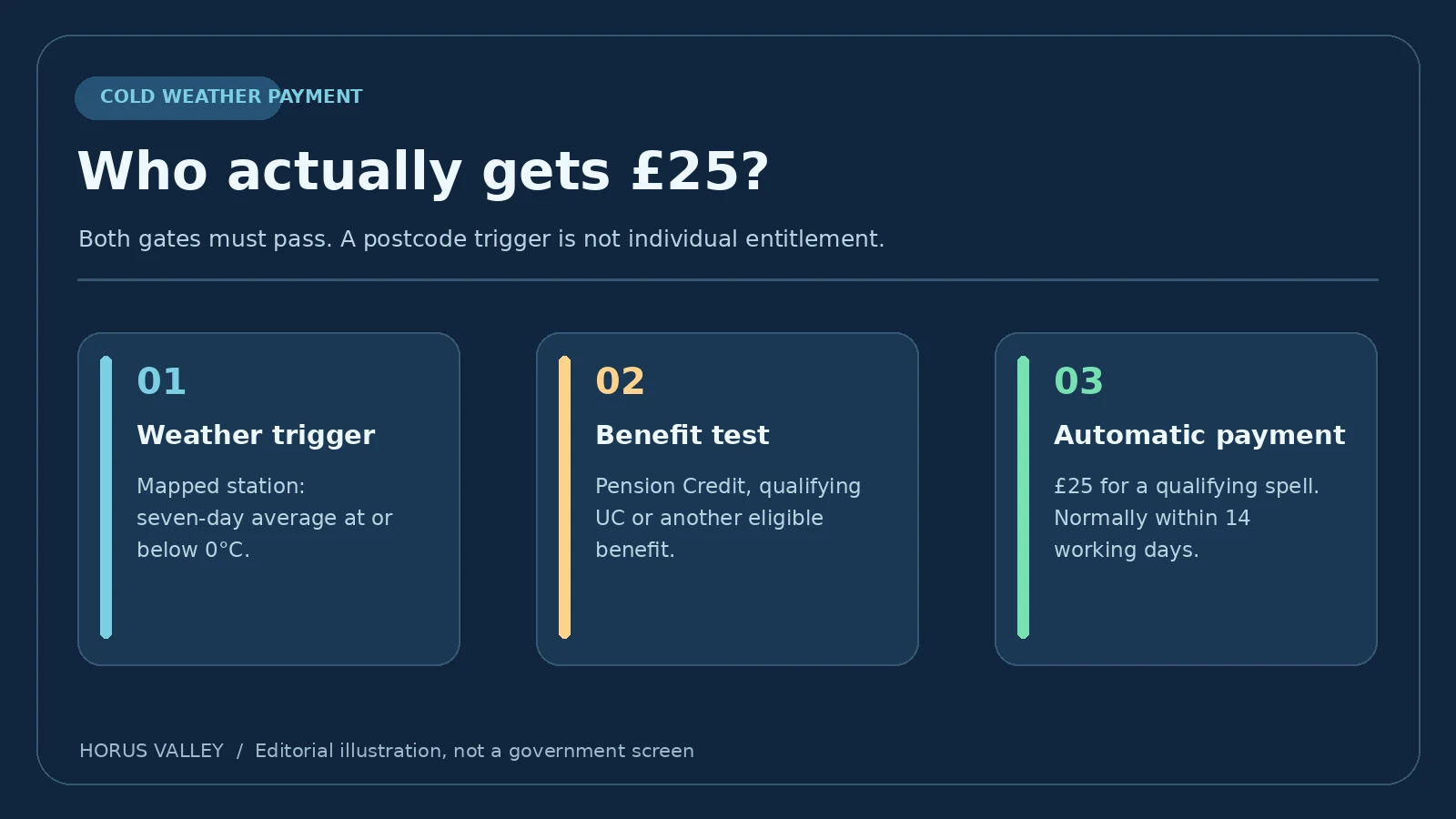
The 2026–27 Cold Weather Payment season began on 1 November 2026. Eligible people in England, Wales and Northern Ireland can receive £25 per qualifying seven-day period when the official recorded or forecast average temperature for their assigned weather station is 0°C or lower. The winter scheme ends on 31 March 2027. There is no claim form: qualifying payments are made automatically into the account used for the relevant benefit. This guide has been substantively updated on 1 November 2026 with an on-screen postcode-checker walkthrough. Use GOV.UK for the scheme rules, not social-media payment lists.
There are two questions that must BOTH have a favourable answer: Has your postcode's assigned weather station triggered a payment? And did your household meet the qualifying benefit conditions for that period? A below-freezing night, an eligible benefit in isolation, or a neighbour's payment does not prove your own entitlement. This guide explains how to check both sides, why locations are assigned to different weather stations, what to do when money is missing, and how Scotland's different system works.
Cold Weather Payment 2026–27: essential dates and amounts
| Item | Official rule for 2026–27 | Practical implication |
|---|---|---|
| Scheme begins | 1 November 2026 | The 2026–27 season has started; check the official service for real triggers, not the previous winter. |
| Scheme ends | 31 March 2027 | No £25 weather-triggered payments outside this seasonal window. |
| Cold threshold | Recorded or forecast seven-day average of 0°C or less | A single frosty morning does not qualify. |
| Amount | £25 per qualifying seven-day spell | Three eligible non-overlapping triggers mean £75, not £25 for every ordinary week. |
| Claims | Automatic if you qualify | Avoid third-party “registration” forms asking for bank details. |
| Normal arrival | Within 14 working days after a triggered spell | Weekends and public holidays can affect the calendar date. |
| Postcode checker | 2026–27 triggers checkable during November 2026 onward | The 2026–27 scheme has started; a current trigger appears only when confirmed by the official checker. |
| Where available | England, Wales, Northern Ireland | Scotland pays a separate annual Winter Heating Payment to qualifying people. |
Official sources: GOV.UK scheme overview, benefit eligibility, 14-working-day payment rule and nidirect Northern Ireland guidance, checked 1 November 2026. A positive postcode weather result is not a personal benefits entitlement decision.
Who qualifies? Start with the benefit, not the temperature
Receiving any state benefit is not enough. You need to meet the specific qualifying rules, and those differ by benefit. The latest GOV.UK eligibility page focuses on Pension Credit, income-related ESA, Universal Credit and Support for Mortgage Interest. DWP's 2025–26 statistical methodology also covers remaining legacy Income Support and income-based JSA claimants; those categories require individual verification as the benefits transition changes.
| Benefit or circumstance | Likely outcome and important qualification |
|---|---|
| Pension Credit | Normally qualifies if the location triggers; check any change in personal circumstances. |
| Income-related ESA | Normally qualifies in the support or work-related activity group; other ESA recipients may need a qualifying disability/pensioner premium, disabled child or child under five. |
| Universal Credit | Generally requires neither adult in a couple to be employed or gainfully self-employed and either limited capability for work or a child under five; an award containing the disabled child amount is a separate route even when an adult works. |
| Support for Mortgage Interest | May qualify if treated as receiving a qualifying benefit and the specified disability/pensioner/child conditions apply. |
| Income Support / income-based JSA (legacy) | Some remaining recipients may be eligible under additional premiums or child rules; confirm with the paying office and do not assume all JSA qualifies. |
| PIP, Attendance Allowance or State Pension alone | Not an automatic entitlement to Cold Weather Payment; check whether you also have a qualifying income-related benefit. |
| Scotland resident | No Cold Weather Payment under this scheme; see Scotland's Winter Heating Payment instead. |
Important distinction: “Income-related ESA” is not the same as every form of ESA. And “Universal Credit” does not mean every UC household receives a payment. Read your benefit statement and the official eligibility rules rather than applying a social-media yes/no test.
Pension Credit: the simplest typical case
If someone receives Pension Credit and lives in a postcode whose assigned weather station triggers, they will usually receive the £25 automatically. A person receiving only the State Pension is in a different position: State Pension by itself is not the qualifying benefit. Someone who may be eligible for Pension Credit should check the official Pension Credit information; obtaining it may affect access to several kinds of help, but an application made today does not establish entitlement to a previous winter period without an official decision.
Universal Credit: three common mistakes
First, a person receiving Universal Credit who works is not generally covered merely because household income is low. Ordinarily, neither adult in the couple should be employed or gainfully self-employed, and there must be either limited capability for work or a child under five.
Second, the UC disabled child amount changes the answer. GOV.UK explicitly says people with that amount in their claim can qualify whether or not they or their partner work. That exception is often lost in simplified online summaries.
Third, a child under five must be correctly recorded on the claim. If you have had a baby or a young child has come to live with you, report the change in your Universal Credit account, not just to a school or GP. The department warns that the payment may not be automatic without that update.
Income-related ESA and other legacy benefits
For income-related Employment and Support Allowance, membership of a support group or work-related activity group usually qualifies. If someone is outside both groups, a qualifying premium, a disabled child or a child younger than five may establish entitlement. For the remaining Income Support or income-based Jobseeker's Allowance cases, DWP's official methodology continues to recognise eligible claimants; however, because entitlement depends on the exact legacy award and possible migration to UC, the correct next step is to check with the office administering that award. Do not assume a claim for new-style or contribution-based JSA meets the same rules.
How the seven-day temperature rule actually works
The official rule is about the seven-day average temperature at a designated weather station, recorded or forecast at 0°C or lower. In England and Wales, DWP's 2025–26 methodology describes a network of 71 Met Office weather stations, with postcode districts allocated to stations according to how representative their climate is. The department uses recorded and forecast averages and avoids counting overlapping seven-day periods more than once. The exact station mapping for a new season should be confirmed when published. Source: DWP methodology.
This is not the same as the air temperature inside your home, an overnight low displayed on your phone, or simply counting seven icy mornings. It is also not a nationwide trigger: one mapped area can qualify while another does not.
Two hypothetical temperature examples
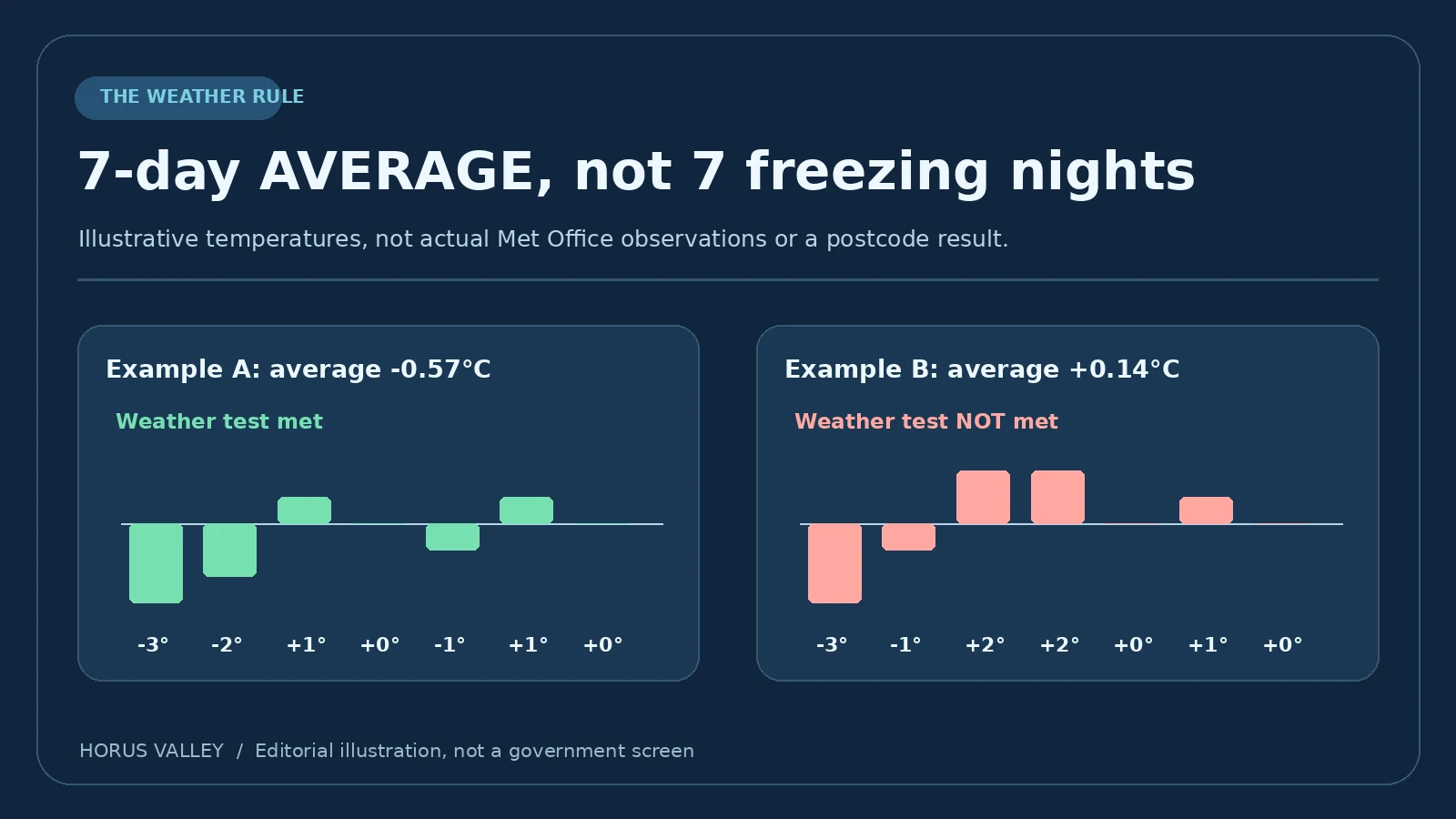
Imagine a weather station reports seven daily averages (°C): −3, −2, +1, 0, −1, +1, 0. Their sum is −4, so the simple seven-day average is −4 ÷ 7 = approximately −0.57°C. If these were the relevant official inputs and no overlapping spell had already been paid, this would cross the weather threshold despite some days being above zero.
By contrast, suppose the averages were −3, −1, +2, +2, 0, +1, 0. Their sum is +1; +1 ÷ 7 ≈ +0.14°C. This hypothetical period would not cross the weather threshold even though several individual days were freezing or colder. Actual triggers are decided by DWP using its weather-station data and forecasts, not by readers performing these sums.
| Hypothetical mapped-station result | Temperature condition | Possible £25 trigger? |
|---|---|---|
| Seven-day average −0.57°C | At or below freezing | Weather condition met; personal eligibility still needed. |
| Seven-day average +0.14°C | Above freezing | No trigger on that average. |
| Overnight minimum −5°C, daytime mild | Insufficient by itself | A minimum is not a seven-day average. |
| Two seven-day windows sharing most days | Could overlap | DWP prevents duplicate payments for overlapping periods. |
Check your postcode for the 2026–27 Cold Weather Payment
The official checker starts at coldweatherpayments.dwp.gov.uk. The screenshots below were captured directly from the live public services on 1 November 2026. We followed the England/Wales journey and submitted LS1 1AG, the example postcode printed on the official form, to show how to read a real result. We did not access a claimant’s benefits account. Northern Ireland has a separate nidirect checker.
England and Wales: follow the official postcode checker screen by screen
- Open the government checker: use coldweatherpayments.dwp.gov.uk directly, or follow the postcode link from GOV.UK. Confirm the address bar ends in the official
dwp.gov.ukdomain. - Choose your nation: the starting page asks which country you want to check. Select England or Wales. Do not use the separate Northern Ireland checker for an English or Welsh address.
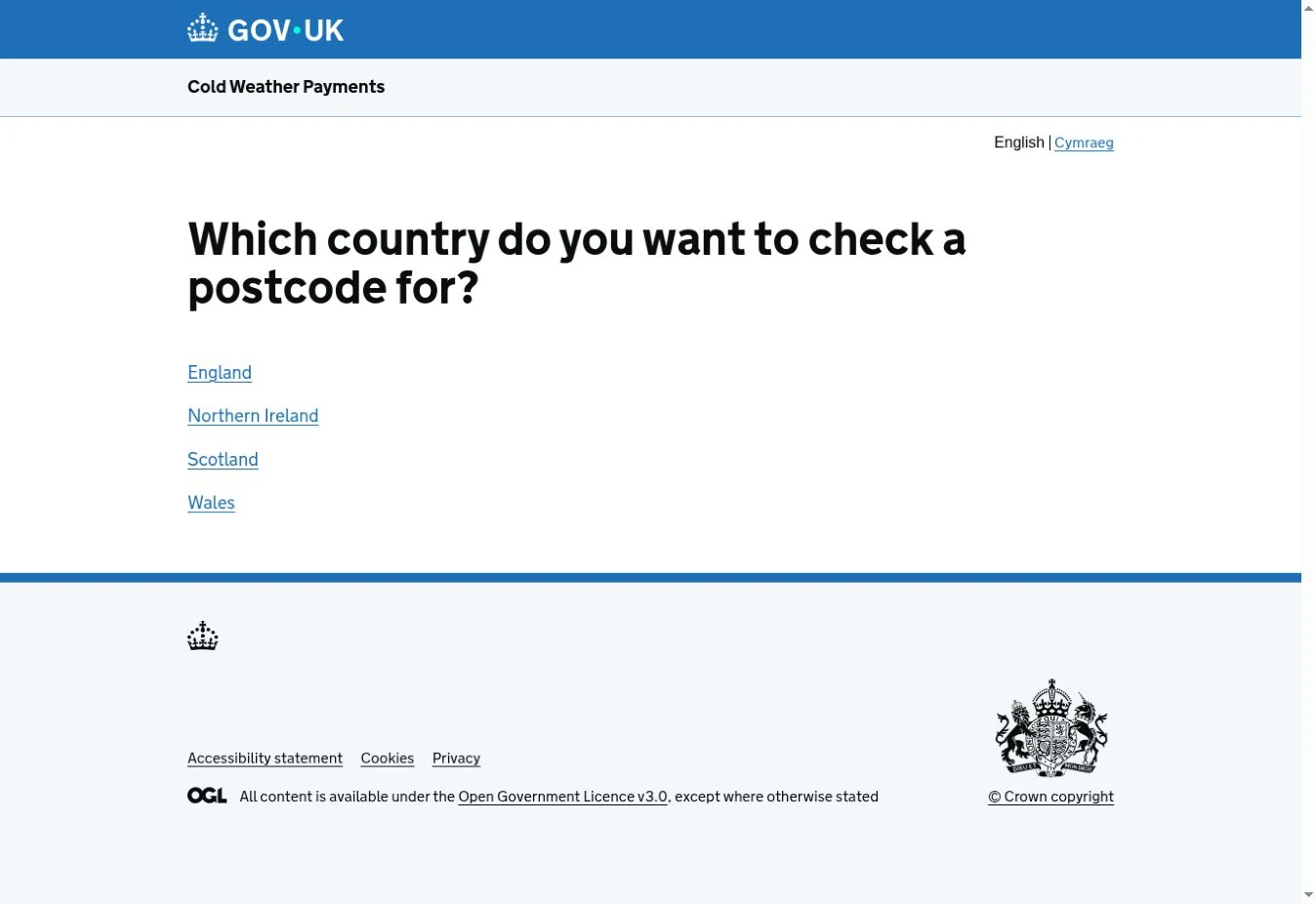
Next, open the England or Wales form. Both links lead to the postcode-entry screen shown below. Use the address recorded on your qualifying benefit claim; the field’s printed example is not a postcode you should copy for your own claim.
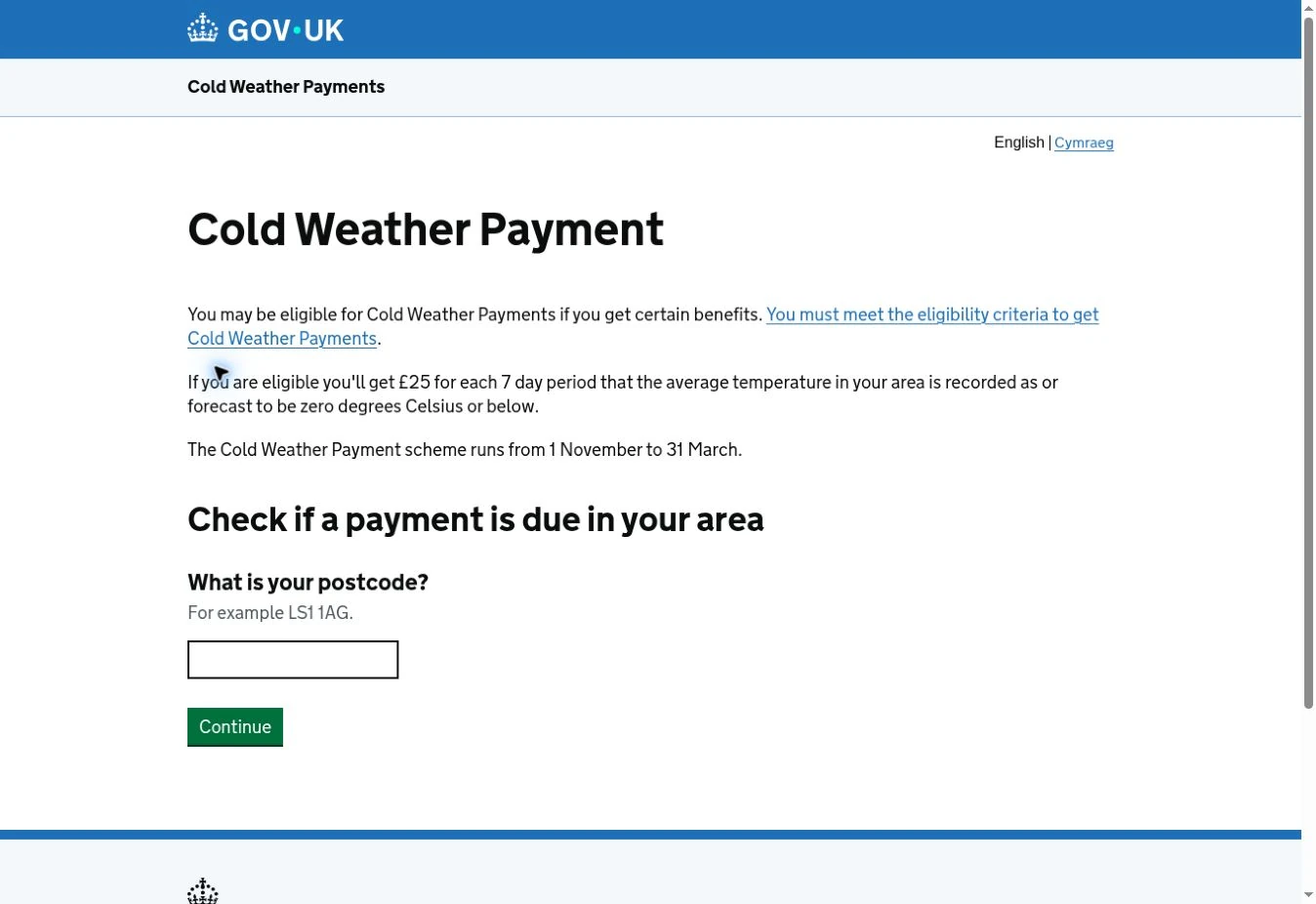
- Find the postcode field: look for the heading Check if a payment is due in your area and the label What is your postcode?. The official example is LS1 1AG, a full postcode. Enter the postcode for the address recorded on the qualifying benefit claim.
- Submit the official form: continue using the button on that page. Read the complete response, paying special attention to the winter or qualifying-period dates rather than relying on a search-result snippet.
- Interpret the result: if the government service shows a triggered period, note its date(s) and keep the result for your own records. If no qualifying period is shown, that does not rule out a later payment: the winter season continues until 31 March 2027.
- Check personal eligibility separately: verify your Pension Credit, qualifying Universal Credit, income-related ESA or other relevant benefit circumstances against the official eligibility criteria. The weather screen is not a person-specific award decision.
- If both conditions are met: allow up to 14 working days after the qualifying cold spell; then follow the missing-payment instructions in this article if nothing arrives.
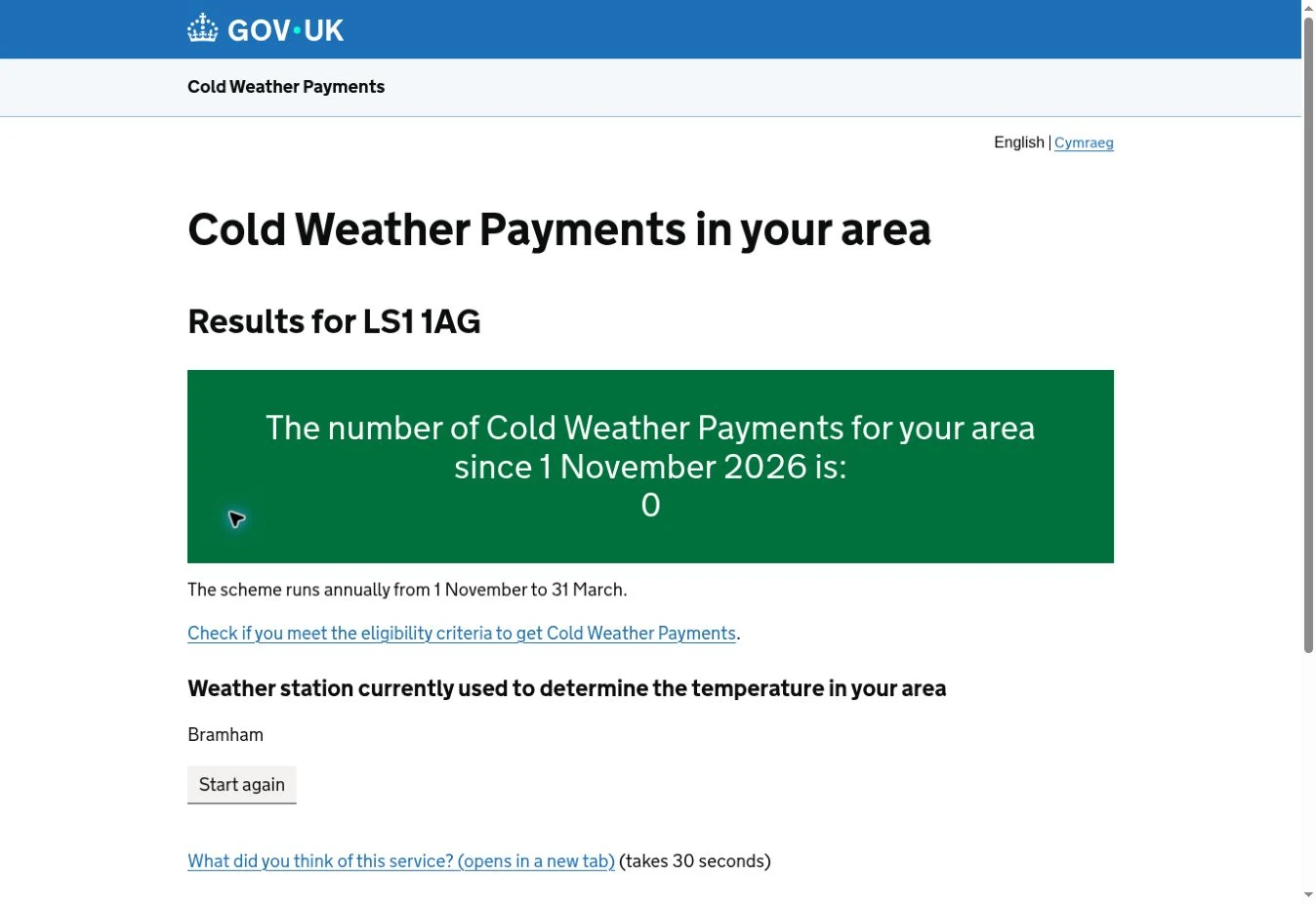
Reading the real example: the green panel shows the payment count for the postcode and season. The weather-station name appears underneath. A count of 0 means the service showed no qualifying trigger for this example postcode when captured; it does not decide whether a claimant meets the benefit rules or whether a later cold spell will trigger a payment.
Important: a full postcode (such as the example shown on GOV.UK) is appropriate for the official checker. Do not publish your full address, National Insurance number, bank information or a screenshot containing personal details in blog comments. This walkthrough describes public screens; we did not enter an actual claimant’s postcode or inspect a personal benefits account.
Northern Ireland: the checker uses a separate page
- Open nidirect: Cold Weather Payment checker.
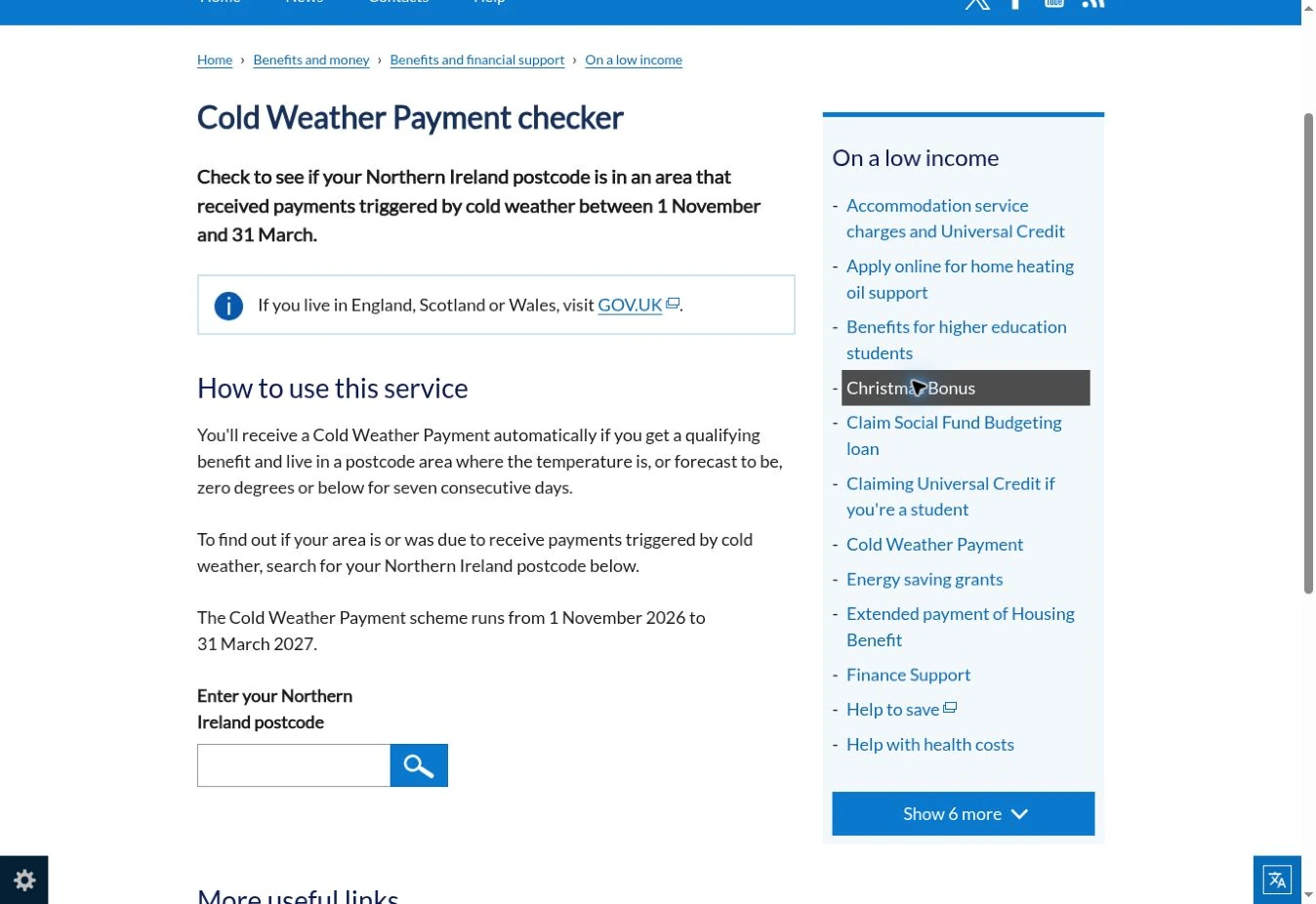
- Locate the label Enter your Northern Ireland postcode and use the postcode linked to the household’s benefit claim.
- Read the period and dates returned by the service. Its public page identifies the current winter as 1 November 2026 to 31 March 2027.
- If a trigger appears, check benefit eligibility as a separate question; wait for the normal automatic payment window or contact the Northern Ireland Pension Centre / local Jobs and Benefits office as appropriate.
What the postcode result means—and what it does not
| What appears / happens | How to interpret it | Next sensible step |
|---|---|---|
| Government checker shows one or more qualifying periods | The official weather trigger appears to have been recorded for the mapped location. | Verify personal benefit rules, note dates and allow 14 working days. |
| Checker shows no qualifying periods | No trigger is shown for that postcode and period at the time checked. | Do not assume an immediate £25 payment; check again after future cold spells. |
| Page still mentions 2025–26 | The service may not yet be fully refreshed for the newly opened 2026–27 winter. | Revisit from the main GOV.UK guide; do not quote old trigger lists as current. |
| Your neighbour received £25 but you did not | Different mapped stations or different benefit circumstances may explain it. | Confirm your own postcode and eligibility before contacting the benefit office. |
| Trigger confirmed, more than 14 working days have passed | A missing payment enquiry may now be appropriate. | Use your UC journal or contact Pension Service/Jobcentre Plus; never a fee-charging agent. |
Example: A postcode checker may show one qualifying seven-day period; a Pension Credit recipient who met the rules during that period may receive £25. A second person at the same postcode with only State Pension does not automatically qualify. Conversely, two qualifying spells could mean £50 for an eligible recipient, not £25 for every winter week.
Why this checker may not display a payment on 1 November 2026
The scheme starting does not mean every weather station has triggered a payment. During our live check on 1 November 2026, the DWP result for the official form’s example postcode LS1 1AG showed 0 payments since 1 November 2026 and named Bramham as its weather station. This is a dated demonstration for one postcode, not a nationwide statement or a forecast for the rest of winter. Repeat the check with your own postcode to see the latest result.
- England/Wales: open the DWP country selector and use the full-postcode field (example LS1 1AG).
- Northern Ireland: use the nidirect service and read its stated winter dates.
- Record the official trigger period if one appears, then separately confirm personal eligibility and payment timing.
- If the service is showing 2025–26 information, do not mistake it for a 2026–27 trigger.
What you should never enter into a weather checker: your bank PIN, banking app password, payment card CVV or an advance “administration fee”. Cold Weather Payments are automatic. If a message asks you to pay to release a government benefit, treat it as suspicious and navigate to GOV.UK independently.
Why someone in the next town may receive £25 when you do not
The assigned weather station is what matters. DWP maps postcode districts to meteorological stations using climate representativeness and geography, not necessarily the nearest place where a reader happens to see snow. An urban area, upland valley or coastal neighbourhood may be attached to different station data. Two genuine claimants with identical benefits may receive different payments in the same week because their mapped stations triggered differently. That does not by itself indicate an error, although an incorrect address on a claim is worth correcting.
How much could you receive over the winter?
There is no guaranteed £25 every week. The number of non-overlapping cold spells that trigger in your mapped area controls the total, provided you were eligible for those periods. Multiply the number of eligible triggers by £25.
| Qualifying triggers in your area | Example amount for a qualifying recipient |
|---|---|
| 0 | £0 |
| 1 | £25 |
| 2 | £50 |
| 3 | £75 |
| 4 | £100 |
| 6 | £150 |
These are illustrative amounts, not a 2026–27 forecast. A seven-day spell can be established by a forecast as well as recorded temperatures, and DWP's system determines which non-overlapping periods count. A family should not budget on six triggers merely because there were six cold-looking weeks last winter.
When will the money reach your bank account?
GOV.UK states that Cold Weather Payments should normally arrive within 14 working days after each qualifying very cold period. The money goes to the same bank or building-society account as your qualifying benefit. A working-day period is not the same as a 14-day calendar period: weekends and public holidays may push the arrival date later. The department does not publish a universal nationwide payday because different weather stations trigger on different dates.
For example, if a hypothetical trigger finished on a Friday, do not count the following Saturday and Sunday as working days. Check the bank account linked to your benefit rather than waiting for a separate paper cheque or responding to a payment-activation SMS. Official reference: When you'll get paid.
Missing Cold Weather Payment: a practical 2026–27 troubleshooting route
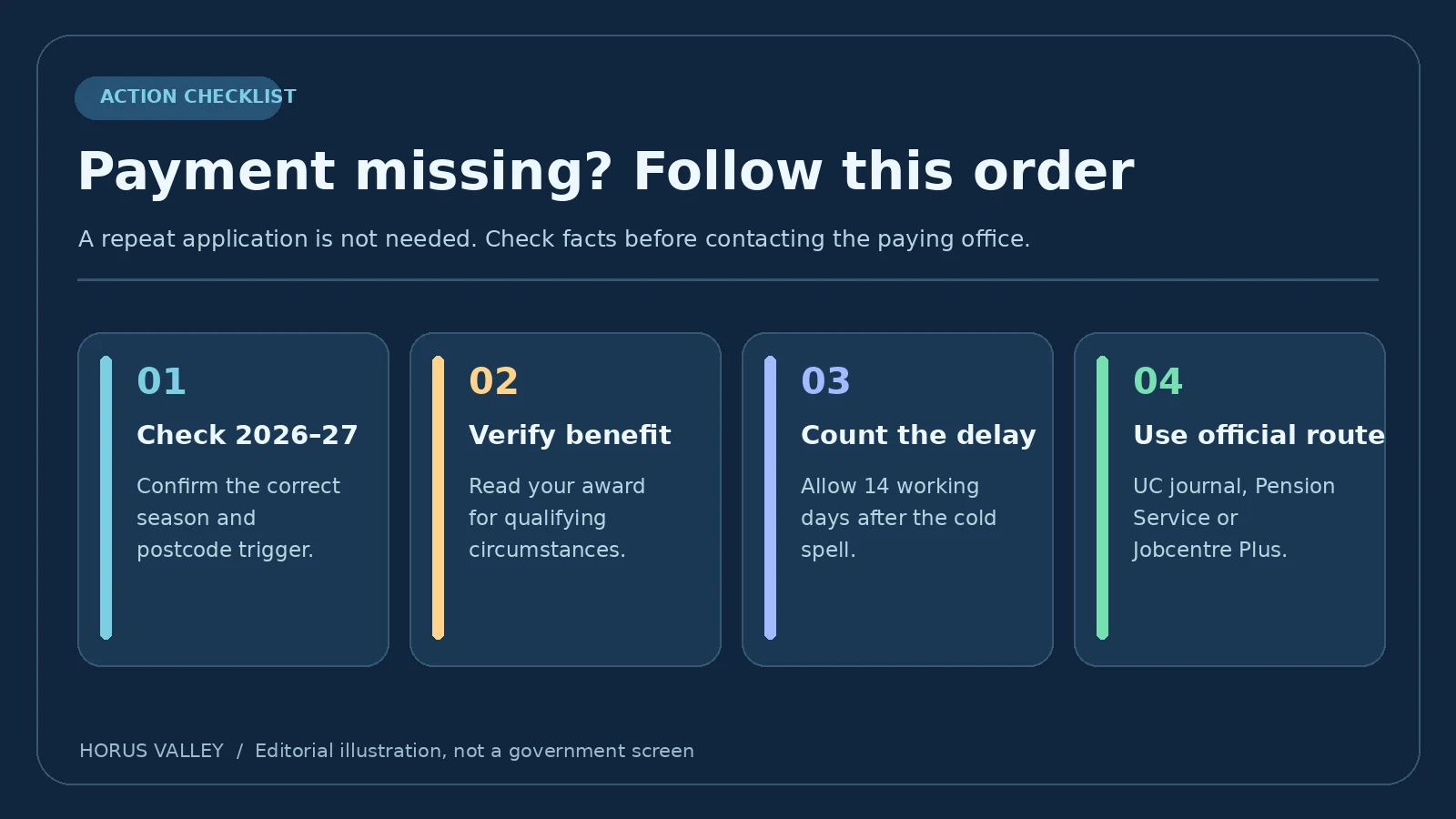
If the checker shows a trigger and your money has not arrived, resolve the problem in a consistent order rather than repeating an unsupported online application.
- Confirm location and season. Check the 2026–27 period, not a historical page from 2025–26. Verify that the postcode is the current address recorded on the relevant benefit claim.
- Confirm the weather trigger. Save the government result or record the dates and the postcode district shown. If no trigger occurred, the next step is to check again after new cold weather, not to claim £25 anyway.
- Confirm the qualifying benefit. Read the latest UC statement or other benefit decision. Look for limited-capability or disabled-child elements where relevant. A claim for PIP alone is not enough.
- Check reported changes. If a baby arrived or a child under five moved in, make sure the correct authority has recorded the change. Also report moves, relationship and bank-account changes through the normal benefit route.
- Count working days. Allow the normal 14-working-day payment period after the cold spell, then check the bank account used for benefit payments.
- Contact the correct office. In England or Wales, contact the Pension Service or Jobcentre Plus as appropriate. If receiving UC, write a clear note in your Universal Credit journal, or call the helpline shown on your official award correspondence if you cannot access your account. In Northern Ireland, contact the Northern Ireland Pension Centre or your local Jobs and Benefits office; UC claimants should use their account journal.
- Request an explanation. Give the relevant dates, your current postcode, benefit type and whether your child/disability circumstances were up to date. Keep records of the answer and any reference number. Only share personal details through an authenticated government channel.
A ready-to-use Universal Credit journal message
I am checking a possible Cold Weather Payment for the 2026–27 season. My postcode district is [POSTCODE DISTRICT]. The official postcode checker shows a qualifying cold period ending [DATE]. I believe my Universal Credit award meets the eligibility rules because [RELEVANT UC ELEMENT OR CIRCUMSTANCE]. More than 14 working days have passed, and I have not received a payment in my usual benefit account. Please check whether my entitlement and address have been recorded correctly and explain the next step.
This wording is an editorial template. Do not paste a full National Insurance number, bank password or card details into a public discussion. Use the secure account journal for benefit-specific queries.
When a child under five joins your household
If you receive Universal Credit, record the birth or arrival as a change of circumstances, then write in your journal if needed. For income-related ESA, tell Jobcentre Plus. Government guidance says these changes can affect automatic eligibility. The action should be taken promptly as part of ordinary benefit administration, not postponed until a weather warning is issued. What you need to do.
Hospital and care-home situations
A stay in hospital can affect the payment; GOV.UK explicitly asks recipients to tell the Pension Service or Jobcentre Plus, or add a journal note for UC. Care-home circumstances can also be relevant to entitlement; do not rely on a headline suggesting all residents are automatically included. Ask the administering office to assess the dates and personal circumstances. Hospital stays.
Four worked examples: deciding what to do without guessing
Example A: Pension Credit in Wales. The government checker reports one qualifying trigger for the claimant's postcode. The claimant receives Pension Credit and their details have not changed. Likely next action: expect an automatic £25 within the official payment window; if it does not arrive, contact the Pension Service. The trigger does not mean every person in that postcode receives money.
Example B: Working UC parent with a disabled-child amount. An employed parent sees a qualifying cold period and assumes they cannot be paid because they work. But GOV.UK says the disabled-child amount in a UC claim may qualify regardless of work status. They should review their award and ask for a check if eligible; a child having a disability is not necessarily proof that the required amount is present in the claim.
Example C: Universal Credit without a qualifying circumstance. A single adult receives UC, works, has no child under five and no disabled-child amount. Their postcode triggers. Their benefit status by itself is not enough; the sensible action is to check the precise rules rather than assume the checker promises £25.
Example D: Neighbours across a weather-station boundary. Both neighbours receive Pension Credit. One postcode maps to a station whose seven-day average is below zero; the other does not. They may have different weather-trigger results without either having an incorrect award.
Scotland, Northern Ireland and the rest of the UK: do not mix up three schemes
England and Wales use the DWP Cold Weather Payment scheme and its government postcode-checking service. Northern Ireland runs a parallel £25 scheme, with its own nidirect pages and checker. Scotland does not run Cold Weather Payment, having replaced it with a different annual Winter Heating Payment for qualifying lower-income households. Scotland's 2026–27 amount is £62, regardless of the number of freezing spells. It is also separate from Scotland's Pension Age Winter Heating Payment for eligible older residents. Sources: mygov.scot and the Scottish Government's 2026–27 rates.
| Scheme | Where | Main trigger | 2026–27 payment structure |
|---|---|---|---|
| Cold Weather Payment | England and Wales | Qualifying benefit + 7-day cold average in mapped area | £25 per qualifying cold spell |
| Cold Weather Payment | Northern Ireland | Comparable benefit/weather rules; NI administration | £25 per qualifying cold spell |
| Winter Heating Payment | Scotland | Qualifying low-income benefit and Scottish eligibility rules | Single £62 payment, independent of cold spells |
| Winter Fuel Payment | England, Wales, Northern Ireland | Separate age/residency and income-recovery framework | Not the same as Cold Weather Payment |
| Pension Age Winter Heating Payment | Scotland | Separate pension-age rules | Separate annual amount depending on circumstances |
For the separate pension-age scheme, see Horus Valley's Winter Fuel Payment 2026–27 guide. For bills that remain unexpectedly high even with support, see our UK energy price cap and high-bill guide.
Avoid common Cold Weather Payment scams and misleading headlines
A common misleading headline says “All UK households to get £25 a week from November.” That is false: only eligible claimants in locations with official weather triggers receive the payment, and Scotland uses a separate system. Another deceptive claim says applicants must click an emailed link and pay a small administration fee to unlock money. There is no application fee or online registration requirement for Cold Weather Payment. Northern Ireland's official guidance also warns that it does not send texts or emails asking recipients to supply bank details. nidirect.
Never trust a search ad, social post or text simply because it uses a government logo. Start from GOV.UK or nidirect yourself. A genuine entitlement question can be raised through the normal UC journal or benefits office; there is no need to send banking passwords or one-time security codes to somebody offering to “check a postcode”. If you suspect fraud, consult the relevant official reporting service and contact your bank immediately if account credentials were compromised.
Early-season checklist: seven things to verify
- Check that your current address and postcode are correct in your benefit account.
- Read the specific rules for your benefit; especially check UC children/disability exceptions and employment status.
- Tell UC or ESA about a new baby or a child under five joining your household.
- Bookmark the government England/Wales guide or Northern Ireland checker; use the public 2026–27 checker during November and later; check the dates shown in each result.
- Do not confuse a weather trigger with a personal approval, and do not budget for a guessed number of winter payments.
- If triggered and eligible, note the end of the period and allow 14 working days before investigating missing money.
- If you are in Scotland, switch to the annual Winter Heating Payment guidance instead.
Sources, method and review date
Substantively updated: 1 November 2026. Original guide published 27 October 2026. Four real screenshots were captured on 1 November 2026: the DWP country selector, England/Wales postcode form, a result for the form’s printed example LS1 1AG, and the nidirect checker. The example returned 0 payments since 1 November 2026 and Bramham weather station. No claimant account or personal benefit entitlement was inspected. Screenshots show dated public-page states; repeat checks for current results. DWP screenshots reproduce public government information under the Open Government Licence v3.0; government branding remains the respective owner’s property. nidirect screenshot credit: Crown copyright, nidirect; reproduced to explain its public service. The article distinguishes DWP benefit rules from official postcode trigger results and illustrative worked examples. DWP station counts from the 2025–26 methodology are labelled historical; verify any new-season mapping before relying on a station count. Source priority: GOV.UK and nidirect for payment rules and screens, mygov.scot for Scottish Winter Heating Payment, DWP methodology for weather calculations, then independent money-advice sites for comparison.
- GOV.UK — Cold Weather Payment overview
- GOV.UK — Eligibility
- GOV.UK — What you need to do
- GOV.UK — When you will get paid
- DWP — Background and methodology, 2025–26
- nidirect — Cold Weather Payment 2026–27
- nidirect — Postcode checker
- mygov.scot — Winter Heating Payment
- Scottish Government — 2026–27 benefit rates
- DWP — official country-selection page
- DWP — England/Wales public postcode checker
- nidirect — Northern Ireland postcode checker
- Horus Valley — separate £100 England Household Energy Payment explainer
Bottom line: For 2026–27 the £25 payment is automatic only when your qualifying benefit conditions and your postcode's official seven-day cold trigger align. Start with your benefit entitlement, check the official postcode service after the winter scheme opens, then use the normal benefits office or UC journal if a due payment has not arrived.
You may also like
 UK Guides
£100 Energy Payment: Council Tax Bands and Eligibility
Check the £100 Household Energy Payment, Council Tax bands, official postcode search and January 2027 payment arrangements in…
 UK Guides
UK Digital ID Cancelled: What Happens to Right-to-Work Checks, One Login and eVisas?
The UK cancelled its national Digital ID programme, but One Login, eVisas and right-to-work checks continue. See the…
 UK Guides
UK Student Visa Financial Requirements From 30 November 2026: New Funds and Bank Statement Rules
UK Student visa financial requirements rise on 30 November 2026: London £1,570/month, outside London £1,203/month. Learn tuition calculations,…