
UK Student Visa Financial Requirements From 30 November 2026: New Funds and Bank Statement Rules
UK Student visa financial requirements rise on 30 November 2026: London £1,570/month, outside London £1,203/month. Learn tuition calculations, 28-day funds, 31-day bank proof and common refusal errors.
Contents
- Quick answer: how much money must you show?
- What exactly changes on 30 November 2026?
- London and outside London are defined by where you study
- Does the new figure apply to Child Student visas or dependants?
- Work out your exact amount in five steps
- Worked examples: how much savings are needed?
- Example A: a London master’s applicant with £8,000 tuition outstanding
- Example B: a six-month course outside London
- Example C: a sponsor accommodation deposit
- Example D: exchange-rate uncertainty
- The 28-day rule and the 31-day evidence rule
- Example: the old amount is in the account but the 30 November increase is not
- Example: funds are held for 28 days, then a debit reduces the account
- Evidence date and application date are different
- Which bank statements and funding sources are accepted?
- What a compliant bank statement should show
- What if you use a student loan or official sponsor?
- Do you have to upload financial evidence with the application?
- Does a dependant add extra savings?
- How to prepare your application, step by step
- Mistakes that cause delays or refusals
- Troubleshooting: what if your bank letter is rejected or the visa is refused?
- Your bank will not issue a 28-day history letter
- The exchange rate falls after you collected your statement
- You already applied before 30 November but your appointment is later
- Your visa is refused over finances
- What the competing university guides miss — and what this page adds
- Official documents and useful links

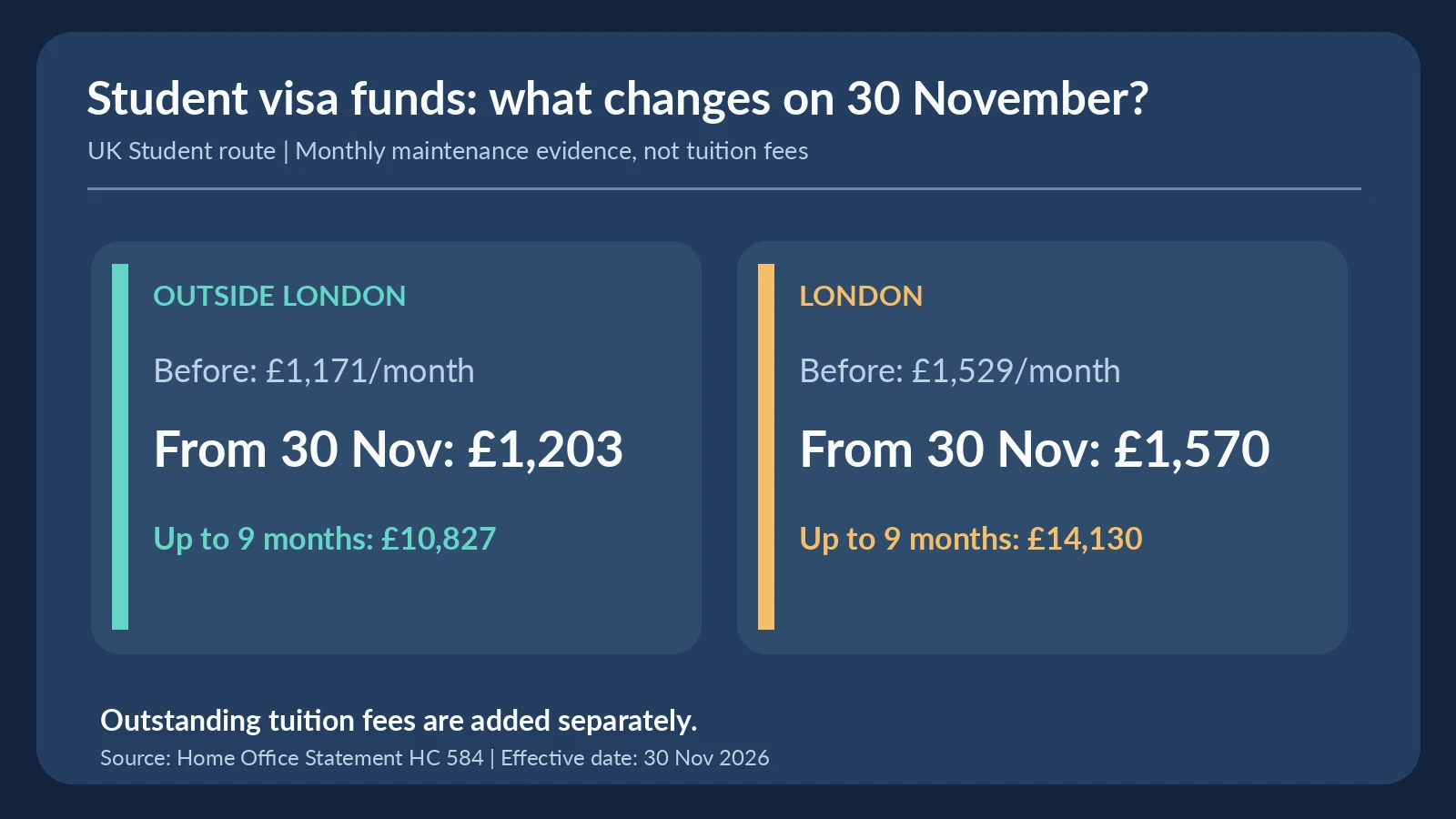
From 30 November 2026, applicants for a UK Student visa who need to meet the financial requirement will generally need to show £1,570 per month for living costs in London or £1,203 per month outside London, for up to nine months. The new nine-month totals are £14,130 and £10,827 respectively, plus any outstanding tuition fees shown on your Confirmation of Acceptance for Studies (CAS). The change is set out in the UK Home Office’s official HC 584 Statement of Changes, published on 3 September 2026. Read the exact rule change.
The critical date is when your visa application is made, not when a university issues your offer or when you attend a biometric appointment. Applications made before 30 November are assessed under the earlier figures for these particular changes; applications made on or after 30 November use the increased figures. In addition, most applicants relying on bank funds must hold the complete required amount for 28 consecutive days, with sufficiently recent evidence. Information checked 28 October 2026; the increased figures are future-effective on the date of this guide. Home Office implementation paragraph.
Quick answer: how much money must you show?
| Application date | Outside London (per month) | London (per month) | Outside London: nine months | London: nine months |
|---|---|---|---|---|
| Up to 29 November 2026 | £1,171 | £1,529 | £10,539 | £13,761 |
| 30 November 2026 onwards | £1,203 | £1,570 | £10,827 | £14,130 |
| Increase per month | £32 | £41 | £288 for nine months | £369 for nine months |
These are maintenance (living-cost) figures. They are not visa application fees, not the Immigration Health Surcharge, not a guarantee of how much you will actually spend, and not a substitute for the tuition-fee balance. Your calculation also depends on your course length, study location, paid tuition, eligible sponsor accommodation payments, and whether a financial-evidence exemption applies. The rule changes £1,529 to £1,570, £1,171 to £1,203, and the maximum sponsor-arranged accommodation offset to £1,570. See APP ST8–ST10.
What exactly changes on 30 November 2026?
The Home Office changed Appendix Student, paragraphs ST 12.3(a), ST 12.3(b), and ST 12.4. The increase is not a newly introduced requirement to maintain a separate UK bank account: the core framework still revolves around tuition fees plus a monthly amount for living costs, supported by an acceptable funding source. The September 2026 explanatory memorandum describes the increase as an annual uplift aligned with the maintenance-loan levels for home students. Explanatory memorandum.
London and outside London are defined by where you study
The relevant location is generally your main study site, not the address where you rent a room. Someone whose programme is mainly taught in a Greater London borough ordinarily uses the London figure, even if they live across the boundary. A student based in Bath, Sheffield, Cardiff or Edinburgh generally uses the outside-London figure. For a multi-site course, check the main study location and your sponsor’s international student adviser before deciding which rate applies. Appendix Student requirements.
Does the new figure apply to Child Student visas or dependants?
This article is about the Student route, not boarding-school cases under the separate Child Student route. The £845 (London) and £680 (outside London) monthly amounts currently listed for eligible Student dependants are distinct from the Student applicant’s new maintenance uplift; HC 584 APP ST8–ST10 do not themselves replace those dependant figures. Not all students can bring dependants. Since the January 2024 changes, the eligible postgraduate category is usually a PhD, doctorate or research-based higher degree, or a qualifying government-sponsored course. Verify eligibility before adding family costs. GOV.UK dependant guidance.
Work out your exact amount in five steps
- Find your course start and end dates on the CAS. Work out the number of course months, rounding any part month up to a whole month, to a maximum of nine.
- Confirm whether your main study location falls within Greater London or outside London; use the rate that applies on the date your visa application is made.
- Find the first academic year’s course fees on your CAS and deduct tuition already paid to the education sponsor, provided the payment is recorded correctly on the CAS or proved by an eligible sponsor receipt.
- If you paid the sponsor for sponsor-arranged accommodation, see whether an eligible amount may be offset against maintenance, up to the legal cap (from 30 November: £1,570). A private landlord deposit does not normally qualify.
- Combine outstanding eligible course fees and maintenance after any legitimate offset; then check whether the funding source meets the evidence rules and has been held for the required period.
Basic formula: funds to evidence = unpaid qualifying tuition fees + (applicable monthly maintenance rate × course months, maximum nine) − any allowable accommodation offset. If you have an official full scholarship or compliant student loan, evidence may take a different route, but you still must satisfy the relevant rules. See Appendix Student ST 12.
Worked examples: how much savings are needed?
Example A: a London master’s applicant with £8,000 tuition outstanding
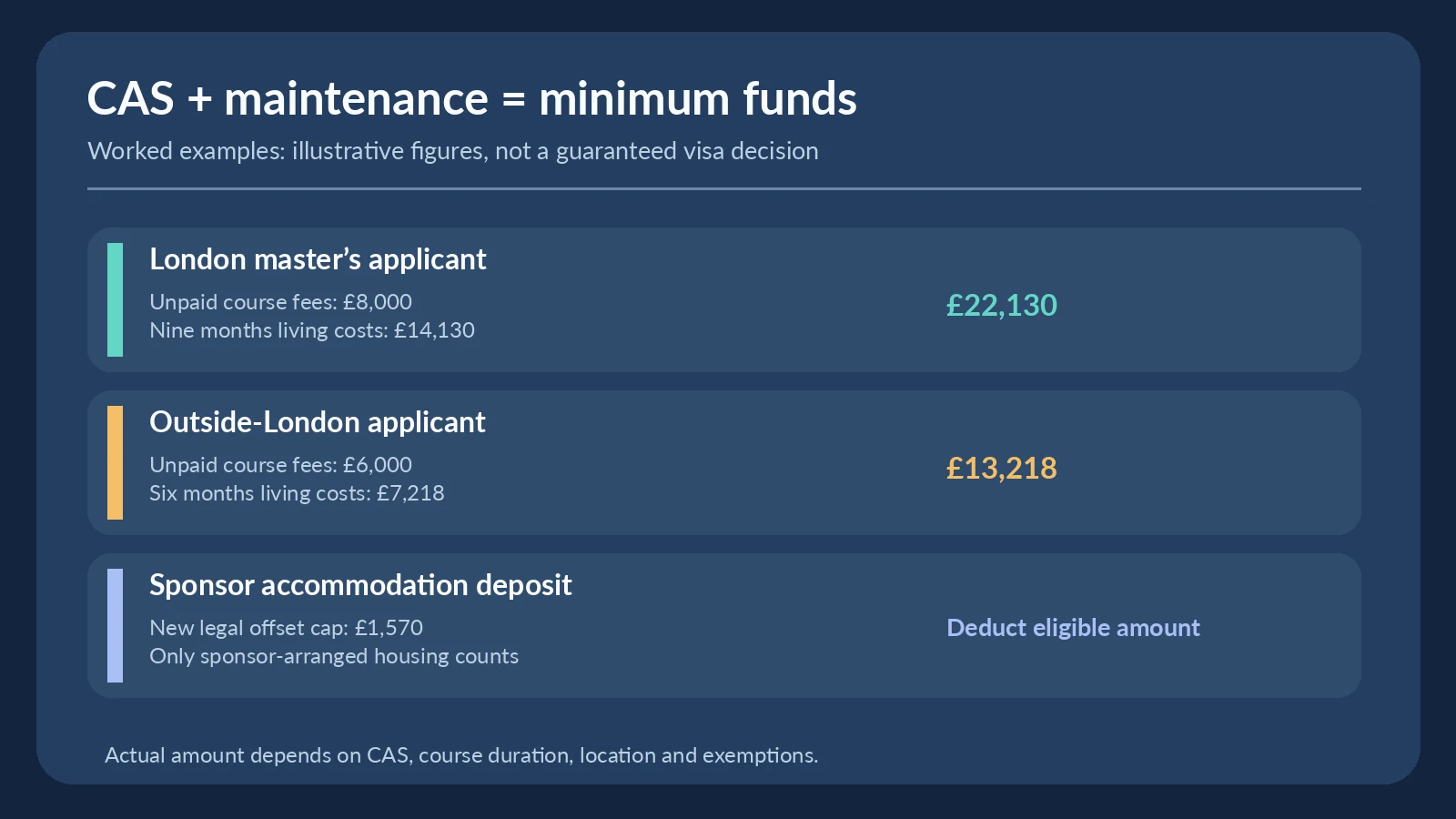
Suppose the course lasts at least nine months and your main study site is in London. Your CAS records £20,000 annual tuition, of which you have already paid £12,000 to the sponsor. For an application on or after 30 November 2026: £20,000 − £12,000 = £8,000 unpaid tuition. Add 9 × £1,570 = £14,130 maintenance. Total ordinary bank-funded requirement: £22,130. Applying before 30 November under the older monthly rate would instead produce £21,761. The difference is £369; applying early does not bypass the separate legal timing and document rules.
Example B: a six-month course outside London
A course runs for exactly six qualifying months outside London, with £6,000 unpaid course fees. For a post-change application, the maintenance element is 6 × £1,203 = £7,218; the total is £13,218. Do not automatically multiply every course by nine months. A course of six months and a few days may round up to seven months under the Immigration Rules. And do not use the London rate simply because your university has a London head office if your actual main teaching site is elsewhere.
Example C: a sponsor accommodation deposit
A London applicant has £8,000 in outstanding tuition and nine months of maintenance (£14,130). The university also records a £2,200 deposit paid for accommodation arranged by the same education sponsor. From 30 November 2026, only up to £1,570 can ordinarily be offset. The example minimum becomes £8,000 + £14,130 − £1,570 = £20,560. Paying £2,200 to a private rental agency normally does not create this deduction. The eligibility of the payment and its inclusion in sponsor evidence matter more than the word “deposit” alone. HC 584 changes ST 12.4.
Example D: exchange-rate uncertainty
You hold funds in euros, Egyptian pounds, rupees or another currency. UKVI normally converts eligible foreign funds using the OANDA spot rate on the application date, under Appendix Finance. A bank statement converted at yesterday’s rate or a screenshot of a Google exchange rate is not the binding UKVI conversion. If the balance is just above the threshold, currency movement could turn a seemingly adequate account into a shortfall. Build a sensible buffer; there is no official universally safe percentage. Appendix Finance FIN 1.1.
| Applicant | Tuition unpaid | Maintenance | Allowable sponsor accommodation offset | Illustrative bank amount |
|---|---|---|---|---|
| London, 9-month course | £8,000 | £14,130 | £0 | £22,130 |
| Outside London, 6-month course | £6,000 | £7,218 | £0 | £13,218 |
| London, 9-month course, qualifying sponsor accommodation payment | £8,000 | £14,130 | £1,570 | £20,560 |
| Outside London, 9-month course, tuition fully paid | £0 | £10,827 | £0 | £10,827 |
All four examples assume the student needs to demonstrate funds by ordinary personal or permitted family bank evidence, is not in an exempt route and has no other offsets. Visa fees, Immigration Health Surcharge and tuition for any other year are separate questions. The exact CAS figures and the applicant’s circumstances always control.
The 28-day rule and the 31-day evidence rule
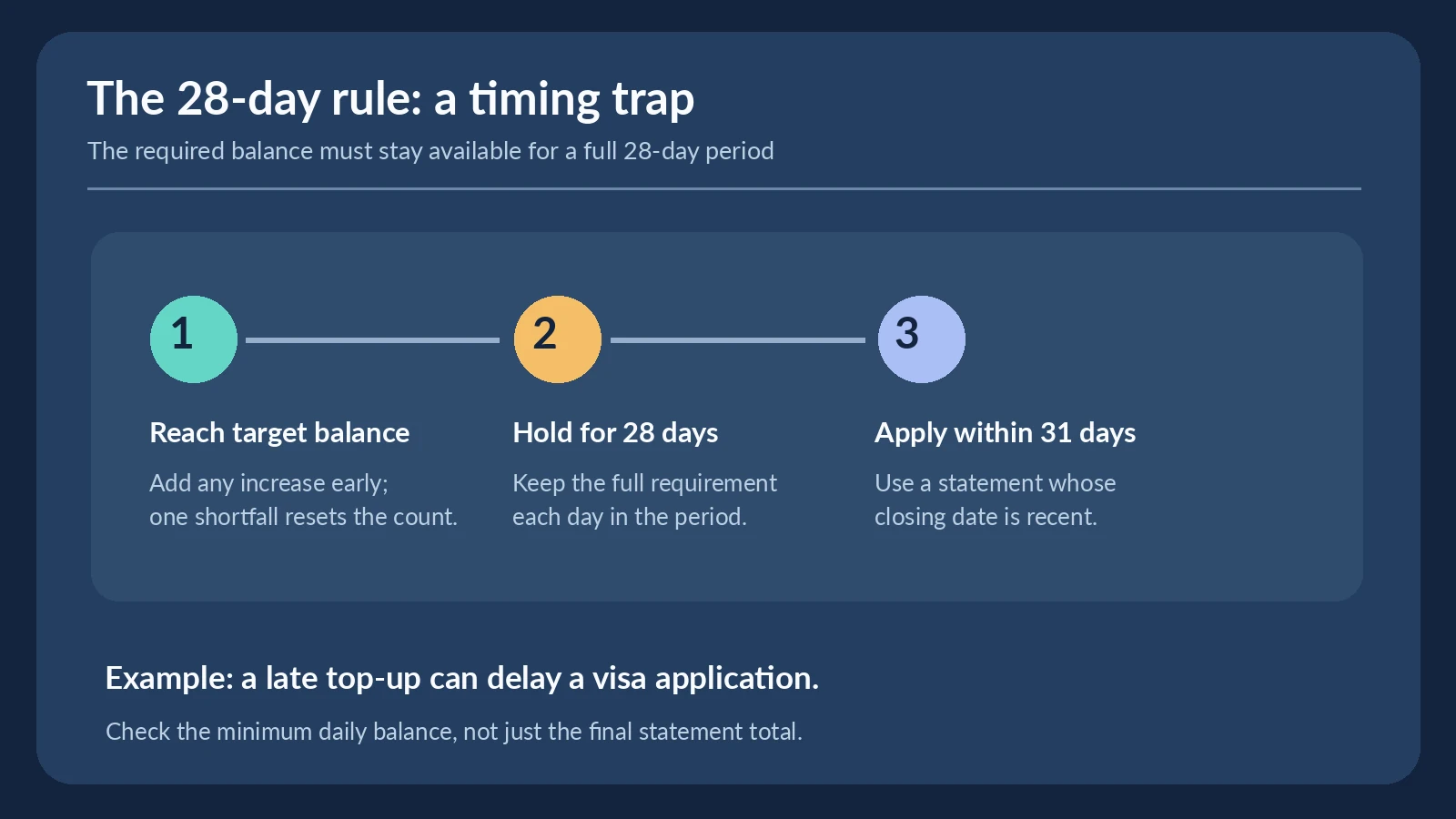
For ordinary bank-funded applications, the required amount must be available for 28 consecutive days. Think of the lowest closing balance during the qualifying period, not the highest balance or the balance on the day the statement is printed. The end of that 28-day period shown by the financial evidence must be no more than 31 days before the visa application date. This is why a bank letter issued too early can fail even when the money has existed for months. Read GOV.UK financial evidence guidance and Appendix Finance.
Example: the old amount is in the account but the 30 November increase is not
Imagine a nine-month applicant outside London already held £10,539 plus unpaid tuition for two months. On 20 November they add the extra £288 required for a post-30-November application. The larger amount has not been held for 28 days by 30 November. An application on that date using ordinary bank funds may fail the money-evidence test despite the final balance being sufficient. The person should allow a complete 28-day holding period after the new full amount is available, obtain a compliant statement, and ensure the evidence remains within 31 days of the application. Exact date counting and statement coverage should be checked with the student sponsor.
Example: funds are held for 28 days, then a debit reduces the account
Suppose the required balance is £22,130. During the 28-day period a card payment briefly takes the recorded account to £21,900. A later transfer that returns it to £22,500 does not repair that uninterrupted 28-day period. You generally need to identify a fresh eligible period when the balance did not dip below the requirement. Using more than one account can be possible where all evidence conditions are met, but overlapping periods and funds must genuinely demonstrate the required amount.
Evidence date and application date are different
The UKVI test is tied to the date the online visa application is made, not simply the date an applicant schedules or attends biometric enrolment. Plan for bank processing delays, weekends and any institution-specific CAS verification procedure. If you are close to the 30 November transition, seek your university’s immigration team’s advice rather than trying to rely on an unfinished or unpaid online form as if it were a submitted application. HC 584 implementation wording.
Which bank statements and funding sources are accepted?
| Source | Can it work? | Key condition |
|---|---|---|
| Your own current or savings account | Usually yes | You control the account; funds are accessible and 28-day evidence is met |
| Parent or legal guardian account | Can work | Evidence of relationship and their written consent, plus compliant bank evidence |
| Qualifying partner account | May work | Evidence must satisfy the relevant Appendix Finance control rules and relationship conditions |
| Official financial sponsorship | Yes, if compliant | Proper sponsor letter or CAS entry covering required funds |
| Eligible student loan | Yes, if compliant | Loan letter satisfying the visa rules; separate account 28-day rule may not apply |
| Overdraft, credit card or credit limit | No as funds | Available credit is not qualifying personal cash balance |
| Shares, bonds, locked investments | Normally no | Funds must be immediately accessible; see detailed exceptions in Appendix Finance |
| Cash kept at home or unverified informal promises | Not sufficient by itself | Qualifying documentary evidence and verifiable controlled funds are required |
The rules allow certain regulated accounts that are in the applicant’s, parent’s/guardian’s or partner’s name. They do not allow a random cousin or friend’s account to be treated as parental funds just because the person is willing to support you. If parents will fund your studies, prepare a formal relationship document such as a birth certificate and a signed consent letter, as well as their compliant financial evidence. Currency and financial-institution verification are additional risks. Government evidence guide.
What a compliant bank statement should show
- Name of the bank or building society and enough contact or identification details for verification.
- Name of the account holder, with evidence linking that person to the applicant where relevant.
- Account identification, dates and balances showing the whole consecutive 28-day window.
- Enough available funds every day during that window, not just on the final date.
- The closing evidence date within 31 days before application; translation where required for non-English documents.
- Funds held with an acceptable, verifiable financial institution and available for immediate access.
Electronic statements can be acceptable. A stamped letter is not universally required, but an official letter may help if a downloaded document omits critical information. A spreadsheet you created yourself or an edited PDF will not replace verifiable bank documents. Home Office caseworkers may contact financial institutions; unverifiable documents create an application-refusal risk. Robert Gordon University financial evidence checklist.
What if you use a student loan or official sponsor?
An eligible student loan or government/university scholarship can satisfy some or all of the financial requirement through evidence other than an ordinary 28-day bank balance. Your letter must meet detailed content, date and availability conditions; an informal promise of future funds is not enough. Check who provides the loan, how much is payable, when it is available, and whether your CAS records scholarship payments. A partial award does not make the remaining balance disappear: calculate the uncovered part separately. Appendix Finance FIN 8.3.
Do you have to upload financial evidence with the application?
Applicants who qualify under the differential evidence arrangement may not have to submit bank documents at the outset, but UKVI can request the evidence later. This does not mean the financial requirement has been waived; the ability to meet it still matters. Applicants applying for permission to stay who have already lived in the UK with valid permission for at least 12 months normally satisfy the Student financial requirement without fresh bank evidence under Student ST 12.1. Exceptions and other special categories need to be tested against the current rules. GOV.UK exemptions list.
Never assume the country shown on a social-media list is still eligible for lighter evidence treatment. Nationality-based evidence rules and the individual application pathway may change. Check the current official country list on the day you apply, not only an article screenshot.
Does a dependant add extra savings?
In the limited cases where a student is eligible to sponsor a partner or child, each dependant generally needs extra maintenance: £845/month in London or £680/month outside London, for up to nine months. These are separate figures from the new student maintenance amounts. A student travelling with a partner and one child would potentially need two separate dependant amounts on top of the student’s own funds and any unpaid tuition. However, most taught master’s students cannot automatically bring dependants under post-2024 rules. Check route eligibility first. Student dependant eligibility and financial requirements.
How to prepare your application, step by step
- Ask the university to verify the CAS and ensure that tuition already paid and any eligible sponsor-accommodation payment are correctly recorded.
- Confirm the application date you realistically can meet; use the old maintenance amount only for a genuine application before 30 November 2026.
- Calculate the new minimum balance from course months, campus location, unpaid tuition and allowed offsets, with a currency buffer if relevant.
- Check permitted sources of money and identify whose name is on the account; gather parental consent, sponsor or loan letters if applicable.
- Hold the full required amount for the complete consecutive 28-day period; do not spend below the minimum during that time.
- Generate the most recent bank statements, double-check the 31-day rule and whether translations or extra bank details are required.
- Use the official GOV.UK Student visa application route, upload requested documents accurately, and save confirmation of the application date.
- Retain original evidence and be ready for additional verification or a request for financial documents, even if initially exempt from uploading them.
Start from the official Student visa overview and the government application instructions. The exact digital application screens can change; this guide deliberately does not recreate a fake UKVI screenshot. Where a government form asks you for something different from this overview, follow the live form and the current Immigration Rules, and seek your sponsor’s visa advice team if it affects eligibility.
Mistakes that cause delays or refusals
| Mistake | Why it fails | Better approach |
|---|---|---|
| Using £1,171 outside London after 30 November | Out-of-date maintenance amount | Use £1,203 per month for a post-change application |
| Using £1,529 in London after 30 November | Out-of-date maintenance amount | Use £1,570 per month |
| Counting only course fees | Living-cost proof is also required | Combine CAS unpaid tuition plus maintenance |
| Adding a top-up the day before applying | New full balance has not met 28-day hold | Start or restart the 28-day clock after reaching the new requirement |
| Statement ends over 31 days before application | Evidence too old | Request updated compliant bank evidence |
| Using the home address to choose London rate | Location is based on where course is studied | Confirm the main teaching site and sponsor guidance |
| Subtracting a private landlord’s deposit | Normally not an eligible sponsor-arranged offset | Only deduct permitted sponsor accommodation payment |
| Missing tuition payments from CAS | UKVI may not recognise claimed deduction | Ask university to update CAS or issue valid fee receipt |
| Unreliable bank account or impossible withdrawal | Appendix Finance evidence conditions fail | Use qualifying verifiable immediately accessible funds |
| Parent’s account without consent/relationship proof | Control of funds unproven | Prepare correct parent documentation |
| Foreign currency at a fixed guessed rate | UKVI uses applicable OANDA rate | Recheck rate and hold prudent buffer |
| Assuming nationality means no need for money | Evidence concession is not universal waiver | Keep funds/evidence available if UKVI requests them |
Troubleshooting: what if your bank letter is rejected or the visa is refused?
Your bank will not issue a 28-day history letter
Ask whether official electronic statements show the same information, including dated opening and closing balances and the full transaction period. If the standard printout does not display dates or verification details, request a formal letter on the institution’s headed paper. Avoid editing a PDF to “improve” it: altered documents can cause serious credibility problems. Contact the university visa team before submitting if the bank cannot produce compliant evidence.
The exchange rate falls after you collected your statement
Estimate your balance using the exchange-rate methodology described in Appendix Finance and keep more than the exact minimum where possible. Exchange movements in a thin-margin account may leave you below the threshold at the application-date conversion. If your funds fall short under the applicable calculation, do not try to mask the shortfall with a cropped screenshot.
You already applied before 30 November but your appointment is later
According to the HC 584 implementation clause, applications made before 30 November are decided under the prior rules for this particular uplift. That does not exempt the application from all the other conditions. The actual legal application date is important. Keep confirmation of when it was submitted and paid, and ask your sponsor for case-specific advice if you are uncertain about the timing.
Your visa is refused over finances
Read the decision letter carefully to identify whether the concern was the amount, the holding period, a document condition, currency conversion or another issue. The refusal letter should explain the available next steps, which may include administrative review in eligible situations or a fresh application. Do not assume a late bank transfer or newly written letter automatically cures a refused application. Contact your licensed education sponsor or qualified UK immigration adviser promptly, particularly when course start or appeal deadlines are close.
What the competing university guides miss — and what this page adds
We checked three relevant university resources: University of Bath’s September 2026 change notice, Goldsmiths’ student-visa finance guide and the University of Cambridge financial-evidence guide. These are excellent specialist references for individual students. Bath clearly reports the new outside-London figure, Goldsmiths explains the London increase, and Cambridge covers recurring bank-statement errors. Rather than merely restating them, this guide combines the transition-date rule, 28-day top-up trap, two-region calculations, tuition and sponsor-deposit deductions, and foreign-exchange risk in one step-by-step workflow. The competitor sample is not presented as a verified Google search ranking.
Official documents and useful links
- Home Office HC 584, 3 September 2026 — legal changes and dates
- Home Office explanatory memorandum — why the maintenance figure rose
- Immigration Rules Appendix Student — maintenance, tuition, and exemptions
- Immigration Rules Appendix Finance — evidence, currency and funds control
- GOV.UK official financial-evidence guidance
- Student visa money requirement landing page
- Student visa family-member eligibility and dependant costs
- Student visa documents checklist
- Official GOV.UK application instructions
Editorial note (28 October 2026): The GOV.UK general landing page and some university financial-advice pages still display the pre-30-November figures at the date of writing, because the HC 584 increase has not yet taken effect. For applications from 30 November 2026 onward, refer to the future-effective Home Office statement and recheck GOV.UK for any subsequent changes. This page is general information, not personalised immigration legal advice.
You may also like
 UK Guides
£100 Energy Payment: Council Tax Bands and Eligibility
Check the £100 Household Energy Payment, Council Tax bands, official postcode search and January 2027 payment arrangements in…
 UK Guides
UK Digital ID Cancelled: What Happens to Right-to-Work Checks, One Login and eVisas?
The UK cancelled its national Digital ID programme, but One Login, eVisas and right-to-work checks continue. See the…
 UK Guides
Child Benefit Stopped at 16? How to Restart Payments Before 30 November 2026
HMRC says parents who missed the August 2026 Child Benefit update can restart an eligible claim and may…