
Child Benefit Stopped at 16? How to Restart Payments Before 30 November 2026
HMRC says parents who missed the August 2026 Child Benefit update can restart an eligible claim and may get up to three months of backdating. Check the 30 November reminder, education rules, rates and online steps.
Contents
- Quick answer: what should you do today?
- 31 August versus 30 November 2026: the deadline explained
- Who can continue getting Child Benefit after age 16?
- Full-time non-advanced education: what counts?
- Do families need to update HMRC every academic year?
- A decision guide: choose the correct route before you apply
- Step-by-step: extend or restore Child Benefit online
- Alternative: use the HMRC app
- What if you did not receive a reminder letter?
- How much money could you recover? Realistic examples
- Example 1: a family missing twelve eligible weeks
- Example 2: two children with different rates
- Example 3: waiting beyond the HMRC November reminder
- High Income Child Benefit Charge: the £60,000–£80,000 trap
- The 20-week extension is a different arrangement
- When Child Benefit still does not restart: common problems
- How to investigate a missing payment properly
- Contact HMRC when you need a human review
- Six scenarios that change the answer
- Your 16-year-old has enrolled in an A-level college course
- Your teenager is already in the second year of the same A levels
- A 17-year-old has started a paid apprenticeship
- An 18-year-old starts a first university degree
- Your child studies at home after illness or disability
- A teenager left school and registered with a careers service
- Avoid scams when updating a Child Benefit claim
- Official sources and how this guide was checked
- What to do next: a practical checklist

If Child Benefit stopped on 31 August 2026 after your teenager turned 16, you may still be able to restore the payments. HM Revenue & Customs (HMRC) has urged eligible parents and carers to act before 30 November 2026 so that they can receive their full potential entitlement, including up to three months of backdating. The child must be continuing in eligible full-time, non-advanced education or approved training. The parent or carer who actually claims Child Benefit can update the record online or in the HMRC app. Source: HMRC October 2026 employer bulletin.
Importantly, 30 November is not a blanket legal cut-off after which Child Benefit can never be claimed again. It is a practical backdating window highlighted by HMRC for families whose payments stopped after the August 2026 deadline. Waiting longer risks losing part of the earlier entitlement because backdating is normally limited to three months. This guide is specifically about UK Child Benefit for young people aged 16 to 19, not Universal Credit child elements or the unrelated Child Benefit arrangements in other countries. Information checked: 28 October 2026.
Quick answer: what should you do today?
| Your situation | Best immediate action | Why it matters |
|---|---|---|
| Payments stopped after 31 August but teen is on an eligible course | Claimant updates their child’s education on GOV.UK or HMRC app | HMRC says you may restart and receive up to 3 months’ backdating |
| Teen is beginning year two of the same full-time non-advanced course | Check the existing claim; HMRC says a fresh update is not needed just for year two | Prevents duplicate or unnecessary notifications |
| Teen left approved study aged 16 or 17 | Check the separate 20-week extension conditions | It is not the same as extending Child Benefit for ongoing study |
| Teen has started university or a paid apprenticeship | Verify eligibility before attempting continuation | These routes generally do not count as qualifying non-advanced education or approved training |
| Payments stopped for an unrelated reason | Review payment history, other messages, bank details and contact HMRC | An education update will not necessarily fix a different suspension |
Use the official starting point Child Benefit when your child turns 16 rather than a third-party “claim now” form. No private website needs your Government Gateway password to do this.
31 August versus 30 November 2026: the deadline explained
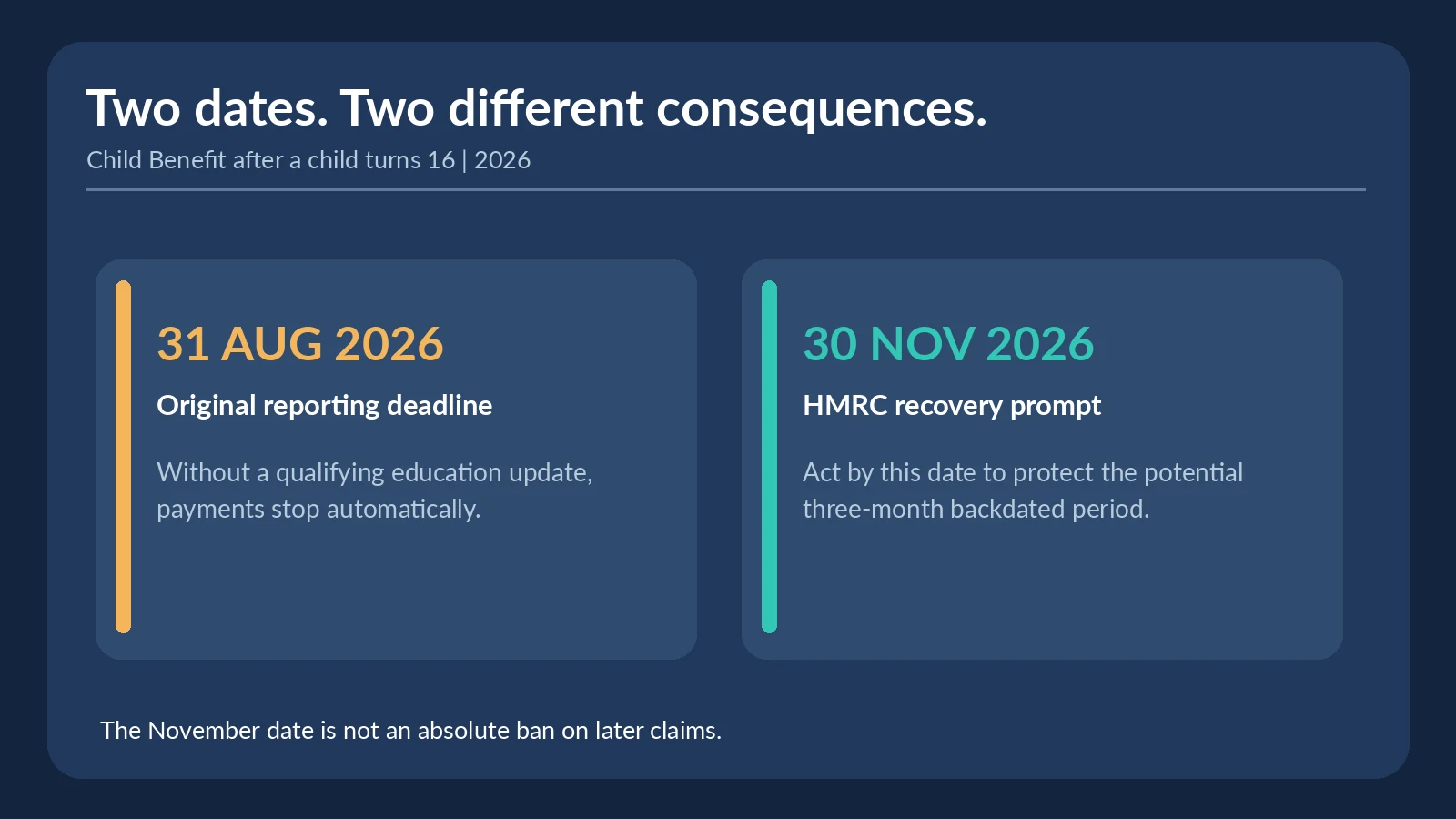
These dates do different jobs. Parents whose teenagers turned 16 and were moving into a qualifying post-16 course were asked to tell HMRC by 31 August 2026. If HMRC did not receive the required confirmation, the benefit stopped automatically. In its October 2026 employer bulletin, HMRC explained that eligible parents who missed that date can have their claims restarted, with backdating available for up to three months. It urged action before 30 November 2026 to obtain the full potential entitlement. HMRC statement.
| Date | Meaning | What it does NOT mean |
|---|---|---|
| 31 August 2026 | The original deadline for confirming eligible continuing study after age 16 | That nobody can restart their claim later |
| 28 October 2026 | Publication check date for this guide; a family may still act | That today is the start of a new government scheme |
| Before 30 November 2026 | HMRC’s recommended action date for full potential backdating after the August stop | That every claimant has identical qualifying circumstances or guaranteed arrears |
| After 30 November 2026 | A later approach may still be possible; backdating could cover less of the lost period | That claims become universally illegal or permanently closed |
Do not confuse 30 November here with the separate terminal date rules that apply when a qualifying young person finishes a course. The government also lists the end of February, 31 May, 31 August and 30 November as possible terminal dates after a course ends. That is a different part of the Child Benefit system. See the official rule.
Who can continue getting Child Benefit after age 16?
Child Benefit can continue for an eligible young person until they turn 20 when they are on qualifying education or approved training, provided that they were accepted onto the course before turning 19 and do not receive Universal Credit in their own right. The claimant needs to notify HMRC when required. Eligibility is driven by the actual course, not simply by a child being “at college” or “still a student”. GOV.UK eligibility guide.
Full-time non-advanced education: what counts?
The general full-time test is more than an average of 12 hours per week of supervised study, tuition or course-related practical work. Unsupervised homework and meal breaks are not automatically counted. A special relaxation allows a young person with an illness or disability to undertake fewer hours when that is appropriate to their individual needs. That qualification was reflected in official HMRC guidance updated in June 2026. HMRC technical manual.
| Education or training example | Usually eligible? | Important qualification |
|---|---|---|
| A levels, Scottish Highers or International Baccalaureate | Yes | Must meet the qualifying course and age conditions |
| T levels, GCSEs, qualifying NVQ / vocational courses up to level 3 | Yes | Check the precise level and whether the education is non-advanced |
| Home education | Can qualify | Course and supervised-study circumstances need to meet current HMRC rules |
| Qualifying unpaid approved training | Yes | Specified programmes depend on nation and scheme |
| An apprenticeship with paid employment | No, generally | An apprenticeship is not the same as an eligible pre-apprenticeship |
| A university degree or higher education course | No | Advanced education is outside the normal post-16 Child Benefit continuation |
| Training required under an employment contract | No | Having a course timetable does not override a job contract |
For examples of approved training, government guidance lists schemes such as Jobs Growth Wales+ in Wales and No One Left Behind in Scotland. The list is not an invitation to assume all unpaid courses qualify: confirm the scheme with your provider and use the government guide. Young people with complex home-education or disability situations should use the official HMRC contact route rather than reject the claim solely because it does not match a typical college timetable.
Do families need to update HMRC every academic year?
No, not necessarily. HMRC specifically states in its October 2026 bulletin that parents of young people starting the second year of a full-time non-advanced education course do not need to contact HMRC purely for that progression. But you must report material changes, such as leaving the course early, switching to non-qualifying education or another circumstance affecting eligibility. If a payment has already stopped or you are unsure what HMRC recorded, check your claim rather than assume.
A decision guide: choose the correct route before you apply
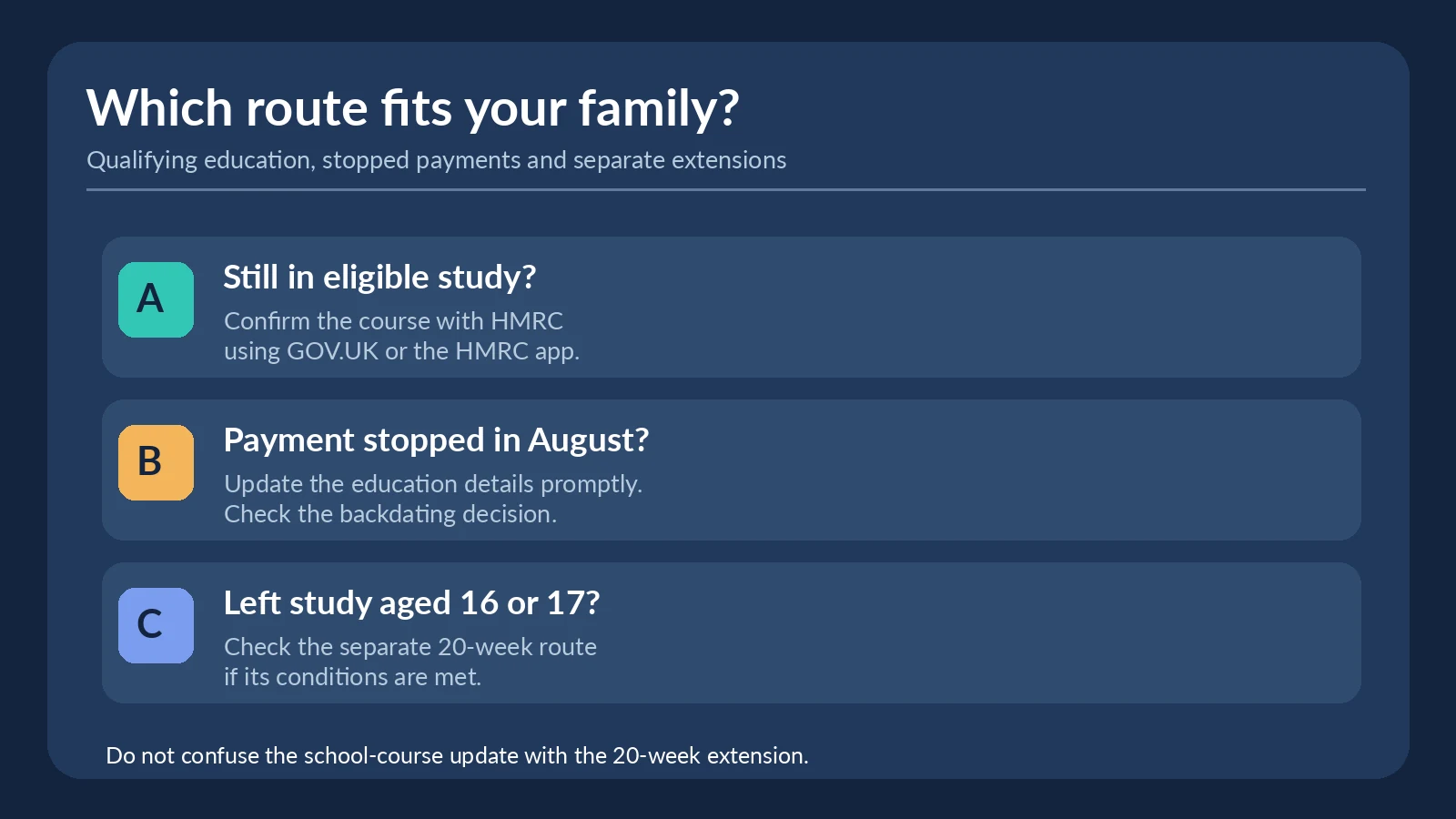
- Route A — Continuing eligible education: claimant reports the course and expected end date through the official HMRC route, then checks payment history.
- Route B — Education not eligible: do not represent a degree or paid apprenticeship as qualifying study; check the date on which entitlement actually ended.
- Route C — Left study at 16 or 17: consider whether the separate 20-week extension applies through registration with an approved careers body or the armed forces.
- Route D — Same qualifying course, year two: HMRC says no new contact is required just because the student progresses to year two; still check for unrelated claim problems.
- Route E — Homeschooling or reduced hours due to illness or disability: check the special rule rather than assuming the 12-hour threshold always decides the case.
Step-by-step: extend or restore Child Benefit online
The official pages are suitable for phones and computers. Interface labels can change, so the steps below describe the current supported process rather than pretending to be a verbatim screenshot of every HMRC screen.
- Open GOV.UK: visit Child Benefit when your child turns 16 and select the government link for reporting that the child is staying in education or training.
- Sign in as the existing claimant: use the credentials HMRC requests. Current services may offer Government Gateway or GOV.UK One Login. If you need an account, follow the official prompt, not an unsolicited text-message link.
- Check your child’s details: confirm the teenager’s identity and the claim the service asks you to update. Do not submit a different family member’s details.
- Describe the actual course: use the provider’s exact course name, its qualification level, course start date and expected end date where requested. If your child changed plans, submit the real current information.
- Review before submitting: incorrect start dates or claiming a non-qualifying apprenticeship can lead to problems later. Confirm your details and submit.
- Keep the reference or confirmation: note the date you reported the change and retain any acknowledgement. Check payment history and contact HMRC if the claim is not updated.
If a sign-in challenge blocks you, use the official HMRC sign-in help. HMRC explains that an existing account may continue using Government Gateway while other customers may be prompted to GOV.UK One Login. There is no need to create multiple accounts just because you have heard about a new login system.
Alternative: use the HMRC app
Download the app through GOV.UK’s HMRC app page rather than a sponsored app listing or imitation website. Sign in, go to Child Benefit if available, open the claim-management or amendment route and follow its prompts to confirm education or training. HMRC says eligible families can make the update in minutes through the app or online. If the option is not visible or the claim requires a specialist check, use HMRC’s Child Benefit contact page instead.
What if you did not receive a reminder letter?
Do not wait for a missing letter. HMRC has said the online route is available to eligible claimants independently of the reminder. The legitimate government domain is gov.uk (or the HMRC service linked from it). Anyone asking you to send your National Insurance number and banking password over messaging apps is not using the correct process.
How much money could you recover? Realistic examples
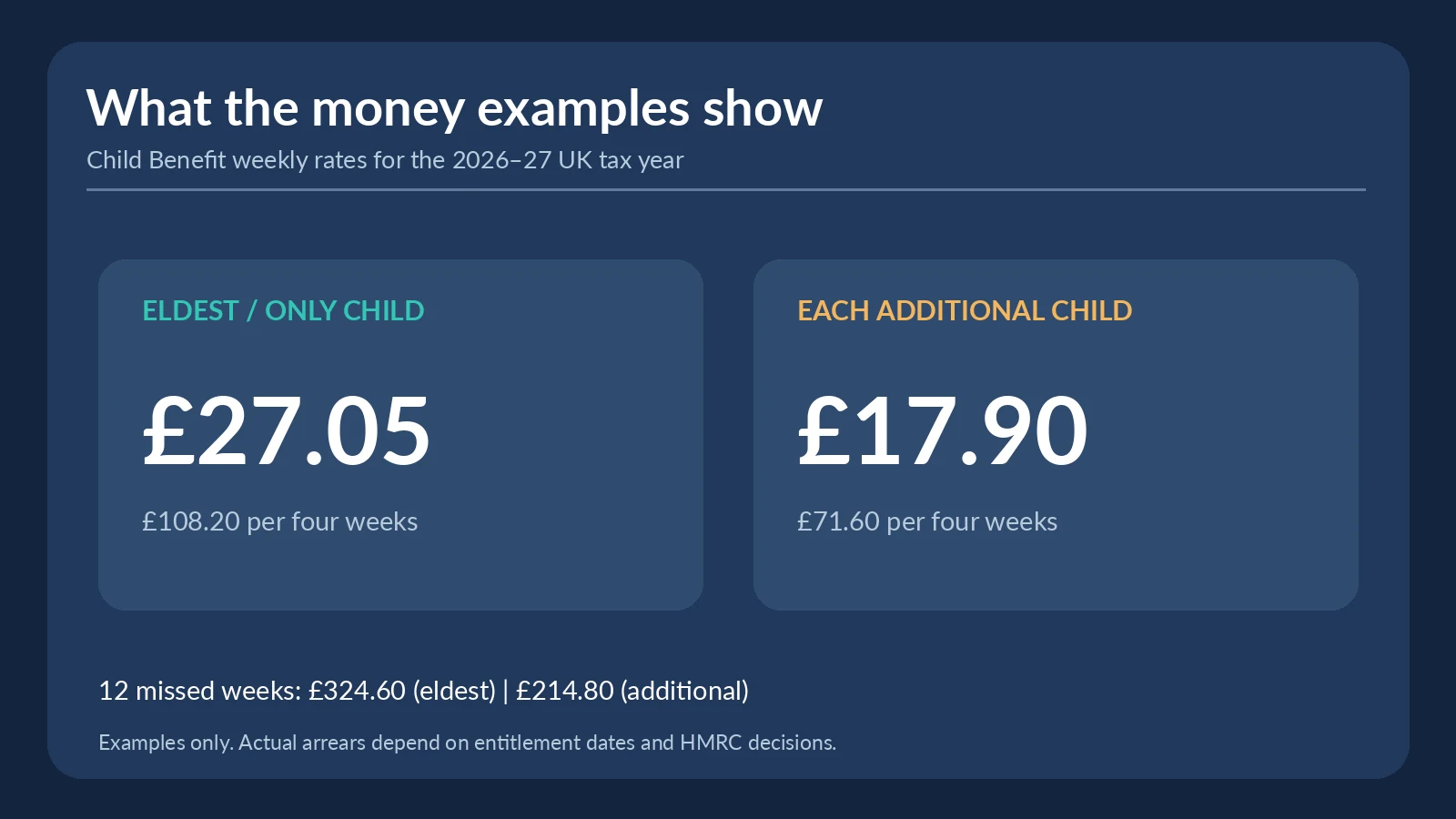
The official weekly rates from 6 April 2026 to 5 April 2027 are £27.05 for the eldest or only child and £17.90 for each additional child. HMRC normally pays Child Benefit every four weeks, although some families receive weekly payments. Below are transparent arithmetic examples, not promises of backdated awards. Actual entitlement depends on the verified circumstances, date of eligibility, any other children and the decision HMRC makes. Official 2026–27 rates.
| Rate / illustrative missed time | Eldest or only child | Additional child |
|---|---|---|
| One week | £27.05 | £17.90 |
| Four weeks | £108.20 | £71.60 |
| Eight weeks | £216.40 | £143.20 |
| Twelve weeks | £324.60 | £214.80 |
| 52-week annualised equivalent | £1,406.60 | £930.80 |
Example 1: a family missing twelve eligible weeks
Assume an eldest teenager remains in a qualifying A-level course, the parent’s claim stopped and HMRC accepts entitlement covering twelve missed weeks. 12 × £27.05 = £324.60 in illustrative arrears. That does not mean every claim restarted in late November automatically produces £324.60: HMRC must establish the exact entitlement period and any relevant adjustments. The calculation is designed to show how weekly rates translate into a missed-payment estimate.
Example 2: two children with different rates
Suppose a claimant is entitled to the higher weekly rate for one child and the additional-child rate for another during the same eight-week period. The combined weekly total is £44.95, so a simple eight-week equivalent is £359.60. But if the older child ceased to qualify part-way through that window, the order of children and rate allocation may change. Do not simply multiply the old payment amount without checking who qualifies during each week.
Example 3: waiting beyond the HMRC November reminder
Imagine eligible payments stopped on 31 August, but the claimant only contacts HMRC in mid-January 2027. A routine three-month backdating limit may not cover every week since August. The exact retrospective date must be decided by HMRC. The main lesson is that the November warning concerns recoverable backdating, not a permanent ban on restarting.
High Income Child Benefit Charge: the £60,000–£80,000 trap
Continuing the claim does not automatically mean all the payments are tax-free to keep. In the 2026–27 tax year, if either partner has adjusted net income above £60,000, the higher-income partner may have to pay the High Income Child Benefit Charge (HICBC). The charge generally rises by 1% of the benefit for every £200 above £60,000; at £80,000 or more it equals the Child Benefit amount. It is the individual’s adjusted net income, not the combined gross pay of the household, that determines the threshold. HMRC tax-charge rules.
| Higher partner’s adjusted net income | Illustrative percentage of benefit charged back | Meaning |
|---|---|---|
| £59,000 | 0% | No HICBC solely on this income |
| £64,000 | 20% | £4,000 / £200 = 20 steps |
| £70,000 | 50% | Half the Child Benefit may be charged back |
| £76,000 | 80% | Most of the benefit may be charged back |
| £80,000 or more | 100% | Tax charge matches the benefit |
These percentages are simplified whole-year illustrations; the actual tax calculation follows the rules for your taxable year and entitlement. HMRC now offers an option for eligible families to pay the charge through their PAYE tax code without submitting a Self Assessment return solely for that charge. The PAYE route is not available to every taxpayer, and a person who must file a tax return for another reason normally uses Self Assessment. Check PAYE conditions.
You may also choose not to receive Child Benefit payments while keeping an eligible claim registered. This can be important for National Insurance considerations and automatic allocation of a National Insurance number to a child. However, do not assume a claim for a teenager alone gives the parent fresh National Insurance credits: such credits depend on separate conditions, including the age of the child. Check your own National Insurance record and the current rules before planning around credits.
The 20-week extension is a different arrangement
One frequent source of confusion is the term “extension”. When parents confirm that a 16- to 19-year-old is still studying, they are seeking continued Child Benefit based on eligible education or training. A separate government scheme can provide up to 20 weeks after a 16- or 17-year-old leaves education or training and registers with a qualifying careers body or the Ministry of Defence, for example before joining the armed forces. To qualify, the child must generally work less than 24 hours a week, not receive certain benefits such as Universal Credit, and the parent must have been entitled immediately before education ended. The application must be within three months of leaving. Official CH299 extension information.
| Feature | Continuing eligible education | Separate 20-week extension |
|---|---|---|
| Who is it for? | Typically qualifying 16–19-year-olds | 16- or 17-year-olds after leaving approved study/training |
| Central condition | Ongoing qualifying non-advanced study or approved training | Registration with a qualifying careers body or armed-forces route |
| Maximum age | Until age 20, subject to conditions | Limited by the specific 16–17 and 20-week rules |
| How to act | Confirm continuing education through HMRC | Apply for the CH299 extension pathway if eligible |
| What to avoid | Calling a university degree a qualifying school course | Assuming every gap year automatically qualifies |
When Child Benefit still does not restart: common problems
| Problem or symptom | Likely check | Practical next step |
|---|---|---|
| No Child Benefit menu in the app | Signed into a different claimant account, incomplete online setup or service issue | Try the official GOV.UK service and verify who is the registered claimant |
| HMRC says the course is not eligible | Course is advanced, employer-contracted, or other qualifying test fails | Confirm actual course type and ask HMRC to review if information was misclassified |
| Course title changed after enrolment | Old course data may not match current school records | Gather correct school/college information and report the actual change |
| Payments missing despite submitted update | Processing, different payment date or claim issue | Check award notice and payment history, then contact HMRC |
| No reminder letter arrived | HMRC reminder not received or address outdated | Use online service without waiting; update personal details |
| Child moved into year two | Already notified in prior year | HMRC says a new contact is not required merely for year two; investigate another reason |
| Online sign-in blocked | Lost password, security code issue or lockout | Follow HMRC official login-help route; avoid third-party “recovery” sites |
| Claimant opted out because of high income | Opting out of payments is different from eligibility ending | Follow the separate official restart-payments procedure if appropriate |
How to investigate a missing payment properly
First, check the original award notice for the four-weekly payment cycle. Then verify your bank statement and HMRC account payment history. Government guidance says payment dates may vary around bank holidays, and a first payment can take time. If a due payment is genuinely missing, check with the bank before contacting HMRC. Keep a record of the date you submitted education information and any confirmation shown. HMRC payment-date guidance.
Contact HMRC when you need a human review
For Child Benefit, HMRC lists a helpline at 0300 200 3100 (or +44 161 210 3086 from outside the UK), normally Monday to Friday, 8am–6pm UK time, excluding bank holidays. HMRC may ask security questions and can only discuss a claim with the claimant or an authorised representative. Confirm current opening hours on the official contacts page rather than relying on a phone number from social media.
Six scenarios that change the answer
Your 16-year-old has enrolled in an A-level college course
This is generally a qualifying non-advanced course. If the August confirmation was missed, the claimant should update HMRC now, provide the real start and expected end dates, and check whether backdating can cover eligible missed weeks. The outcome is not guaranteed until HMRC reviews entitlement.
Your teenager is already in the second year of the same A levels
HMRC’s October 2026 bulletin says year-two progression on a full-time non-advanced course does not itself require a new report. If money nevertheless stopped, check whether a different change was recorded, the claimant switched payments off, or there is another eligibility issue.
A 17-year-old has started a paid apprenticeship
A paid apprenticeship is generally not eligible training for this purpose. Do not choose the “continuing qualifying education” route automatically. Depending on the circumstances and timing, verify whether a different form of support is relevant. Job-contracted training is not made eligible simply because it involves classroom learning.
An 18-year-old starts a first university degree
A university degree is advanced education, so the usual Child Benefit continuation based on non-advanced study does not apply. The fact that a student is under 20 is not enough by itself. Notify HMRC of the change to avoid potential overpayments.
Your child studies at home after illness or disability
Do not conclude that Child Benefit must stop merely because the teenager cannot attend a standard 12-hour college timetable. HMRC guidance recognises home education and allows fewer supervised hours where appropriate due to illness or disability. The exact course and circumstances still need assessment.
A teenager left school and registered with a careers service
The parent should check the specific 20-week extension rules promptly, rather than entering a fictional college course. Only certain registered routes and conditions qualify, and the three-month application limit is different from the November HMRC backdating reminder.
Avoid scams when updating a Child Benefit claim
Fraudsters often exploit deadlines and official-looking messages. Do not trust a link merely because it contains an HMRC logo, a “last chance” countdown or a QR code. Navigate from GOV.UK yourself, avoid giving your login details to a third-party agent, and check whether a genuine government service is requesting the information. An HMRC 2025 bulletin explained that authentic QR codes in official letters lead to GOV.UK or HMRC app routes; nevertheless you should verify the source of any letter. HMRC advice about communications.
- Do not pay an unofficial “reinstatement fee” to a random website.
- Never enter a Government Gateway password on a website opened through a suspicious SMS.
- Ask the actual Child Benefit claimant—not a friend or a third party without authorisation—to sign in.
- Keep a copy of any HMRC correspondence, but avoid posting sensitive personal documents in public forums.
Official sources and how this guide was checked
This article was checked against the October 2026 HMRC employer bulletin for the 30 November reminder, the standing GOV.UK post-16 eligibility guide, the official 2026–27 benefit rate table, the High Income Child Benefit Charge guidance, the HMRC contact details, and the distinct CH299 20-week extension route. For accuracy, confirm current rules on the original pages before submitting your individual claim.
- HMRC October 2026 bulletin — 30 November reminder
- GOV.UK — Child Benefit when your child turns 16
- HMRC 2026–27 rates
- High Income Child Benefit Charge
- Payment dates and missing payments
- CH299 — separate 20-week extension
- Child Benefit helpline and contact information
What to do next: a practical checklist
- Confirm who is named on the existing Child Benefit claim.
- Check whether the teenager’s actual course qualifies and whether HMRC already has a current course record.
- If payments stopped on 31 August 2026, act before 30 November 2026 where possible to protect potential backdating.
- Use GOV.UK or HMRC app; record the submission date and keep the acknowledgement.
- Estimate missed weeks with the correct eldest/additional weekly rate, but treat any figure as illustrative until HMRC confirms the claim.
- If a partner’s adjusted net income exceeds £60,000, check the High Income Child Benefit Charge.
- If the child has left study at 16 or 17, check the separate 20-week extension rather than reporting false continuing education.
- Review payment history and contact HMRC through the official contact page if payment does not restart.
Bottom line: an August 2026 Child Benefit stop is not necessarily the end of the claim. Eligible parents should update their child’s qualifying education details promptly. The 30 November reminder is about preserving the potential three-month backdated window—not an absolute deadline after which every claim is rejected. Take the correct route for your family and rely on HMRC’s current decision on entitlement.
You may also like
 UK Guides
£100 Energy Payment: Council Tax Bands and Eligibility
Check the £100 Household Energy Payment, Council Tax bands, official postcode search and January 2027 payment arrangements in…
 UK Guides
UK Digital ID Cancelled: What Happens to Right-to-Work Checks, One Login and eVisas?
The UK cancelled its national Digital ID programme, but One Login, eVisas and right-to-work checks continue. See the…
 UK Guides
UK Student Visa Financial Requirements From 30 November 2026: New Funds and Bank Statement Rules
UK Student visa financial requirements rise on 30 November 2026: London £1,570/month, outside London £1,203/month. Learn tuition calculations,…