
A 75,000-Year-Old Neanderthal Spear Wound: What Shanidar Cave Reveals About Violence, Care and Burial
New Shanidar Cave research documents a probable fatal 15-mm spear wound in a 75,000-year-old Neanderthal, earlier facial trauma and evidence of possible care and burial.
Contents
- The discovery in six essential facts
- Where is Shanidar Cave—and why does it matter?
- Who was Shanidar A?
- Why the skeleton was incomplete
- The 15-millimetre hole that changed the interpretation
- Why do researchers suspect a wooden spear?
- Did the spear wound kill Shanidar A?
- Was this murder—or a hunting accident?
- A second, older injury reveals another side of the story
- Did other Neanderthals care for the injured person?
- Were Shanidar A and the others deliberately buried?
- What a cluster can tell us—and what it cannot
- What happened to the famous “flower burial” story?
- How scientists examined a bone that nearly turned to dust
- The evidence chain from excavation to interpretation
- Why a wooden weapon would be so important
- What this case adds to the history of prehistoric violence
- A 75,000-year timeline, not a modern true-crime episode
- What the new study does not prove
- Why care and violence can exist in the same ancient community
- Why Shanidar Cave still has so much to teach us
- How to read a claim about “the first Neanderthal murder” critically
- The bigger picture: what Shanidar A tells us about Neanderthal humanity
- Scientific sources and further reading
A small round hole in a shoulder blade has complicated one of archaeology’s longest-running stories about Neanderthals. Deep inside Shanidar Cave in Iraqi Kurdistan, researchers recovered the partial remains of an older adult who lived around 75,000 years ago. The individual, named Shanidar A, had survived a severe injury to the front of the mouth. But a different injury—a nearly circular perforation in the left shoulder blade—appears to have happened around the time of death. The research team argues that a sharpened wooden spear is the best explanation.
That discovery has generated headlines about the possible killing of a Neanderthal. The more revealing story, however, is not a simple prehistoric murder mystery. The bones offer evidence about injuries, the likelihood of help from other people, the rare survival of traces left by wooden weapons, and the repeated placement of bodies in the same part of a cave. Each conclusion has a different level of certainty.
The underlying research, “Evidence for funerary behaviour and lethal trauma in a new Neanderthal individual from Shanidar Cave,” was published on 15 October 2026 in the peer-reviewed journal Scientific Reports. The full, open-access paper is available at Nature Portfolio, while the University of Cambridge’s account explains the excavation and its significance.
The essential finding: An approximately 15-millimetre opening in Shanidar A’s shoulder blade is consistent with a weapon penetrating the body from the front. The scientists believe the wound was probably fatal and consider a wooden spear plausible. They cannot determine whether it was caused by an attack, a hunting accident, or another incident.
The discovery in six essential facts
| Location | Shanidar Cave, in the Zagros foothills of Iraqi Kurdistan | The precise activity that led to the fatal injury |
|---|---|---|
| Age | The remains were deposited around 75,000 years ago | The exact calendar date of death |
| Individual | Shanidar A, an older adult, approximately 45 years old | Biological sex and full life history |
| Shoulder injury | A roughly 15 mm circular hole in the left scapula with associated fractures | The actual weapon, the person who held it, and the precise circumstances |
| Older facial injury | Severe damage to front teeth with signs of survival afterwards | Exactly what injured the face and how much assistance was received |
| Mortuary setting | Remains within a tight cluster of at least five Neanderthal individuals | The beliefs, ceremonies, or emotions associated with the depositions |
Where is Shanidar Cave—and why does it matter?
Shanidar Cave lies in the Zagros Mountains region of northern Iraq, within the Kurdistan Region. It is not a recently discovered hole in the ground. It is one of the most important Neanderthal sites in Southwest Asia, famous for evidence that has challenged simplistic portrayals of Neanderthals as unthinking or universally brutal.
Excavations directed by Ralph Solecki in the 1950s and 1960s uncovered remains of multiple Neanderthals. Some had survived serious injuries and debilitating conditions. Others were found in intriguing spatial relationships that raised the possibility of deliberate body placement. One burial, Shanidar 4, became famous because pollen clumps around it were interpreted as evidence that flowers had been placed with the dead—a proposal that has since been questioned.
The site later returned to the center of research through new excavation campaigns led by an international team working with Kurdish archaeological authorities. Modern techniques allow researchers to record sediment layers, bones and microscopic traces more precisely than was generally possible when the first skeletons were excavated.
Shanidar is therefore not only a place where one unfortunate individual may have been struck by a spear. It is a site where researchers can ask how a Neanderthal group lived, treated injured companions, used the cave, and handled death across many generations. See the University of Cambridge’s overview of Shanidar Z for the history of the excavation and why the cave’s burial evidence matters.
Who was Shanidar A?
The new individual is known by the research designation Shanidar A. The team describes an older adult, approximately 45 years old, whose remains came from deposits about 75,000 years old. An age around 45 should not be understood as a precise birthday or proof of an extraordinary prehistoric lifespan; skeletal aging provides approximate biological estimates.
Shanidar A is not Shanidar Z, the better-known individual whose flattened skull and upper body were reported through earlier work. The new study places Shanidar A beneath the torso of Shanidar Z, within the wider cluster of Neanderthal remains. Similar names and overlapping excavation areas can easily confuse readers, so it is important to keep the individuals separate.
The bones recovered for Shanidar A are incomplete. The material includes a mostly complete right hand, parts of several ribs, a left shoulder blade, seven teeth, and additional fragments. The missing portions limit what can be reconstructed about height, sex, disability, activity and the exact sequence of events at death.
The work that identified this individual involved excavations in 2019 and 2022, followed by conservation, imaging, comparisons and contextual analysis. According to the Nature Portfolio research summary, Shanidar A lay on the back with the head oriented toward the east. The remains were affected by subsequent natural processes, including water movement.
Why the skeleton was incomplete
Bones do not normally stay perfectly arranged for tens of thousands of years. As soft tissues decay, sediment shifts, water may carry pieces away, and geological pressure can break or flatten even robust fossils. At Shanidar, the new paper describes evidence that a flash flood disturbed Shanidar A’s remains after decomposition. That matters when interpreting the original body position.
A disturbed skeleton does not automatically rule out deliberate placement. It means archaeologists must reconstruct what happened at several different stages: the body’s initial deposition, decay, later disturbance, and modern excavation. Every stage can change what eventually appears in a trench.
The 15-millimetre hole that changed the interpretation
The central forensic clue is a near-circular hole about 15 mm across in the broad, relatively thin blade of the left scapula—the shoulder blade. At least three fractures radiate outward from the opening. Investigators also identified a pattern of bevelling, meaning one margin of the opening is shaped differently from the other.
Those features are not merely cosmetic damage. The study draws on the interpretation of bone fractures and microscopic images to argue that the opening was formed while the bone retained properties associated with living or recently deceased tissue. This is known as perimortem trauma: injury occurring at or near the time of death, not necessarily at the exact instant life ended.
A spear, pointed object, or projectile passing through the body can create a penetrative defect. A hole formed long after burial, by contrast, can have different fracture characteristics. The researchers considered the geometry and preservation of the bone as part of their explanation.
The team infers that the weapon moved from the front of the body toward the back, passing through the torso before reaching the shoulder blade. That inference relies on the orientation of the opening and the bevelled edge—not on a weapon found still lodged in the fossil.
Why do researchers suspect a wooden spear?
The unusually round outline is an important clue. A sharpened wooden point may produce a rounded perforation. A stone-tipped implement could leave a different shape, although real injuries vary with the tip, force, angle, bone thickness and other factors.
The paper argues that a wooden thrusting spear or wooden projectile provides a plausible explanation for the circular damage. It does not report a surviving spear tip from Shanidar A’s body. The weapon is inferred from the injury, not recovered as a physical artifact.
Wood decays in most archaeological environments. Stone tools survive more readily, creating a preservation bias: researchers may know much more about the stone points people made than the wooden shafts, handles and weapons they used. A characteristic injury can, in some circumstances, provide indirect evidence of wooden technology even when the original object is gone.
That is one reason the find matters beyond the question of how Shanidar A died. It may help archaeologists recognize the role of organic weapons in Middle Palaeolithic societies that did not leave preserved wooden spears at every site.
Did the spear wound kill Shanidar A?
The authors interpret the shoulder-blade injury as likely lethal. A weapon arriving from the front on a trajectory that reaches the shoulder blade could have damaged major structures in the chest, potentially including the lung and significant blood vessels. Those are serious possibilities, not injuries that can be diagnosed with clinical certainty from a partial skeleton.
There is no preserved soft tissue showing the precise path through organs, and investigators do not have a complete medical record or the weapon itself. Therefore, the strongest defensible wording is that the trauma was probably fatal and plausibly caused by a spear. It would overstate the evidence to say scientists have proved the exact organ struck or the minutes between injury and death.
Was this murder—or a hunting accident?
This is the most important distinction in the story. The injury could be evidence of interpersonal violence, meaning one human relative injured another. But researchers also identify the possibility of a hunting accident or other unintended spear injury.
Imagine several scenarios: a spear thrust during a confrontation, a weapon striking a companion during a hunt, or a dangerous encounter that left no other bones or artifacts explaining it. The shape of one hole does not distinguish all such possibilities. Without information about the people present and the events surrounding the injury, intent cannot be established.
| Shanidar A suffered a penetrating shoulder injury | Supported by the bone and imaging |
|---|---|
| The injury probably happened around the time of death | Supported by fracture and bevel characteristics |
| A wooden spear is a plausible cause | An interpretation consistent with the morphology |
| The injury probably caused death | The authors’ likely conclusion, not absolute proof |
| Another Neanderthal deliberately killed Shanidar A | Not established |
| This was definitely the world’s first murder | Not established and not a justified headline |
A prehistoric story should be compelling because the evidence is intriguing, not because uncertainty has been removed from it. The peer-reviewed study explicitly states that the exact cause—accident or violence—cannot be known.
A second, older injury reveals another side of the story
The shoulder injury may have ended Shanidar A’s life. A major facial injury appears to have happened well before death, and this older trauma is equally significant for understanding Neanderthal social behavior.
The teeth show unusual damage affecting the front of the mouth, including a front tooth that had split and evidence of changes that developed afterwards. The pattern indicates that Shanidar A did not die immediately from that earlier facial event. The individual lived long enough for subsequent tooth wear and deposits to develop.
Such an injury could have made chewing difficult. It might have produced pain, affected speech-like communication or required changes to food preparation. The evidence cannot tell us exactly what Shanidar A ate each day, but the consequences of severe mouth injury are plausible.
Did other Neanderthals care for the injured person?
The authors consider it likely that Shanidar A received assistance during recovery or afterwards. If the individual struggled to eat or function normally, group members may have helped with food or other needs. Still, a bone cannot record a caregiver’s actions directly. It supports a reasoned inference, not a film of what happened.
This fits a broader pattern from Shanidar Cave, where other individuals survived serious physical limitations. In the past, some researchers described this evidence as proof that Neanderthals possessed compassion comparable to ours. The more careful conclusion is that long-term survival with substantial impairment is evidence compatible with social support, and particular circumstances must be assessed case by case.
A cave can preserve two kinds of story at once: an injury consistent with a weapon strike and survival after an earlier serious injury. These do not cancel each other out. Human social groups today also contain cooperation, conflict, assistance and occasional violence; it would be misleading to expect an extinct human relative to fit a single stereotype.
Were Shanidar A and the others deliberately buried?
The new research places Shanidar A within a tight cluster of at least five Neanderthal individuals near a prominent feature of the cave. They were not all deposited in one clearly documented modern-style funeral. Rather, their archaeological positions suggest repeated use of a particular place over time.
The researchers interpret this spatial pattern as consistent with purposeful deposition of bodies, potentially within the living memory of members of the same community or connected communities. A natural shallow channel in the cave floor may have provided a location where the dead were placed, and parts of the surrounding context indicate modifications to the surface.
The team cannot reconstruct the religious ideas behind those actions. An archaeologist may identify repeated placement and possible digging without knowing whether the behavior involved mourning, ceremony, practical management of remains, tradition or a combination of motives.
What a cluster can tell us—and what it cannot
- It can show patterned behavior. Several people ending up in the same small zone is evidence that needs explaining, especially when their arrangement is not easily explained by random deposition alone.
- It can support an interpretation of intentional burial. Body position, stratigraphy, sediment and excavation context matter together.
- It cannot prove a specific spiritual belief. The fossil record does not preserve words spoken, prayers, intentions or a complete ritual sequence.
- It can be modified by later events. A flash flood disturbed some remains, so reconstruction must separate the original deposition from later movement.
The study expands a much older debate about Neanderthal funerary practices. Previous analysis of Shanidar Z also raised the possibility that the cave was a place to which people returned to position their dead, rather than a random collection of bodies.
What happened to the famous “flower burial” story?
Shanidar Cave became internationally famous for the Shanidar 4 “flower burial.” After the mid-20th-century excavations, dense pollen concentrations near a skeleton prompted the idea that mourners had placed flowers in a grave. The image of a Neanderthal funeral with bouquets appealed to the public because it suggested tenderness and symbolic behavior.
The hypothesis remains disputed. A later reassessment argued that at least some of the pollen clumps could have been introduced by nesting solitary bees and that other natural explanations must be considered. That does not prove ancient people never placed flowers at graves. It means the pollen evidence, by itself, cannot confidently establish a floral offering.
The peer-reviewed pollen reassessment and the Cambridge team’s site history illustrate a central rule of archaeology: new methods can strengthen certain interpretations while weakening others.
Shanidar A’s spear-like injury and placement among other bodies provide different kinds of evidence from Shanidar 4’s pollen. They should not be combined into an embellished narrative about a funeral following a murder. Those details were not observed together as one event.
How scientists examined a bone that nearly turned to dust
Excavating ancient human remains is often as much a conservation project as a digging operation. Shoulder blades are thin, and archaeological bone can be exceptionally fragile after tens of thousands of years. Researchers work slowly to preserve both the physical fossil and the sediment relationships that explain its history.
At Shanidar, the team documented the remains in place, stabilized delicate material and used laboratory imaging—including micro-computed tomography (micro-CT)—to study the shape of the scapula perforation and its fracture margins. The combination of excavation records and high-resolution imaging helped investigators distinguish possible trauma from breaks caused by drying, crushing or later disturbance.
The evidence chain from excavation to interpretation
- Record the context. Identify the bone’s exact position relative to sediment layers and nearby remains before moving it.
- Preserve fragile material. Support delicate bones so they can be lifted without destroying the damage that researchers need to analyze.
- Document the defect. Measure the hole, examine its round outline and assess the fractures radiating away from it.
- Use detailed imaging. Microscopic or CT views can reveal bevels and features not obvious on a photograph.
- Compare mechanisms. Consider penetrating injury, geological damage, excavation damage and other processes.
- State the uncertainty. Infer the most plausible explanation while acknowledging alternative scenarios that the available evidence cannot eliminate.
These methods are important precisely because the final conclusion is not a direct eyewitness account. The more carefully researchers describe their analytical steps, the more transparently others can evaluate the interpretation.
Why a wooden weapon would be so important
Stone spear points and stone flakes are common among Palaeolithic finds. Wooden implements are much harder to study because they rarely survive unless conditions are unusual. That imbalance can make prehistoric technology seem more stone-dominated than it really was.
Evidence from other European archaeological sites has already shown that ancient people used sophisticated wooden weapons and worked wood long before this Neanderthal lived. The Shanidar A finding does not suggest that wooden spears were invented 75,000 years ago. Instead, it offers a possible trace of the weapon’s effect on a body, preserved where the weapon itself was not.
If the round perforation is correctly attributed to a wooden point, it shows how scientists can investigate organic technology indirectly. Bone trauma, residues, use-wear on stone tools, sediment impressions and exceptional waterlogged artifacts can all provide parts of the picture.
It also puts the long-running question of Neanderthal hunting methods in context. A spear could be used at close quarters or thrown, and the present injury cannot settle the specific method. The researchers discuss a penetrating weapon, not a confidently reconstructed hunting scene or duel.
What this case adds to the history of prehistoric violence
Evidence for violence deep in prehistory is harder to interpret than modern forensic evidence. A broken skull might result from a blow or an accident; a healed fracture establishes survival but not always the cause; a pointed puncture may provide a stronger clue but still leave intent unresolved.
The Shanidar A scapula joins a small and debated record of possible prehistoric interpersonal trauma. The authors compare it with cases from other Neanderthals, archaic humans and early modern humans. However, not every candidate wound proves an attack, and evidence of one violent incident does not reveal how common interpersonal violence was across Neanderthal societies.
A single individual’s remains cannot establish a prehistoric crime rate, whether communities frequently fought, or how aggression varied across regions and periods. The word “earliest” in news coverage should also be treated carefully: researchers are usually referring to a particular kind of evidence, such as a potentially lethal wound consistent with a wooden spear in the fossil record, not the first harmful act ever committed by a human relative.
A 75,000-year timeline, not a modern true-crime episode
| Around 75,000 years ago | Shanidar A lived, sustained a serious earlier facial injury, and eventually died with the probable penetrating wound |
|---|---|
| After death | The body decomposed in a location later associated with several Neanderthal deposits |
| Later prehistory | Natural processes, including a flash flood, disturbed parts of the remains |
| 1950s–1960s | Ralph Solecki’s excavations made Shanidar Cave internationally important |
| 2018–2022 | Modern work in the burial area documented additional Neanderthal material, including Shanidar A remains recovered in 2019 and 2022 |
| 15 October 2026 | Pomeroy and colleagues published their open-access analysis in Scientific Reports |
The timeline helps avoid collapsing thousands of years, several different individuals and multiple research projects into a single dramatic claim. It is possible to tell an accessible story without pretending everything happened in one excavation or funeral.
What the new study does not prove
Careful science is defined not only by its findings but also by the limits it openly states. For Shanidar A, several tempting claims go beyond what the material can demonstrate.
- It does not identify a killer. No specific attacker, group or species has been established.
- It does not distinguish murder from accident. Both interpersonal violence and an accidental spear strike remain possible.
- It does not recover the weapon itself. The wooden spear is an interpretation of the bone’s shape and damage.
- It does not establish the exact time between injury and death. The authors consider the wound likely fatal, but soft tissues and clinical signs are absent.
- It does not prove all Neanderthal funerals included flowers. That older hypothesis remains contested.
- It does not prove a universal Neanderthal culture. Shanidar represents specific individuals, a specific cave, and episodes separated by time.
- It does not tell us the exact caregiving arrangements. The earlier facial injury suggests survival and possible support, not a documented treatment plan.
Reading the headline responsibly: “A Neanderthal may have died after being struck by a wooden spear” reflects the research far better than “Scientists prove the first murder happened 75,000 years ago.”
Why care and violence can exist in the same ancient community
Popular stories about Neanderthals often move between two extremes. One depicts them as fierce, instinctive and constantly fighting. The other portrays them as uniformly gentle, living in emotionally sophisticated groups that performed rituals much like modern people. Neither stereotype follows from the evidence.
The new Shanidar study shows why a more complicated picture is necessary. An individual could survive a major facial injury and perhaps benefit from others’ help, yet later die from another traumatic event. Members of the same broader community might cooperate in food procurement, protect injured companions, compete, and manage the dead according to repeated practices.
Those possibilities are not contradictory. In evolutionary archaeology, care and conflict are different dimensions of social life. A population need not be either entirely violent or entirely peaceful to exhibit both.
The archaeological task is to identify specific observations and test interpretations, while resisting the urge to project today’s social roles, moral labels or ceremonies directly into the Palaeolithic past.
Why Shanidar Cave still has so much to teach us
The greatest strength of Shanidar is not a single sensational discovery. It is the accumulating body of evidence produced across multiple excavation campaigns and increasingly sophisticated scientific methods. Old field records can be reexamined; new bones can be matched with historic finds; sediments can be studied at microscopic scales; and anatomical details can be measured rather than guessed from photographs.
For a long time, debates about Neanderthal burial and care depended on material removed decades earlier, often before modern recording methods were available. Recent excavations have introduced new contexts that allow some questions to be revisited using primary evidence. This makes the cave unusually valuable for studying both individual life histories and patterns shared among people.
There is also an important local dimension. Shanidar is part of the cultural landscape of the Kurdistan Region of Iraq, and research at the site has depended on cooperation with local archaeological authorities and communities. The story is not simply one of European laboratories studying an isolated fossil; the site’s protection and documentation rely on the place and people around it.
How to read a claim about “the first Neanderthal murder” critically
Readers encountering reports of this discovery can use a short evidence test:
- Look for the original paper. Is the claim traceable to a peer-reviewed publication rather than a social-media image or a headline alone?
- Separate observation from inference. The round hole is observed; a wooden spear is inferred; an intentional attacker is not demonstrated.
- Check the language of uncertainty. Words such as consistent with, likely, and possible do meaningful work in scientific writing.
- Ask whether the subject was identified correctly. Shanidar A, Shanidar Z and Shanidar 4 are different designations with different archaeological evidence.
- Avoid turning art into evidence. A convincing reconstruction of a spear or burial may help explain an idea without proving the exact event occurred that way.
- Notice what new evidence could change. Further microscopic work, comparison of injuries or analysis of surrounding sediments could refine the interpretation.
These habits make the discovery more interesting rather than less. They invite readers to understand how a persuasive scientific argument is assembled from incomplete remains.
The bigger picture: what Shanidar A tells us about Neanderthal humanity
A damaged shoulder blade is not a transcript of the final moments of Shanidar A’s life. The 15-mm perforation suggests a penetrating blow consistent with a wooden spear and perhaps a fatal injury. The earlier damage to the mouth suggests prolonged survival following severe trauma, with care from others a plausible explanation. The individual’s position among several other Neanderthals supports continuing discussion of intentional placement of the dead.
Taken together, the evidence points toward a past in which injury, survival, cooperation and death were all parts of social experience. That picture is more persuasive than either a claim that the world’s first murder has been solved or the comforting fiction that Neanderthals were incapable of harming each other.
The discovery also shows the enduring value of archaeological care. Scientists did not need to find a named killer, a preserved weapon or a written history to learn something profound. A fragile fossil, precisely excavated and examined, can still illuminate how an extinct human relative lived and died tens of thousands of years ago.
Scientific sources and further reading
- Primary research: Pomeroy, E., Hunt, C. O., López-Polín, L. and colleagues (2026). Evidence for funerary behaviour and lethal trauma in a new Neanderthal individual from Shanidar Cave. Scientific Reports 16, 30042. The open-access study documenting Shanidar A, the injuries and the mortuary context.
- University research report: University of Cambridge (15 October 2026). Fatal Neanderthal wound may be earliest evidence of a wooden spear attack on a human ancestor. Excavation context, statements from the researchers and an explanation of the shoulder injury.
- Publisher summary: Nature Portfolio (16 October 2026). Possible fatal spear wound in Shanidar Cave Neanderthal remains. Concise research summary with the major limitations.
- Institutional contributor: CENIEH (15 October 2026). Fatal Neanderthal wound may provide earliest evidence of the lethal use of a wooden spear. Context from the Spanish research institution contributing to the study.
- Background on burial evidence: University of Cambridge. Shanidar Z: What did Neanderthals do with their dead? Historical overview of the cave, excavations and competing burial interpretations.
- Earlier archaeological study: Pomeroy and colleagues. New Neanderthal remains associated with the ‘flower burial’ at Shanidar Cave. Antiquity. Earlier peer-reviewed reporting on the cluster.
- Pollen reassessment: Hunt, Pomeroy and colleagues. Shanidar et ses fleurs? Reflections on the palynology of the Neanderthal ‘Flower Burial’ hypothesis. Reassesses the claim that pollen necessarily came from flowers placed with the deceased.
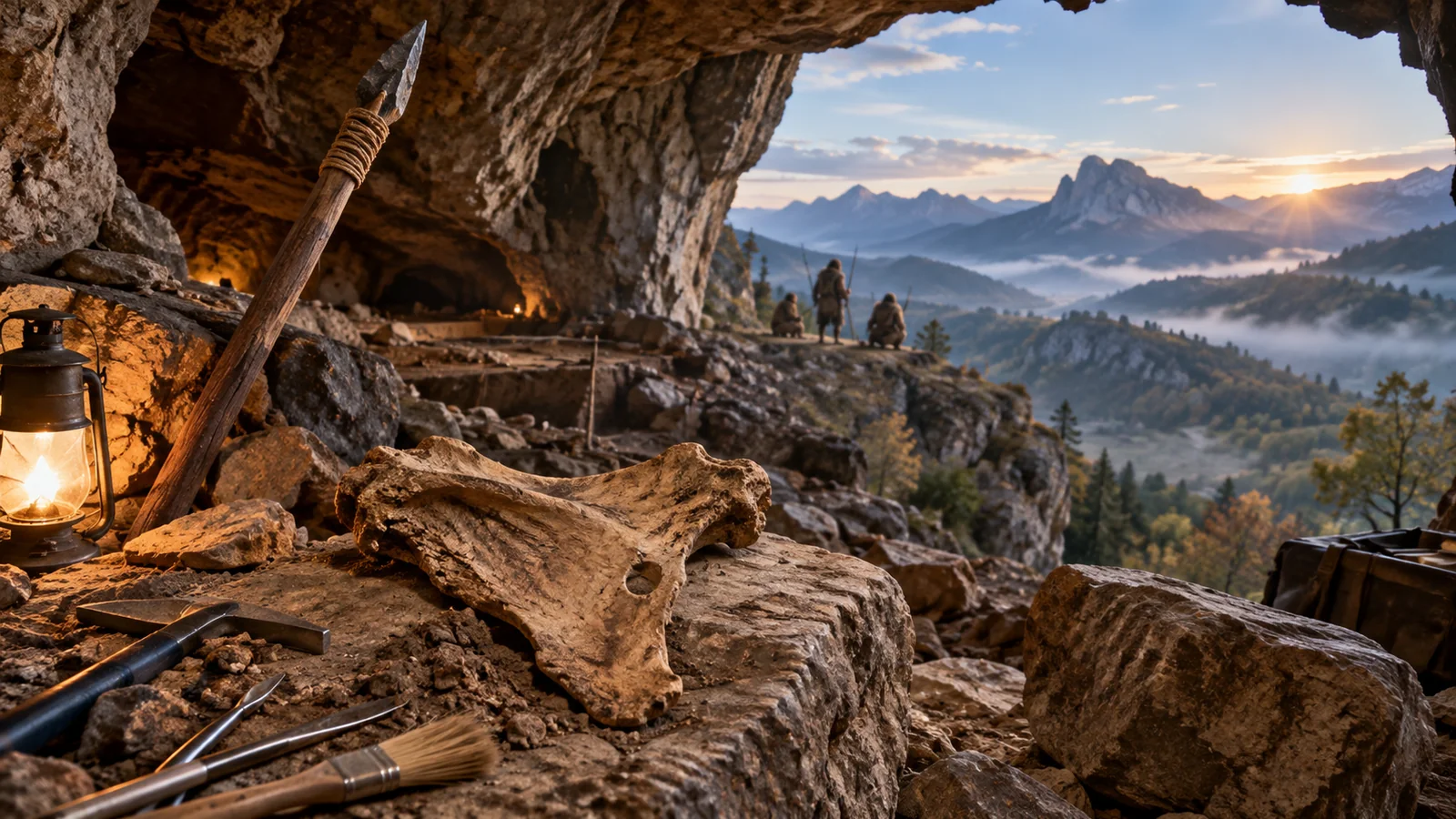
Editorial note: The featured image is a conceptual illustration of prehistoric archaeology, not a photograph of Shanidar A, the actual perforated scapula, or a verified reconstruction of events.
You may also like
 History & Archaeology
 Ancient Egypt’s Mining Map: How Egyptians Charted Roads, Rocks and Gold
Explore the Turin Papyrus Map, the ancient Egyptian record of Wadi Hammamat, quarry routes, rocks and gold.
 History & Archaeology
 23,000-Year-Old Footprints at White Sands: New Evidence of Human Life and Climate Change During the Ice Age
New 2026 research dates the White Sands human footprints to 23,500–21,700 years ago and reveals an abrupt Ice…
 History & Archaeology
 A Roman Pyramid Tomb in Egypt Reveals a 19-Line Greek Poem Mourning a Father
A Roman-period tomb in Egypt’s Dakhla Oasis preserves a 19-line Greek lament for a father, hieroglyphic protection spells…