
A Roman Pyramid Tomb in Egypt Reveals a 19-Line Greek Poem Mourning a Father
A Roman-period tomb in Egypt’s Dakhla Oasis preserves a 19-line Greek lament for a father, hieroglyphic protection spells and a remarkable blend of cultures.
Contents
- The discovery at a glance
- Where is Bir al-Shaghala, and why does it matter?
- A tomb that looks Egyptian but belongs to Roman Egypt
- Why a pyramid-shaped roof was still meaningful
- The Greek poem: a father remembered across centuries
- Why literary Greek matters in an Egyptian oasis
- Why the stone stele survived when so much else did not
- The Egyptian Amduat: why the seventh hour is important
- Who was buried here?
- Does the tomb imply a wealthy or important family?
- What else was found in and around the tomb?
- A timeline of the evidence — not just the headlines
- Why one tomb can contain Egyptian, Greek and Roman elements
- How archaeologists tell a genuine find from a dramatic reconstruction
- What remains unknown?
- Could the poem change what we know about life in the Western Desert?
- A discovery that links archaeology with ordinary human grief
- Sources and further reading
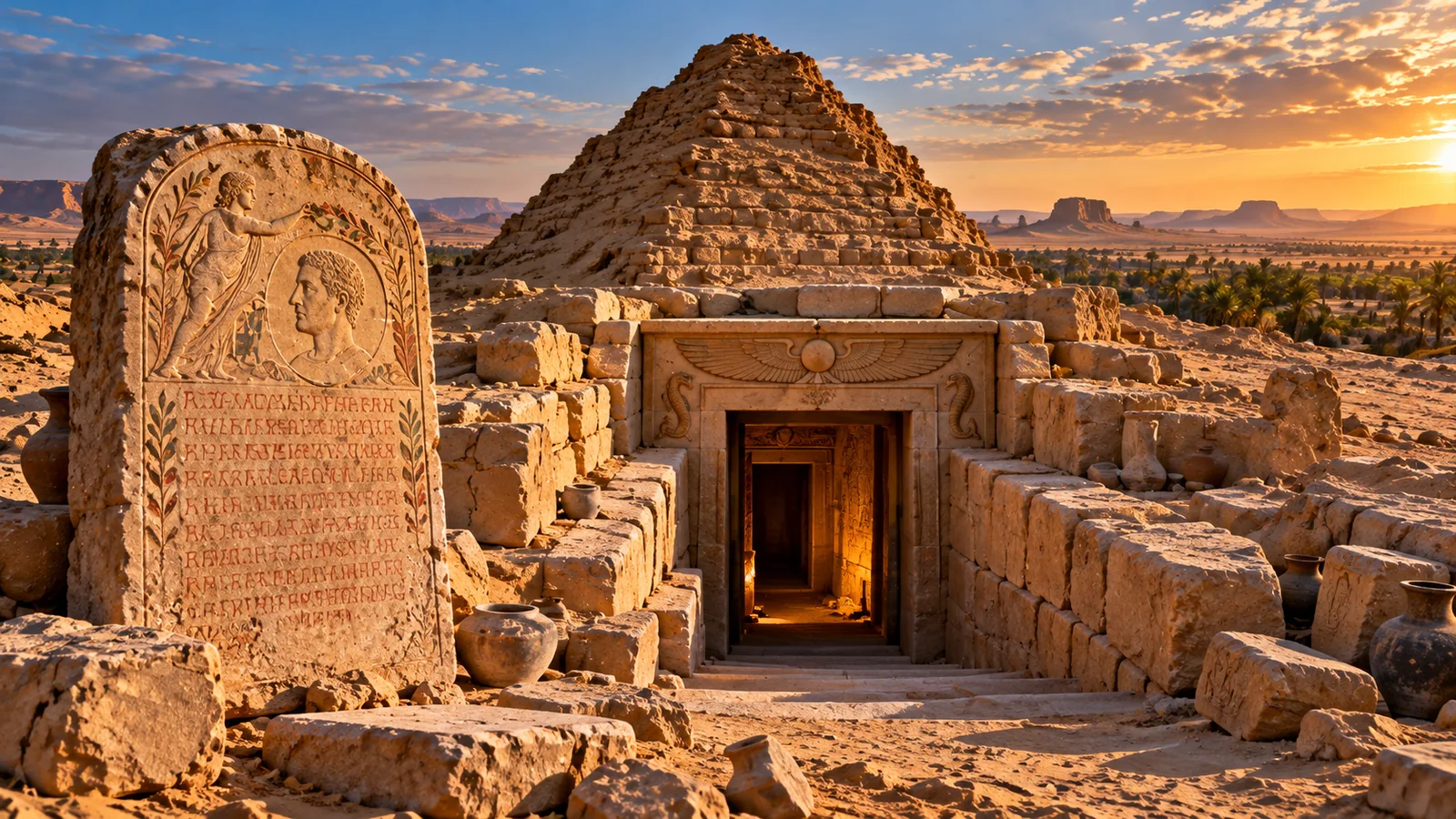
A poem written in red ink has survived for roughly 1,700 years inside a desert tomb. It does not recount a king’s victories or the ambitions of an empire. Instead, it remembers a father: a man praised for the counsel and kindness he offered in life. The inscription belongs to an extraordinary Roman-period burial monument at Bir al-Shaghala in Egypt’s Dakhla Oasis. Its architecture speaks the visual language of ancient Egyptian religion, while the mourners’ words were written in Greek. Together, they reveal a world more complicated than the usual dividing lines between “Egyptian,” “Greek,” and “Roman.”
On 24 September 2026, Egyptian authorities announced that a mission affiliated with the Supreme Council of Antiquities had uncovered a mud-brick tomb with a pyramid-shaped superstructure near Mut in the New Valley Governorate. The reported finds included a sandstone doorway carved with protective spells, two burial chambers, a Greek funerary poem of 19 lines, an offering table and purification basin, pottery and a bronze coin associated with Emperor Constantine. Subsequent reporting and specialist comments drew attention to the poem’s deeply personal message. The evidence is impressive without turning it into a story of a previously unknown pharaoh or a newly discovered Great Pyramid.
What is confirmed, and what is not? The tomb, the 19-line Greek inscription, the architectural features and the associated objects are reported in official and specialist accounts. The precise role of the deceased, the detailed sequence of use and some interpretations of the poem remain preliminary. The artwork accompanying this article is an original conceptual illustration, not a photograph or facsimile of the actual tomb or inscription.
The discovery at a glance
| Location | Bir al-Shaghala (also spelled Bir el-Shaghala or Bir esh-Shaghala), Dakhla Oasis, New Valley Governorate, Egypt |
|---|---|
| Announced | 24 September 2026 by Egyptian authorities |
| Broad period | Roman Egypt; the poem has been provisionally assigned to the late third or early fourth century CE |
| Tomb form | Mud-brick building with a small pyramidal superstructure and a sandstone entrance |
| Access and chambers | A 14-step staircase, a vaulted hall and two mud-brick burial chambers |
| Most remarkable inscription | A 19-line ancient Greek funerary elegy, written in red on a stone stele |
| Person remembered | Named in reports as Pisechtes, Psychtis or related transliterations; described tentatively as a judge |
| Other finds | Sandstone offering table and basin, pottery and a bronze coin depicting Constantine |
| Important limitation | Objects within an archaeological complex need not all date to the same construction or burial phase |
Where is Bir al-Shaghala, and why does it matter?
Bir al-Shaghala lies near Mut, the principal town of the Dakhla Oasis in Egypt’s Western Desert. In Greek and Roman texts the ancient settlement is known as Mothis. This was not an isolated cemetery in an empty wilderness. Dakhla was a settled oasis landscape with cultivated land, communities, administrative life and routes connecting the Western Desert to the Nile Valley and other oases. The cemetery served a population that lived through Egypt’s Ptolemaic and Roman periods, when local identities were shaped by several overlapping cultural traditions.
The Supreme Council of Antiquities began archaeological work at Bir al-Shaghala in 2002. Excavations have since revealed tombs with mud-brick vaults, sandstone features, courtyards, funerary chapels and pyramid-like upper structures. A new excavation announcement therefore belongs to a continuing archaeological project; it is not the discovery of an entirely unknown cemetery. This context is essential because older tombs from the same site help scholars recognize which architectural patterns recur and which elements of the newly announced tomb are unusual.
Published research by Maher Bashendi and other specialists previously examined tombs from the necropolis, describing how Egyptian funerary scenes were used in elaborate monuments under Roman rule. Scholars Roger Bagnall, Raffaella Cribiore and Günter Vittmann also published inscriptions from the cemetery. Those earlier studies establish that Greek and Egyptian writing had already been found in the wider burial ground. The newsworthy element of the 2026 announcement is the particular tomb and its unusual, personal funerary elegy, not the first evidence of Greek speakers in the oasis.
A tomb that looks Egyptian but belongs to Roman Egypt
A pyramid-shaped burial building can easily make readers think of the Old Kingdom monuments at Giza. That is a misleading comparison. This was not a royal, Old Kingdom pyramid on the scale of Khufu’s monument. It was a much smaller funerary superstructure associated with a private tomb in Roman-period Egypt. Pyramidal forms endured and were reinterpreted long after the great royal pyramids were built, including in local tomb traditions.
Archaeologists reported that a 14-step staircase leads toward a sandstone doorway. The doorway is decorated in an Egyptian architectural idiom, with a cavetto-style cornice, a winged sun disk and two cobras. The carved hieroglyphic writing includes funerary invocations and protective formulas. The upper lintel carries a representation associated with the seventh hour of the Amduat, an ancient Egyptian account of the sun god’s night journey through the underworld. Officials described that particular scene as unprecedented among the tombs documented at this necropolis.
Beyond the entrance lies a transverse hall built in mud brick and covered by a vault. Reports describe two mud-brick burial chambers to one side, with the pyramidal upper structure above. An Osirian figure and protective writing were recorded on a blocking stone near the entrance. Such details are not interchangeable decoration: they reflect beliefs about divine guardianship, bodily regeneration and the deceased person’s hoped-for passage to a renewed existence after death.
Why a pyramid-shaped roof was still meaningful
The pyramid form in a later private tomb was not an attempt to claim the status of a pharaoh merely by imitating Old Kingdom engineering. Egyptian funerary architecture drew from a long repertoire of sacred shapes and temple imagery. Some Roman-era Dakhla tombs combined a chapel on an upper level with burial spaces beneath. Studies of the cemetery have documented older examples with pyramidal superstructures and elaborate Osirian iconography. The present discovery should be interpreted against those local traditions, not as an architectural anomaly floating outside its archaeological setting.
A 2014 study of a different Bir al-Shaghala tomb described a larger multi-level family monument with a steep pyramid containing a chapel and funerary spaces below. That published structure is not the newly announced 2026 tomb. It is a valuable comparative example showing that the type existed locally over an extended period. Mixing dimensions or floor plans from separate excavations would create a false description of the new discovery.
The Greek poem: a father remembered across centuries
The inscription that captured international attention consists of 19 lines in ancient Greek, written with red ink on a stone funerary stele. Accounts describe a rectangular stele with a pediment-like top and a solar disk in relief. Rather than presenting an official decree, the text functions as a personal lament. It commemorates a man whose name has appeared with different spellings in English-language reports, including Pisechtes and Psychtis. Such variations often result from transliteration of ancient names through modern reporting, and should not be mistaken for evidence of separate people.
Specialist commentary summarized in recent reporting describes a bereaved son addressing his dead father, recalling his wisdom, kindness and guidance. Some readings associate the son with the name Sarapion. The phrase “Listen, father” has featured prominently in news coverage, but readers should not confuse brief excerpts in journalism with an independently verified, complete academic translation. For that reason this article does not fabricate an English rendering of all 19 lines or present invented verses as an archaeological transcription.
The father has been tentatively identified as a judge, based on preliminary interpretation. That is plausible but remains less certain than the existence of the inscription itself. If the identification proves correct, the poem may offer a glimpse of a respected local figure’s place in the social and perhaps legal world of Roman Dakhla. Even without the occupational title, the emotional content is significant: someone invested considerable effort in giving grief an enduring literary form.
Why literary Greek matters in an Egyptian oasis
Ancient Greek was used for a range of administrative, literary and private purposes in Egypt after Alexander’s conquest and through centuries of Roman rule. Its presence in a cemetery does not mean Egyptian language or religious practice had disappeared. The tomb illustrates precisely the opposite: a family could commemorate someone in Greek while choosing Egyptian-style protective images for the burial space. Language, religious imagery and political rule do not always line up neatly as separate identities.
A polished funerary epigram also hints at education, access to writing specialists and a community that valued literary expression. It does not prove that every inhabitant of Dakhla could read sophisticated Greek poetry. Wealth, training, occupational networks and patronage mattered. A stone poem can reveal a person’s aspirations or social connections even when most everyday residents left no comparable written record.
The question of authorship is similarly delicate. A surviving inscription may speak in the voice of a son, but its language could have been drafted, polished or copied by someone trained in literary conventions. We should distinguish the mourner represented in the text from a demonstrated autograph by that person. Until a full critical edition is available, there is no reason to turn a touching inscription into an unsupported biography.
Why the stone stele survived when so much else did not
Stone is durable; ink is not invulnerable. Burial environments can nonetheless shelter writing from light, weather and repeated disturbance. A text preserved in red pigment is an especially valuable source because it carries visual evidence of a writing practice in addition to the words. The material, placement and condition of the inscription can all help researchers reconstruct how visitors encountered it and what ritual or memorial function it served.
The durability of an object should not be confused with perfect preservation. Reading an ancient inscription requires choices about letter forms, damaged passages, names and poetic structure. The most responsible future publication would include high-resolution images, a transcription, translations, commentary on the Greek and a careful description of its original find position. Those items allow other specialists to test the interpretation rather than relying exclusively on a news summary.
The Egyptian Amduat: why the seventh hour is important
One of the most distinctive features reported at the tomb is a scene from the seventh hour of the Amduat. The Amduat, often translated approximately as “That Which Is in the Netherworld,” describes the night journey of the solar god through successive hours. In this cosmological drama, darkness and danger are not simply the absence of light. They are challenges that must be overcome for the sun to rise again and the cosmic order to continue.
The seventh hour is associated in traditional interpretations with a perilous confrontation involving Apophis (Apep), the enemy of the solar journey. Placing imagery from this cycle in a private burial setting can draw the deceased symbolically into a process of protection and renewal. The exact scene at Bir al-Shaghala still needs detailed specialist publication, so comparisons to better-known royal tomb programs should be offered as context, not as a claim that every image was copied identically.
Egyptian religion under Roman rule was neither completely unchanged nor suddenly erased. It was practiced in local communities, adapted in funerary art and sometimes combined with forms from wider Mediterranean culture. The same tomb can preserve Greek poetic mourning and Egyptian cosmological symbolism, without forcing us to choose one label for its occupants.
Who was buried here?
The Egyptian announcement described a tomb used for a man and his wife. The Greek stele commemorates a man identified in reports as Pisechtes or Psychtis, while preliminary readings associate him with judicial service. It is tempting to imagine a full family narrative: their wedding, professions, social standing and the life of a son who later wrote his tribute. Yet archaeological evidence currently made public does not establish all of those details.
We cannot infer the exact age at death of the couple, whether they died together, the cause of either death or the family’s entire history from the existence of a tomb and a poem. Nor should the surviving grave goods be treated as a complete inventory of their possessions. Tombs can be disturbed, reused, reorganized and affected by ancient or modern processes that shape what archaeologists eventually find.
Does the tomb imply a wealthy or important family?
The carved entrance, multiple spaces, funerary installations and sophisticated stele are compatible with access to resources beyond those of the poorest households. The larger Bir al-Shaghala necropolis includes monuments that scholars associate with relatively prosperous residents of the ancient oasis capital. But wealth and office are interpretations, not directly measured categories. A title, a comparable tomb group, personal names and the broader settlement record would help refine the assessment.
Social history becomes richer when archaeologists resist reducing every well-decorated tomb to “a nobleman’s grave.” Oasis residents could have been landholders, officials, merchants, priests or members of extended families engaged in several activities. The combined archaeological and documentary record, not the grandeur of a single doorway, must decide how securely an individual fits any of these categories.
What else was found in and around the tomb?
| Sandstone offering table | Suggests ritual provision for the dead; its position may help reconstruct repeated commemorative practices |
|---|---|
| Purification basin | May relate to ritual washing or preparation and complements the tomb’s funerary installations |
| Pottery vessels | Can illuminate vessel use, burial or ritual activities and potentially relative dating when forms are sufficiently diagnostic |
| Bronze coin with Constantine’s image | Provides an important historical clue, although a coin alone does not automatically date the original construction |
| Mud-brick chapel and shrine with four square columns | Reportedly associated with an upper or subsequent phase, raising questions about how the complex changed over time |
| Decorative spells and Osirian imagery | Show how Egyptian funerary protection and regeneration were expressed visually and textually |
The bronze coin showing Emperor Constantine deserves special caution. Constantine ruled during the early fourth century CE, but coins can circulate for years, move between layers or be left during later visits. A coin’s image and archaeological context can contribute to dating; the simple presence of a coin does not prove every wall, inscription and burial was installed in the year the coin was minted.
Reports also suggest that the tomb underwent later reuse and that mud-brick architectural additions may belong to another phase. If so, not every feature originated at one moment. Establishing the building’s history requires recording which walls join, which cut across earlier structures, where objects were found and how sediments accumulated. This is why an archaeological “discovery date” is fundamentally different from a secure construction date.
A timeline of the evidence — not just the headlines
| Ptolemaic and Roman eras | Long-term historical setting in which Mothis and the Dakhla oasis communities used the cemetery |
|---|---|
| First centuries CE | Earlier Roman-era Bir al-Shaghala tombs documented in scholarly publications; not all belong to the newly discovered monument |
| Late third to early fourth century CE | Preliminary dating of the newly announced Greek funerary elegy |
| Early fourth century CE | Reign of Constantine, whose image appears on an associated bronze coin |
| 2002 onward | Continuing excavation activity by Egyptian antiquities authorities at Bir al-Shaghala |
| 24 September 2026 | Official announcement of the new tomb and its associated discoveries |
| October 2026 | International coverage and specialist discussion of the inscription’s personal and literary significance |
Why one tomb can contain Egyptian, Greek and Roman elements
Modern history books divide centuries into dynasties, reigns and empires. Ordinary communities experienced cultural change less neatly. Roman officials ruled Egypt, Greek remained important in some written contexts, and Egyptian religious images persisted. In Dakhla, those layers became visible in architecture, writing, ritual and personal memory. The tomb is an unusually compact example of an ancient society making meaning from several traditions at once.
Calling the monument “Roman” describes its historical setting; it does not mean its builders must have been ethnic Romans from Italy. Calling the poem “Greek” identifies a language and literary form; it does not make the people buried there necessarily immigrants from Greece. Calling the decoration “Egyptian” recognizes its iconography; it does not settle the family’s preferred identity. An archaeological object can participate in multiple cultural traditions simultaneously.
That insight is more historically useful than the sensational phrase “Rome built a pyramid in Egypt.” The ancient Mediterranean world was connected through roads, administration, commerce, education and family networks. Dakhla belonged to those networks while retaining local practices. The evidence asks us to think about continuity, adaptation and choice, not a simple replacement of one culture by another.
How archaeologists tell a genuine find from a dramatic reconstruction
A discovery announcement describes objects actually encountered and recorded by an archaeological team. A reconstruction illustration imagines how a setting may once have looked. Both can be useful, but they must not be labeled interchangeably. A rendered stele displaying attractive Greek letters is not an authentic transcription of an excavated inscription; a digitally rebuilt facade is not direct evidence for its original colors, proportions or complete roofline.
For readers looking for trustworthy evidence, start with an institutional announcement from the Egyptian authorities. Then consult excavation reports or peer-reviewed research and distinguish older monuments at the same site from the 2026 tomb. Photographs of the actual monument can answer visual questions that a conceptual illustration cannot. For a disputed reading of Greek letters, the ideal source is a critical edition produced by a specialist epigrapher.
This article therefore uses an original feature illustration only to evoke the setting. It is not intended to reconstruct the exact tomb geometry, reproduce its actual funerary stele or supply text that the excavation team has not published in full.
What remains unknown?
There are still substantial research questions. Which elements can be securely dated by architecture, stratigraphy and associated objects? Was the funerary stele installed with the initial burial or added later? Which surviving names can be read confidently, and how exactly are the people mentioned related to the couple in the tomb? Was the man an actual judge, or did the text use a less formal description of wisdom or judgment? And what does the Greek poetic language reveal about education and literary models in the oasis?
The most productive response to those uncertainties is not skepticism about the entire find. The monument and the inscription can be real while their interpretation remains incomplete. That is a normal part of archaeological research. Good reporting separates observation from inference and explains what a future specialist study might clarify.
Could the poem change what we know about life in the Western Desert?
It could add important detail, particularly regarding social networks, education, mourning practices and multilingual life. The broader cemetery was already known as a rich source of Roman-period Egyptian funerary culture, so the poem should be seen as a new piece of a growing record. It may contribute to the history of elite self-presentation and literary expression, but it does not by itself establish an otherwise unknown civilization or rewrite the chronology of ancient Egypt.
The greater historical value lies in the human-scale story. Archaeology often preserves rulers, temples and administrative lists. A 19-line lament can help us recognize a relationship between living and dead within an oasis community. The father praised in the inscription lived under an empire, but the memory his family wished to preserve was also personal.
A discovery that links archaeology with ordinary human grief
The Dakhla find is memorable because two kinds of ancient language meet at the same doorway. The carved Egyptian spells ask for protection and passage through the afterlife. The Greek poem gives grief a voice, reaching toward someone who could no longer answer. A small pyramid-shaped monument in the Western Desert contains both. Nothing about that combination requires exaggeration.
The responsible conclusion is neither that an unknown king’s pyramid has been uncovered nor that scholars have solved every detail of a lost biography. It is that Egyptian archaeologists have documented a notable Roman-period private tomb, and a 19-line Greek funerary poem found there adds an unusually intimate dimension to the history of the Dakhla Oasis. As future editions and excavation reports appear, the monument will have more to tell us—about ritual, identity, education and the ways families kept their loved ones present after death.
Sources and further reading
- Egypt’s State Information Service — official announcement, 24 September 2026: summary of the excavation, monument, inscription and associated finds.
- Ahram Online — Roman-era pyramidal tomb unearthed at Bir al-Shaghala: detailed archaeological description of the entrance, staircase, chambers and Amduat imagery.
- Archaeology Magazine — pyramid-shaped tomb discovery: concise specialist archaeology news summary.
- Smithsonian Magazine — a Roman-era father’s Greek elegy: October 2026 coverage of specialist interpretations and the poem’s personal significance.
- Live Science — Greek poem and protective hieroglyphics: discussion of the literary context and interpretations of the lament.
- IFAO — Maher Bashendi, A Roman Period Tomb with a Pyramidal Superstructure: scholarly comparison with an earlier, different tomb from Bir al-Shaghala.
- New York University digital archive — Inscriptions from Tombs at Bir esh-Shaghala: pre-existing Greek and Egyptian epigraphic research at the necropolis.
- Egyptian Ministry of Tourism and Antiquities — earlier discoveries at Bir al-Shaghala: background on continued excavations and Roman-period burials in the oasis.
You may also like
 History & Archaeology
 Ancient Egypt’s Mining Map: How Egyptians Charted Roads, Rocks and Gold
Explore the Turin Papyrus Map, the ancient Egyptian record of Wadi Hammamat, quarry routes, rocks and gold.
 History & Archaeology
 23,000-Year-Old Footprints at White Sands: New Evidence of Human Life and Climate Change During the Ice Age
New 2026 research dates the White Sands human footprints to 23,500–21,700 years ago and reveals an abrupt Ice…
 History & Archaeology
 A 75,000-Year-Old Neanderthal Spear Wound: What Shanidar Cave Reveals About Violence, Care and Burial
New Shanidar Cave research documents a probable fatal 15-mm spear wound in a 75,000-year-old Neanderthal, earlier facial trauma…