
Orionid Meteor Shower 2026: Peak Time, Best Viewing Hours and Where to Watch in the US and UK
When the Orionid meteor shower peaks in 2026, how to watch in the US and UK, and why moonset matters.
Contents
- The Orionids return in October 2026
- When does the Orionid meteor shower peak in 2026?
- Best time to watch in the United States
- Best time to watch in the United Kingdom
- How moonlight changes the view
- How many shooting stars can you expect?
- Where to look in the sky
- Why Halley’s Comet causes the Orionids
- How to watch the Orionids
- How to photograph the meteor shower
- What if October 21–22 is cloudy?
- Are Orionid meteors dangerous?
- The bottom line
- Scientific sources
- How to Watch the Orionids: Step-by-Step
- Can You Photograph the Orionids?
- What If It Is Cloudy on Peak Night?
- Scientific Sources
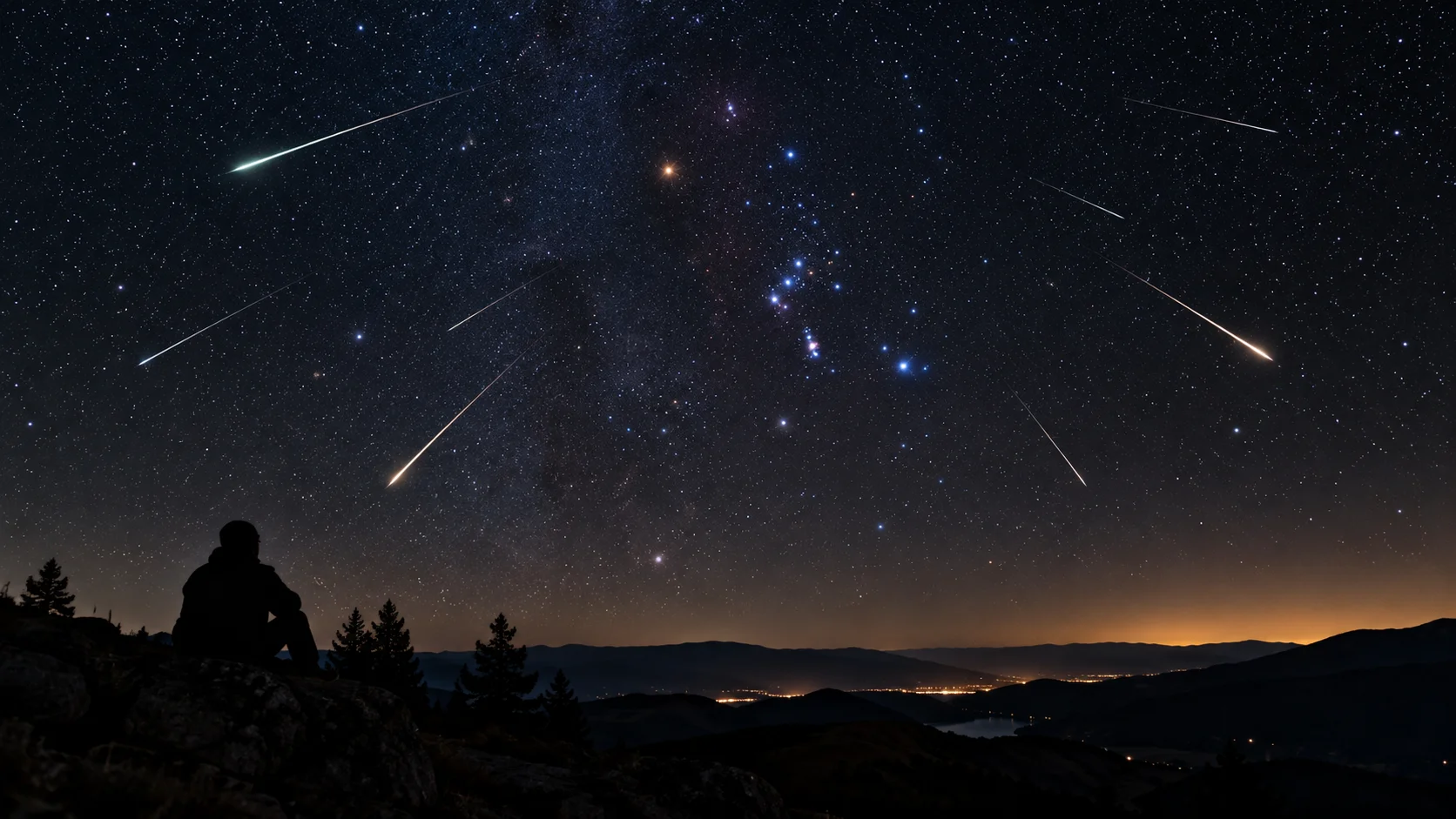
Peak: October 21–22, 2026. The most promising viewing window is after local moonset and before dawn on October 22.
The Orionids return in October 2026
The annual Orionid meteor shower brings fragments of Halley’s Comet into Earth’s atmosphere. Its main peak is expected overnight October 21–22, 2026. A bright waxing gibbous Moon may hide faint meteors, so the best opportunity is after local moonset and before dawn.
When does the Orionid meteor shower peak in 2026?
NASA lists the Orionids as active October 2 through November 7, with the peak around October 21–22. The shower has a broad maximum, so surrounding nights can still produce meteors. Under favorable dark skies, roughly 10–20 meteors per hour may be possible; this is not a guarantee for any particular location.
Best time to watch in the United States
For much of the US, aim for the early morning of October 22, after moonset and before morning twilight. NASA suggests around 3 a.m. as a general guide, but the precise moonset time depends on location. Check your city’s moonset and twilight times. Rural dark sites in the eastern, central and western states are preferable to brightly lit suburbs.
Best time to watch in the United Kingdom
Across England, Scotland, Wales and Northern Ireland, target the early hours of October 22 after the Moon sets and before dawn. Northumberland, the Yorkshire Dales, Eryri and parts of the Scottish Highlands offer potential dark-sky locations, weather and access permitting. Check the Met Office forecast and local site access rules before traveling.
How moonlight changes the view
The waxing gibbous Moon brightens the sky, washing out many fainter meteors. Brighter Orionids may still be visible before moonset, but darker skies after moonset should reveal more. Do not assume the same observation window works in every city.
How many shooting stars can you expect?
The typical dark-sky rate is around 10–20 meteors an hour. Suburban observers may see far fewer, perhaps only a handful, depending on lighting, weather, and lunar glare. Give yourself at least 45–60 minutes of watching rather than expecting a meteor immediately.
Where to look in the sky
The radiant is near Orion, close to Betelgeuse, but meteors can streak across any part of the sky. Recline and watch a wide unobstructed area rather than staring only at the constellation. Orion rises higher during the second half of the night.
Why Halley’s Comet causes the Orionids
Comet 1P/Halley leaves dust along its orbit. Earth passes through some of that debris each October. Tiny particles enter the atmosphere at about 66 kilometers per second, producing bright streaks; some leave persistent glowing trains. Halley’s Comet last visited the inner solar system in 1986 and is expected back in 2061.
How to watch the Orionids
Check the weather and local moonset; choose a safe dark site away from direct lights; bring warm layers and a reclining chair; allow 20–30 minutes for dark adaptation; keep phone screens dim; watch broadly and patiently. Neither telescopes nor binoculars are required. A dim red flashlight helps preserve night vision.
How to photograph the meteor shower
Use a tripod, wide-angle lens, carefully set manual focus, and repeated exposures. A starting point is a 10–20 second exposure with a wide aperture and ISO adjusted to local sky brightness. Test shots for overexposure and star trails. Some phones offer astrophotography modes, but faint meteors can be difficult to capture.
What if October 21–22 is cloudy?
The Orionids remain active into November. Clear nights on October 20, 23 or 24 may be more rewarding than a clouded-out peak, though rates and moonlight vary. Avoid long trips without checking the latest forecast.
Are Orionid meteors dangerous?
The visible streaks are normally made by very small particles burning up high in Earth’s atmosphere. Watching requires no special eye protection. Follow ordinary outdoor safety precautions.
The bottom line
For US and UK observers, plan for the early morning of October 22 after local moonset and before dawn, with a clear sky and as little artificial light as possible. The Moon may reduce counts, but bright Orionids can still reward patient observers.
Scientific sources
NASA — Orionids; NASA — October 2026 Skywatching; Royal Observatory Greenwich — Orionids 2026.
How to Watch the Orionids: Step-by-Step
- Check cloud cover and the exact moonset time for your location.
- Choose a dark, legally accessible location with a wide sky view.
- Dress warmly and bring a reclining chair or blanket.
- Allow 20–30 minutes for your eyes to adjust to darkness.
- Watch a broad section of sky for at least 45–60 minutes.
- Avoid bright phone screens and use a dim red light if necessary.
Can You Photograph the Orionids?
Use a stable tripod, a wide-angle lens, manual focus on distant stars and interval shooting. Try exposures of approximately 10–20 seconds, then adjust aperture and ISO for your camera and sky brightness. Smartphone astrophotography modes may capture bright meteors, but faint streaks are difficult to record.
What If It Is Cloudy on Peak Night?
The Orionids remain active into early November. If October 21–22 is cloudy, try nearby clear nights instead; meteor activity and moonlight will vary.
Scientific Sources
You may also like
 Science
Why Can’t We Remember Being Babies? What Memory Research Shows
Why our first years are hard to recall, what infant brain scans reveal, and why forming a memory…
 Science
Can Octopus Arms Think for Themselves? What the Science Shows
How octopus arms process information, what segmented nerve cords reveal, and why local control does not prove nine…
 Science
The Lost Ahramat Nile Branch: How Did Ancient Egyptians Transport Stone to the Pyramids?
The lost Ahramat Branch of the Nile may help explain how ancient Egyptians reached pyramid sites. Explore the…