
Could Neanderthals Have Used Natural Antibiotics? What Evidence Shows
Evidence from ancient dental calculus suggests Neanderthals may have used medicinal plants. That is not proof they invented modern antibiotics.
Contents
- What did researchers actually find?
- Did they invent penicillin?
- What are alternative explanations?
- Why does it matter?
- What should readers remember?
- The 2017 dental-calculus investigation
- Why poplar and Penicillium attracted attention
- How researchers separate clues from proof
- What this reveals about Neanderthal life
- The distinction between natural remedies and antibiotics
- What future research could clarify
- Sources and further reading
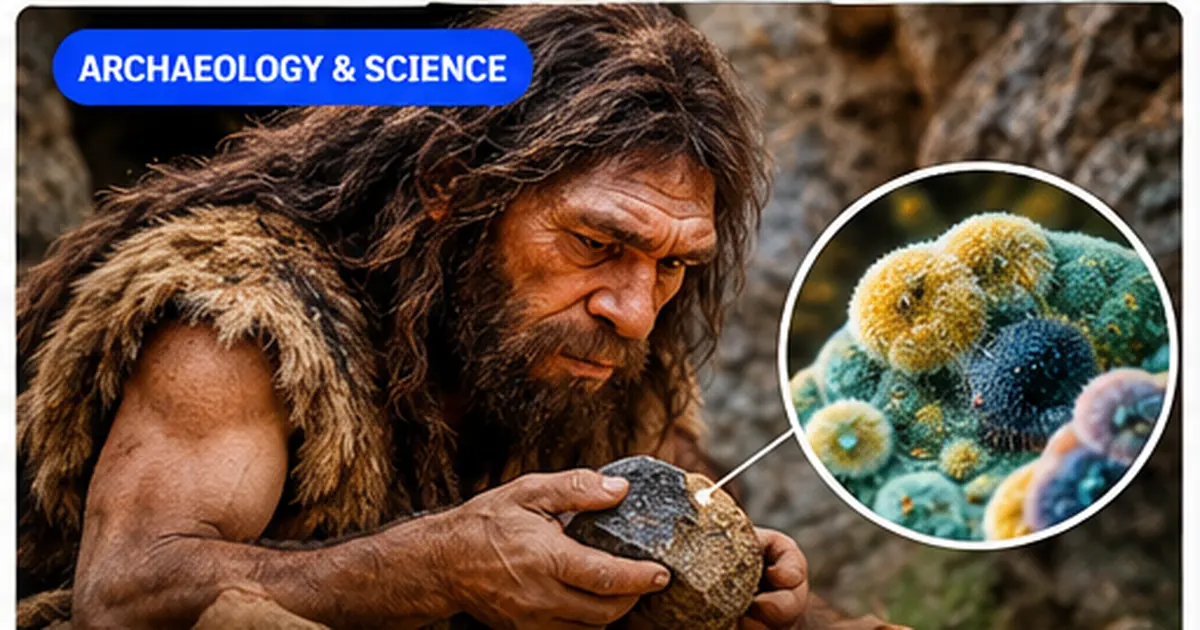
Evidence from ancient dental calculus suggests Neanderthals may have used medicinal plants. That is not proof they invented modern antibiotics.
What did researchers actually find?
Researchers studying Neanderthal dental calculus identified traces of plant material and microbial DNA. A widely discussed study of a specimen from El Sidrón, Spain, reported poplar and Penicillium-related evidence in a person with signs of illness. These observations are suggestive, not a written medical record.
Did they invent penicillin?
No evidence shows Neanderthals isolated penicillin, measured doses, or developed antibiotics as modern medicine defines them. Penicillium is a fungal genus, and finding its DNA does not establish that the person intentionally used an antibiotic.
What are alternative explanations?
Plant traces might reflect food, environmental exposure or deliberate use. Microbial signals may also have multiple origins. Scientists compare samples, context and contamination controls before drawing conclusions.
Why does it matter?
The evidence adds nuance to our picture of Neanderthal behavior, including self-care, diet and knowledge of their surroundings. The strongest claim is possible medicinal behavior—not the invention of antibiotics.
What should readers remember?
Do not try to treat infections with wild fungi or plants. Modern antibiotics require diagnosis, appropriate prescribing and quality-controlled manufacture.
The 2017 dental-calculus investigation
The 2017 Nature study examined hardened dental plaque from Neanderthal individuals, including remains from El Sidrón in Spain and Spy in Belgium. Dental calculus can preserve tiny fragments of food, microbial DNA and other material that became trapped in the mouth during life. It is an unusually useful archaeological archive, but it is not a diary of what someone intended to do.
One El Sidrón individual had signs consistent with a dental abscess and an intestinal pathogen. Researchers reported DNA associated with poplar and a Penicillium mould. These observations led to a hypothesis of possible self-medication, not a demonstration of a manufactured antibiotic or a proven cure.
Why poplar and Penicillium attracted attention
Poplar bark contains salicylate-related compounds, which are chemically connected to substances used in modern pain-relieving medicines. Certain Penicillium species can produce antibiotic molecules, but finding a fungal signature in ancient plaque does not establish that the mould produced penicillin in that individual’s mouth.
The study therefore supports a more cautious conclusion: Neanderthals encountered plants and microorganisms that have medically interesting properties. Whether they intentionally selected them for relief, consumed them as food, or acquired them through the environment is harder to establish.
How researchers separate clues from proof
Ancient DNA studies rely on contamination controls, sequence analysis and comparisons across samples. The age of material, preservation conditions and laboratory handling can all affect which organisms appear in a dataset. A species identification alone cannot show how much of a substance was present or whether it had a therapeutic effect.
A convincing case for habitual medicinal use would benefit from repeated findings across individuals and sites, evidence that the substances were chosen despite low food value, and a plausible relationship between the individual’s condition and the material detected.
What this reveals about Neanderthal life
Neanderthals lived across varied Eurasian environments for hundreds of thousands of years. Their survival required detailed practical knowledge of local resources. Archaeological evidence also points to complex tool use, hunting and care of some injured individuals. Possible plant-based self-care fits within that broader picture without requiring modern pharmaceutical knowledge.
Different Neanderthal communities probably had different diets and traditions. It would be misleading to turn evidence from one or two individuals into a claim that all Neanderthals routinely treated infections with antibiotics.
The distinction between natural remedies and antibiotics
A plant used to relieve discomfort is not necessarily an antibiotic. An antibiotic is a substance capable of inhibiting or killing bacteria under appropriate conditions; modern treatment additionally depends on diagnosis, formulation, dose and safety testing. Historical use of plants and fungi should not be confused with these clinical requirements.
This distinction matters because untreated bacterial infections can become dangerous. Archaeological speculation is not a reason to replace evidence-based medical care with wild plants or mould.
What future research could clarify
Better reference databases, improved ancient-DNA recovery and chemical residue analysis may help researchers distinguish dietary material from possible medicinal use. Larger samples could show whether certain plants repeatedly appear in individuals with similar health problems.
Even with improved methods, researchers may never be able to reconstruct a person’s intentions with certainty. The most valuable finding is a more detailed picture of behavior, rather than a dramatic claim that a prehistoric group invented a modern drug.
Sources and further reading
Explore more science and technology explainers on Horus Valley.
You may also like
 Science
 The $1.8 Billion AI Biology Project: Can Virtual Cells Transform Medicine?
Inside the $1.8 billion Virtual Biology Initiative: funding, partners, virtual cell AI, drug discovery potential, data access and…
 Science
 Can Human Cells Remember Things Outside the Brain? What Studies Really Show
Can cells outside the brain remember? Explore NYU research on cellular memory, spaced stimulation, ERK and CREB, and…
 Science
 What Are Mirror Life Organisms and Why Are Scientists Concerned?
Mirror life is hypothetical, but its potential risks have prompted UN warnings. Explore molecular chirality, real research, safety…