
The $1.8 Billion AI Biology Project: Can Virtual Cells Transform Medicine?
Inside the $1.8 billion Virtual Biology Initiative: funding, partners, virtual cell AI, drug discovery potential, data access and scientific limitations.
Contents
- What was announced on October 7, 2026?
- What is a virtual cell?
- Where does the $1.8 billion come from?
- Why biology needs a different kind of AI dataset
- How the research pipeline could work
- The measurement technologies behind the initiative
- Why perturbation experiments are more informative than snapshots
- Could virtual cells accelerate drug discovery?
- What could this mean for cancer and rare diseases?
- How is this different from AlphaFold?
- What researchers must prove before trusting the models
- Data openness, exclusivity and public value
- Privacy, ethics and biosafety
- Timeline: what might happen next?
- How to read future headlines about this project
- The bottom line
- Original sources and reporting
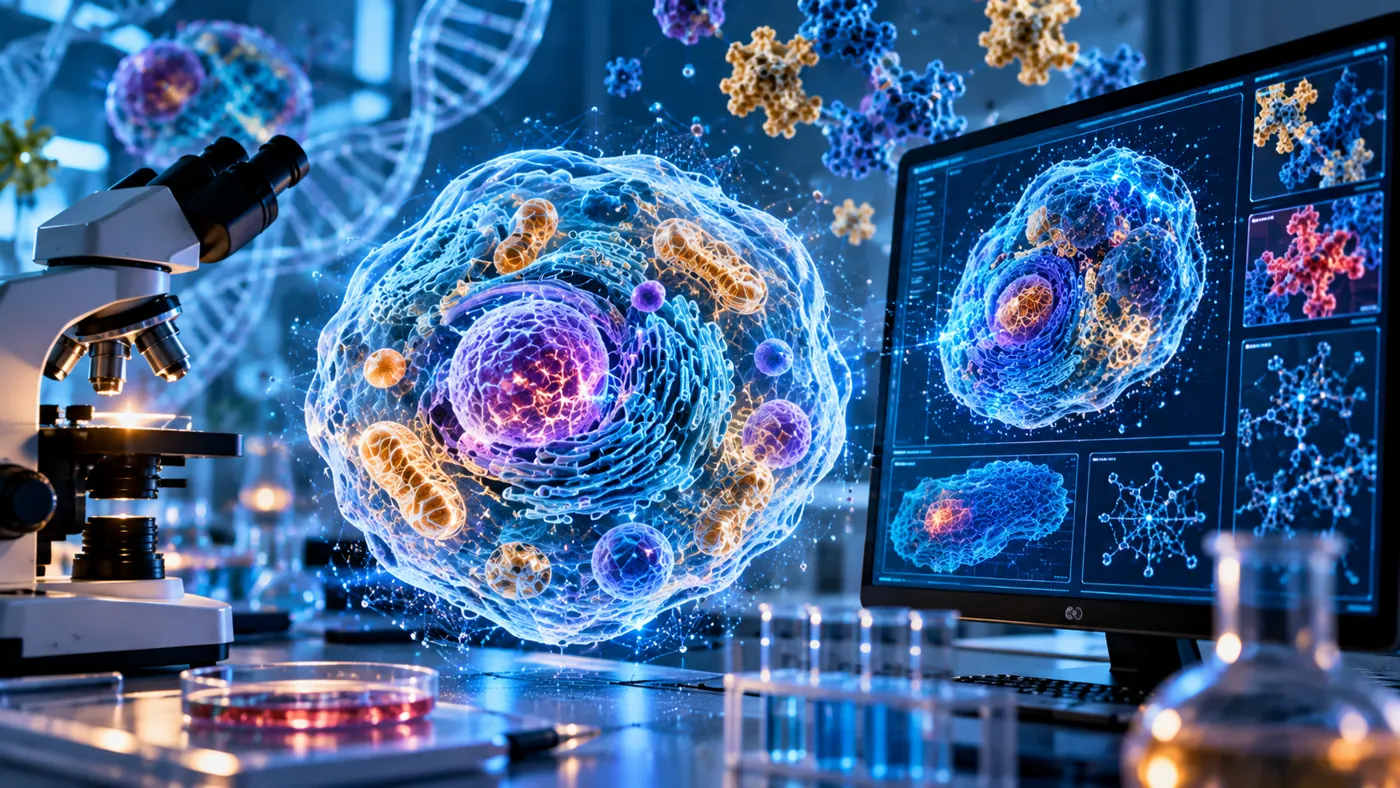
In October 2026, a Biohub-led coalition announced $1.8 billion in combined commitments to build the data foundation for AI models that predict cell behavior. The promise is exciting, but the science and financing need careful unpacking.
What was announced on October 7, 2026?
Biohub, the nonprofit research organization founded by Mark Zuckerberg and Priscilla Chan, announced that its Virtual Biology Initiative had expanded into a $1.8 billion collaboration. Partners include the US Department of Energy, the National Institutes of Health, Google DeepMind, Isomorphic Labs and Meta. The goal is not to release a new medicine or a fully functioning digital human today. It is to build the experimental data, measurement tools and computational infrastructure needed to train models that can predict how living cells respond to changes. This distinction is fundamental: the announcement concerns an ambitious research foundation, not a proven clinical breakthrough.
What is a virtual cell?
A virtual cell is a computational representation that attempts to predict a biological cell’s behavior. Imagine asking what might happen if a gene were disabled, a drug added, a virus encountered or the surrounding tissue became inflamed. A useful model would estimate changes in gene activity, proteins, cell shape, survival and interactions with neighboring cells. Unlike a static 3D illustration, a predictive model must make testable forecasts about interventions it has not seen. Today’s tools model parts of biology with varying success; an accurate, broadly generalizable virtual human cell remains a research ambition.
Where does the $1.8 billion come from?
The headline figure combines several kinds of contributions, not $1.8 billion of newly transferred cash. Biohub initially committed $500 million in April 2026: $400 million toward large-scale measurement and technology and $100 million toward a coordinated external research effort. The Department of Energy plans more than $500 million over five years for laboratory measurement, modeling and computation. Meta, Google DeepMind and Isomorphic Labs collectively pledged $300 million. The NIH is coordinating repositories and datasets developed through more than $500 million of earlier federal investment. That last contribution represents previously funded research resources, rather than a fresh $500 million payment. NVIDIA is also providing computing expertise and infrastructure support, without a separately specified monetary amount in the main headline.
Why biology needs a different kind of AI dataset
Language models can learn from enormous quantities of text, but living cells cannot be understood simply by collecting more scientific articles. Researchers need standardized measurements linking a specific cell type, its environment, a defined intervention and its observed response. Two cells with the same DNA can behave differently because of age, tissue location, signaling molecules or disease state. Measurements taken by different laboratories may also vary because of protocols, instruments and batch effects. Data quantity matters, but consistent metadata, reproducibility, representative samples and experimental controls matter just as much.
How the research pipeline could work
First, scientists select relevant human cell types and biological questions. Second, they perturb cells: for example, alter a gene, expose cells to a candidate compound or change an environmental signal. Third, they measure the results with imaging, gene-expression assays, protein measurements and other techniques. Fourth, carefully labeled records are assembled into datasets and used to train predictive models. Fifth, researchers test the models on new interventions, cell types and independent laboratories. Only if predictions repeatedly match reality can models become useful tools for prioritizing costly experiments. Every step creates opportunities for error and bias.
The measurement technologies behind the initiative
Biohub’s original plan emphasizes cryo-electron tomography for fine-scale structures, microscopy capable of observing vast numbers of cells in living tissue, and engineering approaches that deliberately perturb molecular and cellular systems. These techniques provide different views of biology. Images reveal structure and location; sequencing can reveal which genes are active; perturbation experiments help determine how cells react when something changes. Combining these modalities is technically difficult because they differ in resolution, sampling and noise. No single measurement captures an entire living cell at every scale and moment.
Why perturbation experiments are more informative than snapshots
Suppose a protein is abundant in diseased cells. A model trained only on snapshots may associate the protein with disease without knowing whether it causes the problem, responds to it or is unrelated. In a controlled perturbation experiment, researchers change a specific factor and observe what follows. This provides stronger evidence about mechanisms, though experiments still have confounders and off-target effects. The initiative’s promise depends on collecting enough carefully designed interventions to move from pattern recognition toward useful causal prediction.
Could virtual cells accelerate drug discovery?
Drug discovery involves selecting biological targets, identifying compounds, assessing toxicity and testing whether effects survive increasingly realistic experiments. A validated virtual cell might help screen hypotheses before researchers spend money on physical assays, predict unwanted cellular effects or identify which experiments would be most informative. It would not eliminate animal research, human clinical trials or regulatory review. Effects in one cultured cell type do not establish how a medicine will behave across organs, immune systems, doses or individual patients. The realistic near-term benefit is better experimental prioritization, not instant drug approval.
What could this mean for cancer and rare diseases?
Cancer involves evolving populations of cells interacting with immune and surrounding tissue. A predictive model could eventually help scientists explore why a tumor resists a treatment or which cellular pathways merit investigation. For rare genetic disorders, models might support hypotheses about how a mutation alters a cell’s function. These are potential research applications, not demonstrated patient outcomes from the new initiative. Any claim that the project has cured cancer or can already recommend an individual’s treatment would go beyond the published announcement.
How is this different from AlphaFold?
AlphaFold-style systems predict important aspects of protein structure, a narrower task than predicting an entire cell. A cell contains many interacting molecules, compartments and signaling pathways that change over time. Predicting a protein’s shape does not tell researchers how a drug will affect a tissue or patient. The virtual-cell ambition builds on progress in molecular AI but adds dynamic behavior, environmental context and interactions across biological scales. Success will require new data and independent testing rather than merely enlarging an existing protein model.
What researchers must prove before trusting the models
Useful validation needs more than a single impressive accuracy score. Researchers should test previously unseen gene perturbations and compounds, new donors, different instruments and independent laboratories. They must report when the system fails, how uncertain its predictions are and whether its performance changes across cell types or populations. External replication, transparent benchmarks and safeguards against training-test leakage are crucial. In medicine, a convincing prediction in a cell culture is still several steps away from evidence of benefit to patients.
Data openness, exclusivity and public value
The coalition describes the intended data foundation as open, but reporting on the collaboration notes an initial period of privileged access for commercial partners before broader public release. That raises legitimate questions: Which datasets will become downloadable, under what licenses, with what metadata, and on what timetable? Open access alone does not guarantee usability or fair participation if computational costs are prohibitive. Independent researchers will need practical access to documentation, benchmarks and suitable computing resources. Commercial incentives and public investment must be balanced with transparent governance.
Privacy, ethics and biosafety
Biological datasets can include information linked to human donors, genetic characteristics or clinically sensitive conditions. Responsible projects require appropriate consent, de-identification where possible, controlled access for sensitive records and independent ethics oversight. Another concern is dual use: detailed biological prediction may enable beneficial research while also raising questions about misuse. Safeguards should be proportional to the capabilities actually demonstrated, rather than treating every virtual-cell model as an immediate biosecurity threat.
Timeline: what might happen next?
Biohub announced the initial five-year initiative in April 2026 and its expanded partnership on October 7. Reuters reported an ambition to produce an initial dataset within roughly a year and functional predictive models within five years. These are targets, not guarantees. A dataset can arrive on schedule without producing a model that works reliably in clinics. The most meaningful milestones will be public data releases, reproducible benchmarks, externally validated predictions and peer-reviewed evidence that researchers can use the tools to make better experimental decisions.
How to read future headlines about this project
When you encounter a claim that AI has created a digital cell, ask what was actually modeled: one protein, one cell line, one pathway or multiple tissues? Was the result predicted before the laboratory experiment? Did an independent team replicate it? Was the model tested on unfamiliar drugs or genes? Is the reported result about laboratory efficiency, biological understanding or a clinical treatment? These questions help separate genuine progress from marketing language and avoid confusing a promising simulator with a proven cure.
The bottom line
The $1.8 billion Virtual Biology Initiative is a substantial attempt to solve a real bottleneck: the shortage of high-quality, standardized experimental data needed for predictive biology. Its potential is large, from understanding disease mechanisms to improving the selection of drug experiments. Its limits are equally important. A virtual cell is not yet a replacement for living biology, and the investment is not proof of a medical breakthrough. The next few years will show whether better data can translate into reliable predictions and, eventually, meaningful benefits for patients.
Original sources and reporting
Biohub announcement, October 7, 2026
Biohub founding announcement, April 29, 2026
You may also like
 Science
 Can Human Cells Remember Things Outside the Brain? What Studies Really Show
Can cells outside the brain remember? Explore NYU research on cellular memory, spaced stimulation, ERK and CREB, and…
 Science
 What Are Mirror Life Organisms and Why Are Scientists Concerned?
Mirror life is hypothetical, but its potential risks have prompted UN warnings. Explore molecular chirality, real research, safety…
 Science
 Could Neanderthals Have Used Natural Antibiotics? What Evidence Shows
Evidence from ancient dental calculus suggests Neanderthals may have used medicinal plants. That is not proof they invented…