
Can Human Cells Remember Things Outside the Brain? What Studies Really Show
Can cells outside the brain remember? Explore NYU research on cellular memory, spaced stimulation, ERK and CREB, and the limits of the evidence.
Contents
- What scientists mean by cellular memory
- The experiment that made headlines
- Why the spacing of signals matters
- What exactly did the cells remember?
- What are ERK and CREB?
- Were these ordinary kidney cells inside a human body?
- How does this differ from memory in the brain?
- Are neurons the only cells involved in human memory?
- Can a single-celled organism learn?
- Is immune memory an example?
- What about epigenetic memory?
- Does muscle memory mean muscles store learned movements?
- Can transplanted organs transfer a donor's memories?
- Could this research improve medicine?
- Why is the experiment scientifically important?
- What are the limitations of the evidence?
- How to spot exaggerated claims
- What questions should future research address?
- Conclusion
- Primary sources and further reading
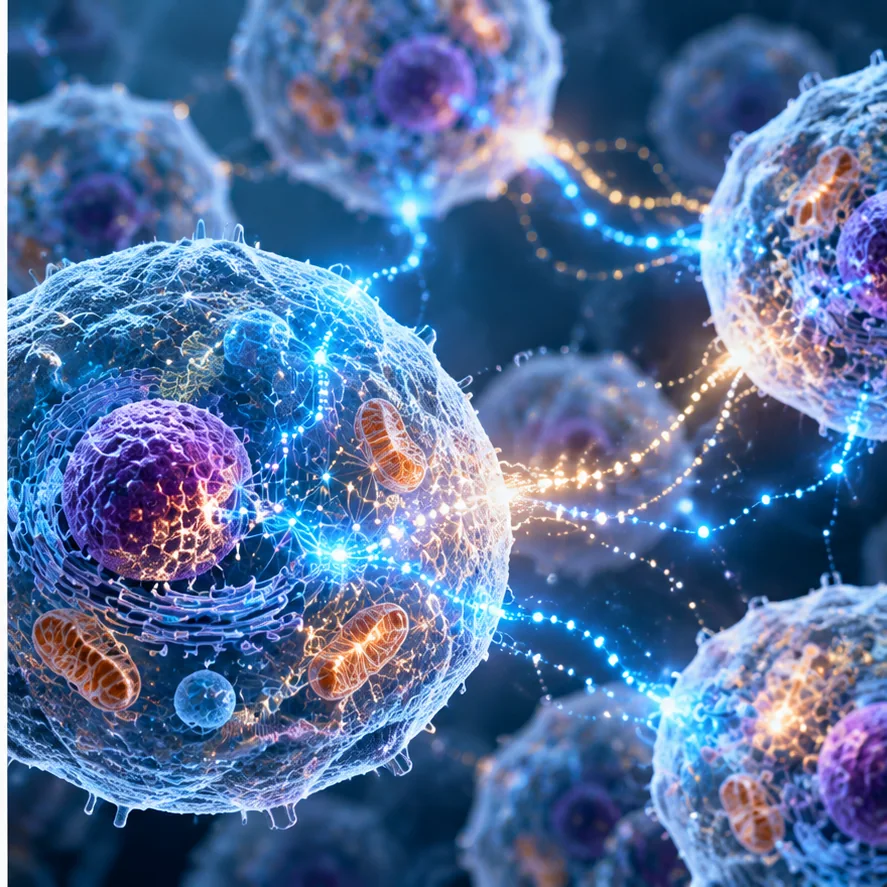
Can a cell outside the brain remember a previous experience? The answer depends on what “remember” means. Researchers have shown that certain non-neural human cells can respond differently to repeated chemical stimulation depending on how those stimuli are spaced in time. That is a measurable form of cellular history dependence, not evidence that skin or kidney cells remember conversations, childhood events or personal identities.
What scientists mean by cellular memory
In everyday language, memory means recalling information or experiences. In cell biology, the word can describe a persistent change in how a cell behaves after an earlier signal. Cells may alter gene expression, signaling pathways, receptor sensitivity or other internal states. Those changes can affect later responses even after the original stimulus disappears. Cellular memory is therefore a broad term covering several mechanisms; it should not automatically be equated with conscious, autobiographical memory.
The experiment that made headlines
A study published in Nature Communications on November 7, 2024, by Nikolay Kukushkin and colleagues at New York University examined the massed-spaced learning effect in two non-neural human cell lines. The researchers engineered cells to produce a short-lived luciferase reporter when a CREB-dependent signaling program was activated. Luciferase generates a measurable light signal, allowing the team to track the response after different patterns of stimulation.
The researchers applied chemical pulses that activated cellular signaling and compared spaced exposures with more concentrated or massed exposures. Four spaced pulses produced stronger and more sustained reporter expression than a single massed pulse. The finding was reproduced in HEK293 cells, a laboratory cell line originally derived from embryonic kidney tissue. The effect lasted more than 24 hours under the experimental conditions.
Why the spacing of signals matters
Many animal learning studies show that repeated training separated by intervals can produce longer-lasting effects than the same training packed together. The researchers asked whether this temporal sensitivity might exist in cells without a nervous system. Their results suggest that the dynamics of molecular signaling can register not only whether a signal occurred, but also how repeated signals were arranged over time. This does not mean a kidney cell is studying for an exam; it means a biochemical network can integrate temporal information.
What exactly did the cells remember?
The cells did not recall an image, a word or an event. They showed an altered molecular response following earlier stimulation. The readout was the activity of an engineered reporter controlled by a CREB-dependent promoter, rather than a behavioral test of memory. This distinction is central: the experiment demonstrated a memory-like property of signal processing, not the presence of thoughts, awareness or human-style recollection in a dish of cells.
What are ERK and CREB?
ERK is part of a signaling pathway that carries information inside cells and can influence how they respond to their environment. CREB is a transcription factor involved in regulating the activity of particular genes. Both are well studied in neuronal plasticity, but they also operate in many other cell types. In the 2024 experiments, blocking ERK or CREB interfered with the spacing effect, supporting the view that ordinary cellular signaling machinery can generate sustained, timing-sensitive responses.
Were these ordinary kidney cells inside a human body?
No. HEK293 is an immortalized cell line maintained under laboratory conditions and genetically modified in this experiment to carry a reporter. The researchers also used another non-neural cell line. These results do not prove that a person's kidneys store memories of their life or that the same response occurs unchanged in every tissue in the body. Cell-line studies are useful for testing mechanisms, but translating them into living human physiology requires further experiments.
How does this differ from memory in the brain?
Brain memory involves coordinated activity across networks of neurons and other supporting cells, changes at synapses, molecular signaling and systems-level processes. Non-neural cellular memory can refer to a persistent response within a cell or tissue. The same molecular pathways may participate in both, but shared ingredients do not imply identical abilities. A single cell's prolonged gene response is not equivalent to a person recalling a face or learning a language.
Are neurons the only cells involved in human memory?
No. Research increasingly recognizes contributions from astrocytes, other glial cells and vascular cells within the brain. A 2025 perspective in Neuron described how learning and memory depend on cooperation among multiple cell types rather than neurons acting alone. This is a different question from whether a cell in the kidney or skin stores personal memories. Both lines of research broaden understanding of biology without erasing the importance of neural circuits.
Can a single-celled organism learn?
Scientists have studied habituation in organisms with no nervous system. Habituation means a reduced response to repeated, harmless stimulation while the organism can still respond to other kinds of signals. Research discussed in Current Biology in 2026 examined Stentor coeruleus, a single-celled ciliate that contracts in response to mechanical stimulation. Its changing response involved calcium and kinase signaling. The results support the possibility of basic learning-like processes without a brain, while leaving open philosophical and biological debates about how to define learning.
Is immune memory an example?
Yes, but it uses different mechanisms. The adaptive immune system can retain specialized responses to pathogens, and trained innate immunity describes longer-lasting changes in certain innate immune cells after stimulation. Such mechanisms help explain why previous exposures can influence later immune responses. They are not evidence that immune cells can recall a person's conscious experiences. Using the word memory across different fields does not make those processes interchangeable.
What about epigenetic memory?
Cells can maintain patterns of gene regulation through chemical modifications to DNA-associated structures and other regulatory processes. Some patterns persist through cell division, helping a cell maintain its identity and response characteristics. This is often called epigenetic memory. It is an important part of development and cell biology, but it does not demonstrate that every life event is stored in body tissues as an autobiographical record.
Does muscle memory mean muscles store learned movements?
In ordinary speech, muscle memory refers to a practiced skill becoming easier and more automatic. Much of that improvement depends on learning in the nervous system. Muscles also adapt biologically to training, and researchers investigate persistent molecular changes in muscle tissue. These distinct processes should not be collapsed into the claim that muscles remember specific thoughts or episodes.
Can transplanted organs transfer a donor's memories?
There is no reliable clinical evidence that an organ transplant transfers the donor's autobiographical memories, personality or preferences through cellular memory. Stories about changes in tastes after transplantation cannot establish the mechanism: medications, stress, recovery, expectations and many other factors can influence behavior. The NYU cell-line study did not test organ transplantation or the transfer of personal memories. It should not be used to support such claims.
Could this research improve medicine?
Possibly, but practical applications remain speculative. Understanding how non-neural cells integrate repeated signals might inform future studies of drug dosing intervals, cellular adaptation and tissue responses. Researchers may also use simplified cell systems to test theories about how signaling networks encode time. No approved treatment or diagnostic test follows directly from the 2024 experiment, and its findings should not be presented as a proven method to enhance human memory.
Why is the experiment scientifically important?
It challenges an overly narrow assumption that all memory-like computation requires a network of neurons. A cell has internal molecular networks that respond to sequences of events. Showing a reproducible spacing effect, linking it to ERK and CREB, and observing a sustained reporter response provides a tractable way to investigate how biochemical systems encode temporal patterns. The importance lies in the mechanism and the testable hypotheses, not in assigning consciousness to cells.
What are the limitations of the evidence?
The work used engineered laboratory cell lines and a reporter of molecular activity. The stimuli were experimental chemicals rather than ordinary life experiences, and the readout was not behavior or recall. Other cells, tissues and in-vivo conditions may respond differently. The term memory-like is useful when carefully defined but can mislead if presented without these limitations. Replication and experiments in more physiologically realistic systems will be needed to establish broader relevance.
How to spot exaggerated claims
Headlines such as “your kidneys remember your childhood” or “every cell has a mind” go well beyond the data. Look for the type of cell tested, the stimulus, the measured outcome and whether the experiment took place in a dish, animal or human. Ask whether the scientists measured subjective memory or a biochemical response. In this case the answer is a biochemical response in cultured cells.
What questions should future research address?
Researchers need to understand which natural cell types show comparable timing effects, how long those responses persist, whether the responses alter meaningful tissue functions and whether similar mechanisms operate in the human body. Another challenge is separating ordinary adaptation from stricter definitions of learning. Clear terminology and independent replication will help the field develop without overclaiming.
Conclusion
Some human cells outside the nervous system can retain measurable information about earlier stimulation, at least under controlled laboratory conditions. The evidence expands the science of cellular signaling and memory-like behavior, but it does not show that body cells store personal memories or think independently. The most interesting discovery is that the timing of experience can matter at the level of a single cell.
Primary sources and further reading
Nature Communications: The massed-spaced learning effect in non-neural human cells (2024)
PubMed record of the NYU study
Current Biology: Cellular memory—Learning without building (2026)
Neuron: Not just neurons—The diverse cellular landscape of learning and memory (2025)
eLife: Reconsidering the evidence for learning in single cells
You may also like
 Science
 The $1.8 Billion AI Biology Project: Can Virtual Cells Transform Medicine?
Inside the $1.8 billion Virtual Biology Initiative: funding, partners, virtual cell AI, drug discovery potential, data access and…
 Science
 What Are Mirror Life Organisms and Why Are Scientists Concerned?
Mirror life is hypothetical, but its potential risks have prompted UN warnings. Explore molecular chirality, real research, safety…
 Science
 Could Neanderthals Have Used Natural Antibiotics? What Evidence Shows
Evidence from ancient dental calculus suggests Neanderthals may have used medicinal plants. That is not proof they invented…