
What Are Mirror Life Organisms and Why Are Scientists Concerned?
Mirror life is hypothetical, but its potential risks have prompted UN warnings. Explore molecular chirality, real research, safety concerns and what remains unknown.
Contents
- What does mirror life actually mean?
- Mirror molecules, mirror cells and mirror bacteria are not the same
- Why does the direction of a molecule matter?
- How close are scientists to creating mirror life?
- Why did scientists sound the alarm before such organisms exist?
- Could a mirror bacterium evade the immune system?
- What could happen in natural ecosystems?
- Would ordinary antibiotics or disinfectants work?
- Could mirror life be invisible to medical tests?
- Why research mirror molecules at all?
- Could mirror organisms explain extraterrestrial life?
- What did the United Nations say in 2026?
- What safeguards are being discussed?
- How should readers evaluate alarming headlines?
- What remains unknown?
- Conclusion
- Primary sources and further reading
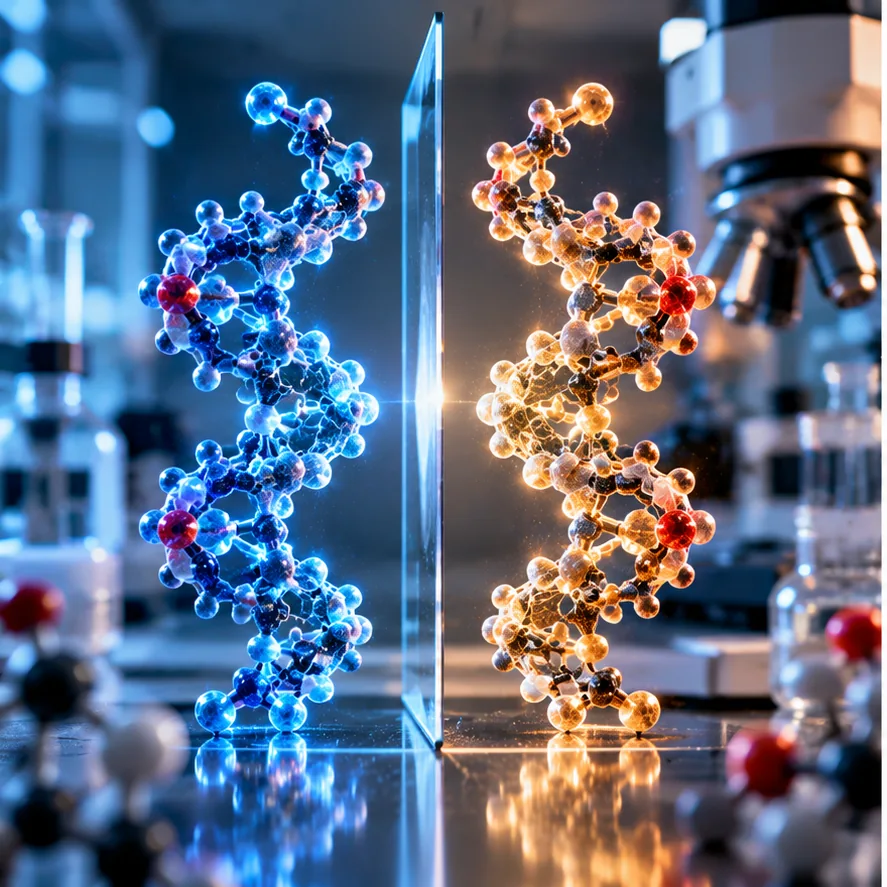
Imagine a living cell whose essential molecular building blocks have the opposite handedness from those used by life on Earth. The idea sounds like science fiction, but researchers have already made selected mirror-image biomolecules. The possibility of assembling an entire self-replicating organism from them has prompted an unusually early international debate about biological safety. The distinction matters: a mirror molecule is not a mirror bacterium, and as of October 2026 there is no verified self-replicating mirror organism.
What does mirror life actually mean?
Mirror life describes a hypothetical organism constructed with biological molecules of the opposite chirality to their counterparts in familiar life. Chirality is a geometrical property: two shapes can be mirror images yet cannot be placed perfectly on top of one another, like your left and right hands. The difference is not merely cosmetic. Molecular interactions depend on three-dimensional fit, so enzymes and receptors can respond very differently to opposite-handed forms of a compound.
Ordinary biology strongly favors L-amino acids in proteins and D-sugars in nucleic acids. A comprehensive mirror system would reverse the relevant molecular handedness throughout its biological machinery. It would still need to store instructions, use energy, build a membrane, make its components and reproduce. Reversing individual molecules is far simpler than achieving all of those tasks together.
Mirror molecules, mirror cells and mirror bacteria are not the same
Researchers can synthesize some mirror peptides, nucleic acids and enzymes, and these molecules may have valuable properties. Mirror-image components are not automatically alive: they do not metabolize or multiply simply because they have reversed chirality. A mirror cell would require an integrated network of functioning components, while a mirror bacterium would be a particular self-replicating cellular organism. The United Nations scientific advisory brief in March 2026 explicitly emphasized this separation because the benefits and risks differ dramatically.
Why does the direction of a molecule matter?
Think of a key and a lock. A key with its grooves mirrored may not fit a lock designed for the original. In biology, proteins recognize other proteins, sugars and genetic material through similarly specific three-dimensional contacts. Enzymes that digest ordinary biological polymers may not process their mirrored versions efficiently. Conversely, a mirror enzyme might be designed to work on a mirror substrate. This helps explain why researchers are interested in chemically stable therapeutics, but also why natural ecological interactions could behave unpredictably if a replicating mirror organism existed.
How close are scientists to creating mirror life?
The building blocks are advancing, but a working organism remains a distant prospect. Scientists have demonstrated selected mirror-image biochemical components, including research toward systems that copy mirrored genetic material. Yet a functioning cell requires coordinated protein production, metabolism, membrane maintenance and replication. Even building a wholly synthetic ordinary cell is a major challenge. A 2025 UK Government Office for Science review said self-replicating mirror cells were generally thought to be at least decades away, while acknowledging that fundamental breakthroughs could change estimates. The UN's 2026 brief also stresses that mirror life does not exist and should not be treated as an imminent laboratory product.
Why did scientists sound the alarm before such organisms exist?
The concern is not a current outbreak. It is a high-consequence, highly uncertain future scenario in which a mirror bacterium might escape or be deliberately released and interact with natural ecosystems in ways that existing defenses are poorly equipped to handle. A 2024 Science policy paper, subsequent technical discussions and the UN scientific advisory brief called for oversight before a major technical milestone is crossed. That precautionary approach aims to avoid waiting for a replicating organism to be built before asking how to contain it.
Could a mirror bacterium evade the immune system?
Many immune mechanisms recognize specific molecular shapes. Scientists worry that some of those systems might fail to recognize mirror components. However, it would be incorrect to claim that every immune defense would be bypassed. Innate responses, physical barriers and other nonspecific mechanisms could still matter, while the reversed chemistry might also make it difficult for a hypothetical bacterium to attach to or invade ordinary host cells. The balance between immune evasion and reduced ability to cause disease is unknown because no complete mirror bacterium exists for testing.
What could happen in natural ecosystems?
A replicating mirror microbe might resist certain predators or viruses adapted to ordinary cells. That raises questions about competition for resources, persistence in soil and water, and effects on food webs. Yet mirror organisms could also struggle to find usable nutrients or function in existing environments. Photosynthetic mirror life has been discussed as a particularly serious hypothetical scenario because it could potentially use light energy rather than depend entirely on specialized organic nutrients. These are risk hypotheses, not observed environmental events.
Would ordinary antibiotics or disinfectants work?
There is no universal answer. Some antibiotics target very specific biological structures and could be ineffective against their mirrored analogues, while other interventions work through broader chemical or physical mechanisms. The UK science-advice review notes that some existing antibiotics might still eliminate certain hypothetical mirror organisms. Laboratory effectiveness against an engineered molecule would not prove that an uncontrolled environmental release could be contained. Claims that mirror life is invulnerable to all medicines or sterilization are unsupported.
Could mirror life be invisible to medical tests?
Many diagnostics use molecular recognition of familiar DNA, RNA, proteins or antigens. A fully mirrored system might escape tests designed only for ordinary chemistry. But “invisible” should not be interpreted literally: microscopy, physical measurements and purpose-built assays could potentially identify unusual material. The practical issue is that current routine surveillance is not validated for hypothetical mirror organisms. Developing detection concepts before the technology becomes feasible is therefore part of responsible governance.
Why research mirror molecules at all?
Mirror-image molecules may resist breakdown by common biological enzymes, potentially helping researchers design longer-lasting drugs or stable molecular tools. They may also be useful for studying the origins of biological handedness and for building new materials or diagnostic systems. Such benefits belong primarily to non-replicating components, not to hypothetical self-replicating mirror bacteria. Treating all mirror chemistry as equally hazardous could block promising work without addressing the highest-risk scenario.
Could mirror organisms explain extraterrestrial life?
No mirror organism has been discovered on Earth or elsewhere. Astrobiologists consider whether life elsewhere could use different chemical choices, including alternative molecular handedness. That is a question about what is chemically possible, not evidence that mirror life already exists in space. Mirror chemistry also should not be confused with mirror universes, antimatter, cloned organisms or DNA sequences that simply read backward.
What did the United Nations say in 2026?
The UN Secretary-General's Scientific Advisory Board published a brief on March 9, 2026. It distinguished lower-risk mirror components from hypothetical self-replicating mirror life and urged early international safeguards, clear boundaries and scientific coordination. Its warning concerned potentially severe consequences if a future organism escaped natural constraints. The document did not announce the creation or discovery of mirror bacteria.
What safeguards are being discussed?
Proposals include international scientific dialogue, independent biosafety review, transparent reporting of relevant milestones, limits on projects that seek self-replicating mirror organisms, and research on detection and containment. The challenge is to define thresholds that respond to genuine capability without treating every reversed molecule as a global emergency. A 2026 discussion of adaptive risk governance argues that oversight should evolve with evidence and technical progress.
How should readers evaluate alarming headlines?
Check whether the story concerns a single synthetic molecule, a partial biochemical system or a self-replicating organism. Ask whether the result was experimentally demonstrated or only modeled. Look for an original scientific paper or authoritative risk assessment and check whether uncertainty is acknowledged. A claim that scientists have “created a deadly mirror bacterium” would require extraordinary evidence that is not currently available.
What remains unknown?
Researchers do not know whether an entire mirrored cell can be built, whether it could obtain nutrients in natural settings, how it would interact with human and animal immune systems, or which containment strategies would work best. These unknowns cut both ways: they prevent confident claims of inevitable catastrophe and also prevent confident assurances of safety. Good risk assessment must distinguish possibility, probability and severity.
Conclusion
Mirror life is an important frontier in synthetic biology precisely because the scientific opportunity and the speculative risk are not the same thing. Mirror molecules already have legitimate research uses; self-replicating mirror organisms remain hypothetical. The strongest case for action today is proportionate international oversight, careful scientific communication and preservation of beneficial non-replicating research—not sensational claims that a new life form is already spreading.
Primary sources and further reading
United Nations Scientific Advisory Board: Mirror Life (2026)
UK Government Office for Science: Mirror Life assessment (2025)
Science: Confronting risks of mirror life (2024)
American Society for Microbiology: Mirror microbial life and the dual use dilemma (2026)
You may also like
 Science
 The $1.8 Billion AI Biology Project: Can Virtual Cells Transform Medicine?
Inside the $1.8 billion Virtual Biology Initiative: funding, partners, virtual cell AI, drug discovery potential, data access and…
 Science
 Can Human Cells Remember Things Outside the Brain? What Studies Really Show
Can cells outside the brain remember? Explore NYU research on cellular memory, spaced stimulation, ERK and CREB, and…
 Science
 Could Neanderthals Have Used Natural Antibiotics? What Evidence Shows
Evidence from ancient dental calculus suggests Neanderthals may have used medicinal plants. That is not proof they invented…