
Little Albert Experiment: What Really Happened and Why It Is Disputed
Explore the Little Albert experiment through the original 1920 study, a 2021 reassessment of its film, the identity dispute, and the ethics of fear conditioning.
Contents
- What was the Little Albert experiment?
- How did the experiment work? A session-by-session account
- What is classical conditioning in this example?
- Did Little Albert become afraid of every furry animal?
- Did the experiment really demonstrate conditioned fear?
- What were the study’s methodological weaknesses?
- What happened to Little Albert after the study?
- Was Little Albert Douglas Merritte or Albert Barger?
- Why is the study considered unethical today?
- Did Watson and Rayner remove the fear afterward?
- Does the case prove all phobias are learned?
- What can students and readers learn from Little Albert?
- Frequently asked questions
- When did the Little Albert experiment take place?
- How old was Little Albert?
- Were electric shocks used?
- Did Little Albert develop a permanent fear of rats?
- Was the conditioning successful?
- Could such an experiment be repeated today?
- Conclusion
- Primary research and further reading
- Related reading on Horus Valley
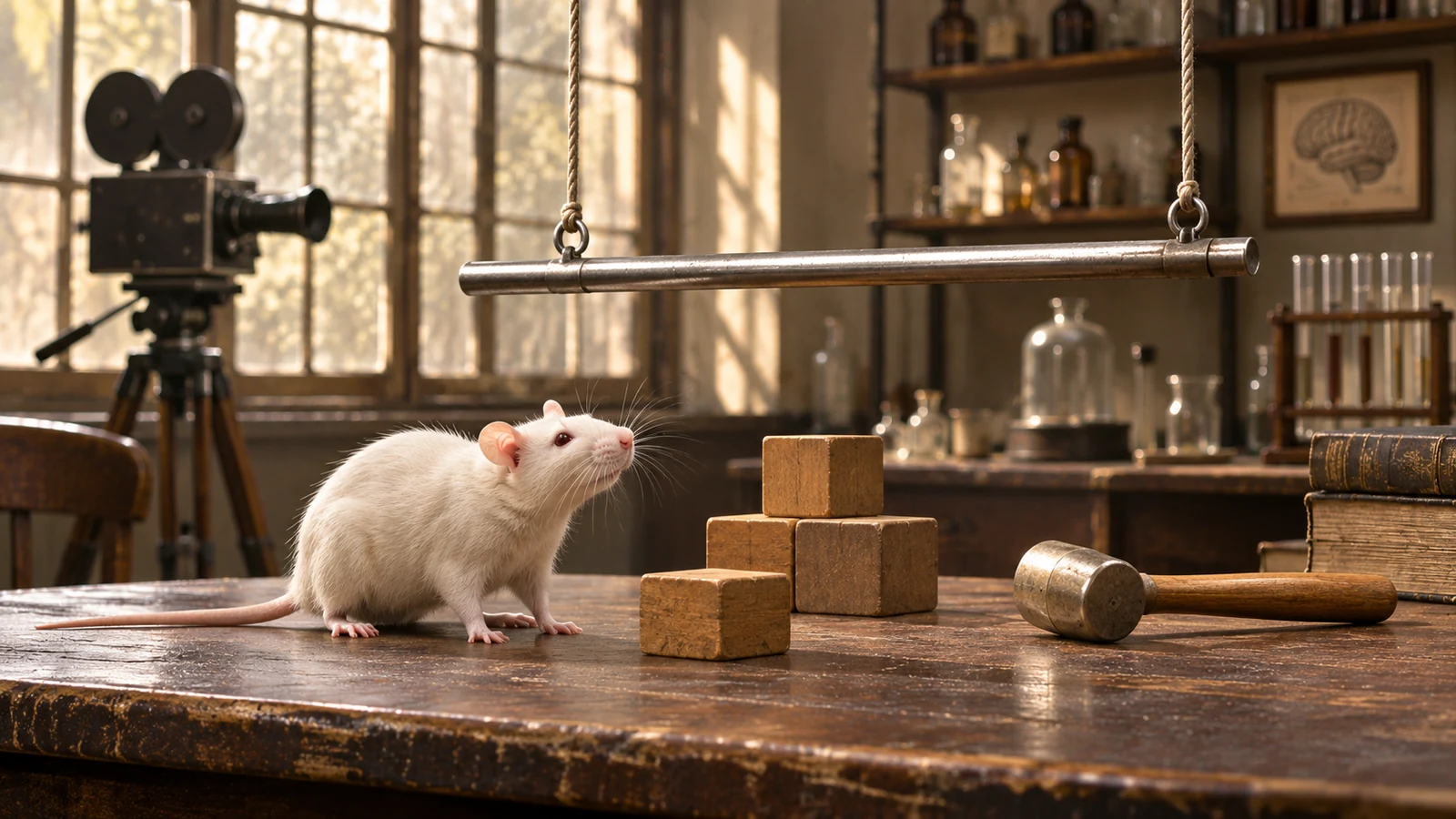
The Little Albert experiment is a famous 1920 case study by John B. Watson and Rosalie Rayner. They paired the sight of a white rat with a sudden, loud noise that startled an infant, then reported that he began reacting fearfully to the rat even when no noise was made. Yet the study did not establish a lifelong phobia, later scholars have challenged how convincingly conditioning was demonstrated, and the child’s identity remains disputed.
This guide distinguishes the researchers’ original observations from their interpretation, explains what subsequent historians and psychologists found, and examines the ethical concerns that make the case as important as its place in the history of behaviorism. It draws on the primary 1920 report and research published through 2026—not on the simplified textbook legend.
What was the Little Albert experiment?
American psychologist John B. Watson and researcher Rosalie Rayner investigated whether an emotional response could be acquired through classical conditioning. Their only participant was an infant called “Albert B.” who was living in an institutional medical setting associated with Johns Hopkins University. The investigators published “Conditioned Emotional Reactions” in the Journal of Experimental Psychology in 1920. The work itself appears to have taken place in late 1919 and early 1920, so the publication year should not be mistaken for the date of every session.
The theoretical question came from the broader behaviorist interest in learning by association, including Ivan Pavlov’s work. If a previously neutral event repeatedly predicts something that naturally prompts an emotional reaction, might the neutral event itself come to evoke that reaction? Watson and Rayner attempted to test this proposition by creating fear in a human infant.
How did the experiment work? A session-by-session account
- Initial observation: At about nine months of age, Albert was presented with a white rat, rabbit, dog, and other objects. The researchers reported no clear fear of these items at baseline.
- Loud-noise test: A hammer striking a suspended steel bar behind the child prompted startle reactions and, during testing, crying. The noise was the aversive stimulus.
- First pairings: At about 11 months and three days, the rat was presented while the bar was struck. Two rat-and-noise pairings were reported in this session.
- Further pairings: One week later, five more pairings were made, followed by reports of withdrawal and crying when the rat appeared without the noise.
- Transfer tests: The investigators presented other furry or unusual stimuli, including a rabbit, dog, fur coat, and mask. Responses were not identical across items or sessions.
- Short follow-up: Another assessment was performed roughly a month later, but there is no reliable long-term psychological follow-up and no systematic removal of the conditioned response was undertaken before the infant left.
The chronological details come from Watson and Rayner’s original 1920 report. The commonly repeated figure of seven pairings refers to the two initial sessions combined, not to a group of seven participants. Only one infant was studied.
What is classical conditioning in this example?
| Term | Example | Proposed interpretation |
|---|---|---|
| Initially neutral stimulus | White rat | Reportedly did not provoke fear before pairing |
| Unconditioned stimulus | Loud sound of a struck metal bar | Provoked startle without prior training |
| Unconditioned response | Startle or crying at the sound | Automatic response to an aversive event |
| Possible conditioned stimulus | Rat after the pairings | Acquired predictive significance, in the authors’ account |
| Possible conditioned response | Withdrawal or crying at the rat alone | Interpreted by the authors as learned fear |
A critical distinction is conditioning versus sensitization. A child can become more reactive or distressed after repeated startling events without necessarily learning a stable, specific association with the rat. A compelling demonstration must rule out alternatives rather than infer the underlying psychological process from crying alone.
Did Little Albert become afraid of every furry animal?
Watson and Rayner described some transfer of fearful reactions to an animal or furry object that had not been paired directly with the noise. However, the apparent generalization was inconsistent and variable: the infant sometimes approached or explored a stimulus and sometimes avoided it. The original record does not justify saying that he became equally afraid of all animals, all white things, or all furry objects.
A brief laboratory reaction should also not be confused with a modern clinical diagnosis of a phobia, which requires a much broader assessment. And with a single participant, no population-level conclusion can be drawn about how fear develops in every child.
Did the experiment really demonstrate conditioned fear?
The canonical textbook answer has been yes. But in an analysis published in History of Psychology in 2021, Russell A. Powell and Robert M. Schmaltz reviewed Watson’s filmed record and argued that the observable distress was relatively weak and could be explained partly by sensitization or ordinary developmental changes. They also identified issues in the way the historical film was assembled and presented.
This is a later scholarly critique, not unanimous proof that every observation in the original report was wrong. It does show why “the researchers created a severe lifelong phobia” is a stronger claim than the available record supports. See Powell and Schmaltz’s film-based reassessment.
What were the study’s methodological weaknesses?
- One participant: The findings cannot estimate how frequently the response would occur in other infants.
- No control group: Repeated exposure, heightened general distress, and maturation are hard to disentangle.
- Subjective observational outcomes: There was no independent, blinded measure of the magnitude of fear.
- Changing test conditions: Exposure to several objects, repeated noises, and changes in context complicated causal interpretation.
- Limited follow-up: A test after several weeks cannot establish a decades-long psychological effect.
- Selective visual evidence: A historical edited film is not a complete log of every session and behavior.
What happened to Little Albert after the study?
The historical record does not establish a definitive answer. The 1920 paper does not follow Albert into later childhood or adulthood. Claims that he suffered a permanent phobia, lived with lifelong trauma, or died because of the procedure have not been established by the study itself.
Was Little Albert Douglas Merritte or Albert Barger?
A 2009 historical investigation proposed that the child was Douglas Merritte. In 2012, researchers advanced arguments that Merritte had neurological impairments and challenged the original description of the infant’s health. Other scholars disputed both the identity claim and aspects of the medical inference.
A separate 2014 analysis proposed William Albert Barger, citing a closer fit to the surviving demographic and family information. Some later evaluations have favored Barger, while historical disputes about evidence and inference remain. The responsible conclusion is therefore not to present either identity as conclusively established. Consult Powell and colleagues’ 2014 article and Ben Harris’s 2020 historical analysis.
| Candidate | Evidence proposed | Why caution remains necessary |
|---|---|---|
| Douglas Merritte | Historical family and hospital records | Later investigators questioned the match and neurological interpretation |
| William Albert Barger | Name, age, and family circumstances presented in 2014 | No universally accepted definitive identification |
| Established conclusion | Two competing archival hypotheses | Neither candidate’s biography can automatically be attributed to the experimental subject |
Why is the study considered unethical today?
The central concern is straightforward: the experiment intentionally exposed an infant who could not consent to a frightening noise to study an emotional response. It would be historically inaccurate to apply every present-day institutional procedure as if it existed in 1920. Even so, the foreseeable distress, the participant’s vulnerability, and the absence of documented systematic deconditioning all invite serious ethical criticism.
The American Psychological Association’s ethics code emphasizes protection from harm, appropriate informed consent, and additional safeguards for people unable to consent for themselves. The available early record does not contain enough information to establish a parental consent process that would meet current expectations.
Did Watson and Rayner remove the fear afterward?
No systematic deconditioning procedure was carried out. Their original paper raised the question of how conditioned fears might be removed, but explained that Albert left the institution before they could test a removal method. A test some weeks after conditioning was not equivalent to treatment or to long-term surveillance of his well-being.
Does the case prove all phobias are learned?
No. Learning and associative processes can contribute to some fears, but clinical anxiety disorders and phobias arise through multiple interacting biological, developmental, cognitive, and environmental factors. A one-child historical study cannot serve as a complete explanation of every fear disorder.
What can students and readers learn from Little Albert?
- Separate observation from interpretation: A crying response does not by itself prove a specific learning mechanism.
- Do not confuse fame with evidential quality: A landmark teaching example can still have weak research design.
- Consult primary sources: Retellings often omit inconsistent responses and uncertainty.
- Protect participants: Scientific curiosity cannot displace a researcher’s obligations to vulnerable people.
- Be explicit about uncertainty: The infant’s identity, health, and long-term outcomes are not established beyond reasonable doubt.
Frequently asked questions
When did the Little Albert experiment take place?
The study was published in 1920. The experimental sessions are generally placed in late 1919 and early 1920. These are different dates and should not be conflated.
How old was Little Albert?
Baseline observations began when the infant was roughly nine months old. The rat-and-noise conditioning sessions took place when he was about eleven months old.
Were electric shocks used?
No. The aversive event was the loud noise of a steel bar struck with a hammer. Electric shocks belong to other, unrelated experiments and are sometimes mistakenly inserted into the Little Albert story.
Did Little Albert develop a permanent fear of rats?
There is no reliable long-term follow-up establishing that outcome. The original investigators reported fear-like responses during the study, but they did not demonstrate a lifelong phobia.
Was the conditioning successful?
Watson and Rayner interpreted several observed behaviors as conditioned fear. A subsequent film-based analysis published in 2021 questioned whether the evidence was strong enough, so the reported success should be described as their original interpretation, not a settled clinical fact.
Could such an experiment be repeated today?
Intentionally causing distress in an infant without the stringent safeguards, justification, and permissions expected in contemporary research would be ethically unacceptable. Modern studies of fear learning use substantially safer protocols and independent research oversight.
Conclusion
The Little Albert experiment matters because it shaped the history of behavioral psychology—and because its limitations illuminate how psychology has changed. Watson and Rayner reported responses consistent with learned fear, but their one-infant design and inconsistent evidence restrict the claim. The 2021 reassessment, the unresolved identity debate, and modern ethical standards make it more accurate to teach this as a historically influential but contested study rather than proof that a lifelong phobia was manufactured.
Primary research and further reading
- Watson & Rayner (1920): original paper, Conditioned Emotional Reactions.
- Zenodo archive record for the original report.
- Powell & Schmaltz (2021): critical examination of the historical film.
- Beck et al. (2009): first major modern identification investigation.
- Fridlund et al. (2012): Douglas Merritte hypothesis and neurological claims.
- Powell et al. (2014): evidence for Albert Barger.
- Digdon et al. (2014): rebuttal of neurological allegations.
- Harris (2020): the publication dispute over Little Albert’s identity.
- APA: ethical principles and code of conduct.
Related reading on Horus Valley
You may also like
 Psychology
The Illusory Truth Effect: Why Repeated Claims Seem More Believable
Why does a repeated statement start to feel true? Explore the illusory truth effect, what 182 studies reveal,…
 Psychology
Why Do We Feel Nostalgic for a Time We Never Lived? The Psychology of Anemoia
Why do we miss decades we never experienced? Explore anemoia and historical nostalgia, the role of family stories…
 Psychology
What Happens When Actions Have No Consequences? Psychology Explained
Does a lack of punishment cause misconduct? Explore research on rule-following, accountability, behavior reinforcement and practical nonviolent boundaries.