
Leonids Meteor Shower 2026: Peak Time, Best Viewing Hours in the US and UK
Find the Leonids 2026 peak time in the US, UK and Egypt, why peak dates differ, Moon conditions and the best ways to watch on November 17–18.
Contents
- Leonids 2026: the dates and times that matter
- Why do some websites say 16–17 November and others 17–18 November?
- Best time to see the Leonids in the United States
- Eastern and Central states
- Pacific states
- Best time to see the Leonids in the UK and Europe
- Can you see the Leonids from Egypt or the Southern Hemisphere?
- Exact Moonset and pre-dawn dark-sky times by city (17–18 Nov)
- Will the Moon spoil the 2026 Leonids?
- How many shooting stars will actually be visible?
- Exactly where should you look?
- A simple plan if the peak night is cloudy
- Photographing Leonid meteors with a camera or phone
- Why does the shower happen—and is a meteor storm likely?
- Real observation photos and reference sources
- Common questions
- Is the Leonid meteor shower visible without a telescope?
- Is the 2026 Leonid peak on November 17 or 18?
- What if I live in a bright city?
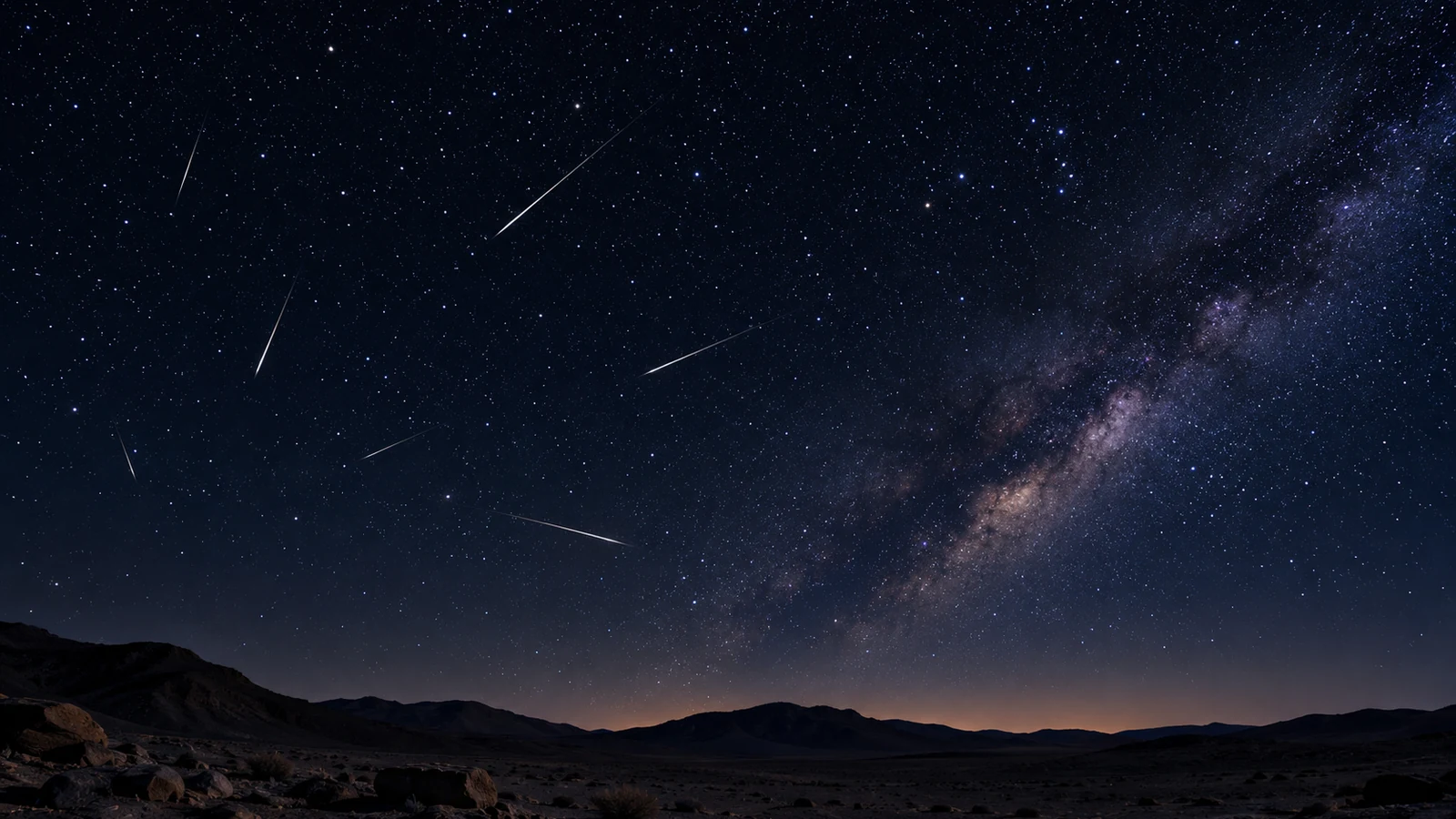
The best all-round viewing window for the 2026 Leonid meteor shower is after midnight and before dawn on 18 November, local time, if your sky is clear. The International Meteor Organization (IMO) places the regular maximum at 23:45 UTC on Tuesday, 17 November. Some calendars instead label 16–17 November as peak night; both nights are worth considering. Expect an ordinary shower, not a predicted meteor storm.
The Leonids are active from 6 to 30 November 2026. The peak theoretical zenithal hourly rate is approximately 15 meteors per hour, not a promise of 15 meteors visible from a city. The nearly first-quarter Moon should be out of the way during many of the most useful pre-dawn observing hours. These dates and rates come from the IMO 2026 calendar and NASA Leonids guide. Information checked 1 November 2026.
Leonids 2026: the dates and times that matter
| Location | Predicted maximum on local clock | Practical observing window |
|---|---|---|
| London, United Kingdom | Tue 17 Nov, 11:45 p.m. GMT | After midnight through dawn, Wed 18 Nov |
| New York, United States | Tue 17 Nov, 6:45 p.m. EST | Late Tue 17 Nov through pre-dawn Wed 18 Nov |
| Los Angeles, United States | Tue 17 Nov, 3:45 p.m. PST (daylight) | Pre-dawn Wed 18 Nov; also try Tue 17 Nov |
| Cairo, Egypt | Wed 18 Nov, 1:45 a.m. EET | After midnight through dawn, Wed 18 Nov |
| Paris, France | Wed 18 Nov, 12:45 a.m. CET | After midnight through dawn, Wed 18 Nov |
| Sydney, Australia | Wed 18 Nov, 10:45 a.m. AEDT (daylight) | The pre-dawn hours of Wed 18 Nov; visibility is lower |
Important: a global maximum is a moment in time, while a viewing window must also be dark, cloud-free and late enough for the radiant in Leo to rise. In California and Sydney, the precise maximum occurs in daylight. You still watch at night rather than at the daytime clock hour.
Why do some websites say 16–17 November and others 17–18 November?
The IMO scientific calendar (p. 18) predicts the regular nodal maximum on 17 November at 23:45 UTC. It also describes a separate model placing a modest maximum around 16:00 UTC on 17 November. NASA and the American Meteor Society display 16–17 November as their highlighted night; the Royal Observatory Greenwich gives 18 November in its annual calendar. This is a calendar-label and model difference, not evidence that the shower lasts only one night.
Practical decision: mark the nights of 16–17 and 17–18 November. If you can choose only one night, favor the clearer, darker pre-dawn window; for most US and European readers, the early hours of 18 November are an excellent starting choice. If both nights are equally clear, 17–18 November sits closest to the IMO regular maximum. Meteor activity is variable and the exact spike is not guaranteed.
Best time to see the Leonids in the United States
Eastern and Central states
For New York, Boston, Washington, Chicago and other eastern/central locations, start once Leo is comfortably above the horizon after midnight. The roughly 2 a.m. to dawn portion of the night on 18 November is a useful planning window, rather than a predicted city-specific meteor forecast. Check your local sunrise, cloud cover and Moon-set time first.
Pacific states
The IMO maximum occurs mid-afternoon on 17 November for Los Angeles and the West Coast. That does not rule out the shower: watch during the pre-dawn hours of 18 November, when the sky is dark and Leo has risen. A clear morning on 17 November is also a sensible backup, depending on local conditions.
For official US weather alerts and forecasts, use NOAA/National Weather Service. A dark, permitted observing site is more helpful than traveling to a famous landmark with nearby lighting.
Best time to see the Leonids in the UK and Europe
In London the predicted regular maximum is 11:45 p.m. GMT on 17 November, just before midnight. However, the constellation Leo climbs higher after midnight, making the early hours of Wednesday 18 November attractive for observers across the UK. A darker sky generally matters more than being outside at precisely 11:45 p.m.
Check the UK Met Office forecast shortly before going out; cloud coverage varies substantially from place to place. For other European cities use your local midnight and dawn window and verify the Moon, clouds and radiant height using the interactive timeanddate meteor sky map.
Can you see the Leonids from Egypt or the Southern Hemisphere?
Yes. The Leonids can be observed from both hemispheres, but they generally favor northern locations because Leo climbs higher. In Cairo the IMO regular maximum converts to 1:45 a.m. on Wednesday 18 November, with the rest of the night until dawn worth considering if the sky is clear. Egypt-based observers should avoid streetlights and haze, not assume that a remote desert site is automatically accessible or safe.
South of the equator, Leo may remain lower in the sky and the number visible can be smaller. Sydney’s clock maximum occurs in daylight: it is not a daylight observing opportunity. Plan for the dark pre-dawn hours and a clear northeastern/eastern sky where available.
Exact Moonset and pre-dawn dark-sky times by city (17–18 Nov)
| City | Moonset (night of 17–18 Nov) | Astronomical dawn 18 Nov | Useful moonless window |
|---|---|---|---|
| Cairo (EET) | Tue 17 Nov, 11:50 p.m. | Wed 18 Nov, 4:59 a.m. | Around 2:00–4:50 a.m. |
| London (GMT) | Tue 17 Nov, 11:29 p.m. | Wed 18 Nov, 5:25 a.m. | Around 2:00–5:15 a.m. |
| New York (EST) | Tue 17 Nov, 11:56 p.m. | Wed 18 Nov, 5:11 a.m. | Around 2:00–5:00 a.m. |
| Los Angeles (PST) | Wed 18 Nov, 12:07 a.m. | Wed 18 Nov, 5:01 a.m. | Around 2:00–4:50 a.m. |
Moonset: Cairo calculation, London, New York, Los Angeles/Griffith Observatory. Astronomical twilight: Cairo, London, New York, Los Angeles. The useful window starts at around 2 a.m. because Leo’s radiant climbs during the latter part of the night; it is not the exact moment of the astronomical peak.
Observation tip: Check the two nights, 16–17 and 17–18 November, because meteor activity is not a clockwork event; weather can matter more than which night is closer to the model peak. The New York, London and Cairo Moonset times above refer to Tuesday 17 November, whereas Los Angeles moonset falls just after midnight on Wednesday 18.
Will the Moon spoil the 2026 Leonids?
The first-quarter Moon falls around 17 November. Its bright half can wash out faint meteors while it is up, but it sets around late evening or near midnight in many locations, leaving a darker pre-dawn sky. The exact set time changes with city and horizon, so avoid publishing one Moon-set time as valid everywhere. The IMO calendar specifically describes the Leonids as having favorable moonlight conditions near the maximum.
In practice, choose a spot sheltered from direct lights, do not stare toward the Moon when it is visible, and wait until your eyes have adjusted. A cloudy moonless night will be worse than a clear night with some moonlight.
How many shooting stars will actually be visible?
The often-quoted 15 per hour is a zenithal hourly rate (ZHR): a standardized ideal-dark-sky rate with the radiant overhead and other assumptions. It is not a fixed count for a backyard, camera or one-hour viewing session. Actual observed numbers may be substantially lower because of cloud cover, artificial light, Moon glare, the lower altitude of the radiant and naturally uneven meteor activity. NASA notes that ordinary Leonid displays can be quite modest.
A fair expectation is to watch patiently for 45–60 minutes or longer without assuming a meteor will arrive every four minutes. Very bright meteors and occasional persistent trails are possible, but a dramatic storm is not expected in 2026. IMO model notes about weak dust-trail encounters do not predict a major outburst.
Exactly where should you look?
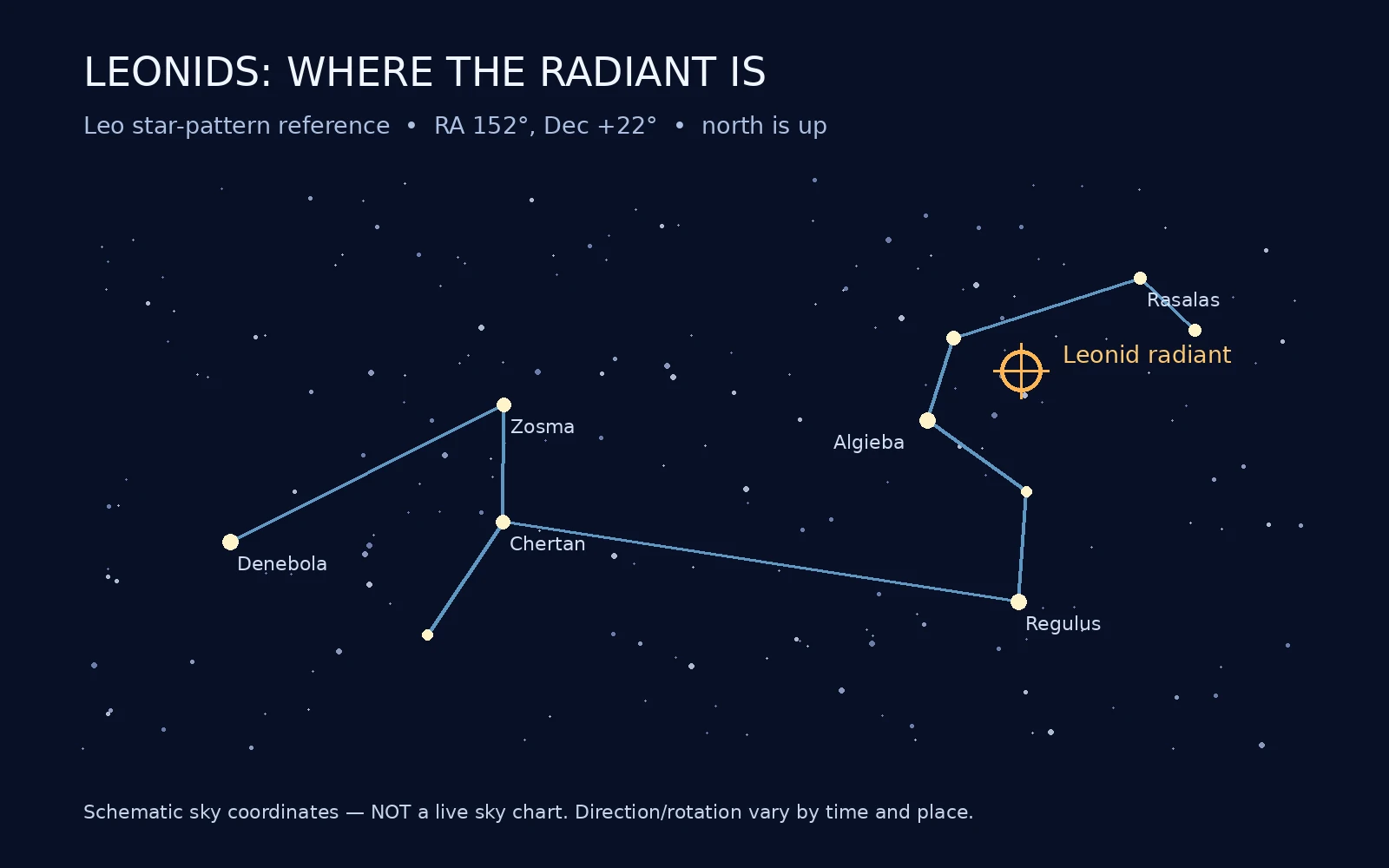
What the chart shows: Leo is the radiant reference, not the only area to watch. The annual Leonid radiant is near right ascension 152° and declination +22° in the IMO calendar. The star pattern is a schematic, not a representation of the sky from a specific city. For a location-aware live view, use the interactive sky map.
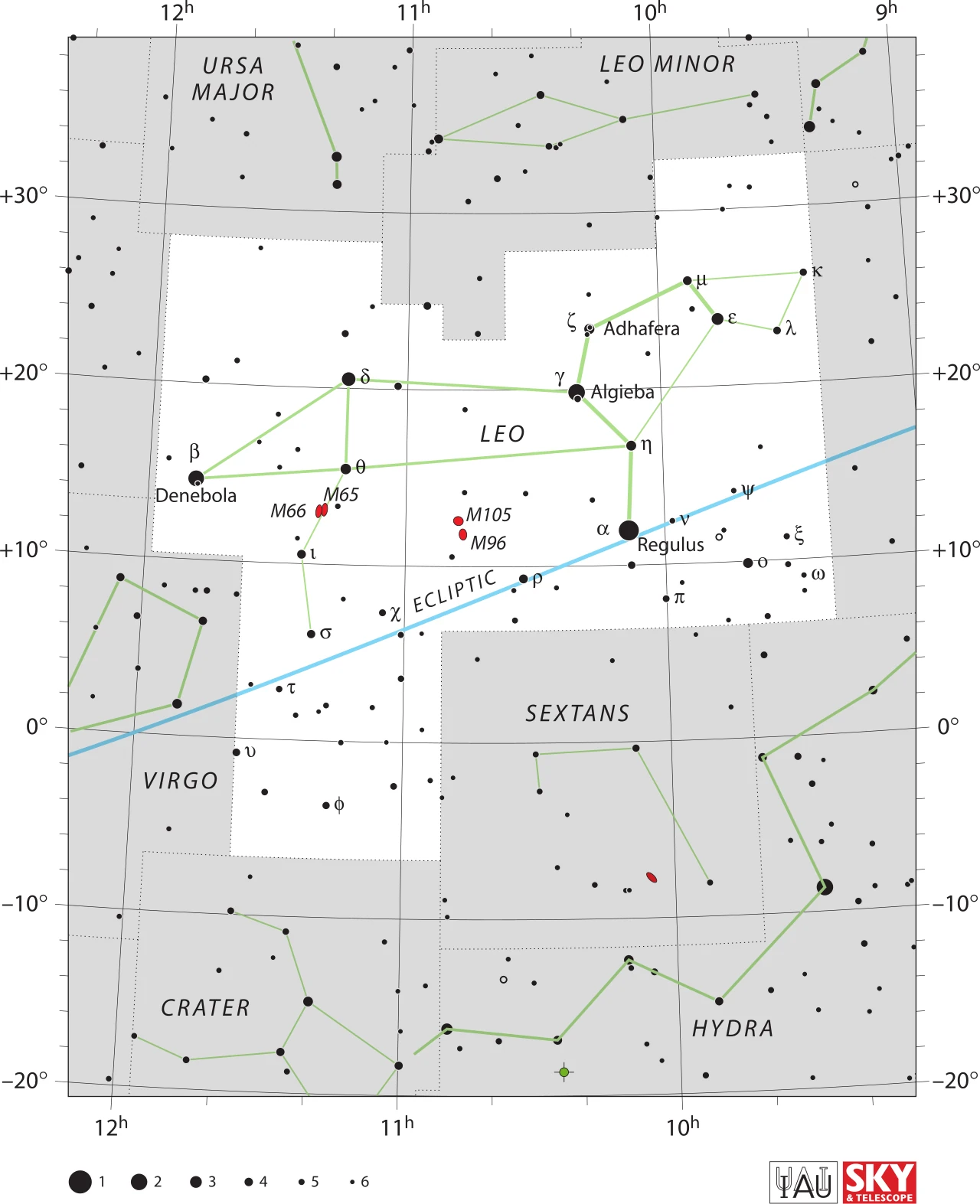
Authentic constellation chart: this Leo star map comes from the IAU and Sky & Telescope (Roger Sinnott and Rick Fienberg; CC BY 3.0). The chart is a reference star map, not a live sky view or a map of a specific city. It does not mark the Leonid meteor radiant by itself; use the preceding schematic for that location. The uploaded chart was converted to WebP with a white background to keep its labels legible.
The Leonids appear to radiate from Leo the Lion, roughly east after midnight, but meteors can streak anywhere across the sky. Face a dark, open part of the sky away from the Moon and local lights; looking only at Leo can make the trails look shorter. You do not need to know every star or own a telescope.
- Choose a safely accessible place with broad views of the sky and a clear way home.
- Check clouds and Moon-set time for your city; do not assume national forecasts apply to your exact site.
- Dress for the temperature, take a reclining chair or blanket, and let your eyes adapt for about 20–30 minutes.
- Silence bright screens or use a dim red light, keep your field of view wide, and stay for an hour if possible.
- If you are recording a sighting, note the local time, city, duration and whether conditions were clear.
A simple plan if the peak night is cloudy
Compare forecasts for the mornings of 17 and 18 November, not just the calendar peak label. If 18 November is cloudy but 17 November looks clear, take the clear night. The shower remains active through 30 November, though rates generally weaken away from the maximum. A remote site with no road access or permission is not worth the risk.
Photographing Leonid meteors with a camera or phone
NASA’s meteor photography guide recommends a stable camera, wide field, manual focus and test exposures. For a suitable DSLR or mirrorless camera, begin with a tripod, wide-angle lens, a wide aperture, a carefully checked focus on stars, and repeated exposures around 10–20 seconds; adjust ISO and duration after checking sky brightness and star trails. There is no universally correct ISO.
A phone in a supported astrophotography or long-exposure mode may catch bright meteors, but do not promise that every phone will record faint ones. Keep the camera stable and avoid bright artificial lighting. Never use a photograph of a different year as evidence that the 2026 peak has happened.
Why does the shower happen—and is a meteor storm likely?
Earth crosses a stream of dust left by comet 55P/Tempel-Tuttle, whose orbit around the Sun takes roughly 33 years. The particles enter Earth’s atmosphere at around 71 km/s, producing luminous streaks. Historical Leonid storms have been extraordinary, but ordinary years are often much quieter.
The IMO’s 2026 analysis describes some modeled encounters with low-density dust trails, with no significant storm expected. That is why headlines promising thousands of meteors in 2026 would overstate the evidence. For context, compare the different viewing conditions of the October 2026 Orionid meteor shower, which comes from a different comet and peaks on different dates.
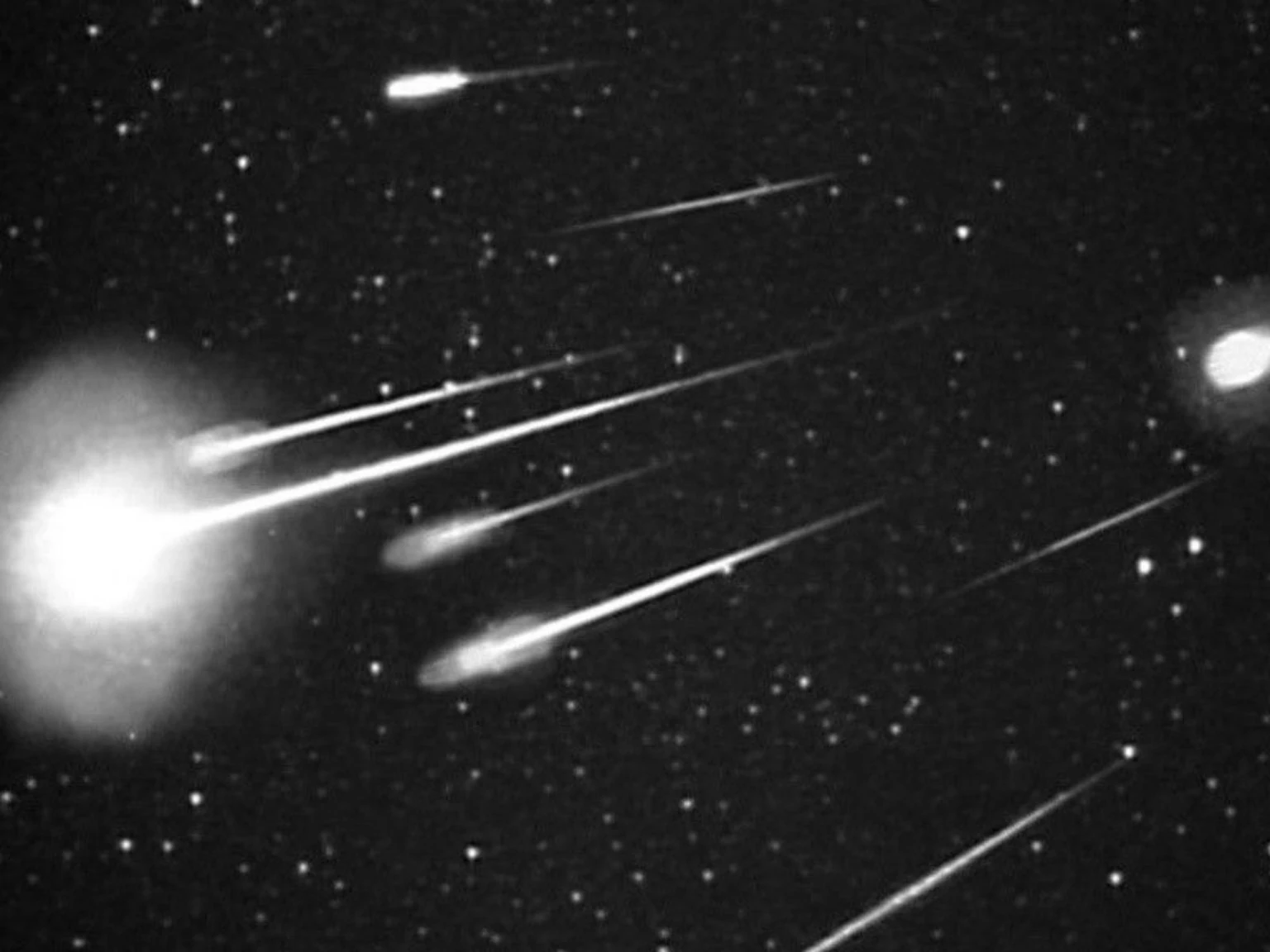
Historical evidence, not a 2026 forecast: the image above records a 1999 burst of Leonid meteors during the NASA Leonid MAC airborne campaign. Image credit: NASA/Ames Research Center/ISAS/Shinsuke Abe and Hajime Yano. A strong 1999 display does not imply an equivalent storm in 2026.
Real observation photos and reference sources
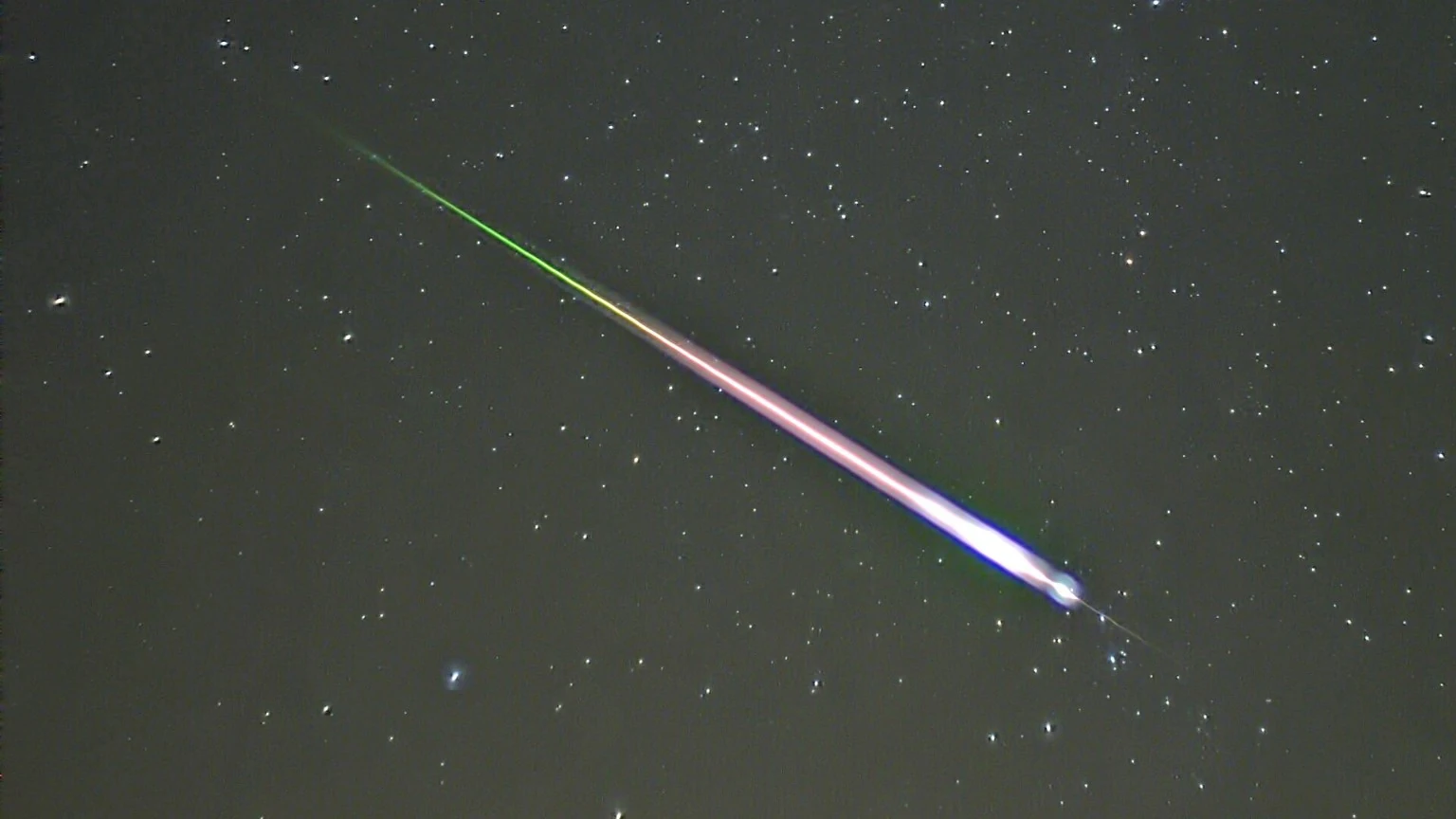
A real 2009 Leonid meteor: photograph by Navicore, dated 17 November 2009, via Wikimedia Commons (CC BY 3.0; a cropped version of an earlier image). The submitted copy was converted to WebP without changing the photographed event. This is a historical photo, not a photograph of the 2026 Leonids.
Both authentic observation photos are now included above, with NASA’s official 1999 source and Navicore’s 2009 Wikimedia Commons source. Their dates and credits are provided with the images. The featured illustration is conceptual, not a record of the 2026 shower.
Scientific and observing references: International Meteor Organization 2026 calendar; Spain’s National Astronomical Observatory; NASA Science; American Meteor Society; timeanddate sky map. Verify forecasts again within a few days of the event.
Common questions
Is the Leonid meteor shower visible without a telescope?
Yes. In fact, your unaided eyes are better for scanning a wide area of sky. Telescopes restrict the view and make brief meteors easy to miss.
Is the 2026 Leonid peak on November 17 or 18?
The main IMO calculation is 23:45 UTC on 17 November. That is the night of 17–18 November in many countries; NASA and AMS also highlight the preceding night, 16–17 November. Try both if conditions allow.
What if I live in a bright city?
You may still catch a bright meteor, but faint meteors will be harder to see. Find a safe darker area, shield your eyes from direct lighting, and do not confuse an ideal ZHR with your actual visible count.
You may also like
 Animals
Are Dogs as Smart as Two-Year-Olds? What Research Shows
Are dogs really as intelligent as two-year-old toddlers? Learn what recent canine cognition studies reveal about words, memory,…
 Nature
Are Crows as Smart as Seven-Year-Olds? What Science Really Shows
Are crows as intelligent as seven-year-old children? Explore the original water-displacement study, its limits, and the latest research…
 Psychology
Stockholm Syndrome Explained: Trauma, Survival and the Evidence
Is Stockholm syndrome a real diagnosis? Explore the 1973 case, trauma bonding, coercive control, new research and safe,…