
Are Crows as Smart as Seven-Year-Olds? What Science Really Shows
Are crows as intelligent as seven-year-old children? Explore the original water-displacement study, its limits, and the latest research on tools, counting and social learning.
Contents
- What did the 2014 crow-and-child comparison actually show?
- Where did the five-to-seven-year comparison come from?
- Are all crows equally intelligent?
- Five documented crow abilities and what they mean
- 1. Making and using tools
- 2. Recognizing people and learning from other crows
- 3. Number processing and controlled calls
- 4. Tool-use skills beyond one species
- 5. Different ways to solve the same numerical problem
- What did the 2026 systematic review add?
- Common myths about crow intelligence
- How to evaluate an animal-intelligence experiment
- Original experiment footage and authentic wildlife photo
- Frequently asked questions
- Are crows smarter than seven-year-old children?
- Can crows count?
- Do crows remember human faces?
- Which crow species uses tools?
- Can you test a wild crow’s intelligence at home?
- Bottom line
- Primary scientific sources and further reading
- Related reading on Horus Valley
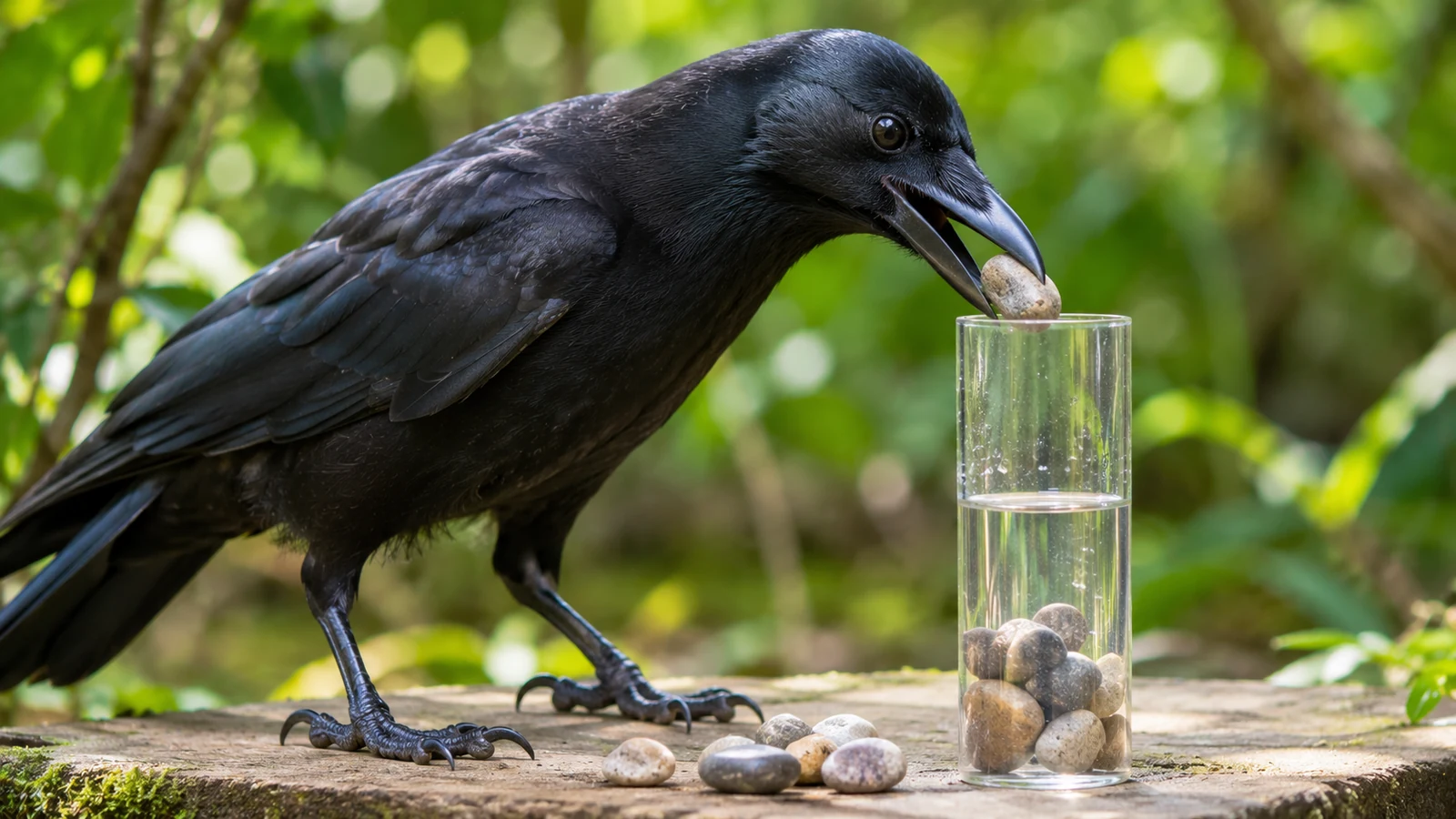
Are crows as smart as seven-year-old children? A 2014 study found that six New Caledonian crows performed comparably to children aged five to seven on several water-displacement tasks. That does not mean a crow has the overall intelligence or mental age of a seven-year-old. The birds also failed two more demanding tasks in the same experiment, and no single test can translate an animal’s full cognitive abilities into a human mental age.
The scientifically interesting story is not the number seven. It is the diverse ability of some corvids to use tools, learn socially, recognize people and solve problems involving physical cause and effect. Results depend on the species, sample and design of each experiment, so the evidence is best understood task by task rather than as one universal crow IQ score.
What did the 2014 crow-and-child comparison actually show?
Sarah Jelbert and colleagues at the Universities of Auckland and Cambridge published a study in PLOS ONE on March 26, 2014. They tested six New Caledonian crows (Corvus moneduloides) across six tasks inspired by Aesop’s story of the crow and the pitcher. The birds dropped various objects into tubes to bring a floating food reward within reach. They were not simply being tested on whether they could drink water, as popular retellings sometimes imply.
The birds preferred water-filled tubes over sand-filled ones, sinking rather than floating objects, solid rather than hollow objects, and a tube with a higher initial water level. However, they did not succeed in two harder tasks: accounting for tube width and responding to counterintuitive clues in a connected U-shaped apparatus. The authors therefore described their understanding as sophisticated but incomplete. Read the original 2014 study
| Task | Observed result | What the result does not establish |
|---|---|---|
| Water rather than sand | The birds favored the more effective medium | Understanding every principle of physics |
| Sinking and solid objects | Effective choices under some test conditions | That all crows pass without learning |
| Initial water level | A preference for a more useful starting level | Exact mathematical volume calculations |
| Tube width and connected U-tube | Failures on two harder tasks | Human-equivalent causal understanding |
Where did the five-to-seven-year comparison come from?
A 2012 comparison tested children aged four to ten on versions of the Aesop task. Children aged five to seven showed performance similar to that of certain birds on particular problems, while children aged eight and older succeeded from the first trial on all tasks in that comparison. The 2014 team used these findings to place crow performance in context. The comparison concerns specific problem-solving tasks, not overall intelligence. The 2012 child-comparison study
The headline should not obscure the limitations. The 2014 sample involved just six birds from one species, and not all completed every task. Changing the apparatus or the objects can also change performance. Later studies showed that object preferences and learning across trials can contribute alongside causal reasoning. Study on changes to the task and Study on object-choice biases
Are all crows equally intelligent?
No. Crows belong to the wider corvid family, which also includes ravens, jays, rooks and magpies. Species differ in their ecology, social behavior and foraging skills. New Caledonian crows are especially well known for tool use, American crows have been studied for recognition of human faces, and carrion crows have been studied in numerical tasks. Findings from one species cannot automatically be generalized to every crow or other corvid.
Five documented crow abilities and what they mean
1. Making and using tools
Some New Caledonian crows modify sticks and manufacture tools to reach food. In a 2018 experiment, four of eight birds naïve to the specific task spontaneously combined short pieces into longer functional tools; one individual constructed tools from three or four pieces. This reveals flexible problem solving, but it does not imply every member of the species will succeed at the same task. Original compound-tool experiment
2. Recognizing people and learning from other crows
Experiments near Seattle found that American crows recognized masks associated with previous trapping and that alarm responses spread to birds that had not personally been caught, including young birds learning from parents. At one site, responses spread at least 1.2 kilometers over five years. This is social learning about threats, not evidence that crows exchange human names or tell verbal stories about specific people. Original social-learning study
3. Number processing and controlled calls
A May 2024 paper in Science trained carrion crows to produce a specified number of vocalizations in response to cues. Their behavior indicated planning of the vocal sequence under the tested conditions. This is evidence of a measurable numerical and vocal skill, not proof that crows can count indefinitely or perform human-style arithmetic. Original 2024 Science paper
4. Tool-use skills beyond one species
A 2025 report documented hooked-stick tool use by Sunda crows and house crows in a zoo setting. Such limited observations do not establish that all members of these species routinely manufacture tools in the wild. They do, however, broaden the list of corvid species in which tool use has been observed. The 2025 opportunistic tool-use report
5. Different ways to solve the same numerical problem
A 2026 study compared two carrion crows and two rhesus macaques on a numerical delayed-matching task. Accuracy was similar, but reaction-time patterns differed, suggesting that different cognitive strategies can produce similar outcomes. The sample was small, so this result should not be turned into a blanket ranking of crows versus monkeys. 2026 numerical-decision comparison
What did the 2026 systematic review add?
A July 2026 systematic review synthesized 47 empirical studies across 16 corvid species, covering areas such as object permanence, caching, tool use, object manipulation and gaze following. The authors identified both parallels and differences between corvid and primate cognitive development. They also warned about small samples, captive-setting biases and limited longitudinal evidence. 2026 review in Animal Cognition
There is a broader sampling problem: avian cognition research disproportionately studies a small subset of bird families. A November 2026 discussion of comparative evidence stressed how many other bird species remain barely tested, making an absolute claim that corvids are the undisputed smartest birds premature. A more defensible conclusion is that corvids are among the best-studied birds with sophisticated abilities on numerous tasks. November 2026 coverage of comparative bird cognition
Common myths about crow intelligence
| Claim | What evidence supports |
|---|---|
| “A crow has the IQ of a seven-year-old” | Similarity concerned specific water-displacement tasks |
| “Every crow species makes tools” | Different tool skills have been documented in specific species and samples |
| “Crows talk about people who hurt them” | Evidence supports face recognition and social learning about threats |
| “Crows are smarter than dogs or cats at everything” | Species excel at different tasks; there is no universal cross-species IQ test |
| “Every crow knows traffic lights and uses cars to crack nuts” | Interesting urban observations should not be generalized to all crows |
How to evaluate an animal-intelligence experiment
- Identify the species: New Caledonian, American and carrion crows are not interchangeable.
- Check sample size: A six-bird result is not a universal property of the species.
- Separate skills from general intelligence: A tool-choice task cannot measure every cognitive domain.
- Look for training and learning: Was success immediate or acquired through repeated trials?
- Read the failures too: Unsuccessful tasks define the boundaries of an experiment just as much as successes do.
Original experiment footage and authentic wildlife photo
For visual evidence, see real footage from the 2014 water-displacement experiment on Wikimedia Commons and an authentic New Caledonian crow photograph by Donald Davesne, taken in July 2026 and published under CC BY 4.0. The featured image accompanying this article is a conceptual illustration of the task, not a frame from the original research and must not be presented as photographic evidence of the study.
Frequently asked questions
Are crows smarter than seven-year-old children?
There is no defensible overall ranking. Some crows perform similarly to young children on narrow tasks, but this does not compare every type of cognition, and different species are adapted to different challenges.
Can crows count?
Controlled experiments have shown trained carrion crows can regulate the number of calls they produce in response to cues. That is not the same as possessing a complete human-like arithmetic system.
Do crows remember human faces?
Yes. American-crow studies document recognition of faces associated with prior encounters and socially learned warning responses. The mechanism is behavioral and social, not human-style conversation.
Which crow species uses tools?
New Caledonian crows are especially well known for habitual tool making, although examples have also been documented in other species. Occasional tool use and habitual tool manufacture in the wild are different claims.
Can you test a wild crow’s intelligence at home?
Do not trap wild crows, deprive them of food or attempt to reproduce laboratory protocols. Published studies use specialist procedures and animal-welfare safeguards. Nonintrusive observation is a more appropriate way to appreciate their behavior.
Bottom line
Crows show impressive cognitive skills, but the claim that a crow has the intelligence of a seven-year-old requires a clear qualifier: it comes from a small sample of New Caledonian crows tested on particular water-displacement problems. Other research supports sophisticated tool use, numerical processing, face recognition and social learning—not a universal human-equivalent mental age.
Primary scientific sources and further reading
- Jelbert et al. (2014), New Caledonian crow water displacement — PLOS ONE.
- Cheke et al. (2012), Aesop’s Fable in human children — PLOS ONE.
- Object-choice biases in Aesop tasks — PLOS ONE (2016).
- Social learning about dangerous human faces — Proceedings B (2012).
- Compound tool construction — Scientific Reports (2018).
- Counting self-generated vocalizations — Science (2024).
- Opportunistic tool use in two more corvid species — Ecology and Evolution (2025).
- Development of cognition in corvids — Animal Cognition (2026).
- Numerical-decision strategies in crows and monkeys — Cognition (2026).
Related reading on Horus Valley
For additional accessible science coverage on the site, see the study of rats driving small cars and how some birds sleep while flying.
You may also like
 Psychology
The Illusory Truth Effect: Why Repeated Claims Seem More Believable
Why does a repeated statement start to feel true? Explore the illusory truth effect, what 182 studies reveal,…
 Psychology
Why Do We Feel Nostalgic for a Time We Never Lived? The Psychology of Anemoia
Why do we miss decades we never experienced? Explore anemoia and historical nostalgia, the role of family stories…
 Psychology
What Happens When Actions Have No Consequences? Psychology Explained
Does a lack of punishment cause misconduct? Explore research on rule-following, accountability, behavior reinforcement and practical nonviolent boundaries.