
What Are the Mysterious Little Red Dots Found by the James Webb Telescope?
What are James Webb’s mysterious little red dots? Explore 2026 evidence for gas-shrouded black holes, competing star theories, and why the discovery matters.
Contents
- Quick answer: what are little red dots?
- How did the James Webb Telescope find them?
- Why do they look red?
- How old are the objects we are seeing?
- Why were astronomers so surprised?
- Theory 1: a black hole hidden inside a dense gas cocoon
- The 2026 breakthrough: GLIMPSE-17775
- A separate 2026 result: a 50-million-solar-mass black hole
- Why do most little red dots appear faint in X-rays?
- Theory 2: unusually massive stars or stellar systems
- Are little red dots actually galaxies?
- Why do little red dots seem to disappear later in cosmic history?
- Did JWST discover something that breaks the Big Bang theory?
- How do scientists investigate a dot that is billions of light-years away?
- What would confirm the black-hole explanation?
- What do the discoveries mean for the first supermassive black holes?
- What we know—and what remains uncertain
- Frequently asked questions
- Are the little red dots dangerous to Earth?
- Are they black holes or stars?
- Why can Webb see them but earlier telescopes struggled?
- Does a red dot mean a galaxy is moving away?
- Did scientists discover a black hole older than the universe?
- Where can I see actual JWST images?
- Conclusion
- Sources and further reading
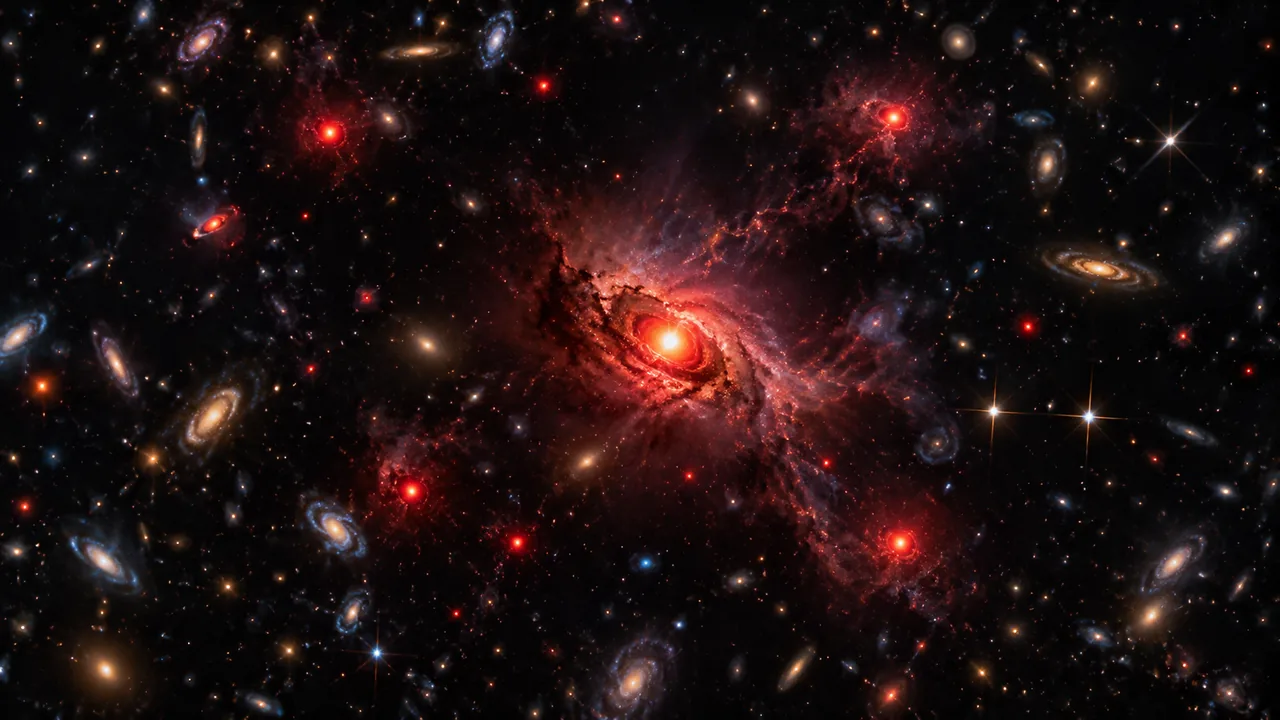
In images of the early universe taken by the James Webb Space Telescope (JWST), astronomers have identified a surprising population of compact, reddish sources. They are nicknamed little red dots (LRDs). The name describes how they appear in observations—not their physical size, composition, or a confirmed new type of star. Their discovery has become a major clue in the search for the first rapidly growing black holes.
The leading explanation for at least some LRDs is a growing black hole wrapped in dense gas, sometimes described as a “black hole star.” But the population may be diverse, and competing stellar explanations remain under study. Here is what Webb actually sees, why the objects are so puzzling, and what new evidence published in 2026 changes.
Quick answer: what are little red dots?
Little red dots are compact, distant sources identified in Webb infrared observations, especially in the early universe. Many exhibit unusual spectra and colors that do not fit neatly into ordinary galaxy or active-galactic-nucleus templates. They are not confirmed to be literal red stars. Observations increasingly support accreting black holes inside thick gas cocoons for some examples, but there is not yet a single settled explanation for every LRD.
How did the James Webb Telescope find them?
JWST began science operations in 2022. Its sensitive near-infrared camera (NIRCam) and spectrograph (NIRSpec) allow researchers to detect faint sources whose light has been stretched to longer wavelengths by the expansion of the universe. Astronomers examining Webb survey images noticed unexpectedly numerous tiny, red-looking objects and began collecting samples across different fields.
Webb does not see these objects as close-up red spheres. A dot in a deep-space image can represent an enormous source so far away that its structure cannot be resolved. Color-composite telescope images also map different infrared wavelengths into visible colors. The red appearance is a scientific clue, not a photograph of a red surface.
Why do they look red?
Several effects can make a distant source look red: cosmic redshift moves its light toward longer wavelengths; dust or dense gas can absorb or redistribute shorter-wavelength light; and the source’s underlying spectrum may rise toward redder wavelengths. Researchers use spectroscopy to separate these possibilities. Red color alone cannot prove the presence of a black hole.
How old are the objects we are seeing?
Many LRDs are observed as they existed during the universe’s first billion years. NASA notes that examples appear from roughly 600 million years after the Big Bang and that the population becomes much less common later in cosmic history. That distribution raises an important question: are LRDs a short-lived stage of black-hole growth, or do their observational signatures simply become harder to recognize as galaxies evolve?
Why were astronomers so surprised?
Early Webb studies suggested some compact red sources were extraordinarily massive galaxies that had assembled stars faster than expected. Others showed broad hydrogen emission lines that can signal rapidly moving gas around a black hole. The same sources often appeared unusually faint in X-rays, even though ordinary active galactic nuclei can be bright at those wavelengths. These apparently contradictory clues made straightforward classifications difficult.
Theory 1: a black hole hidden inside a dense gas cocoon
A black hole can grow by pulling surrounding gas inward. As material approaches the black hole, it releases energy. In the “black hole star” or BH* scenario, a dense envelope of gas surrounds that central engine and reshapes the light that escapes. The object can look more like a compact luminous atmosphere than a conventional bright active galactic nucleus.
The phrase “black hole star” is a nickname for this model. It does not mean the black hole itself is a star, or that light escapes from inside its event horizon. The light comes from hot matter and gas outside the black hole.
The 2026 breakthrough: GLIMPSE-17775
In June 2026, a team led by Vasily Kokorev reported an unusually detailed Webb spectrum of an LRD named GLIMPSE-17775. Gravitational lensing by foreground matter magnified the source, allowing astronomers to extract more than 40 spectral lines. NASA described this as the strongest evidence yet for the black-hole-star interpretation in this particular object.
The team identified a collection of iron lines, along with oxygen, helium and hydrogen features, that collectively favored a powerful central source surrounded by hot, dense gas. Some broad spectral features could be explained by electrons scattering photons through that gas. The evidence strengthens a physical model; it is not proof that every little red dot has the same engine.
GLIMPSE-17775 has a measured redshift of about 3.5 and is seen as it existed roughly 1.8 billion years after the Big Bang. It is an important case study, but it should not be confused with the very earliest LRDs.
A separate 2026 result: a 50-million-solar-mass black hole
Another remarkable object, Abell 2744-QSO1, is a strongly gravitationally lensed little red dot observed at redshift 7.04, when the universe was only about 700 million years old. In May 2026, researchers reported a direct dynamical mass estimate from the motion of gas around its center. Their result supports a black hole of approximately 50 million solar masses, with comparatively little room for an ordinary stellar host.
This is unusually direct evidence that at least one little red dot contains an already massive, growing black hole. It does not establish whether the original black-hole seed formed through direct gas collapse, mergers, or another mechanism. The origin of such early massive black holes remains actively debated.
Why do most little red dots appear faint in X-rays?
One difficulty with the black-hole hypothesis was the lack of strong X-ray detections from many LRDs. A thick gas cocoon could absorb or scatter high-energy radiation before it escapes, leaving a source that looks different from an unobscured active galaxy. This is a plausible explanation, not a universal observational rule.
In April 2026, NASA reported an unusual X-ray-emitting source detected with Chandra and examined in the context of Webb observations. Researchers suggested it might represent a transition between a gas-enshrouded little red dot and a more recognizable active black hole. Follow-up observations are needed to confirm that interpretation.
Theory 2: unusually massive stars or stellar systems
Not all scientists agree that every LRD is powered by a black hole. Researchers have also modeled exceptionally massive stars, unusual stellar atmospheres, compact star-forming systems, and other exotic possibilities. A study publicized by the Harvard-Smithsonian Center for Astrophysics in August 2026 proposed that pulsating supermassive stars could reproduce several LRD characteristics, including compact appearance and certain chemical signatures.
These ideas are scientifically useful because different models make testable predictions about spectral lines, variability, emitted X-rays and the surrounding galaxy. The existence of strong black-hole evidence in some sources does not rule out multiple types of objects being grouped under the same visual nickname.
Are little red dots actually galaxies?
Some may contain host galaxies, but an LRD is not automatically a galaxy in the usual sense. The observed light may be dominated by gas close to a central black hole rather than by millions or billions of stars. If astronomers assume all that light comes from stars, they can infer a stellar mass that is too high. Determining the relative contributions of stars, gas and accretion is central to interpreting these objects.
Why do little red dots seem to disappear later in cosmic history?
Their abundance changes dramatically with redshift. One possibility is that a dense, gas-rich growth phase eventually ends as the black hole consumes or disperses its envelope, exposing a more ordinary active nucleus. Another is observational selection: some features used to recognize LRDs in the early universe become less prominent or are measured differently at later times. A July 2026 NASA report highlighted research exploring how observational bias may contribute to the apparent population change.
Did JWST discover something that breaks the Big Bang theory?
No. These discoveries test models of how galaxies and black holes formed, not whether the Big Bang occurred. Some early interpretations made the objects appear too massive or too mature for their age. Improved spectra and physical models can change the estimated contribution of stars and black holes, reducing apparent tension without requiring a wholesale rejection of cosmology.
Scientists can still find that standard models need refinement. A surprising observation is an opportunity to improve a model, not automatic proof that the entire framework is wrong.
How do scientists investigate a dot that is billions of light-years away?
• Infrared imaging: Webb measures faint sources and their colors across multiple filters.
• Spectroscopy: NIRSpec spreads light by wavelength, revealing chemical signatures, redshift and gas motion.
• Gravitational lensing: A massive foreground galaxy cluster can magnify a distant source, giving astronomers a clearer view.
• X-ray comparisons: Chandra and other observatories test whether energetic radiation escapes from a growing black hole.
• Repeated observations: Changes in brightness or spectral features can help distinguish compact accretion from a stable stellar population.
What would confirm the black-hole explanation?
Researchers want more objects with deep, high-quality spectra; measurements of gas dynamics; clearer signatures of accretion; and observations across infrared, optical and X-ray bands. A model that explains one spectacular source must also explain why other LRDs look similar or different. Better samples will reveal whether LRDs form one family or several overlapping populations.
What do the discoveries mean for the first supermassive black holes?
The earliest known black holes are surprisingly massive for their age. If many LRDs are short-lived, heavily obscured growth stages, Webb may be revealing a previously hidden part of how black holes built mass so rapidly. In some cases, large seed black holes may have formed before substantial host galaxies developed. Determining how often that happened is one of the major open questions in early-universe astronomy.
What we know—and what remains uncertain
• Observed: Webb has found a substantial population of compact, red-appearing distant sources with unusual spectra.
• Strong evidence: Specific objects such as GLIMPSE-17775 and Abell 2744-QSO1 support black-hole interpretations.
• Still uncertain: Whether all LRDs share the same physical origin, and exactly how early massive black holes formed.
• Not established: That every red dot is a black hole, that all are stars, or that the discoveries overturn the Big Bang.
Frequently asked questions
Are the little red dots dangerous to Earth?
No. The LRDs under study are extremely distant astronomical sources, observed as they existed billions of years ago. They pose no known danger to Earth.
Are they black holes or stars?
The answer may differ from object to object. Evidence increasingly favors black holes surrounded by dense gas for several well-studied examples, while massive-star models remain under investigation for the broader population.
Why can Webb see them but earlier telescopes struggled?
Webb combines a large collecting area with powerful infrared instruments, making it exceptionally capable of finding faint, highly redshifted objects and measuring their spectra.
Does a red dot mean a galaxy is moving away?
Cosmological redshift contributes to how distant objects appear, but the image color also depends on the filters and image processing. A red-looking dot by itself does not give a precise speed or distance.
Did scientists discover a black hole older than the universe?
No. Reports about surprisingly early black holes refer to how quickly they grew after the Big Bang. They are not observations of objects that existed before the universe.
Where can I see actual JWST images?
Explore the image galleries and research updates on the official NASA Webb mission website and ESA/Webb website. The featured image accompanying this article is an artistic illustration, not an original Webb observation.
Conclusion
The little red dots are one of Webb’s most intriguing discoveries because they may expose a hidden phase of rapid black-hole growth in the young universe. Detailed 2026 observations make the gas-enshrouded black-hole model much more compelling for particular sources, while other studies continue to test alternative explanations. The most scientifically accurate answer is not that the mystery is solved—but that researchers now have better evidence and sharper ways to test it.
Sources and further reading
NASA: The Impact of Webb on Our Understanding of Black Holes
NASA: Webb Finds Strongest Evidence Yet for Black Hole Stars (June 2026)
NASA: Webb Explores Family Tree of Newly Discovered Distant Objects (July 2026)
NASA: Chandra and Webb Connect Little Red Dots (April 2026)
ESA: Webb Reveals Black Hole That Formed Before Its Galaxy (May 2026)
Nature: A Direct Black-Hole Mass Measurement in a Little Red Dot
Harvard-Smithsonian: Supermassive Star Alternative (August 2026)
You may also like
 Science
Can Tardigrades Really Survive in Space? What Experiments Actually Show
Yes, some tardigrades survived real exposure to space. The FOTON-M3 experiments reveal exactly when they survived, how UV…
 Psychology
Can Mice Inherit Their Fathers’ Fear? The Odor Experiment Behind a Controversial Epigenetics Claim
A 2014 mouse experiment linked fathers’ odor–shock learning to odor sensitivity and sensory changes in descendants. Here is…
 Psychology
The Marshmallow Test Revisited: Can Waiting for a Treat Really Predict a Child’s Future?
Does the marshmallow test predict success? Compare original research with the 2013 trust experiment, 2018 replication, 2020 reanalysis…