
Can Mice Inherit Their Fathers’ Fear? The Odor Experiment Behind a Controversial Epigenetics Claim
A 2014 mouse experiment linked fathers’ odor–shock learning to odor sensitivity and sensory changes in descendants. Here is what the data proved—and what it did not.
Contents
- Why Does Inheriting a Learned Fear Sound So Strange?
- The Odor Was Acetophenone, Not Necessarily a Cherry Blossom
- How the 2014 Mouse Experiment Actually Worked
- First: Fathers Learned an Odor–Shock Association
- Second: F1 Offspring Were Tested Without Undergoing the Father's Training
- Third: The Study Examined F2 Grand-Offspring
- What Changed in the Offspring's Olfactory System?
- What Did the Sperm DNA Results Show?
- How Did Researchers Rule Out Fathers Simply Teaching Their Young?
- Were the Young Mice Actually Afraid?
- Genetics, Epigenetics, and a Frequently Misused Word
- Why Do Studies Sometimes Require F2—and Sometimes F3?
- The Follow-Up Study: What Happened When Fathers' Fear Was Extinguished?
- What Do More Recent Critics Say?
- The Headline Claim Versus What the Evidence Actually Supports
- Does Any of This Apply to Human Trauma?
- A Practical Checklist for Reading the Next Viral Inheritance Study
- Six Questions Worth Asking
- What the Mouse Odor Study Really Changed
- Original Papers and Critical Sources
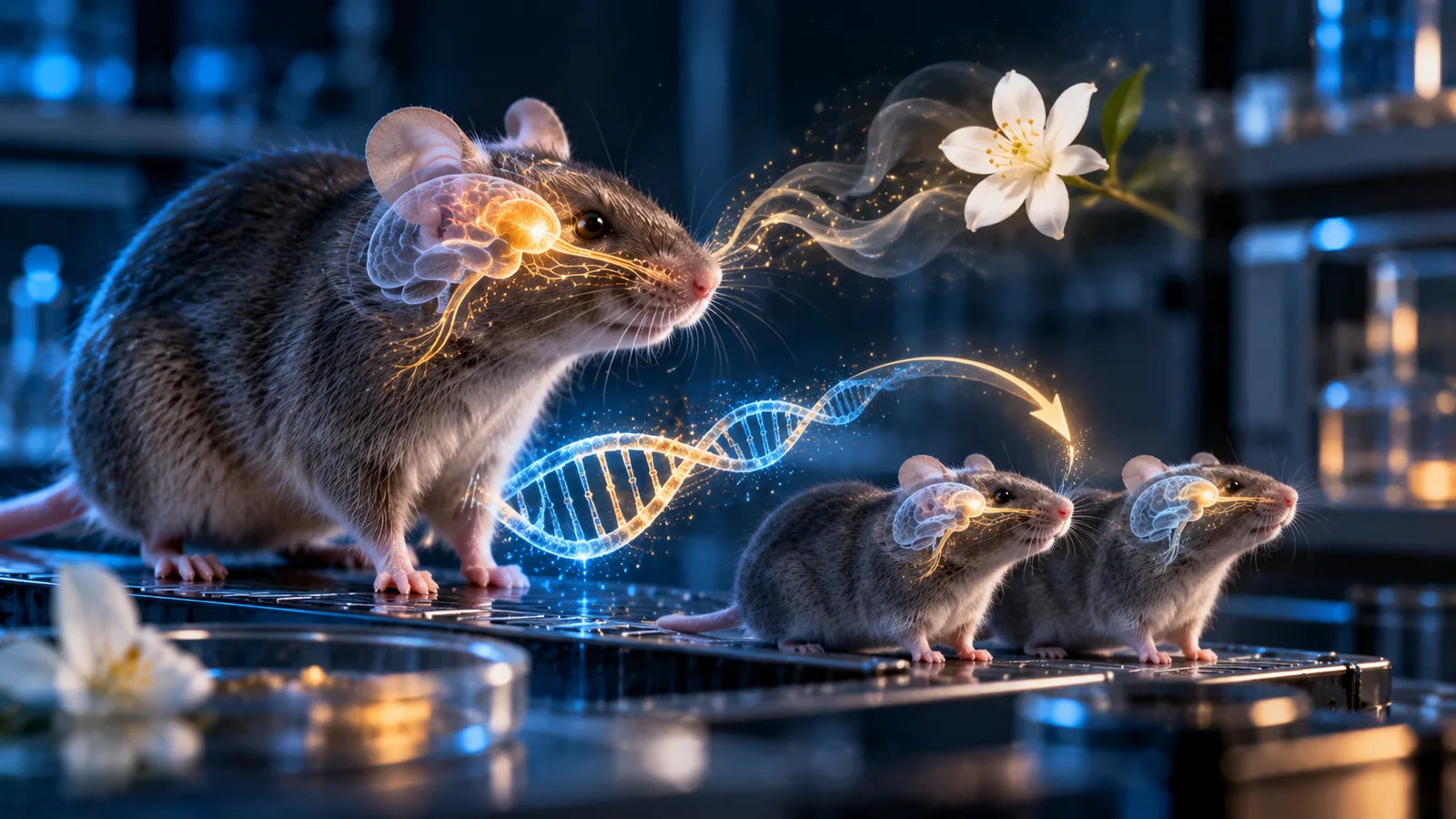
Imagine a mouse reacting unusually strongly to a smell it has never encountered during training. It has not received a shock paired with that smell. But before the mouse was conceived, its father learned to associate the odor with an unpleasant event. Does this mean the offspring somehow inherited its father’s memory? Or did something narrower—and perhaps more biologically revealing—happen in the development of its sensory system?
In a study published online on December 1, 2013, and in the January 2014 issue of Nature Neuroscience, researchers Brian G. Dias and Kerry J. Ressler reported that the offspring and grand-offspring of odor-conditioned male mice showed an increased response to the particular odor associated with the fathers’ training. The team also observed changes in the relevant olfactory neural pathway and differences in DNA methylation in sperm. Those findings made the paper a milestone in debates about inherited environmental effects. They did not establish that a complete autobiographical memory traveled into offspring, or that a human phobia is passed from parent to child in the same way. Read the original paper.
The distinction matters. Some popular retellings jump straight from “a mouse reacts to an odor” to “trauma is encoded in DNA.” This guide reconstructs the experiments, separates measured effects from proposed mechanisms, examines the controls that made the findings interesting, and considers later research and critical reviews through 2026.
Why Does Inheriting a Learned Fear Sound So Strange?
Standard inheritance involves DNA sequence transmitted through eggs and sperm. Learning to fear a smell, by contrast, changes patterns of activity and plasticity in the parent’s nervous system. The neurons involved in a mouse’s learned response are not the same cells as its sperm. There is no established biological route by which a complete, experience-rich memory is copied from a brain into a developing embryo.
Yet development depends on more than DNA sequence alone. Cells regulate which genes are expressed and when. Some of these regulatory influences are called epigenetic and can include DNA methylation, chromatin changes, and small noncoding RNAs. Epigenetic mechanisms are ordinary and important within organisms; the more controversial claim is that a change induced by an acquired experience can cross the germline and reproducibly influence generations of mammals that were never directly exposed. A 2024 methodological review emphasizes that evidence for this latter process must satisfy unusually demanding tests.
A careful investigator therefore asks several different questions. Did the father’s experience predict a measurable difference in the offspring? Was that difference specific to the original stimulus? Could social learning, maternal care, or direct exposure explain it? Did the research identify an associated molecular signal? And, crucially, did it prove that this signal caused the offspring’s behavior?
The Odor Was Acetophenone, Not Necessarily a Cherry Blossom
News accounts often describe the study as mice inheriting a fear of cherry blossoms. The experimental stimulus was actually acetophenone, a chemical often described as having a sweet almond-like or cherry-like scent. That is an evocative shorthand, but the investigators did not need literal cherry blossoms to create the stimulus.
The chemical choice was scientifically useful. Acetophenone activates an olfactory pathway associated with the M71 receptor, encoded by the gene Olfr151. Researchers could visualize or measure parts of this pathway. They could therefore study not only an animal’s behavioral response, but also whether the sensory system representing that particular smell differed in the next generation.
A second odor, including propanol in comparison groups, made the specificity test possible. Offspring that reacted more to every smell might simply be more anxious, more alert, or generally more reactive. Offspring that responded preferentially to the odor associated with the fathers’ experience would support a more focused hypothesis.
How the 2014 Mouse Experiment Actually Worked
First: Fathers Learned an Odor–Shock Association
The researchers trained adult male mice, the F0 generation, to associate presentations of a particular odor with mild electric foot shocks. Over training, the smell became a cue linked with the aversive event. Different conditioned odors and control groups helped the team distinguish an odor-specific effect from a general consequence of stressful handling.
This was a controlled animal-research protocol involving aversive stimulation—not something readers should attempt to recreate at home. The timing is fundamental: the males were trained before mating, which allowed investigators to ask whether a preconception parental experience correlated with later outcomes in offspring.
Second: F1 Offspring Were Tested Without Undergoing the Father’s Training
Trained males mated with females who had not undergone the same conditioning procedure. Their offspring, labeled F1, did not receive the fathers’ odor–shock pairing. When the researchers presented the odor, they measured behavioral sensitivity using assays including odor-potentiated startle—an enhanced startle response in the odor’s presence.
The key reported result was not that these offspring could describe their father’s painful event. It was that mice sired by acetophenone-conditioned fathers showed enhanced sensitivity to acetophenone relative to appropriate controls. The pattern was stimulus-specific rather than a blanket reaction to unrelated odors.
Third: The Study Examined F2 Grand-Offspring
Unconditioned descendants were bred to produce the F2 generation. The researchers reported that increased odor-specific sensitivity could still be detected in this next generation. That step matters because changes in a father’s reproductive cells might directly affect F1 without establishing persistence into a subsequent unexposed generation.
| Generation | Direct experience in the design | Main observation or purpose | What it does not establish |
|---|---|---|---|
| F0 | Odor paired with mild foot shocks before mating | Acquired odor–fear association | A change in the DNA sequence |
| F1 | No matching odor–shock training | Enhanced odor-specific behavioral sensitivity and altered olfactory representation | A consciously recalled paternal memory |
| F2 | No F0 training experience | Persistence of a reported odor-linked effect | A universal law of mammalian epigenetic inheritance |
What Changed in the Offspring’s Olfactory System?
The investigators used mouse lines and staining methods that let them examine M71-expressing olfactory sensory neurons and structures called glomeruli in the olfactory bulb. Glomeruli are regions where inputs from neurons expressing related odor receptors converge. The size and number of relevant neural elements can provide clues about how a particular odor is represented.
Offspring from acetophenone-conditioned lines showed an enhanced anatomical representation of the M71-related pathway, including changes reported in the relevant glomerular areas and receptor-expressing cell populations. This was stronger evidence than a startle measurement alone, because it connected the behavioral findings to a biologically meaningful sensory pathway.
However, a larger or differently represented odor pathway does not automatically equal an inherited fear memory. The sensory anatomy and behavioral outcomes were not always measured in the same animals. Even when both findings move in the expected direction, correlation does not identify the exclusive causal path from neural anatomy to emotional behavior. A contemporaneous Nature Reviews Neuroscience research highlight explicitly noted this distinction.
What Did the Sperm DNA Results Show?
The study then turned to a molecular candidate: DNA methylation around Olfr151, the gene associated with the acetophenone-sensitive M71 receptor. Methylation involves chemical marks on DNA that can influence gene regulation depending on their location and context. It is not a change in the letters of the genetic code.
Researchers reported lower methylation at investigated sites near Olfr151 in sperm from acetophenone-conditioned F0 males and in sperm from some F1 descendants, relative to relevant controls. The same pattern was not found for a separate olfactory receptor gene used for comparison. That association was striking because the molecular candidate corresponded to the same odor pathway implicated by the behavioral and anatomical observations.
But this is where headlines commonly overclaim. Finding a methylation difference is not the same as proving that the difference caused the descendants’ increased sensitivity. A strong causal demonstration would require specifically manipulating the candidate mark and showing that the behavior changes accordingly while controlling other plausible pathways. The 2014 study provided an intriguing association and a mechanistic hypothesis—not a completed molecular explanation.
| Evidence type | What the paper reported | The boundary of the claim |
|---|---|---|
| Odor-potentiated startle | Heightened response tied to the conditioned odor | Cannot reveal subjective, autobiographical memory |
| M71-related anatomy | Greater representation of a relevant olfactory pathway | Cannot on its own prove the cause of fear-like behavior |
| Sperm Olfr151 methylation | Odor-linked differences in selected methylation sites | Does not prove methylation is the sole causal carrier |
| F2 effects | Persistence into a grand-offspring generation | Does not generalize to all mammalian traits |
| IVF and cross-fostering | Findings not explained solely by ordinary parental upbringing | Do not eliminate every biological or developmental alternative |
How Did Researchers Rule Out Fathers Simply Teaching Their Young?
If an offspring lived with a frightened father, it might learn from the father’s posture, behavior, or odor. Maternal care could also differ after mating with a conditioned male. The team therefore included experiments aimed at distinguishing social transmission from effects associated with reproduction.
One test used in vitro fertilization (IVF) with sperm from conditioned males. Another involved cross-fostering, placing young with foster mothers from different experimental backgrounds. Some of the relevant effects persisted, which makes a story of direct teaching by the father an inadequate explanation for the results.
Nevertheless, ruling out direct imitation does not prove that Olfr151 methylation alone carried the information. Germ cells contain multiple forms of potential regulation; embryo development can be influenced by complex biological interactions. An experimental control may reject one alternative without proving every step of the explanation that remains.
That logical distinction is especially valuable for readers. “The offspring did not need to watch their father learning” is a conclusion more closely supported than “researchers located the gene that stores ancestral terror.”
Were the Young Mice Actually Afraid?
The phrase inherited fear is intuitive but imprecise. In the research, investigators quantified odor-dependent startle or sensitivity. They did not obtain verbal reports from mice, did not observe a transferred story with images and dates, and did not demonstrate that the descendants recalled a specific episode that happened to their father.
At least three distinct capacities must be separated: detecting a scent, assigning heightened salience or showing a defensive reaction to it, and remembering a personal event as a narrative. The results directly concern the first two far more than the third.
Consider a simple hypothetical analogy: a person might have unusually acute hearing for a faint alarm without knowing when or why an ancestor once heard that alarm. Sensory sensitivity is not the same thing as historical knowledge. Similarly, a mouse’s unusually strong response to acetophenone does not establish an inherited movie of its father’s training session.
Genetics, Epigenetics, and a Frequently Misused Word
A genetic variant is a difference in the DNA sequence itself. An epigenetic state involves gene regulation that may change without sequence alteration. The mechanisms overlap in development, but they should not be treated as interchangeable. Nor does finding an epigenetic mark guarantee that it survives reproduction or that its effects persist for multiple generations.
Mammalian reproduction includes extensive epigenetic reprogramming. During germ-cell development and shortly after fertilization, many methylation patterns are erased and reorganized. Any proposed inherited molecular signal must explain how it escapes or works around those biological resets. This is one reason that environmental epigenetic inheritance, although plausible in specific settings, remains considerably harder to establish than ordinary gene regulation within one animal.
| Term | Useful meaning here | Common misunderstanding |
|---|---|---|
| Genetic inheritance | Transmission of DNA sequence | Every acquired behavior changes DNA letters |
| Epigenetic change | Changes associated with gene regulation | Every mark is stable across generations |
| F1 offspring | First generation after exposed F0 | Proof by itself of truly transgenerational transmission |
| F2 offspring | Grand-offspring in this paternal design | Proof of a single defined causal molecule |
| Inherited memory | Popular interpretation of the findings | A measured, transferred autobiographical recollection |
Why Do Studies Sometimes Require F2—and Sometimes F3?
Generational labels are more than terminology. In a preconception exposure of an adult male F0, his sperm may themselves be affected by the exposure. An effect in his offspring F1 could therefore reflect a direct influence on germ cells. Researchers typically look to F2 for evidence reaching a generation not directly exposed through the father’s original experience.
Now consider exposure of a pregnant female F0. Her developing F1 embryo is exposed, but so are the primordial reproductive cells inside that embryo, which may give rise to F2. In that design, effects observed in F2 can still involve direct exposure of germline precursors; testing F3 is generally necessary to support a stronger claim about an unexposed generation.
A 2024 review in Epigenetics examines these distinctions and argues that many published reports blur intergenerational effects with genuinely transgenerational epigenetic inheritance. Its authors reviewed 80 papers that claimed or were cited as supporting such effects and called for consistent, rigorous criteria. Review and discussion.
The Follow-Up Study: What Happened When Fathers’ Fear Was Extinguished?
The scientific story did not end in 2014. A follow-up paper published online in 2018 and printed in 2019 in Biological Psychiatry asked a fresh question: what if conditioned fathers subsequently received extinction training—repeated presentation of the odor without the shock—before producing offspring?
The investigators compared groups of mice that encountered an odor, learned to associate it with foot shock, or learned that the odor no longer predicted the shock. They then examined odor sensitivity and olfactory anatomy in F1 offspring, along with selected methylation measures in the fathers’ sperm.
They reported that offspring of fathers whose conditioned responses had been extinguished did not show the same enhanced odor sensitivity or olfactory-pathway representation as offspring of fathers that had been conditioned without extinction. Related sperm methylation patterns also differed in parts of the experiment. Read the follow-up study.
This is an intriguing result because it suggests that some reported influences may be modifiable, not destiny. It is not proof that psychotherapy in human parents will alter an inherited fear marker in future children. This was an animal protocol studying particular odors, and further independent replication and causal testing remain important.
What Do More Recent Critics Say?
A scientifically fair account must include uncertainty, not just excitement. One concern is definitional: heightened odor sensitivity is not a transferred memory. A second is mechanistic: DNA methylation may accompany a change rather than cause it. A third concerns the well-documented resetting of epigenetic marks during mammalian development.
In 2024, Hasan Khatib and colleagues published a systematic conceptual critique arguing that the field needs strict definitions and evidence linking germline changes to phenotypes across genuinely unexposed generations. They identified persistent confusion in claims drawn from mammalian experiments. The 2024 article.
Also in 2024, molecular biologist Adrian Bird published an independent critical perspective stressing that evidence for many environmentally driven transgenerational epigenetic mechanisms in vertebrates remains inconclusive. Such caution does not by itself disprove the Dias–Ressler observations. Rather, it distinguishes a provocative experimental report from a broad theory that has already passed every test. Critical perspective.
The Headline Claim Versus What the Evidence Actually Supports
| Popular statement | Evidence status | More accurate wording |
|---|---|---|
| “Young mice responded more strongly to the odor their fathers were conditioned to fear.” | Supported by reported data | Odor-specific behavioral sensitivity differed among groups |
| “Grand-offspring showed a related effect.” | Reported in the paper | Findings extend to F2 in this experimental system |
| “A full memory was copied into offspring.” | Not demonstrated | No autobiographical memory transfer was measured |
| “One methylation mark definitively explains the inheritance.” | Not established | Relevant sperm methylation associations were observed |
| “People inherit a grandparent’s phobia.” | Unsupported extrapolation | Mouse findings do not establish human individual prediction |
| “Changing the fathers’ experience guarantees healthy descendants.” | Not demonstrated in humans | A later mouse experiment found modifiable outcomes |
This comparison is arguably the article’s most useful safeguard against sensationalism. A finding can be remarkable without being universal. The reported alignment among behavior, sensory anatomy, and sperm molecular signatures deserves attention precisely because the full causal chain remains open to investigation.
Does Any of This Apply to Human Trauma?
Researchers have studied how war, famine, displacement, and other severe experiences affect survivors and their families. Family experiences can be transmitted through numerous established or plausible pathways: caregiving, stress exposure, living conditions, social disadvantage, learned behavior, and biology. Separating these explanations in humans is extraordinarily difficult.
Some human research reports associations between parental trauma and molecular markers in descendants. But an association does not prove a stable inherited molecular message that bypasses environment and upbringing. A mouse odor–shock paradigm cannot diagnose post-traumatic stress disorder, determine a person’s personality, or identify the origin of a family member’s anxiety.
The idea that “your grandfather’s fear lives in your DNA” may feel emotionally compelling, but using it to explain a person’s symptoms or predict a child’s future is not scientifically justified by this study. An evidence-based account respects both the real effects of difficult family histories and the substantial uncertainties surrounding long-range mammalian epigenetic inheritance.
A Practical Checklist for Reading the Next Viral Inheritance Study
When a story claims that scientists have passed a memory, skill, trauma, or preference to unborn offspring, start with the organism studied. Was it a mouse, a fruit fly, an isolated cell culture, or a person? Then identify the actual measured outcome—a startle reflex, a neural marker, a survey answer, or a concrete behavior.
Next, ask whether the response was specific to the original cue or generalized. Examine the controls: were the offspring exposed to the parent, raised by the same mother, or conceived using IVF? Which generation was studied? Could the germ cells themselves have been directly exposed? Most importantly, determine whether a proposed molecular mechanism was causally manipulated or merely measured alongside the outcome.
Six Questions Worth Asking
- Does the headline accurately describe the original published experiment?
- Were the subjects humans or another species?
- What precise outcome was measured, and what was not measured?
- Were direct exposure and parental social learning credibly addressed?
- Was a molecular pathway shown to cause the effect or simply associated with it?
- How have independent researchers and more recent reviews evaluated the claim?
These questions help readers resist exaggerated stories without dismissing legitimate science. They are just as useful for claims about inherited intelligence, trauma, temperament, or newly discovered “memory genes.”
What the Mouse Odor Study Really Changed
The lasting contribution of the Dias–Ressler work is that it connected a specific preconception sensory experience in fathers with odor-specific behavior and olfactory anatomy in descendants, alongside candidate epigenetic differences in sperm. Its IVF, foster-rearing, and F2 experiments were ambitious attempts to separate reproductive transmission from simple parental teaching.
The equally important limit is that it did not establish a complete molecular mechanism or the inheritance of human-like narrative memories. Later research suggests the phenomenon may be sensitive to changes in the original conditioning history, while methodological critiques remind us that mammalian transgenerational epigenetic inheritance remains a challenging, contested field.
So did mice inherit their fathers’ fear? They exhibited inherited-pattern, odor-linked sensitivity in the reported experimental system. Whether—and exactly how—an experience leaves a transmissible signal in the mammalian germline is the deeper question that made the study famous and keeps it scientifically interesting today.
Original Papers and Critical Sources
- Dias & Ressler, Parental olfactory experience influences behavior and neural structure in subsequent generations, Nature Neuroscience (2014).
- Aoued et al., Reversing Behavioral, Neuroanatomical, and Germline Influences of Intergenerational Stress, Biological Psychiatry (2019; online 2018).
- Khatib et al., Calling the question: what is mammalian transgenerational epigenetic inheritance?, Epigenetics (2024).
- Adrian Bird, Transgenerational epigenetic inheritance: a critical perspective (2024).
- Nature Reviews Neuroscience, A lingering smell? (2014).
You may also like
 Psychology
Mental Fatigue vs. Burnout: How to Tell the Difference and What Actually Helps
Mental fatigue or burnout? Compare symptoms, workplace causes and depression red flags with a practical, non-diagnostic guide grounded…
 Psychology
The Marshmallow Test Revisited: Can Waiting for a Treat Really Predict a Child’s Future?
Does the marshmallow test predict success? Compare original research with the 2013 trust experiment, 2018 replication, 2020 reanalysis…
 Psychology
Scientists Created a False Fear Memory in a Mouse: What the 2013 Optogenetics Experiment Really Proved
How did MIT scientists create a false fear memory in a mouse? Explore the 2013 optogenetics experiment, controls,…