
The Marshmallow Test Revisited: Can Waiting for a Treat Really Predict a Child’s Future?
Does the marshmallow test predict success? Compare original research with the 2013 trust experiment, 2018 replication, 2020 reanalysis and 2024 adult follow-up.
Contents
- What actually happened in Walter Mischel's original experiments?
- Why the story became 'one sweet predicts success'
- The research timeline: original findings, replication, dispute and adult follow-up
- 2018: why a larger, more diverse cohort changed the claim
- 2020: the same data, different answers
- 2024: what happened when participants reached age 26?
- The trust experiment: why some children waited four times longer
- Why a marshmallow and a wrapped gift can lead to opposite results
- Correlation, causation and individual prediction are not the same
- One simple calculation shows why effect size matters
- What a child might actually be responding to
- What Mischel's attention experiments still teach us
- What parents and teachers can responsibly take from the research
- Three illustrative situations, not case studies
- A practical checklist for reading headlines about child psychology
- Why the cultural and social findings make the science better
- Why viral marshmallow videos should not become assessments
- The conclusion: a small test revealed a much bigger problem
- Primary research and further reading
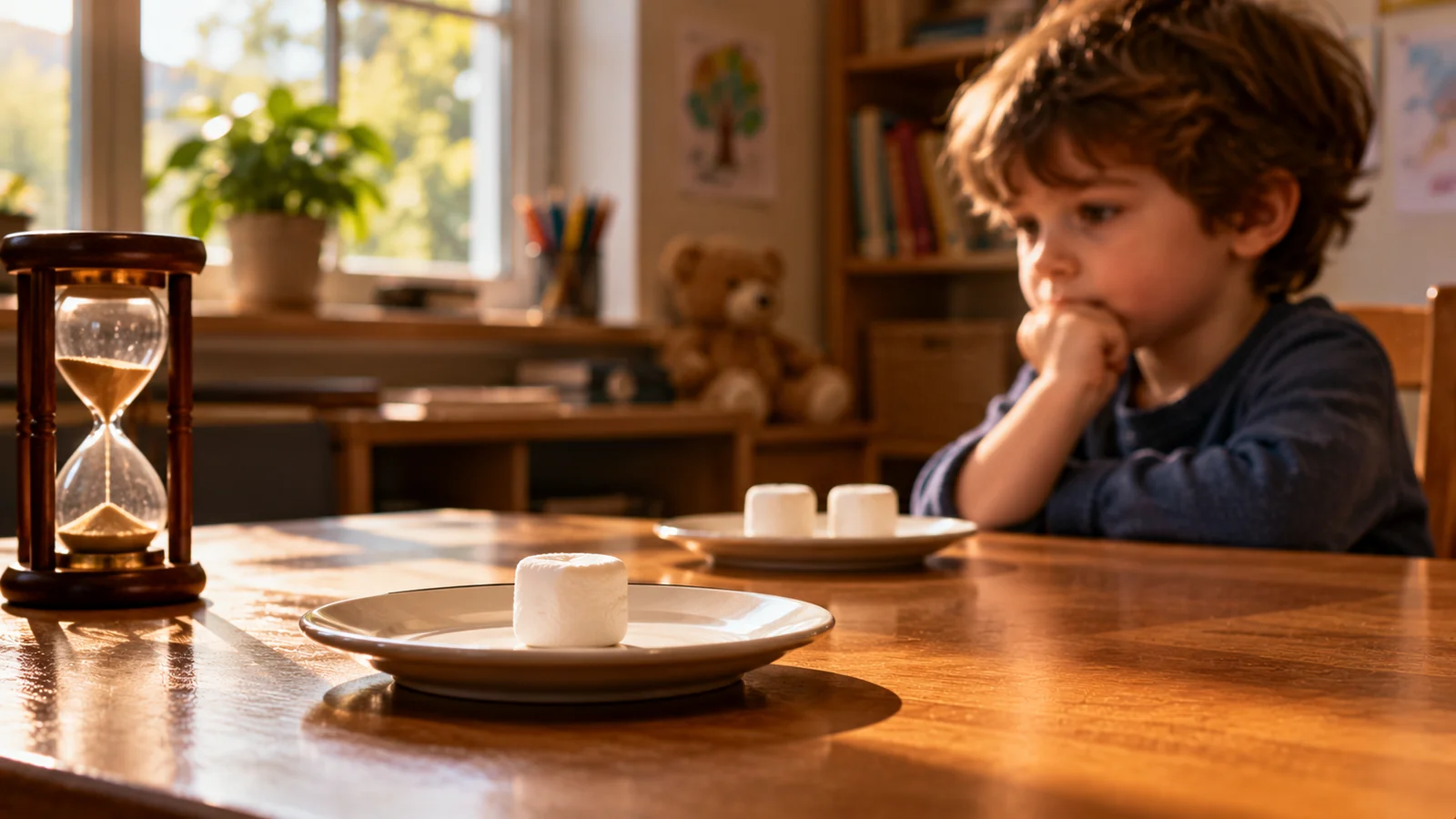
Picture a four-year-old facing a choice: eat one marshmallow immediately, or wait for an adult to return and get a bigger reward. It is the kind of experiment that seems to explain everything in fifteen minutes. According to the popular story, children who resist temptation become successful adults, while those who eat right away reveal a lasting lack of discipline. Decades of research suggest a far more interesting—and much less deterministic—story.
Walter Mischel and colleagues helped transform delayed gratification into an important research question in developmental psychology. Early follow-up studies found associations between children’s waiting and some later outcomes. But later work changed the debate: children’s expectations about whether promises will be kept, the family and social environment, cultural customs, and the method used to analyze the data all matter. Most importantly, a preregistered study published in 2024 followed 702 people to age 26 and did not find the original task to be a reliable predictor of broad adult outcomes. That result does not make self-regulation irrelevant. It changes what we can reasonably conclude from a single test. Read the 2024 study in Child Development.
The bottom line: the marshmallow test measures what a child does in a particular waiting situation. It is not a diagnostic assessment, a measure of intelligence, or a scientifically justified forecast of an individual child’s adult life. Some associations in particular samples have been documented, but their strength and interpretation depend on context and methods.
What actually happened in Walter Mischel’s original experiments?
The test is often described as a single standardized event: a researcher leaves one marshmallow in front of a child, sets a fifteen-minute timer, and counts who manages to resist. In reality, Mischel’s work at Stanford’s Bing Nursery School from the late 1960s onward involved multiple variations of self-imposed delay tasks. Some experiments varied whether rewards were visible; others explored attention, mental imagery and the child’s ability to think about the treat in ways that made waiting easier. The rewards were not always a single marshmallow, and one viral video should not be mistaken for the entirety of the research program.
In the familiar version, a child could have a smaller reward immediately or wait for a larger one. Researchers recorded waiting time and sometimes the strategies children used. This task can reveal how behavior changes when a temptation is visible, when children are given distracting activities, or when an adult makes a credible promise. It was designed to probe a psychological process under controlled conditions—not to score children for life.
In a widely cited 1990 paper, Yuichi Shoda, Walter Mischel and Philip Peake reported links between preschool delay performance and later adolescent cognitive and self-regulatory measures under particular task conditions. The researchers emphasized that the predictive relationship depended on the nature of the delay situation. This crucial qualification largely disappeared as the story traveled from specialist journals into parenting culture. Original 1990 paper.
Why the story became ‘one sweet predicts success’
Few psychology findings have such a vivid central image. A child struggles, looks away, fidgets, laughs, or gives in; observers instantly understand the conflict between an immediate benefit and a bigger future reward. The idea is memorable because adults face similar dilemmas around studying, saving money, and pursuing long-term goals. But a striking analogy does not turn the laboratory situation into a direct measurement of lifelong achievement.
Suppose children from reliably supportive environments tend both to wait longer and to receive more educational resources. A correlation between waiting and grades could then arise even if waiting itself is not the cause of those grades. Alternatively, waiting might partly express developing attention skills that also support learning. Or both processes might coexist. A correlational follow-up study cannot fully choose among these explanations without additional evidence and appropriate designs.
This distinction matters because media summaries frequently slide between three very different claims: waiting correlates with later achievement; teaching children to wait causes better achievement; and an individual child’s waiting time predicts that child’s fate. None of these automatically establishes the next. A measure can be interesting at the population level but too imprecise to make any meaningful judgment about an individual.
The research timeline: original findings, replication, dispute and adult follow-up
The most informative way to read the literature is not as a dramatic reversal in which scientists first proved something and then declared it fake. It is an evolving research program with changing samples, definitions, follow-up periods and statistical models. Each wave asked a somewhat different question. 2018 replication, 2020 preregistered reanalysis and 2024 adult follow-up offer particularly useful contrasts.
| Study | Main question | Reported result | Main caveat |
|---|---|---|---|
| Shoda, Mischel & Peake, 1990 | Could preschool waiting relate to later adolescent functioning? | Associations emerged under selected diagnostic conditions | Selected university-community sample and task variations |
| Kidd, Palmeri & Aslin, 2013 | Does adult reliability change waiting? | Children waited substantially longer following reliable promises | Small experimental sample of 28 children |
| Watts, Duncan & Quan, 2018 | Do links remain in a different cohort with additional controls? | Achievement associations became much weaker after adjustment | Different task duration and analytic choices |
| Michaelson & Munakata, 2020 | Can different preregistered analyses find links in the same broad data? | Significant associations for three of five outcomes; social support mattered | Associations do not identify a single cause |
| Sperber and colleagues, 2024 | Does preschool waiting reliably predict outcomes by age 26? | Little robust prediction of adult achievement, health or behavior | Does not evaluate every possible self-regulation measure |
2018: why a larger, more diverse cohort changed the claim
Tyler Watts, Greg Duncan and Haonan Quan used data from a different and more socioeconomically diverse cohort than the original Stanford follow-ups. For children whose mothers had not completed college, an extra minute of waiting around age four was associated with approximately one tenth of a standard deviation in achievement at age fifteen in a basic model. The raw association was around half as large as those reported in earlier studies and shrank by about two thirds after adjustment for family background, early cognitive ability and the home environment.
A tenth of a standard deviation is not a ten-percent boost in school grades. Standardized units describe variation within a distribution. They cannot be converted into report-card points without knowing the measure and its scale. The researchers also found that much of the association reflected whether children waited at least about twenty seconds, rather than a simple rule under which every additional minute yielded more future success. Watts and colleagues, 2018.
There was another critical design difference: the newer task allowed a maximum waiting time of seven minutes, compared with longer maximum durations in some of Mischel’s experiments. When many participants reach the cap, differences among those who would have waited longer remain unobserved. This creates a measurement issue often called censoring. It is one reason serious scientific debate cannot be reduced to ‘the famous finding was simply disproved.’
2020: the same data, different answers
Laura Michaelson and Yuko Munakata performed a preregistered secondary analysis of the same research cohort underlying the prominent 2018 findings. They reported significant associations for three of five tested adolescent outcomes using choices closer to earlier approaches, including associations with some problem-behavior measures. Their interpretation gave social support an important role: perhaps waiting carries information about a child’s environment in addition to anything that can be labeled self-control.
Other researchers questioned choices about time limits and adjustment variables. That debate illustrates a general scientific principle: statistical controls change the exact question being asked. A simple correlation asks whether two measures move together. An adjusted model asks whether one measure provides information beyond a specified set of others. Adding variables can clarify confounding, but adjustments are not magical proof of causality and can complicate interpretation when variables lie on causal pathways. Michaelson and Munakata, 2020.
The correct takeaway is nuanced. The studies do not unanimously say ‘there is no link,’ nor do they justify a strong claim that preschool waiting independently determines adult success. They tell us that the estimated link is sensitive to what is measured, in whom, and what is included in the analysis. Readers deserve to see those conditions instead of a single dramatic headline.
2024: what happened when participants reached age 26?
A preregistered analysis by Jessica Sperber, Deborah Vandell, Greg Duncan and Tyler Watts followed 702 participants who had completed a delay task at roughly 54 months of age during 1995–1996. Researchers examined survey outcomes at age 26 in 2017–2018, covering adult achievement, health and behavior. Preschool waiting did not emerge as a strong, reliable predictor of these broad outcomes after the planned analytic adjustments.
The paper reported modest, unadjusted correlations with educational attainment (r = .17) and body mass index (r = -.17), while almost all adjusted regression coefficients were not statistically significant. Those correlations are not evidence that waiting caused an education or health outcome. The sample was also not fully representative of every child everywhere: 83% were White and 46% were male. Researchers appropriately framed the result as a limit on the predictive value of this particular task rather than a verdict on the importance of self-regulation more generally. Sperber and colleagues, Child Development, 2024.
The trust experiment: why some children waited four times longer
A particularly revealing experiment by Celeste Kidd, Holly Palmeri and Richard Aslin appeared in Cognition in 2013. Before taking a marshmallow-style task, 28 children participated in an art activity during which an adult either fulfilled promises of better supplies or repeatedly failed to deliver promised materials. Then the children were offered the familiar smaller-immediate versus larger-delayed reward choice. The new variable was not a child’s intelligence; it was the credibility of the situation.
Children in the reliable condition waited on average 12 minutes and 2 seconds. Children who had experienced unreliable promises waited an average of 3 minutes and 2 seconds. The difference is about nine minutes. The reliable group’s mean waiting time was roughly four times the unreliable group’s. This suggests that consuming the available treat may sometimes be a reasonable response when a promised future reward seems uncertain, rather than a straightforward sign of poor impulse control. Original research, Cognition.
| Condition before the task | Reported mean wait | Transparent calculation |
|---|---|---|
| Adult kept earlier promises | 12:02 = approximately 722 seconds | 722 ÷ 182 ≈ 3.97 |
| Adult failed to keep promises | 3:02 = approximately 182 seconds | 722 − 182 ≈ 540 seconds |
These are group averages in a small controlled experiment, not predictions for children in particular households. The study does not justify inferring neglect or unreliable parenting whenever an individual child eats quickly. It demonstrates that expectations about the experimental adult influence the behavior the task supposedly measures. That insight complicates any effort to treat waiting time as a personality score.
Why a marshmallow and a wrapped gift can lead to opposite results
Research from 2022 tested whether the task measures the same thing across different cultural settings. Kaichi Yanaoka and colleagues studied 80 children in Japan and 58 in the United States. Children were asked to delay either eating a marshmallow or opening a wrapped gift. Japanese children tended to wait longer for food than for gifts, while American children tended to wait longer for gifts than for food. The pattern was consistent with differences in everyday customs around waiting for meals or gift-opening moments. Study in Psychological Science.
That does not mean children from one country have superior character. It means that waiting may be shaped by a familiar routine, not merely by an abstract, culture-free quantity called willpower. A child accustomed to not starting lunch until everyone is served may find food waiting routine. Another child who has practiced leaving wrapped presents unopened until a special moment may handle a gift task differently. Those examples explain a plausible mechanism, not a tested claim about any particular individual.
There is a broader methodological implication. If researchers choose one reward and one social context and then rank children from different communities, the test may inadvertently reward a habit the researchers’ preferred cultural setting happens to cultivate. A fair comparison requires careful attention to reward familiarity, instructions, trust and local norms.
Correlation, causation and individual prediction are not the same
Three questions should be kept separate. Association: do children who wait longer tend to score differently on some later measure? Causation: would changing a child’s waiting behavior change that later outcome? Individual prediction: can we forecast this child’s life with useful accuracy from a few minutes of waiting? Each question requires stronger or different evidence than the previous one.
| Common statement | What the research can support | What it does not establish |
|---|---|---|
| ‘Children who wait succeed later’ | Associations in particular samples and outcomes | A guaranteed life trajectory for every child |
| ‘Teaching waiting creates success’ | A plausible intervention question | A causal benefit without intervention evidence |
| ‘Eating now proves weak character’ | A choice in one task | A diagnosis or stable personality trait |
| ‘The replication showed absolutely nothing’ | Smaller, conditional and disputed links | That every self-regulation skill is useless |
| ‘The test works identically worldwide’ | Some processes may recur | Cultural equivalence of reward and setting |
One simple calculation shows why effect size matters
The 2024 paper reported an unadjusted correlation of r = .17 between preschool delay and educational attainment. Squaring the coefficient gives r² = .0289, or roughly 2.9%. In a simple linear context, that describes the proportion of variation statistically shared by the two measures. It does not mean the child has a 2.9% probability of success or that waiting explains 2.9% of an individual’s whole life. It also does not override the paper’s finding that most adjusted estimates were nonsignificant.
This example is intentionally calculated from a published value rather than from invented children or invented test scores. A result can be statistically interesting while remaining far too weak for making decisions about any one child. A school should not use a marshmallow task to deny admission; a parent should not use it to lower expectations; a clinician should not treat it as a diagnostic instrument.
What a child might actually be responding to
Consider how much the laboratory situation compresses into a single behavior. Is the child hungry? Do they particularly like the treat? Have they been disappointed by an adult before? Does the instruction make sense? Are they tired or worried, or do they believe waiting is socially expected? Was the larger reward presented as certain or merely possible? These are not all variables measured in every study; they are reasons a responsible interpretation cannot assume that a momentary choice reflects a lifelong trait.
It is especially important not to use the task as a shortcut for evaluating children with ADHD, children experiencing poverty, or children growing up under uncertainty. Those groups deserve individualized consideration, not popular labels attached to viral clips. A clinical assessment of attention or self-regulation involves multiple observations and sources of information; one snack-related task is nowhere near sufficient.
Nor should a child who waits easily be assumed to possess unusually strong global self-control. The treat may simply be unappealing. Someone can patiently wait for a reward they do not value while struggling to manage tasks that require planning, emotional regulation and persistence. Waiting is a behavior; ‘self-control’ is a much broader construct.
What Mischel’s attention experiments still teach us
Mischel’s broader experimental program highlighted the role of where attention goes and how a reward is mentally represented. Children sometimes waited longer when they looked away, occupied themselves with something else, or thought about the treat in a less immediately tempting way. These findings contributed to psychological accounts of how people manage an immediate desire without treating self-control as pure heroic effort.
The practical interpretation is modest but useful: changing a situation can be easier than constantly fighting the same temptation. For adults and children alike, designing a calmer environment, offering a developmentally appropriate distraction, or clarifying the timing of a reward may help manage a short wait. But an observed benefit within the laboratory task must not be advertised as proof that a particular strategy will raise future earnings or eliminate academic problems twenty years later.
What parents and teachers can responsibly take from the research
The best lesson may be less about training children to ‘win’ a challenge than about building settings in which waiting makes sense. Children learn through repeated interactions with adults, through clear expectations, and through supportive routines. These are reasonable practices consistent with the contextual findings, but they are not guaranteed life-success interventions established by the marshmallow test.
- Make realistic promises and keep them. When plans must change, explain why rather than asking children to trust unexplained delays.
- Use age-appropriate waiting periods. A toddler’s two-minute pause is not comparable to an older child’s twenty-minute wait.
- Teach options for handling boredom. Quiet play, drawing, or redirecting attention can make short delays more manageable.
- Avoid moral rankings. Reaching for a treat is not proof that a child is lazy, unintelligent or destined to fail.
- Look at everyday functioning. Finishing a small project, recovering from frustration and navigating routines involve skills beyond one laboratory task.
Three illustrative situations, not case studies
Situation one: a child waits calmly for lunch at school but eats a dessert immediately at home. School routines, hunger, the desirability of dessert and the instruction itself could all differ. No single explanation is assured. Situation two: an adult has repeatedly postponed a promised reward; a child subsequently takes an immediate option. The choice may partly reflect learned expectations about promises. Situation three: a child who dislikes marshmallows sits through the task easily. That performance cannot be read as extraordinary patience without assessing how much the reward matters. These are hypothetical examples, not observations collected by Horus Valley.
A practical checklist for reading headlines about child psychology
When an article claims that a tiny test reveals the secret of future success, start with the sample. Was it drawn from a university nursery, a diverse longitudinal cohort, or multiple countries? Next, examine the task. Did the researcher cap waiting at seven or fifteen minutes? Was the treat visible, and was an adult’s reliability established? Then ask what was measured years later: grades, survey behavior, health, income or some other construct?
Finally, distinguish unadjusted associations from statistical estimates that account for family circumstances. Adjustments are not automatically perfect, but ignoring them invites overconfident narratives. Also ask whether researchers observed naturally occurring behavior or actually assigned an intervention and measured its later consequences. A study about prediction does not necessarily tell parents which parenting intervention will work.
| Question to ask | Why it changes the interpretation | Marshmallow-study example |
|---|---|---|
| Who was studied? | Samples affect generalizability | Stanford nursery versus broader cohort |
| How long could anyone wait? | A ceiling hides variation | Seven-minute versus longer task limits |
| Was the adult reliable? | Trust can change perceived payoff | Kidd’s 2013 manipulation |
| What variables were adjusted for? | Tests added predictive information | Family background and early cognition |
| How old were participants later? | Outcomes and relationships evolve | Adolescence versus age 26 |
| Was any intervention tested? | Separates correlation from causation | A waiting score is not a parenting program |
Why the cultural and social findings make the science better
One reason the marshmallow story is now more valuable is that it exposes a general weakness in behavioral science: researchers sometimes treat a simple score as if it measures the same internal quality in every context. In reality, behavior may reflect relationships and expectations as much as personal capacity. A familiar cultural custom can make waiting almost automatic in one situation, while a broken promise can make immediate action rational in another.
The 2018 and 2020 disagreements also offer a methodological lesson. Different statistical models can answer different substantive questions even when the underlying records overlap. Readers should neither dismiss all replication work nor treat any one coefficient as a final truth. The evidence is stronger when multiple methods, transparent limitations, and independent populations point in similar directions. The 2024 study further narrows confidence in sweeping adult-life predictions from this isolated childhood task. For another example of how a familiar mental experience requires careful interpretation, see Horus Valley’s guide to how false memories form; it covers a different research question and should not be confused with the marshmallow task.
Why viral marshmallow videos should not become assessments
Online clips of children resisting a sweet are funny and sometimes touching. They are rarely standardized experiments. Viewers do not know the child’s prior experiences, whether the promise was credible, whether the child was hungry, or how the instructions were delivered. A child’s visible struggle can easily become a public performance that invites humiliation or labels. Neither a viral clip nor a homemade ‘challenge’ is a valid psychological diagnosis.
If families want to play a gentle waiting game, they can use it to talk with a child about what makes waiting easier and whether the reward is worth the delay. The game should remain voluntary, supportive and age-appropriate. No child should be told that taking the immediate snack proves they have a poor future. What matters is helping children understand choices and build skills over time, not turning a minute of behavior into a permanent identity.
The conclusion: a small test revealed a much bigger problem
The marshmallow test became famous as a parable about self-discipline. Its real scientific legacy is more subtle. Mischel’s work helped researchers study attention and delayed rewards. Kidd’s experiment showed that trust changes waiting. Watts and colleagues found weaker associations after accounting for early circumstances. Michaelson and Munakata demonstrated that meaningful relationships can reappear under different, preregistered analyses—and may reflect social support. A major 2024 adult follow-up concluded that preschool waiting did not reliably predict broad outcomes at age 26.
Those findings do not cancel one another into meaninglessness. Together they tell us to stop mistaking a task for a destiny. A child’s choices emerge from abilities, expectations, relationships, incentives and culture. A single marshmallow can tell us something about a moment; it cannot tell us the whole story of the person who sits behind it.
Primary research and further reading
- Shoda, Mischel & Peake (1990): original adolescent follow-up.
- Kidd, Palmeri & Aslin (2013): environmental reliability.
- Watts, Duncan & Quan (2018): conceptual replication.
- Michaelson & Munakata (2020): preregistered secondary analysis.
- Yanaoka and colleagues (2022): cultural reward contexts.
- Sperber and colleagues (2024): adult outcomes at age 26.
You may also like
 Psychology
Mental Fatigue vs. Burnout: How to Tell the Difference and What Actually Helps
Mental fatigue or burnout? Compare symptoms, workplace causes and depression red flags with a practical, non-diagnostic guide grounded…
 Psychology
Can Mice Inherit Their Fathers’ Fear? The Odor Experiment Behind a Controversial Epigenetics Claim
A 2014 mouse experiment linked fathers’ odor–shock learning to odor sensitivity and sensory changes in descendants. Here is…
 Psychology
Scientists Created a False Fear Memory in a Mouse: What the 2013 Optogenetics Experiment Really Proved
How did MIT scientists create a false fear memory in a mouse? Explore the 2013 optogenetics experiment, controls,…