
Is ETIAS Open Yet? Official Application Status for UK and US Travellers
Check whether ETIAS applications are open, understand the announced fee and exemptions, and prepare for European travel without confusing ETIAS with EES or the UK ETA.
Contents
- How to check the application status yourself
- Why older pages still mention late 2026
- ETIAS, EES and UK ETA solve different questions
- Which British and American travellers should prepare?
- The announced fee is €20, with exemptions
- What you can prepare without applying
- Passport validity still matters today
- How future validity and processing are described
- Cyprus and Ireland: two itinerary traps
- A practical itinerary worksheet
- Recognising unofficial applications and misleading promises
- A message to clarify a travel agent’s request

ETIAS applications are not open as of October 26, 2026. The official European Union website says the system is not operating and is not collecting travel-authorisation applications. It promises several months’ notice before launch. British and American travellers should not pay a website claiming it can issue an official ETIAS authorisation now.
The useful distinction is between preparing for a future requirement and completing an application that exists today. You can check your passport, itinerary and travel status now. You cannot obtain an official ETIAS approval while the system is closed.
How to check the application status yourself
- Open the official ETIAS website directly.
- Read the operational-status notice, rather than assuming the presence of a “How to apply” menu means applications are open.
- Look for a confirmed start date and live instructions before submitting personal information.
- Check again before your journey, particularly if you booked travel well in advance.
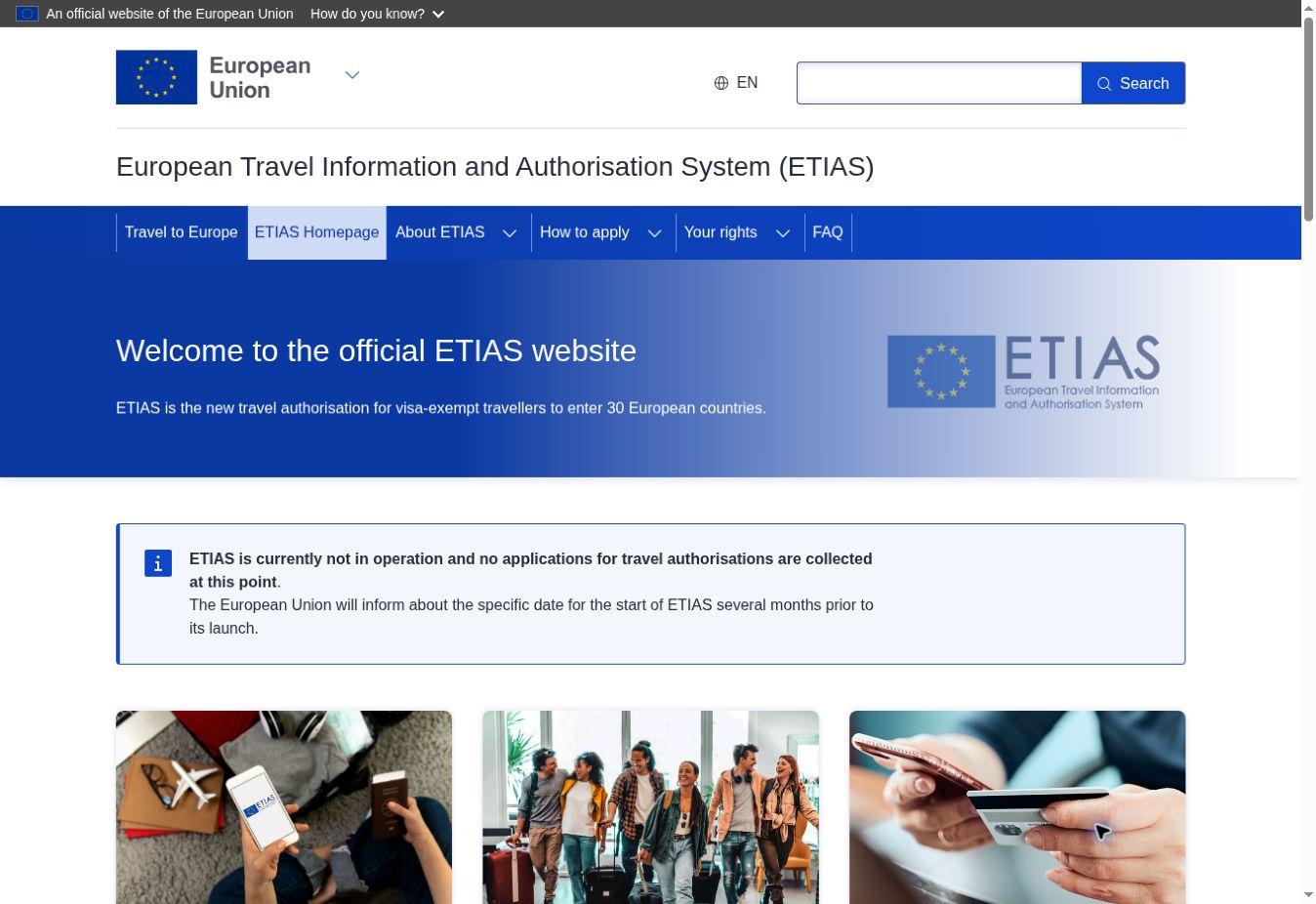
The screenshot shows the public notice observed during this review. The Netherlands government’s ETIAS page independently gives the same status. A website explaining the future process is not evidence that the process has begun.
Why older pages still mention late 2026
Earlier announcements referred to the final quarter of 2026. Some remain online, including dated official news releases. Treat those as historical planning information rather than a confirmed application-opening date. The live operational notice is the relevant check for whether you can apply today.
This article does not substitute a guessed 2027 date for the old target. No specific launch date was confirmed on the live official homepage inspected for this review. Likewise, do not calculate a personal deadline from an unofficial countdown or a travel agent’s provisional estimate.
ETIAS, EES and UK ETA solve different questions
| System | Purpose | Practical distinction |
|---|---|---|
| ETIAS | Future pre-travel authorisation for covered visa-exempt visitors to participating European countries | Not accepting applications at this review date |
| EES | Records covered non-EU short-stay border crossings and relevant biometric information | Border registration is not an ETIAS application |
| UK ETA | A separate permission-to-travel system for eligible visitors to the UK | Does not authorise travel to France, Spain or other ETIAS destinations |
The European Commission’s Smart Borders overview states that EES became fully operational on April 10, 2026, while ETIAS remains unlaunched. Being registered at an EES border kiosk does not mean you have applied for ETIAS.
For the separate problem of calculating remaining short-stay days, use our EES and Schengen 90/180-day guide. An authorisation’s validity and the number of days you may stay are different limits.
Which British and American travellers should prepare?
ETIAS is designed for covered visa-exempt visitors, including ordinary British and U.S. passport holders making eligible short visits. Nationality alone does not resolve every case. Residence documents, long-stay visas, multiple citizenships and special travel documents can change the applicable route.
Check the official Who should apply page for each traveller. Someone who needs a visa should not assume ETIAS will replace it. Conversely, a person covered by an exemption should establish which document demonstrates that status rather than paying an intermediary for an unnecessary application.
Do not infer eligibility from where a journey begins. Flying from London does not make every passenger a British citizen, and living in the United States does not mean every traveller holds a U.S. passport. Review the document actually used for travel.
The announced fee is €20, with exemptions
The official application-preparation page lists a €20 application fee. It exempts applicants under 18 or above 70, and qualifying family members meeting the stated conditions. Fee exemption is different from exemption from needing an authorisation.
The wording matters at age 70: “above 70” should not casually become “70 and over.” Check the live conditions when applications open. Do not use an old €7 figure or an unofficial conversion into pounds or dollars as the amount you must pay.
| Example | Planning implication |
|---|---|
| Two applicants liable for the standard fee | 2 × €20 = €40 in announced application fees |
| A child who needs an authorisation | May be fee-exempt but still requires a separate application |
| A commercial agent quotes a larger total | Separate its service charge from the official fee; no official approval can currently be issued |
The arithmetic is illustrative, not an actual family’s bill. Exemptions must be assessed individually. Do not transmit passport details or payment-card data simply to reserve a place before launch.
What you can prepare without applying
Keep a private checklist for every traveller: nationality and passport used, passport issue and expiry dates, destination, intended dates, relevant residence status, and previous short stays. This avoids treating a family booking as one immigration record.
The EU describes future applications as requesting personal, travel-document, occupation and travel information, together with background questions. Minors’ applications must be handled by someone with the appropriate parental authority or guardianship. Prepare accurate records rather than circulating sensitive information through a group chat.
There is no need to invent a form or rehearse answers on a third-party application site. If your circumstances require clarification, consult the appropriate official authority. A travel agent can explain its services, but cannot make the closed official system issue an authorisation.
Passport validity still matters today
ETIAS being closed does not suspend existing entry conditions. For example, GOV.UK’s France guidance for full British-citizen passports says the passport’s issue date must be less than ten years before arrival and expiry must be at least three months after planned departure from Schengen. Those are two separate checks.
Use the destination’s official requirements for your own document and status. Do not generalise one passport rule to every European territory or special travel document. Depending on the journey, authorities may also request evidence of accommodation, onward travel or sufficient resources.
How future validity and processing are described
The EU’s travel-agent guidance says each traveller needs a separate application, including children. It describes most decisions as taking minutes but some cases as taking up to 30 days. That is not a promise that a particular applicant will be approved before departure.
Authorisations are planned to last up to three years or until the passport used expires, whichever comes first. A long validity period does not grant three years of residence. When applications open, follow the live instructions concerning passport changes and travel with the document linked to the authorisation.
Read any launch transition or grace-period rules when dates are officially announced. Do not assume a proposed transition means every traveller can ignore the requirement for an extra year.
Cyprus and Ireland: two itinerary traps
The official ETIAS guidance treats Cyprus’s permitted-stay calculation separately from the other participating countries. Do not combine a Cyprus visit with Schengen days as though all European travel shared a single clock.
Ireland and the UK are not ETIAS destinations. Their entry requirements remain separate. For UK travel, GOV.UK explains ETA exemptions, including British and Irish citizens. An American visitor’s London–Paris itinerary therefore needs separate checks for each destination, not one generic “Europe visa” search.
A practical itinerary worksheet
| Journey | Check now | Check again before departure |
|---|---|---|
| British passport: UK to France | Passport validity, current entry rules, previous Schengen days | Official ETIAS status and any newly announced applicable requirements |
| U.S. passport: United States to London, then Paris | UK permission-to-travel requirements separately from France | Both governments’ current rules and the EU operational notice |
| Schengen visit followed by Cyprus | Each destination’s rules and separate stay calculations | Authorisation scope and documentary requirements for each leg |
| Family with different nationalities or residence documents | Each person’s passport and immigration status | Individual exemptions and requirements, rather than a household assumption |
These are hypothetical itineraries, not eligibility decisions. Record the official page and the date you checked it. Reopen the page before travel: a saved screenshot documents an earlier status but cannot establish that the rules remained unchanged.
Recognising unofficial applications and misleading promises
The EU has warned about unofficial ETIAS websites. Some commercial intermediaries may legitimately apply on someone’s behalf once the system launches, but that does not make them official or able to issue an authorisation today.
- Start with the official EU site rather than a sponsored result labelled “apply now.”
- Inspect the actual domain, not just a flag, logo or the letters “EU” in a page title.
- Separate a mailing-list subscription from an official application.
- Do not accept a paid “guaranteed approval,” priority slot or pre-launch certificate as government permission.
- If you already entered payment details on a suspected fraudulent page, contact your card issuer promptly through a trusted channel.
Keep a copy of what you were offered and paid for. A receipt proves a transaction with a seller; it does not prove that the EU accepted an application. If a business supplied information or a future service rather than an authorisation, describe that accurately when asking it or your payment provider to review the transaction.
A message to clarify a travel agent’s request
The official ETIAS website currently says applications are not being collected. Please clarify whether your request concerns ETIAS, EES, a visa, or a separate UK ETA. Please provide the official rule that applies to my passport and itinerary, and distinguish any service charge from a government application fee. I do not authorise an ETIAS application or payment while the official system is closed.
Adapt this wording to your situation. If you already agreed to a separate service, review that agreement rather than assuming the same message cancels it. Do not include passport scans, card details or authentication codes in an ordinary enquiry unless an independently verified process actually requires them.
Last verified October 26, 2026. The official status screenshot was captured during this review. No application, account registration or payment was performed. This article’s focus is whether ETIAS is open and how to prepare; it does not replace destination-specific entry advice or the separate calculation of permitted stay.
You may also like
 Technology & How-To
NHS App Prescription Not Showing? Check GP Approval, Pharmacy Status and Tracking
Find out why a prescription or medicine is missing from the NHS App in England. Separate repeat requests,…
 Technology & How-To
Google Wallet Not Working After Switching Phones? Fix Card Setup and Tap to Pay
Google Wallet transferred but tap to pay fails? Separate card verification, bank approval, NFC, screen lock and device…
 Technology & How-To
iCloud Family Sharing Not Working? Why You Still See 5GB and How to Fix It
Still seeing 5GB after joining an iCloud family plan? Check the account, invitation, sharing settings, personal plan and…