
Fruit-Eating Dinosaur Discovered: How Infernogallus jamesi Changed Dinosaur Diets
A 2026 fossil discovery reveals a dinosaur with parrot-like jaws built for soft fruit. Explore the real skull, CT evidence and what researchers still cannot prove.
Contents
- What exactly was discovered?
- See the actual fossil before looking at any life reconstruction
- The four clues that point toward a fruit-rich diet
- The roof of its mouth was unlike that of typical predatory theropods
- Its lower jaw could probably move forward and backward
- Opposing ridges and grooves could process soft material
- Parrots provide a useful evolutionary comparison
- How the scientists reconstructed an ancient meal from bones
- What the evidence proves — and what it does not
- Why the words "first fruit-eating dinosaur" need context
- What might this animal actually have eaten?
- A surprising connection to flowering plants
- Did Infernogallus spread seeds across Cretaceous forests?
- Why a nearly complete skull mattered more than another isolated bone
- What could future discoveries do to strengthen — or challenge — the theory?
- How did it live alongside T. rex and Triceratops?
- The key takeaway
- Primary research and original fossil images
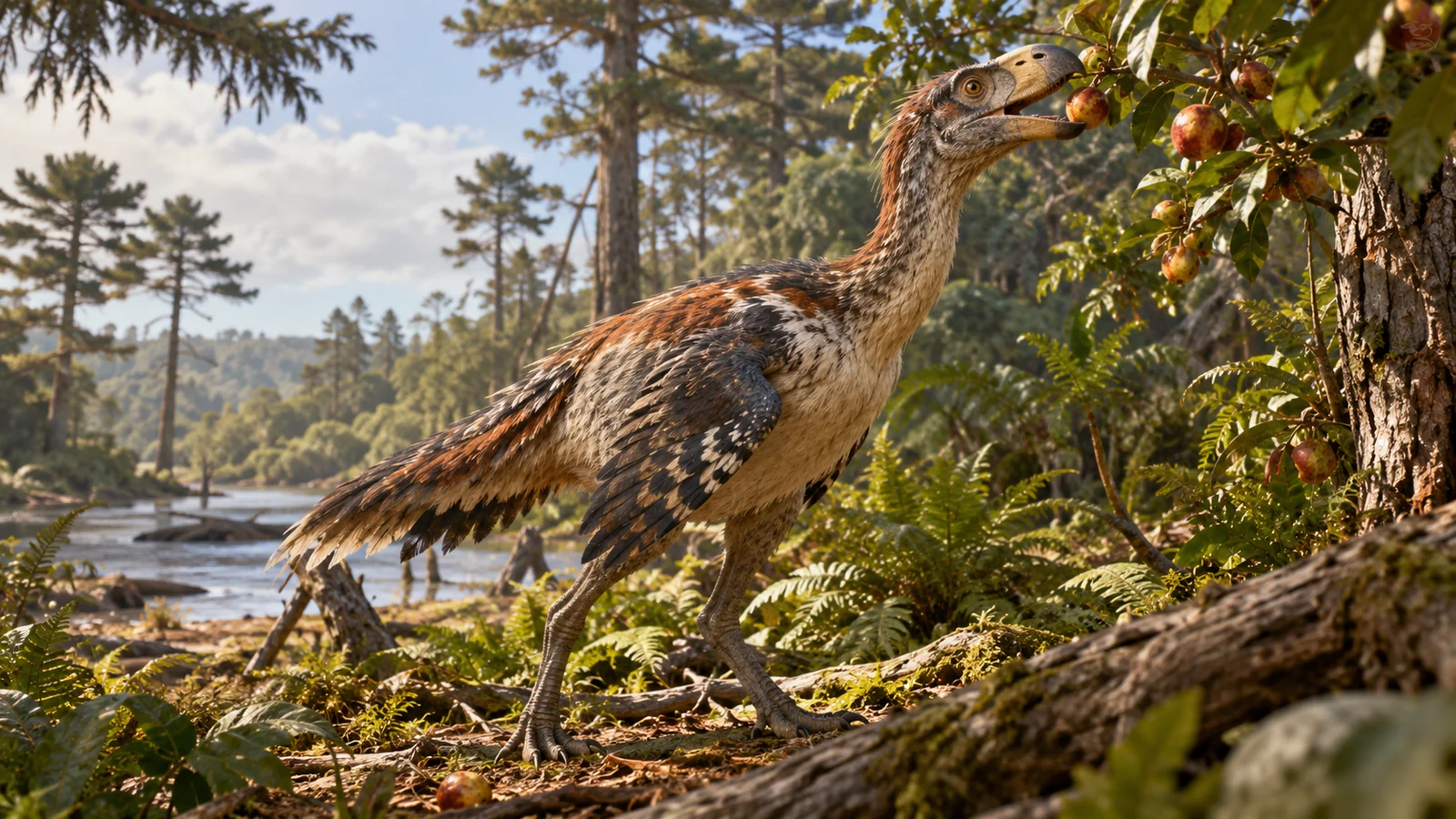
A small, toothless dinosaur from North America’s famous Hell Creek Formation is giving scientists a surprisingly detailed clue about what some dinosaurs ate: soft, fleshy fruit. In a peer-reviewed study published in Nature Communications on October 10, 2026, researchers described Infernogallus jamesi, a turkey-sized relative of oviraptorosaurs whose skull was unusually well adapted for moving food around and crushing it inside the mouth.
The evidence is striking, but it is important to describe it correctly. Scientists did not recover a fossilized cherry or peach from this animal’s stomach. Instead, they reconstructed its palate, jaw joints and likely chewing muscles and found a combination of features that resembles adaptations in certain modern fruit-eating parrots. The best-supported interpretation is that it was a highly specialized plant eater, probably consuming a substantial quantity of fleshy fruits alongside other soft plant material. Read the original study.
That distinction makes this discovery more interesting, not less. It allows us to follow how paleontologists work backward from physical evidence to a plausible ancient behavior — and where the remaining uncertainties lie.
What exactly was discovered?
Infernogallus jamesi is a newly described small theropod from the late part of the Cretaceous Period. It belonged to the Caenagnathidae, a family within the oviraptorosaur group. Unlike the giant carnivores that usually dominate dinosaur headlines, these animals had relatively light bodies and toothless beaks. The research team estimated Infernogallus at roughly 12 kilograms (about 26 pounds), around the mass of a large turkey. The animal lived near the end of the age of non-avian dinosaurs, approximately 66 million years ago. Stony Brook University’s research announcement provides the institutional context.
The crucial material includes a nearly complete, articulated skull, associated skeletal remains, and comparative jaw material. An articulated skull is especially valuable because many bones have survived close to their natural positions. Skull material from caenagnathids had long been fragmentary, making researchers uncertain how the roof of the mouth, jaw joint and major muscles worked together. Infernogallus gave them the anatomical evidence that previous partial finds could not.
Its fossil was discovered in the Hell Creek Formation, a geological unit in the western United States known for animals such as Tyrannosaurus rex and Triceratops. The key specimen was found in 2011, but the careful preparation, digital reconstruction, comparisons and eventual scientific description took years. The new species was formally reported in 2026; it was not a dinosaur that suddenly appeared in the ground this month.
The name Infernogallus means roughly "hell chicken," referring to Hell Creek and the birdlike form. The species name jamesi honors James William Boyd, according to the researchers’ published explanation. Despite the nickname, it was neither an ordinary chicken nor a newly discovered ancestor of modern chickens. It was a non-avian dinosaur on a different branch of the broader theropod family tree.
See the actual fossil before looking at any life reconstruction
To understand the discovery, start with the real evidence. The researchers’ published anatomical plates show the fossil skull, a line drawing, and digitally separated bones; other figures illustrate the lower jaw’s proposed motion. Those images are not photographs of a living dinosaur, and their bright colors often represent different bones in a CT reconstruction, not the animal’s original skin or feathers.
- Original skull fossil, drawings and CT views — scientific figure.png)
- Researchers’ reconstruction of how the jaw could move.png)
- Holotype skeleton and growth-section figure.png)
All three links lead to actual published scientific material hosted on Wikimedia Commons under Creative Commons Attribution 4.0, with author information and a link back to the paper. These are the images to consult when evaluating anatomical claims. Artistic depictions of its color, plumage or surroundings are interpretive, not direct fossil evidence.
The four clues that point toward a fruit-rich diet
The roof of its mouth was unlike that of typical predatory theropods
The palate is the set of bones forming the roof of the mouth. CT scans of the specimen revealed an unusually shaped palate that extended downward into the oral cavity. This is important because it helps determine the paths and angles of muscles connecting the skull and lower jaw. Different arrangements can make different movements mechanically advantageous.
Rather than describing the skull as merely "birdlike," the study investigated how specific bones fitted together. The researchers found that Infernogallus showed major reorganization of the muscles that close the jaws. Its anatomy would not have functioned like the powerful predominantly vertical biting system usually imagined for a predatory theropod such as T. rex.
Its lower jaw could probably move forward and backward
Most readers picture dinosaur jaws working like a hinged trap: open, close, repeat. The proposed motion for Infernogallus was more complex. The geometry of its skull and jaw allowed the researchers to model an anteroposterior movement — essentially a front-to-back slide of the lower jaw during food processing.
That does not mean it chewed in exactly the same way as a human, nor does it mean it had mammal-like teeth. It had a beak. The comparison helps us visualize a multi-stage chewing stroke instead of a simple vertical snap. Muscles inferred from bone attachment sites, paired with the surfaces that meet during jaw motion, help explain how the movement may have worked.
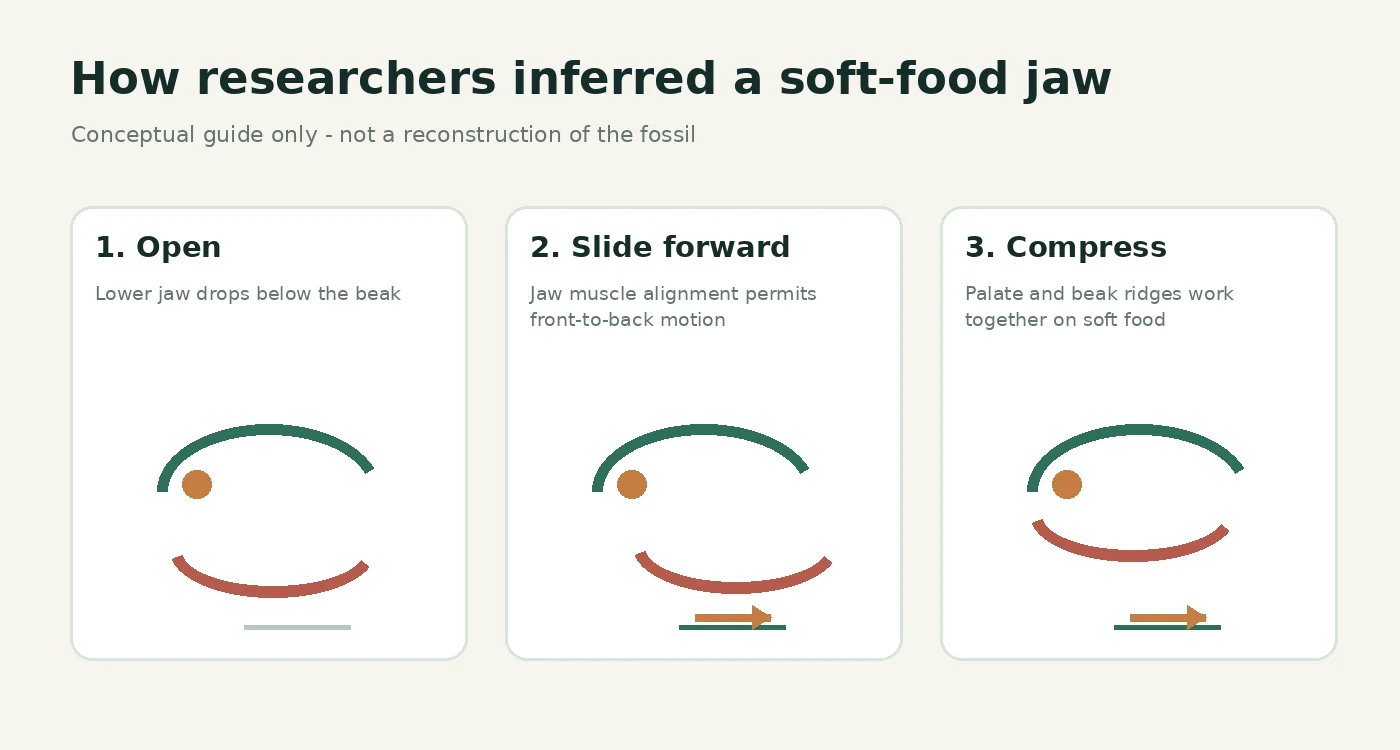
A useful mental picture is a small mortar and pestle. The mouth could manipulate something relatively soft against opposing structures. It did not need to pulverize a large bone or tear through thick hide. The surfaces would have helped mash, reposition or strip food before swallowing. This is a functional interpretation supported by the anatomy; the researchers did not observe a living animal making these movements.
Opposing ridges and grooves could process soft material
The study also describes contact between specialized ridges and grooves on the beak and elements of the palate. Instead of acting like sharp teeth, these surfaces could have worked together when the jaws moved, concentrating pressure on food held between them.
A fleshy fruit is a plausible target because it is soft enough to compress but often contains a firmer center. The dinosaur might have handled the pulp around a hard pit rather than crushing the pit itself. A similar mechanical problem is encountered by animals that eat drupes — fruits characterized by fleshy outer tissue surrounding a hard internal stone. Cherries and peaches are accessible modern examples of this fruit structure, not a verified list of plant species growing at the fossil site.
Parrots provide a useful evolutionary comparison
The researchers compared its head to a range of living beaked animals. Some highly fruit-specialized parrots, including the vulturine parrot, show strikingly similar functional arrangements despite being separated by a very long evolutionary history.
This is an example of convergent evolution: unrelated or distantly related lineages may arrive at similar solutions when facing comparable feeding challenges. Importantly, a parrot analogy is not a family-tree shortcut. Infernogallus was not simply a modern parrot pushed backward in time; the analogy is about what its skull might have been capable of doing.
How the scientists reconstructed an ancient meal from bones
A fossil can preserve hard anatomy far more readily than fleeting behaviors. The research team’s logic moved through several stages, each with a different level of confidence.
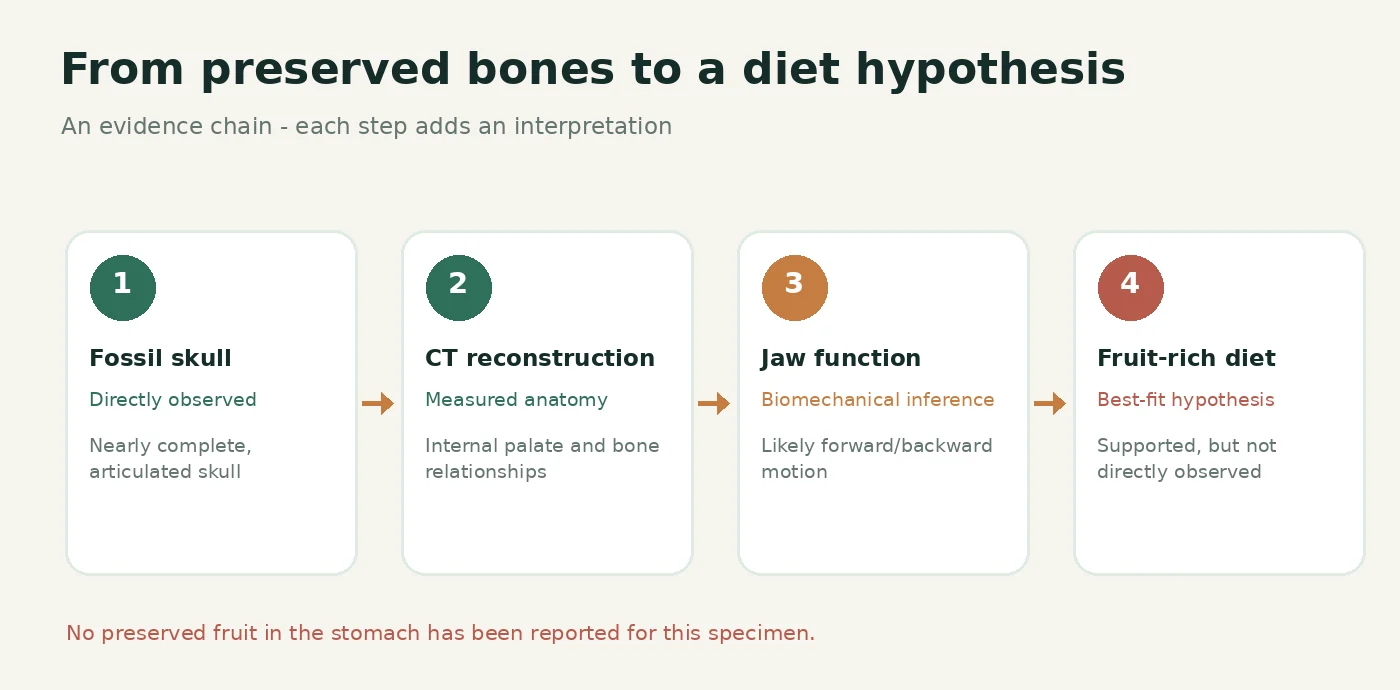
The process is worth examining carefully because many headlines skip the steps between "a fossil was discovered" and "scientists know what it ate."
- Step 1 — Establish the specimen: identify the preserved bones, their positions, their geological context and which parts are broken or distorted.
- Step 2 — Scan the skull: use computed tomography to see overlapping structures and build a three-dimensional model of bones that cannot be isolated safely by hand.
- Step 3 — Reconstruct the joint: determine how the lower jaw could move relative to the skull while keeping contact surfaces anatomically plausible.
- Step 4 — Estimate muscle action: infer muscle pathways from skeletal landmarks, compare them with those in living animals, and model likely chewing mechanics.
- Step 5 — Test functional analogies: compare the reconstructed mechanism with feeding specializations seen in existing birds and other beaked vertebrates.
- Step 6 — Assess possible foods: ask whether softer plant tissue, fruits, hard seeds, animal prey or a broader mixed diet best fits the combined evidence.
This sequence is not the same as watching a feeding experiment. Bones can make some behaviors more likely and others mechanically awkward, but anatomical potential is not identical to documented historical behavior. Even a convincing model of jaw motion is an inference supported by physical structures, not a recording of the dinosaur eating.
What the evidence proves — and what it does not
The following short table separates the preserved facts from the scientists’ interpretation. This is particularly useful when the discovery is summarized as the first dinosaur ever to eat fruit.
| Claim | What supports it | How certain? |
|---|---|---|
| This animal had an unusual palate and nearly complete skull | Preserved fossil and CT reconstruction | Direct anatomical evidence |
| Its jaw could slide forward and backward | Joint geometry and modeled muscle action | Strong functional inference |
| It ate significant amounts of fleshy fruit | Jaw mechanics and analogy with living fruit-eaters | Leading dietary hypothesis; no preserved meal |
| It transported seeds and shaped fruit evolution | Ecologically plausible timing and comparisons | Possible, but not demonstrated |
The most defensible wording is therefore that Infernogallus jamesi provides some of the strongest reported anatomical evidence for a specialized fruit-rich diet in a non-avian dinosaur. It is more than a guess about what happened to be growing nearby, but it is not a fossilized menu.
Why the words "first fruit-eating dinosaur" need context
There are two different uses of the word "first" in this story. The animal lived about 66 million years ago, and it is not being presented as the first dinosaur ever to have encountered a piece of fruit. The discovery is instead presented as an unusually clear scientific case for specialized fruit eating among non-avian dinosaurs.
Also, modern birds are living dinosaurs in evolutionary classification, and many birds eat fruit. So a literal claim that this is the first dinosaur of any kind ever known to eat fruit ignores living birds and the wider evolutionary history of avian diets. The significant advance is the combination of a largely complete non-avian skull and a distinctive jaw mechanism that researchers can compare with fruit-eating species.
There is an additional nuance: the research does not require every caenagnathid to have had an identical diet. A small animal adapted for mashing soft material might have eaten very different foods from a much larger relative. Inferring the behavior of an entire diverse dinosaur group from a single unusually informative species would overreach the evidence.
What might this animal actually have eaten?
The study’s leading hypothesis is that fleshy fruits made up a substantial portion of its food. But soft leaves, flowers and other tender plant tissues could have been consumed as well. The presence of a food-processing adaptation does not measure exact proportions of the diet, identify fruit species, or establish what it ate in every season.
Imagine a humid Late Cretaceous floodplain with fruiting plants producing many kinds of small and medium-sized fleshy structures. In that kind of environment, a toothless beak capable of manipulating fruit could offer an advantage. This is an ecological reconstruction based on geology and fossil plants, not proof of a particular tree, branch or fruit appearing next to the studied skeleton.
The familiar names "cherries" and "peaches" are comparisons to the shape and structure of modern drupes. They should not be read as a claim that the modern supermarket versions of those fruits were present in precisely the same form 66 million years ago. Plant lineages and their fruits have also evolved over time.
Would it have swallowed stones to grind food internally? The study and accompanying research coverage discuss the absence of the usual evidence for gastroliths in the examined caenagnathid material. That absence fits the idea that at least some food processing happened in the mouth. But the lack of preserved stones is supporting context, not a standalone test proving that every member of the species always processed food one way.
A surprising connection to flowering plants
The bigger evolutionary question is not simply what one dinosaur ate. It is whether certain dinosaurs and flowering plants (angiosperms) influenced one another as fleshy fruits became more widespread and diverse during the Cretaceous.
Early flowering plants existed long before the final dinosaurs of Hell Creek. Through the Cretaceous, angiosperms diversified and occupied many terrestrial environments. Some evolved fleshy fruits and increasingly varied seed packages. An animal capable of efficiently processing them might have gained a dependable food resource — and the plants might, in turn, have benefited from animals moving or swallowing their seeds.
This suggests a possible ecological relationship: fruit shapes help determine which animals can feed on them, while animal feeding and movement can affect where seeds end up. Modern ecosystems offer many examples of fruit-eating birds and mammals transporting seeds, but the ancient version needs its own evidence.
The study’s authors are careful here. The timing of the rise of fruit and the diversification of caenagnathids is intriguing. Coincident timing is not proof of coevolution. Demonstrating mutual evolutionary influence would require more than an overlapping fossil record and a compatible jaw mechanism.
Did Infernogallus spread seeds across Cretaceous forests?
Possibly, but researchers have not demonstrated that it did. There is a crucial difference between eating fruit and dispersing viable seeds. An animal might swallow the pulp but destroy the seed, drop the stone near the parent plant, carry it a distance, or pass it intact through its digestive tract. Those possibilities have very different effects on plant reproduction.
A convincing seed-dispersal case would need some evidence about the fate of seeds — perhaps unusually preserved intestinal contents, associated seeds that could be linked to the animal, or stronger ecological and comparative data. The available skull anatomy does not reveal whether a particular seed survived digestion or how far the animal traveled after a meal.
This is why language such as "dinosaurs created modern fruit" would be unjustified. The discovery strengthens the plausibility of a missing ecological link. It does not establish that these dinosaurs caused fruit to evolve or that any specific flowering plant depended on them.
Why a nearly complete skull mattered more than another isolated bone
For decades, the caenagnathid fossil record left a frustrating gap. Isolated jaws, limb bones and incomplete skull pieces reveal that a dinosaur existed and sometimes tell us about size or growth. But they are less useful for reconstructing how multiple connected parts of a feeding mechanism interacted.
The Infernogallus skull allowed researchers to examine the top of the mouth, lower-jaw contact and surrounding cranial architecture as a coordinated system. CT imaging was particularly useful because apparently damaged or inaccessible surfaces could be visualized without physically destroying the fossil. Reconstructing distorted bones digitally remains interpretive, but it is much more constrained when the original specimen retains much of its anatomical arrangement.
The team could also place those features alongside skeletal material and bone histology, which provided evidence of maturity. This matters because a small dinosaur is not necessarily a juvenile of a larger species. Identifying a small, mature individual helps researchers distinguish a genuinely small-bodied species from a juvenile growth stage that might have very different anatomical proportions.
Scientists cannot infer its exact feather pattern or colors from the jaws. Any full-body painting or generated reconstruction, including the illustrative cover accompanying this article, should be treated as an interpretation of anatomy and environment rather than a photograph or a complete record of soft tissues.
What could future discoveries do to strengthen — or challenge — the theory?
One advantage of a scientific hypothesis is that it makes predictions other researchers can investigate. The fruit-specialist explanation is strongest if independent evidence consistently points in the same direction. The following questions would be especially useful:
- Preserved stomach contents: Would an exceptionally preserved individual contain seeds or plant matter? Finding recognizable fruit tissues would provide more direct dietary evidence than skeletal similarity alone.
- Microscopic wear patterns: Could repeated contact with particular kinds of food leave distinctive marks on the beak surfaces? Comparative studies would need to distinguish food wear from damage after burial.
- Additional skulls: Do other mature individuals show the same anatomy, or could some features reflect preservation, individual variation or an unusual specimen?
- Mechanical testing: Do detailed computer or physical models support the proposed forward-back chewing cycle under realistic muscle constraints?
- Plant-fossil context: Were likely fleshy fruit types common in the same places and layers where the dinosaurs lived? Geological association alone would not establish consumption, but it could make a dietary model more or less plausible.
- Other caenagnathids: Do larger and smaller relatives show related adaptations? Any differences could reveal whether fruit specialization was widespread, restricted, or evolved more than once.
A finding of direct evidence for another kind of diet would not necessarily erase the anatomical work. It could show that specialized jaws were used more flexibly than expected. That distinction — between confirming a structure and interpreting its purpose — is central to good paleontology.
How did it live alongside T. rex and Triceratops?
The Hell Creek ecosystem included enormous predators, large herbivores and many smaller animals that rarely receive the same attention. Infernogallus appears to have occupied a different feeding niche from both the giant meat-eaters and the bulky plant-eating dinosaurs. In broad ecological terms, a small, mobile animal selecting soft plant foods could exploit resources that were not the primary target of a giant bone-crushing predator or a broad-grazing herbivore.
That does not tell us where it slept, whether it lived alone or in groups, how quickly it ran, or what predator killed an individual. Those behaviors require separate evidence. Nor is it possible to turn a specimen’s near-extinction age into a claim about exactly why its species disappeared. The end-Cretaceous ecological crisis approximately 66 million years ago reshaped terrestrial life, but a single fossil cannot show the species’ exact final days.
For the wider extinction context, see our related explanation of what a recent fossil model can and cannot tell us about the Big Five mass extinctions. For a separate example of why fragmentary dinosaur fossils can change classification decades later, see the new British megaraptoran discovery.
The key takeaway
Infernogallus jamesi matters because its nearly complete skull makes a rare kind of scientific argument possible. The research connects preserved bone anatomy, CT reconstruction, muscle mechanics and comparisons with fruit-specialized modern birds into a coherent explanation for a dinosaur that probably processed soft fruit inside its beak.
The conclusion is stronger than the casual claim that a dinosaur might have eaten whatever plants were nearby. Yet the distinction between preserved anatomy, modeled jaw movement, likely diet, and unproven ecological effects must be maintained. Scientists have uncovered a compelling candidate for specialized fruit eating, not a fossilized lunch or proof that the animal spread the seeds of modern fruits.
The finding adds a new feeding strategy to the world of T. rex and opens a larger question: how many other dinosaur-plant relationships are still invisible because the right fossils have not yet been found?
Primary research and original fossil images
- Funston and colleagues, Fruit-eating adaptations in a Late Cretaceous oviraptorosaur (Theropoda), Nature Communications (October 10, 2026) — original peer-reviewed research, DOI: 10.1038/s41467-026-78343-w.
- Stony Brook University research release (October 28, 2026) — researchers and original discovery context.
- Royal Ontario Museum’s discovery report (October 28, 2026) — museum reporting on the fossil, jaw mechanism and evolutionary significance.
- Actual fossil skull and CT reconstructions.png) and scientific jaw-motion figure.png) — original scientific illustrations by the research team, CC BY 4.0 as attributed on their file pages.
The header artwork and the explanatory diagrams in this article are conceptual illustrations, not fossil photographs. For direct anatomical evidence, use the linked scientific figures. No claim is made that any color pattern or fruit shown in an artistic reconstruction is known from the specimen.
You may also like
 Science & Discoveries
Climate Prediction Center Heavy Snow Map: November Outlook
Read NOAA’s November heavy-snow outlook, see the mountain areas at risk, understand the map’s limits, and find local…
 Science & Discoveries
UK November Cold Snap: What the Met Office Forecast Says
What the Met Office forecast says about the UK November cold snap, possible northern wintry showers, frost and…
 Science & Discoveries
Altermagnetism Explained: What the New Evidence Shows
What is altermagnetism? Understand the new MnTe experiment, how it differs from other magnetic orders, and what the…