
How to Calculate Pipe Volume in Liters and Gallons: Formulas, Charts and Examples
Calculate how much water a pipe holds using inside diameter and length. Learn metric and US formulas, liters per meter, US vs imperial gallons, and worked PVC pipe examples.
Contents
- What does pipe volume mean?
- The basic pipe volume formula
- Formula using inside diameter in millimeters and length in meters
- Formula using diameter and length both in meters
- Formula in inches and feet for US gallons
- Convert pipe capacity into liters, US gallons, and UK imperial gallons
- Simple conversion example
- How to measure the correct pipe diameter
- Why a 2-inch pipe is not necessarily 2 inches inside
- Pipe volume chart: liters per meter for common internal diameters
- Worked example 1: 50 mm inside diameter over 10 meters
- Worked example 2: a 2-inch Schedule 40 PVC pipe, 30 feet long
- Worked example 3: several pipe lengths with different diameters
- How to account for fittings and valves
- Worked example 4: calculate from outside diameter and wall thickness
- What changes if the pipe is not completely full?
- Horizontal circular pipe: calculate a partially filled segment
- Full, empty, and half-full are different operating states
- How to calculate pipe water volume for filling, flushing, or draining
- If the fluid is not water
- Common mistakes that make pipe-volume estimates wrong
- Use the Horus Pipe Volume Calculator
- Quick pipe volume calculation checklist
- References and data sources
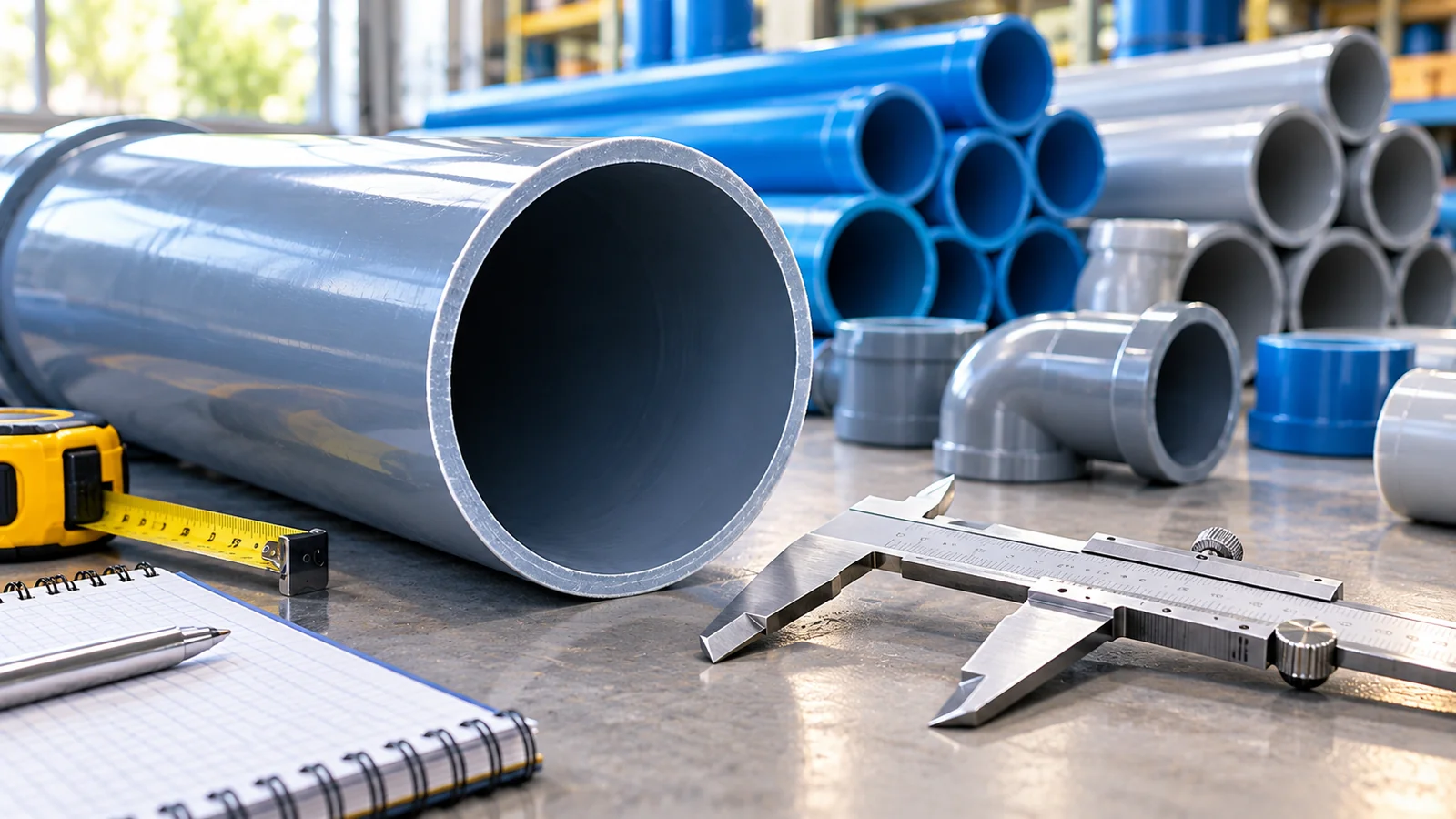
If you need to know how much water a pipe holds, the key measurements are its actual inside diameter and the length of the pipe. Multiply its internal circular area by its length, then convert the result into liters or gallons. The calculation is straightforward, but using the outside diameter, the nominal pipe size, or the wrong kind of gallon can give a surprisingly inaccurate answer.
This practical guide explains how to calculate pipe volume in liters and gallons for plumbing, irrigation, heating, water treatment, and general project planning. It includes metric and US-unit formulas, checked examples, pipe-size reference values, a capacity-per-meter chart, multi-section calculations, and an explanation of when simple geometry is not enough.
Quick answer: For a completely filled, straight, circular pipe, volume in liters = 0.000785398 × (inside diameter in mm)² × length in meters. Divide the result by 3.785411784 for US liquid gallons, or by 4.54609 for UK imperial gallons. A pipe with a true 50 mm inside diameter and a 10 m internal length holds approximately 19.63 liters = 5.19 US gallons = 4.32 imperial gallons.
What does pipe volume mean?
Pipe volume, also called internal capacity or contained volume, is the amount of space inside a pipe. For a full, round pipe, that space has the shape of a long cylinder. Capacity describes how much fluid the pipe could hold when full; it does not, by itself, describe how quickly water will flow through the pipe.
- Capacity: liters, US gallons, imperial gallons, cubic meters, or cubic feet stored in a stated length of pipe.
- Flow rate: liters per minute, cubic meters per hour, or gallons per minute moving through a cross-section.
- Nominal pipe size: a designation used to identify pipe products, which may not equal the measurable internal bore.
- Actual fill volume: water already present in a pipe, which may be less than its full internal capacity.
These distinctions matter if you are calculating a system fill, antifreeze mixture, flushing volume, irrigation-line hold-up, or water used during a maintenance procedure. For pressure, pump selection, and flow loss, a volume calculation is only one part of the analysis.
The basic pipe volume formula
The internal cross-section of a round pipe is a circle. Its area is π × radius². Multiplying by the internal length gives the volume of the cylinder. Since the radius is half the diameter, there are two equivalent forms:
Volume = π × (inside radius)² × pipe length Volume = (π / 4) × (inside diameter)² × pipe lengthUse π ≈ 3.141592654. The diameter, radius, and length must use compatible linear units before multiplication. Cubing a length unit produces a volume unit: meters give cubic meters, inches give cubic inches, and feet give cubic feet.
Formula using inside diameter in millimeters and length in meters
A convenient shortcut avoids separately converting the millimeters to meters. For inside diameter d in millimeters and length L in meters:
Capacity (liters) = π × d² × L / 4000 Capacity (liters) ≈ 0.0007853981634 × d² × L Liters per meter ≈ 0.0007853981634 × d²The factor 1/4000 comes from the circular-area formula and the conversion from cubic millimeters to liters. Do not use this shortcut if d is in centimeters or inches; those units require different constants.
Formula using diameter and length both in meters
Volume (m³) = (π / 4) × [inside diameter (m)]² × length (m) Volume (liters) = Volume (m³) × 1000If the entire pipe run is represented in meters, this is usually the easiest formula to audit. The conversion between cubic meters and liters is 1 m³ = 1000 L, as shown in the NIST unit-conversion tables.
Formula in inches and feet for US gallons
For projects measured in US customary units, measure the inside diameter in inches and the internal pipe length in feet. Each foot contains 12 inches, while one US liquid gallon contains exactly 231 cubic inches.
US gallons = (π / 4) × [inside diameter (in)]² × [length (ft) × 12] / 231 US gallons ≈ 0.0407999 × [inside diameter (in)]² × length (ft)If you first calculate cubic inches, divide by 231 to obtain US liquid gallons. NIST lists the US gallon as 3.785411784 liters. The factor above is not the formula for UK imperial gallons. NIST Handbook 130 records the exact US conversion.
Convert pipe capacity into liters, US gallons, and UK imperial gallons
The word gallon is ambiguous. US homeowners and irrigation suppliers normally mean the US liquid gallon; some British and Commonwealth references use the larger imperial gallon. A label of “10 gallons” without a specified system can therefore be misleading.
| Unit | Equivalent in liters | To convert liters into this unit |
|---|---|---|
| 1 liter | 1 L | L ÷ 1 |
| 1 US liquid gallon | 3.785411784 L | L ÷ 3.785411784 |
| 1 UK imperial gallon | 4.54609 L | L ÷ 4.54609 |
| 1 cubic meter | 1000 L | L ÷ 1000 |
| 1 US cubic foot | ≈ 28.31685 L | L ÷ 28.31685 |
Conversion factors are from NIST Guide to the SI and NIST Handbook 130. The UK imperial gallon is approximately 20.1% larger than the US gallon, so an identical pipe has a smaller numerical capacity in imperial gallons.
Simple conversion example
Suppose your pipe holds 75 liters. The capacity is 75 ÷ 3.785411784 ≈ 19.81 US gallons, or 75 ÷ 4.54609 ≈ 16.50 imperial gallons. Do not mix the two units when estimating chemical doses, tanks, or plumbing-system fill volumes.
How to measure the correct pipe diameter
Most serious pipe-volume errors start before the formula: someone enters the number printed on the pipe as though it were its inner diameter. In reality, nominal pipe size (NPS) and the actual bore can differ. Wall thickness varies by pipe standard, schedule, dimension ratio, material, pressure class, lining, and manufacturing tolerance.
- Best option: obtain the actual inside diameter from the exact manufacturer’s dimensional table for the installed product.
- Accessible open end: measure the inside opening carefully with inside-caliper jaws, at more than one orientation if the pipe may be out of round.
- Known outside diameter and wall: estimate inside diameter by subtracting two wall thicknesses from the outside diameter. Confirm that the thickness data apply to the pipe you have.
- Already installed or buried: use as-built drawings, product markings, purchase records, or a qualified inspection rather than removing a fitting merely to make a measurement.
Inside diameter (ID) = Outside diameter (OD) − 2 × wall thickness Example: OD 60.3 mm, wall 3.9 mm → ID = 60.3 − 7.8 = 52.5 mmThe Plastics Pipe Institute handbook explicitly describes determining the flow diameter of outside-diameter-controlled pipe by deducting twice the wall thickness. This is a dimensional calculation, not a substitute for product tolerances, internal liners, fittings, or restrictions.
Why a 2-inch pipe is not necessarily 2 inches inside
For one manufacturer’s ASTM D1785 2-inch Schedule 40 PVC pressure pipe, the published table lists an outside diameter of 2.375 inches and a nominal inside diameter of 2.067 inches. By comparison, a different pipe schedule or material can have a different opening. Those values are not universal for every product sold as “2-inch pipe.” See Charlotte Pipe, Plastics Product Knowledge Guide, PVC Schedule 40 product data.
| Schedule 40 PVC nominal size | Published nominal ID | Liters per 1 m of pipe |
|---|---|---|
| ½ in | 0.622 in | 0.049 L |
| ¾ in | 0.824 in | 0.086 L |
| 1 in | 1.049 in | 0.139 L |
| 1½ in | 1.610 in | 0.328 L |
| 2 in | 2.067 in | 0.541 L |
| 3 in | 3.068 in | 1.192 L |
| 4 in | 4.026 in | 2.053 L |
Important: These entries use a specific manufacturer’s nominal bore values and a perfect-cylinder model. The actual supplied length, pipe tolerance, deposits, liners, and fittings can alter the real volume. Do not combine values from a Schedule 40 chart with Schedule 80 pipe or metric outside-diameter pipe.
Pipe volume chart: liters per meter for common internal diameters
For planning, this table shows the theoretical water content of a completely full, round pipe per meter of run. The first column is the measured or specified inside diameter, not a retail nominal designation. Multiply the per-meter capacity by the pipe length to estimate the total.
| Actual inside diameter | Liters per meter | US gallons per meter | Imperial gallons per meter |
|---|---|---|---|
| 10 mm | 0.079 L/m | 0.021 US gal/m | 0.017 imp gal/m |
| 15 mm | 0.177 L/m | 0.047 US gal/m | 0.039 imp gal/m |
| 20 mm | 0.314 L/m | 0.083 US gal/m | 0.069 imp gal/m |
| 25 mm | 0.491 L/m | 0.130 US gal/m | 0.108 imp gal/m |
| 32 mm | 0.804 L/m | 0.212 US gal/m | 0.177 imp gal/m |
| 40 mm | 1.257 L/m | 0.332 US gal/m | 0.276 imp gal/m |
| 50 mm | 1.963 L/m | 0.519 US gal/m | 0.432 imp gal/m |
| 63 mm | 3.117 L/m | 0.823 US gal/m | 0.686 imp gal/m |
| 75 mm | 4.418 L/m | 1.167 US gal/m | 0.972 imp gal/m |
| 80 mm | 5.027 L/m | 1.328 US gal/m | 1.106 imp gal/m |
| 100 mm | 7.854 L/m | 2.075 US gal/m | 1.728 imp gal/m |
| 110 mm | 9.503 L/m | 2.511 US gal/m | 2.090 imp gal/m |
| 150 mm | 17.671 L/m | 4.668 US gal/m | 3.887 imp gal/m |
| 200 mm | 31.416 L/m | 8.299 US gal/m | 6.911 imp gal/m |
For example, a 25 mm ID pipe holds about 0.491 L/m, while a 50 mm ID pipe holds about 1.963 L/m. Doubling the internal diameter approximately quadruples the stored volume for the same length because diameter is squared in the formula.
Worked example 1: 50 mm inside diameter over 10 meters
Imagine a straight section of water line with an actual internal diameter of 50 mm and a wetted length of 10 m. Both units match the metric shortcut.
- Step 1: Square the diameter: 50 × 50 = 2500 mm².
- Step 2: Multiply by length: 2500 × 10 = 25,000.
- Step 3: Multiply by 0.0007853981634 to obtain the full volume in liters.
- Step 4: Convert the liters to either US or imperial gallons if required.
Volume = 0.0007853981634 × 50² × 10 = 19.634954 L ≈ 19.63 L US gallons = 19.634954 / 3.785411784 ≈ 5.19 US gal UK gallons = 19.634954 / 4.54609 ≈ 4.32 imp galThis is the quantity of liquid inside the straight pipe cylinder when full; elbows, tees, valves, tanks, and external hoses are not included. It should not be confused with the amount of water delivered by that pipe over a period of time.
Worked example 2: a 2-inch Schedule 40 PVC pipe, 30 feet long
Here the nominal pipe size alone is insufficient. For this illustrative calculation, take the 2.067-inch nominal inside diameter from the Charlotte Pipe Schedule 40 PVC pressure-pipe data. Assume a clear, full, straight section with an effective length of 30 ft.
- Step 1: Convert the straight length: 30 ft × 12 = 360 inches.
- Step 2: Calculate circular area using 2.067 inches as the actual bore assumption.
- Step 3: Multiply by 360 inches for cubic inches, then divide by 231 for US gallons.
- Step 4: Convert the gallon result to liters and imperial gallons.
US gal = (π / 4) × 2.067² × 360 / 231 ≈ 5.23 US gallons Liters ≈ 5.229514 × 3.785411784 ≈ 19.80 L Imperial gallons ≈ 19.795865 / 4.54609 ≈ 4.35 imp galHad you used 2.000 inches as the inside diameter, the estimate would be lower; the error comes from assuming a nominal designation is a measured bore. For a real installation, check the specific product datasheet, not a generic chart.
Worked example 3: several pipe lengths with different diameters
A plumbing or irrigation network may contain several pipes joined in series. You cannot average their diameters and then use a single total length, because each section contributes volume in proportion to its own squared internal diameter. Calculate each section separately and add the results.
| Pipe section | Actual ID | Length | Calculated full volume |
|---|---|---|---|
| Supply line | 32 mm | 18 m | 14.476 L |
| Branch A | 25 mm | 12 m | 5.890 L |
| Branch B | 20 mm | 9 m | 2.827 L |
| Total pipes only | — | — | 23.194 L |
These three clear sections contain approximately 23.19 liters in total (about 6.13 US gallons or 5.10 imperial gallons). If your layout has five identical branches, calculate one branch and multiply by five. Include only sections that actually fill in the situation you are assessing.
How to account for fittings and valves
Straight-pipe geometry does not automatically include the extra internal space in couplings, tees, elbows, valve cavities, strainers, manifolds, expansion vessels, or equipment. For rough household estimates, these may be minor relative to long runs; for small-diameter industrial dosing or system-flush work, their contribution can be material. Use manufacturer internal-volume specifications where available, or a documented engineering estimate. Do not assume each fitting has exactly the same capacity as an equivalent visible length of pipe.
Worked example 4: calculate from outside diameter and wall thickness
Suppose a pipe has a measured outside diameter of 60.3 mm, a known wall thickness of 3.9 mm, and an effective length of 20 m. First calculate the bore; then calculate the full internal cylinder:
Inside diameter = 60.3 − (2 × 3.9) = 52.5 mm Capacity = 0.0007853981634 × 52.5² × 20 ≈ 43.30 litersThis worked example assumes a uniform wall, a round interior, and consistent dimensions along the length. For corrugated pipe, irregular liners, or nominal wall data with significant manufacturing variation, use the appropriate measured or certified internal cross-section instead.
What changes if the pipe is not completely full?
Every simple pipe-volume formula above calculates full capacity. The actual amount of water in a partially filled horizontal drain or gravity sewer can be substantially lower. Importantly, half of the pipe diameter in water depth does equal half of the circular area for a perfectly horizontal, circular bore, but a water depth of one-quarter of the diameter does not equal one-quarter of the capacity.
Horizontal circular pipe: calculate a partially filled segment
For a horizontal circular pipe carrying a water depth h measured from the invert, the wet cross-section forms a circular segment. If radius r = d/2, its area is:
Wet area A = r² × arccos((r − h) / r) − (r − h) × √(2rh − h²) Partly filled volume = A × pipe length Valid when 0 ≤ h ≤ 2r, using compatible length units.Use this only when the water surface is roughly level and the depth is reasonably uniform along the reach. In sloping gravity flow, bends, surcharging, trapped air, and varied depth can make the simple cylinder-segment approach unsuitable. A pipe that is vertical and partly filled along its length needs a different geometric interpretation: its filled liquid height along the axis becomes the filled cylinder length.
Full, empty, and half-full are different operating states
- Full and vented: the geometric volume approximates the liquid hold-up if air is displaced and the line fills fully.
- Partially full: the wetted cross-sectional area, not just nominal pipe size, determines liquid volume.
- Air pockets or blocked sections: actual water volume may be lower than a full-bore calculation.
- Flexible hose: curvature does not change theoretical capacity if the bore and centerline length remain constant, but kinks and deformation can.
How to calculate pipe water volume for filling, flushing, or draining
Capacity is especially useful when estimating the minimum liquid needed to fill a loop or the volume that could drain from a section. Keep the calculation separate from flow, cleaning requirements, disinfection contact time, and operating constraints. For a simple line with steady, known flow:
Estimated exchange time (minutes) = pipe liquid volume (liters) ÷ flow rate (L/min)For the 30 ft Schedule 40 example above, full volume is roughly 19.80 L. At a hypothetical steady flow of 8 L/min, one geometric pipe volume passes the outlet in roughly 2.47 minutes. That is not proof of complete flushing, perfect mixing, removal of trapped air, or safe disinfection. Real procedures may call for several pipe volumes and specific flow velocities, contact times, and testing.
If the fluid is not water
The internal space in the pipe is calculated in exactly the same way regardless of whether it contains water, glycol solution, oil, or another compatible liquid. But weight and chemical dose depend on fluid density and concentration; do not equate one liter to one kilogram for every fluid. For ordinary room-temperature water, one liter has a mass close to one kilogram as a rough planning approximation, not a universal engineering constant.
For chemicals, hot fluids, pressurized systems, and hazardous service, consult the equipment and chemical manufacturer’s instructions and a suitably qualified engineer. Volume alone does not determine pressure rating, temperature suitability, expansion capacity, or safe handling requirements.
Common mistakes that make pipe-volume estimates wrong
- Entering the outside diameter: it includes the wall, and squaring it amplifies the resulting overestimate.
- Assuming nominal size equals inside diameter: published bore values depend on standard and manufacturer.
- Mixing millimeters, centimeters, and meters: the numeric coefficient changes with the units.
- Confusing US and imperial gallons: they differ by about one-fifth.
- Calculating length from a straight-line distance: the actual centerline route around bends can be longer.
- Counting a branch twice: map the system into disjoint pipe runs before summing capacities.
- Ignoring partial filling, air pockets, or deposits: theoretical capacity is not the same as fluid currently present.
- Treating volume as flow rate: a pipe holding 20 liters does not necessarily deliver 20 liters each minute.
- Using a volume result to select a pump: pump sizing also involves head, friction, fittings, duty point, and velocity.
- Applying unverified material or schedule dimensions: the inside diameter of PVC, HDPE, steel, and copper lines may differ even with similar nominal labels.
Use the Horus Pipe Volume Calculator
For a faster cross-check, use the free Horus Pipe Volume Calculator. It calculates a straight circular pipe’s internal capacity from inside diameter and length, with results in liters and cubic meters. To report US or imperial gallons, use the conversion factors in this article or the Horus Unit Converter.
- Enter the actual bore: use a measured or manufacturer-specified inside diameter rather than a nominal label.
- Enter the actual straight-run or centerline length: choose units carefully and sum separate branches individually.
- Calculate full pipe capacity: read the liter and cubic-meter output.
- Convert if necessary: divide the liter value by 3.785411784 for US gallons or 4.54609 for imperial gallons.
- Check your application: add known equipment and fitting volumes separately, and account for partial filling where applicable.
A calculator is an arithmetic tool, not a product-identification service. Its answer is only as reliable as the bore, length, and operating assumptions you supply.
Quick pipe volume calculation checklist
- Identify whether you need full theoretical capacity, actual liquid present, or flow-rate information.
- Find the actual internal bore; verify it against the relevant pipe standard and datasheet.
- Measure length along the real route, including each relevant section exactly once.
- Use compatible units: mm and m with the 0.000785398 factor, or inches and feet with the 0.0407999 US-gallon factor.
- Convert deliberately to US liquid gallons or UK imperial gallons.
- Add separate component volumes where your accuracy requirement justifies them.
- Keep your final figures to a realistic number of decimal places; measurement uncertainty matters more than displaying ten digits.
References and data sources
The geometric formulas in this guide follow standard cylinder geometry. Conversion constants and specific product dimensions were checked against the following primary references. Numerical examples are independently calculated from those values rather than copied from manufacturer capacity claims.
- National Institute of Standards and Technology (NIST): Guide to the SI, Appendix B.9 — liter, cubic-meter, US-gallon and imperial-gallon conversion factors.
- NIST Handbook 130 — exact conversion 1 US liquid gallon = 3.785411784 liters.
- Charlotte Pipe and Foundry: Plastics Product Knowledge Guide (2026 edition) — Schedule 40 PVC pipe outside diameters, nominal bores, and minimum wall thicknesses (product-data table).
- Plastics Pipe Institute: Handbook of Polyethylene Pipe — pipe sizing systems, dimension ratios, and computing inside diameter from outside diameter and wall thickness.
Bottom line: Accurate pipe-volume calculations start with the inside diameter, not the size stamped on the pipe. For a clear, completely full round pipe, cylinder geometry tells you its capacity; reliable product data and careful unit conversion turn that geometry into a useful real-world estimate.
You may also like
 Technology & How-To
NHS App Prescription Not Showing? Check GP Approval, Pharmacy Status and Tracking
Find out why a prescription or medicine is missing from the NHS App in England. Separate repeat requests,…
 Technology & How-To
Google Wallet Not Working After Switching Phones? Fix Card Setup and Tap to Pay
Google Wallet transferred but tap to pay fails? Separate card verification, bank approval, NFC, screen lock and device…
 Technology & How-To
iCloud Family Sharing Not Working? Why You Still See 5GB and How to Fix It
Still seeing 5GB after joining an iCloud family plan? Check the account, invitation, sharing settings, personal plan and…