
England Severe Drought 2026: Affected Areas, Hosepipe Bans, Water Restrictions and What Residents Should Do
England declared severe drought in parts of six counties in October 2026. Check affected areas, water-company hosepipe bans, restrictions, exceptions and resident advice.
Contents
- England severe drought 2026: what has actually been declared?
- How serious are England’s water shortages?
- Drought, severe drought and hosepipe bans are different things
- Which water companies have hosepipe bans in October 2026?
- How to check if a hosepipe ban applies to your address
- What can you do during a hosepipe ban?
- Can you be fined £1,000 for breaking a hosepipe ban?
- Will tap water be switched off? What residents should do
- What if you need water for a disability or medical condition?
- Practical ways to save water without sacrificing hygiene
- Why drought can persist into winter
- Where to get reliable updates
- What residents should remember
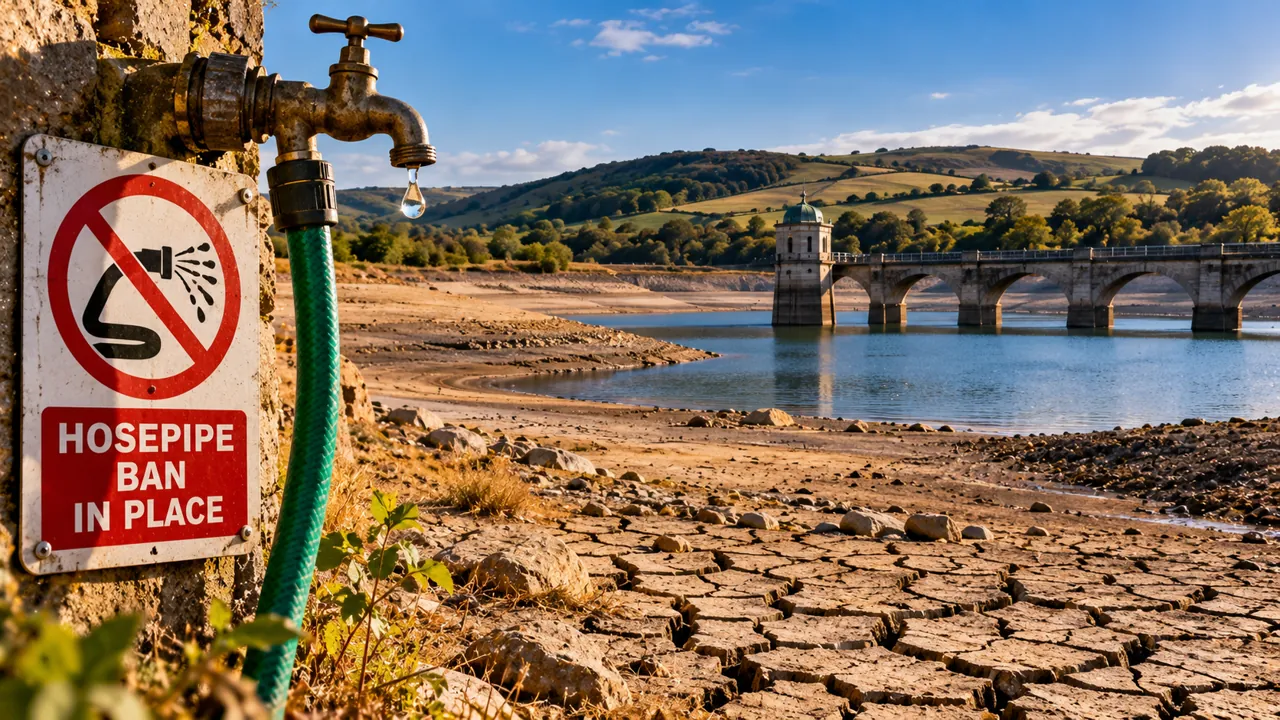
Updated October 17, 2026. The UK government declared severe drought in parts of six English counties on October 15: Cornwall, Devon, Dorset, Somerset, East Sussex and West Sussex. The declaration reflects exceptionally depleted reservoirs after the driest April–September period in the South East and South West in more than a century. It is a serious warning, but it does not automatically mean household taps will run dry or that a hosepipe ban applies to every resident.
This guide separates the official drought declaration from the water-company restrictions residents must actually follow. It explains how to check your address, what common temporary use bans prohibit, how exceptions work, what to do if your supply is disrupted, and which sources to revisit as conditions change.
England severe drought 2026: what has actually been declared?
On 15 October 2026, the Department for Environment, Food & Rural Affairs (Defra) announced severe drought in parts of six counties. The Environment Agency describes severe drought as the highest drought status, requiring exceptional coordination to protect water supplies, agriculture, ecosystems and essential services. It is not, by itself, a civil emergency. Read the government announcement and the Environment Agency explanation.
| County | Coverage stated officially | What residents should check |
|---|---|---|
| Cornwall | Parts of county | South West Water service-area notices |
| Devon | Parts of county | South West Water service-area notices |
| Dorset | Parts of county | Wessex Water or relevant local supplier |
| Somerset | Parts of county | Wessex Water, Bristol Water or relevant supplier |
| East Sussex | Parts of county | South East Water or relevant supplier |
| West Sussex | Parts of county | South East Water or relevant supplier |
Important: County boundaries do not perfectly match water-supply boundaries. A postcode in a named county does not prove a restriction applies; equally, restrictions can apply outside these six counties. Check the company supplying your particular property.
How serious are England’s water shortages?
The Environment Agency’s weekly report for 9–15 October records national reservoir storage at 54% of capacity, about 21 percentage points below the long-term average for that time of year. Eighteen reservoir groups were less than half full, with 11 classified as exceptionally low. These are national figures; they do not describe the level of the reservoir serving every home.
The report singles out Wimbleball Reservoir in the South West and Ardingly Reservoir in the South East as particular concerns for public supplies. The agency says sustained rainfall and continued conservation measures are needed to rebuild reserves; a rainy weekend is not the same as drought recovery.
Drought, severe drought and hosepipe bans are different things
| Term | Meaning | Does it automatically restrict household hosepipes? |
|---|---|---|
| Prolonged dry weather | Early warning of sustained rainfall and flow deficits | No |
| Drought | Water resources and the environment are under significant pressure | No |
| Severe drought | Highest drought status; exceptional coordinated action may be needed | No |
| Temporary Use Ban (TUB) | A water company imposes specified restrictions on certain domestic uses | Yes, for covered activities and addresses |
| Non-Essential Use Ban (NEUB) | Further restrictions under a separate legal process | Only when legally introduced for specified uses |
A severe drought declaration is a status assessment. A Temporary Use Ban is a separate, enforceable restriction announced by your water supplier. Always check both.
Which water companies have hosepipe bans in October 2026?
The Environment Agency’s weekly report provides a snapshot, not a guarantee of live status. As of its 9–15 October reporting period, Temporary Use Bans remained in place for the suppliers below, subject to their published zones and exclusions. Before acting, open the relevant company website and confirm the current notice for your postcode.
| Company | Status reported | Important qualification |
|---|---|---|
| South West Water | TUB in force | Excludes Bournemouth customers |
| Wessex Water | Company-wide TUB | Check official exemptions |
| South East Water | Company-wide TUB | Check zone and exception notices |
| Thames Water | Company-wide TUB | Check company notice |
| Anglian Water | TUB in most areas | Hartlepool excluded |
| Affinity Water | TUB in Central and East regions | Not necessarily other regions |
| Bristol Water | TUB for all customers | Confirm current company notice |
| Cambridge Water | TUB for all customers | Confirm current company notice |
| Essex & Suffolk Water | TUB for all customers | Confirm current company notice |
| Southern Water | TUB in Hampshire and Isle of Wight | Not all Southern Water zones |
The report lists no change to existing Temporary Use Bans during that reporting week. A future lifting, expansion or exception may happen after publication. Do not treat this table as a live postcode checker. For company names and official website links, use your latest bill, the supplier’s customer portal, or the Ofwat water-company information.
How to check if a hosepipe ban applies to your address
- Step 1: Find the name of the company that supplies drinking water to your home. Your water bill is the quickest source; wastewater and drinking-water suppliers may differ.
- Step 2: Visit the supplier’s official website directly rather than relying on social-media screenshots. Look for “hosepipe ban”, “Temporary Use Ban”, “drought” or “water restrictions”.
- Step 3: Enter your postcode if a lookup tool is offered, or read the named supply zones and start date in the legal notice.
- Step 4: Check exactly which activities are restricted and whether you qualify for a published exception.
- Step 5: Save the notice date and recheck before watering, washing a car or using a hose. Restrictions can change.
What can you do during a hosepipe ban?
Under a typical Temporary Use Ban in England, specified uses of a hosepipe connected to mains water are restricted. The exact legal wording and exemptions matter: do not assume every form of watering or cleaning is banned. Check your supplier’s published notice.
| Activity | Typical position during a TUB | What to verify |
|---|---|---|
| Watering a domestic garden with a hose | Restricted | Whether any special exemption applies |
| Washing a private car with a hose | Restricted | Company-specific exceptions |
| Using a watering can or bucket | Usually permitted | How the container is filled and local rules |
| Using a hose to fill a domestic swimming pool | Generally restricted | Specific activity and exemptions |
| Using a hose for safety or essential health needs | May qualify for an exception | Company-specific conditions and evidence |
| Drinking, cooking, bathing and essential sanitation | Normal household supply continues unless separately notified | Any local interruption or emergency advice |
Water companies may allow certain exemptions for disability, health or safety, but these are not universal permissions. If you have accessibility needs, contact the company before using a hose in a way that would otherwise be restricted. See government advice on watering cans and health-related circumstances.
Can you be fined £1,000 for breaking a hosepipe ban?
Breaching a valid Temporary Use Ban without an applicable exception can lead to prosecution and a fine of up to £1,000 under the relevant water legislation. That is a maximum potential court fine, not an automatic £1,000 charge for every incident. The supplier’s legal notice, enforcement approach and the facts of the case matter. If you receive a warning, read the cited rule and contact the supplier if you believe an exemption applies.
Will tap water be switched off? What residents should do
The October 15 government statement says customer water supplies are expected to remain uninterrupted while agencies take preventative action. That is not a promise that no local burst pipe, outage or later emergency measure can occur. If water pressure drops or your supply stops, follow the steps below rather than assuming the drought declaration caused it.
- Check your water supplier’s outage and incident page for your postcode.
- Ask neighbours whether they are experiencing the same issue; this can help distinguish a property plumbing fault from a network problem.
- If your supplier publishes a boil-water or do-not-drink notice, follow that notice precisely; a drought declaration alone is not such a notice.
- Contact your supplier if you need priority support because of a disability, medical dependency or other vulnerability.
- Keep essential contact details available and follow official notices for any emergency bottled-water collection points.
What if you need water for a disability or medical condition?
Many companies operate a Priority Services Register or similar support arrangements for customers who need extra help. Eligibility and assistance differ. Ask the water company whether your circumstances qualify for an exception to a specific restricted activity, and whether it can provide support during a supply interruption. Never assume a general exemption applies automatically.
Practical ways to save water without sacrificing hygiene
- Use a watering can for essential plants where the local rules allow it; prioritise recently planted or vulnerable specimens.
- Repair leaking toilets and taps. The Environment Agency says a leaking toilet can waste hundreds of litres a day.
- Run washing machines and dishwashers with appropriate full loads, following appliance guidance.
- Fit a water-efficient shower head and reduce shower time without compromising health or hygiene.
- Collect rainwater in a water butt for outdoor use when suitable, and avoid using untreated rainwater for drinking.
- Avoid unnecessary lawn watering; established grass can often recover when wetter weather returns.
The government’s water-saving guidance notes that temporary bans have reduced public demand by as much as 9% in some places. That is a reported effect in particular areas, not a guaranteed saving for every household.
Why drought can persist into winter
Reservoir recovery depends on how much rain falls, where it falls, how long it lasts and how much infiltrates into groundwater. Dry soils and low river flows can complicate replenishment. The Environment Agency warned in mid-October that farmers may struggle to refill irrigation reservoirs for the 2027 season if conditions remain dry. It also reported increasing environmental impacts, including low-flow incidents and damage to aquatic life.
The agency’s severe-drought explanation says some areas may need around 120% of normal rainfall over six months to recover. That is a scenario for affected areas, not a national rainfall forecast or guarantee. Read the official explanation for context.
Where to get reliable updates
| Source | Use it for | Link |
|---|---|---|
| Defra / GOV.UK | Severe drought declaration and government measures | https://www.gov.uk/government/news/government-activates-plan-to-protect-consumers-as-severe-drought-declared-in-parts-of-england |
| Environment Agency | Weekly drought status, reservoir and TUB overview | https://www.gov.uk/government/publications/dry-weather-and-drought-in-england-2026-summary-reports/dry-weather-and-drought-in-england-9-to-15-october-2026 |
| Environment Agency blog | Meaning of severe drought | https://environmentagency.blog.gov.uk/2026/10/15/what-is-severe-drought/ |
| Your drinking-water supplier | Current restrictions, exemptions and outage notices | Check supplier named on your water bill |
| Ofwat | Water-company guidance and consumer information | https://www.ofwat.gov.uk/households/your-water-company/ |
What residents should remember
Six counties were named in the October 15 severe drought announcement, but not every address within them is necessarily subject to the same restriction. The drought classification, water-company Temporary Use Bans and any future non-essential-use measures are distinct. Confirm the latest notice for your postcode, use water responsibly, and seek supplier support if health or accessibility needs are affected. This article is a dated public-information guide; always follow current official notices over an older summary.
Sources and verification: Defra, 15 October 2026; Environment Agency weekly report, 9–15 October 2026; Environment Agency, What Is Severe Drought?; Defra and Environment Agency water-saving advice.
You may also like
 Technology & How-To
NHS App Prescription Not Showing? Check GP Approval, Pharmacy Status and Tracking
Find out why a prescription or medicine is missing from the NHS App in England. Separate repeat requests,…
 Technology & How-To
Google Wallet Not Working After Switching Phones? Fix Card Setup and Tap to Pay
Google Wallet transferred but tap to pay fails? Separate card verification, bank approval, NFC, screen lock and device…
 Technology & How-To
iCloud Family Sharing Not Working? Why You Still See 5GB and How to Fix It
Still seeing 5GB after joining an iCloud family plan? Check the account, invitation, sharing settings, personal plan and…