
DVLA Driving Licence Rules for Over-70s in 2026: Renewal, Eye Tests and Fines Explained
Renewing a driving licence after 70? Check the free DVLA process, current eyesight duties, the 2026 consultation, medical declarations and fines, with genuine GOV.UK screenshots.
Contents
- The rules that apply now
- The 2026 eye-test proposal: what has and has not been confirmed
- Check the licence, the vehicle category and the issuing authority
- Renew online through the official over-70 service
- Renewing by post and planning for processing time
- Eyesight standards: more than reading a number plate
- Routine sight tests, medical referrals and code 01
- Medical declarations and changes between renewals
- Driving while the renewal is being processed
- Fines explained: identify the offence before quoting an amount
- Motorhomes, C1 and D1: check before choosing ordinary renewal
- Northern Ireland follows the DVA route
- Three worked situations that change the next step
- A birthday approaches, with an ordinary car entitlement
- The application is pending, but eyesight has worsened
- A motorhome trip is booked after renewal
- A short checklist before the next journey
- Sources, screenshots and review date

DVLA driving licence rules for over-70s in 2026 still centre on renewing your entitlement, meeting the eyesight standard and declaring relevant medical conditions. In Great Britain, renewal at 70 and every three years afterwards is free. You do not automatically have to retake the practical driving test because of your age.
The important 2026 distinction concerns eye tests. The government consulted on mandatory eyesight testing for older drivers, but the official consultation page checked on 25 October 2026 still said it was analysing feedback. The current renewal guidance does not establish a blanket requirement for every over-70 applicant to upload an eye-test certificate. Existing eyesight duties and any individual DVLA medical investigation still apply.
This guide covers ordinary car and motorcycle licences in England, Scotland and Wales. Northern Ireland uses DVA and has its own application route. Additional C1 or D1 entitlements, including those relevant to some motorhomes and minibuses, need separate attention.
The rules that apply now
| Issue | Current position | Action for the driver |
|---|---|---|
| Renewal at 70 | Required if you want to continue driving | Check your expiry date and apply in time |
| Later renewals | Every three years, or sooner if a shorter medical licence applies | Follow the actual dates on your licence |
| Ordinary over-70 renewal fee | Free through the official route | Avoid paying an intermediary unnecessarily |
| Practical retest | No automatic retest solely for reaching 70 | Follow any separate medical assessment or licensing decision |
| Eyesight | The legal vision standards apply whenever you drive | Wear necessary correction and seek advice if vision changes |
| Mandatory age-based eye-test proposal | Consultation closed; feedback still being analysed on the reviewed page | Do not treat a consultation as an implemented rule |
Use GOV.UK’s over-70 renewal service for the application, and the official eyesight consultation to check the status of the proposed change.
The 2026 eye-test proposal: what has and has not been confirmed
The Department for Transport published its consultation on 7 January 2026. The closing date was extended to 11 May 2026. The proposal considers moving away from eyesight self-declaration for older drivers and introducing formal testing as part of renewal.
The consultation document explores possible testing intervals and different approaches. It does not present a settled implementation timetable. On the live page reviewed for this article, the status was closed consultation with feedback under analysis.

Source of screenshot: the official consultation page. A consultation closing date is the deadline for responses, not the date a new driving requirement takes effect.
For readers, there are three separate things to verify in any headline about “new DVLA rules”: the announcement, the final decision and the commencement date. A policy intention does not itself supply the latter two. This review found no confirmed universal start date in the official material checked; consult the live renewal instructions again when you apply.
None of this removes the present duty to meet the eyesight standard. Someone unable to meet it cannot rely on the absence of a new certificate requirement as permission to keep driving.
Check the licence, the vehicle category and the issuing authority
Start with the document rather than your birthday alone. Check the expiry date, the categories of vehicle you are entitled to drive and any restriction codes. A medically restricted licence can need renewal sooner than the usual three-year cycle.
You can use View or share your driving licence information to review a Great Britain driving record. The service also generates a temporary check code for an employer or hire company. Creating that code does not renew the licence or restore a removed entitlement.
If your problem is only an expired sharing code, our driving licence check-code guide covers that separate task. Keeping the two processes distinct can prevent an unnecessary renewal application before a car-hire booking.
For a larger motorhome or minibus, identify the required category before choosing the renewal route. Having driven the vehicle for years does not prove that every previous entitlement will be carried forward automatically.
Renew online through the official over-70 service
The online service is available to eligible Great Britain residents aged 70 or over, including those reaching 70 within 90 days. The licence must have expired or be due to expire within 90 days. Being able to submit an application after expiry is not, by itself, authority to drive while waiting.
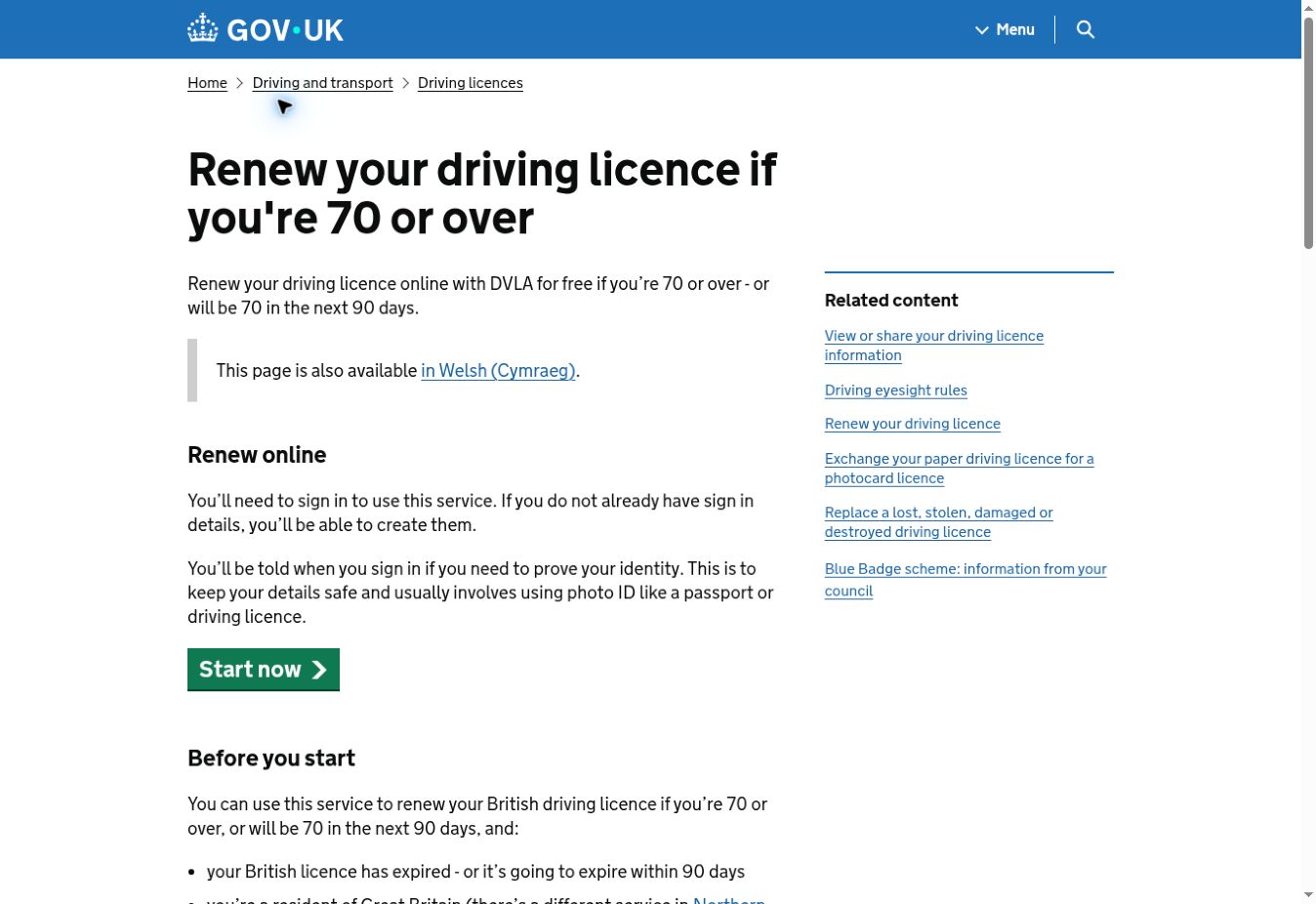
Source of screenshot: GOV.UK’s renewal page. The page identifies the free service and displays the Start now button. Screens and identity checks can change.
- Open the correct service. Start at GOV.UK’s page specifically for people aged 70 or over. Check that it covers your issuing authority and the entitlement you want to retain.
- Prepare your records. Have your current licence, access to your email and any requested identity document available. Review relevant health information before completing the declaration.
- Select Start now. Follow the official sign-in route. The service explains how to create sign-in details if you do not already have them.
- Complete any identity checks. GOV.UK says you will be told whether proof of identity is required, usually using photo ID such as a passport or driving licence.
- Answer the application accurately. Check personal details, the medical and eyesight declaration and any photo instructions. Do not let a helper guess an answer about your health.
- Review and submit. Keep the confirmation email and any reference provided. A submission receipt records an application; it is not a medical clearance or an approval notice.
If you are helping a parent, keep them in control of their account and declarations. Read the questions together and use official help for uncertainty. The application is not a place to simplify or omit a condition because you think it will slow processing.
For sign-in trouble involving a GOV.UK security code, our GOV.UK One Login security-code guide may help where that sign-in route is offered. It does not replace DVLA’s eligibility checks.
Renewing by post and planning for processing time
DVLA normally sends the D46P renewal form 90 days before your 70th birthday or licence expiry. If it does not arrive, the official page directs applicants to the D1 driving licence application form, available at most Post Offices. Do not wait indefinitely for a reminder while the expiry date approaches.
Follow the form’s instructions about your current licence, photograph, supporting evidence and return address. Photo requirements can depend on your existing document and application. Use the address supplied for your particular application rather than copying an unrelated DVLA address from an old article.
Keep a copy of the completed application and a record of posting. Those records can help trace a delay, although proof of posting alone is not proof that DVLA has received a correct and complete application.
The over-70 service states that a postal licence should arrive within three weeks, with longer checks possible where medical or personal details need verification. Treat processing times as estimates. If you have an imminent trip, allow additional time rather than assuming a paper application will be completed before departure.
Eyesight standards: more than reading a number plate
For ordinary car and motorcycle driving, DVLA’s eyesight rules require the following elements. You can use glasses or contact lenses where needed, and must wear them whenever you drive if they are necessary to meet the standard.
| Requirement | Published standard | Practical meaning |
|---|---|---|
| Number-plate reading | Read a number plate from 20 metres | Check with the correction you actually use for driving |
| Visual acuity | At least decimal 0.5, equivalent to 6/12 on the Snellen scale | Measured using both eyes together, or the functioning eye if vision is present in one eye only |
| Visual field | An adequate field of vision | An optician can advise and test; clear central detail alone does not establish a normal field |

Source of screenshot: GOV.UK’s eyesight standards. The image shows the ordinary driving standard, with the separate lorry and bus section below it.
A safely performed number-plate check can reveal a problem, but it is not a substitute for assessing visual acuity and field of vision. Use a measured distance, good visibility and your normal driving correction. Do not step into traffic or drive somewhere simply to test whether your eyesight is adequate.
If you cannot meet the standard, stop driving and seek professional advice. Squinting, guessing a familiar registration or recognising the shape of a sign is not a reliable substitute. Nor should a recent renewal be treated as proof that a later change in vision is safe.
Routine sight tests, medical referrals and code 01
A routine optician appointment, a DVLA-requested eyesight investigation and a proposed age-based certificate system are different things. The NHS guidance on sight-test funding lists people aged 60 or over as eligible for a free NHS sight test in England. Ask your practice about the relevant local arrangements and any additional test fees.
A free routine sight test does not automatically include every specialist visual-field assessment or a private medical report. If DVLA refers you to its contracted optician as part of a medical investigation, its eyesight page says you do not pay for that referred test. If you choose another optician, payment and acceptance are different: DVLA specifies an Esterman visual test and does not guarantee it will accept an independently obtained result.
Check the back of the licence as well. Code 01 means eyesight correction, such as glasses or contact lenses. An automatic-transmission restriction is a different code. Comply with the conditions printed for your entitlement rather than treating the photocard as an unrestricted permission slip.
Medical declarations and changes between renewals
You must report notifiable conditions or relevant deterioration when the reporting rules require it, not just when another birthday comes around. DVLA’s medical-condition guidance explains the process, while its condition checker identifies the rules for a particular diagnosis and licence group.
Ordinary short-sightedness or long-sightedness corrected to the required standard is not the same as every eye condition requiring notification. The rules can depend on whether one or both eyes are affected, the functioning eye, the diagnosis and professional advice. Use the eye-condition reporting guidance rather than assuming that every person wearing glasses must make a separate medical notification.
If you declare a condition during an over-70 renewal, DVLA says the application asks for that information; you do not also need a duplicate notification solely for the same declaration. A later change is a separate matter. Keep copies of what you submitted so that future correspondence is consistent.
DVLA may request medical evidence, contact a healthcare professional or arrange an assessment. Reporting a condition does not automatically establish that the licence will be refused. Equally, waiting for DVLA to investigate is not permission to ignore advice to stop driving.
Driving while the renewal is being processed
Section 88 of the Road Traffic Act 1988 may allow continued driving while DVLA processes an application, even after the previous licence expires. This is conditional. It is not a general grace period for everyone who has reached 70, and clicking Submit does not prove that the conditions are satisfied.
Read DVLA’s INF188/6 guidance in full. Its criteria include:
- Meeting the medical standards and not driving against a doctor’s or healthcare professional’s instruction.
- Previously holding a valid licence and driving only categories both previously held and requested on the current application.
- Continuing to meet the applicable conditions of the old licence.
- DVLA having received a correct and complete application within the previous 12 months.
- No current court disqualification and no last licence refused or revoked for medical reasons.
- No excluded high-risk-offender reapplication; additional restrictions apply to certain Group 2 cases.
The leaflet explains that DVLA cannot tell you during a medical investigation whether Section 88 applies to your circumstances. You and your healthcare professional must consider the criteria. Do not assume a pending-application acknowledgement is a personal clearance certificate.
Permission under this provision ends in circumstances including refusal or revocation, a new disqualification or an application becoming more than a year old. If your health or vision changes, reassess the position immediately. Arrange alternative transport when the requirements are uncertain, and establish your insurance position with the insurer before relying on continued cover.
Fines explained: identify the offence before quoting an amount
There is no separate fine simply for turning 70. Penalties depend on the conduct, the licence position and the offence proved. A headline combining “over-70”, “eye test” and “£1,000” can hide several different legal situations.
| Situation | Published consequence | Important distinction |
|---|---|---|
| Not telling DVLA about a medical condition that may affect safe driving | Up to £1,000; prosecution may also follow an accident | This concerns the notification duty, not age alone |
| Driving otherwise than in accordance with a licence | The Highway Code lists a £1,000 maximum fine, discretionary disqualification and 3–6 points | The actual offence and circumstances determine the consequences |
| Driving after a licence has been refused or revoked on medical grounds | The Highway Code lists an unlimited fine and possible disqualification, with other serious sanctions | This is different from an ordinary renewal still being processed |
| Driving while not meeting the eyesight standard | Possible prosecution | Do not substitute a made-up universal “eye-test fine” for the applicable offence |
Sources: DVLA’s notification warning, the Highway Code penalty table and the eyesight rules.
A card needing renewal, entitlement expiring, driving an unlicensed category and driving after medical revocation are not interchangeable descriptions. Do not assume every expired-document case automatically attracts the same points, or that an ordinary pending application erases a prior medical refusal.
If a police notice or DVLA decision concerns your own case, identify the stated offence and seek appropriate advice. This article explains the published categories; it does not predict a court’s decision or determine an individual driver’s legal entitlement.
Motorhomes, C1 and D1: check before choosing ordinary renewal
Some older drivers hold additional entitlements from earlier test dates. Ordinary car renewal is not a guarantee that you can continue driving every larger vehicle previously covered by your licence. The official over-70 page expressly says that its online service cannot renew C1 or D1 entitlement; the application must be made by post.
For a motorhome, compare the vehicle’s authorised weight with your actual categories and restrictions. The everyday description “campervan” does not establish the required entitlement. Use DVLA’s category guidance and the record for your own licence.
Where higher medical standards and a D4 report are required, follow the appropriate vocational renewal instructions. The doctor, optometrist or optician normally charges for completing the relevant report. A free DVLA licence renewal therefore does not mean every supporting medical service is free.
Raise this before submitting if retaining a category matters to a holiday or voluntary-driving commitment. After renewal, check the new document and driving record before using the vehicle. An old photocard showing a category is not evidence that the category remains current.
Northern Ireland follows the DVA route
Drivers with Northern Ireland licences should use nidirect’s over-70 renewal instructions. DVA normally issues licences for up to three years and sends a reminder about two months before expiry. Its free-renewal timing is expressed differently from DVLA’s 90-day Great Britain route.
The NI page also has separate instructions for photographs and retaining additional categories. Do not apply the GB forms, timescale or penalty discussion to a Northern Ireland case without checking DVA guidance. The DfT eyesight consultation discussed above concerns Great Britain.
Three worked situations that change the next step
A birthday approaches, with an ordinary car entitlement
A driver is 69 and within 90 days of turning 70, with a licence due to expire in that period. The useful sequence is to check the official service’s eligibility, review the health and eyesight declaration and apply through the free route. A paid “urgent renewal” advert does not create a better entitlement than the official application. Keep the confirmation and the expiry date together.
The application is pending, but eyesight has worsened
A driver submitted a renewal and later finds that the usual glasses no longer provide adequate vision. The pending application does not override the present vision standard. The next step is to stop driving and seek professional advice, not to rely on an application email until the new card arrives. Any notification or further evidence then follows the rules for the condition.
A motorhome trip is booked after renewal
A driver renews ordinary car entitlement online but needs an additional category for the booked motorhome. The correct check is the vehicle’s authorised weight against the renewed licence, not whether the driver still has an old card showing C1. Confirm the required postal and medical route before travelling; do not attempt the trip while the necessary category is absent or uncertain.
These examples are illustrations, not individual medical or legal clearances. Their purpose is to identify which decision must be resolved before driving.
A short checklist before the next journey
- Check the current expiry, permitted vehicle categories and restriction codes.
- Use the correct DVLA or DVA renewal service and keep the application record.
- Meet the vision standard with the correction you actually wear when driving.
- Report relevant health changes rather than waiting for the next renewal.
- Read every Section 88 condition if the previous licence expires during processing.
- Confirm extra-category entitlement before using a larger vehicle.
For an unresolved application or licensing question, start with DVLA’s official contact finder. Keep identity documents and medical information off public comment threads.
Sources, screenshots and review date
The linked DVLA renewal and eyesight guidance, DfT consultation, INF188/6 leaflet, Highway Code penalty table, NHS sight-test information and DVA renewal guidance were reviewed for this article on 25 October 2026. No licence application was submitted and no private medical or driver record was accessed.
The three website images are genuine captures of public GOV.UK pages taken on that date. Source: GOV.UK, DVLA and Department for Transport. Government content is reproduced under the Open Government Licence v3.0, except where otherwise stated; Crown copyright acknowledged. Horus Valley is independent of these organisations.
You may also like
 Useful Information
Royal Mail Lost Parcel Claim: Deadlines, Evidence and Next Steps
Check who should claim for a lost Royal Mail parcel, the Tracked and retail deadlines, and evidence to…
 Useful Information
Wrong Mileage on MOT History? How to Correct the Record
Correct an MOT mileage error using the right 28-day route. Genuine government screenshots, evidence checks and practical steps…
 Useful Information
Changed Your Driving Licence Address? Your V5C Needs Updating Too
Updated your driving licence after moving? Change your V5C and vehicle tax Direct Debit separately. Official links, real…