
Royal Mail Lost Parcel Claim: Deadlines, Evidence and Next Steps
Check who should claim for a lost Royal Mail parcel, the Tracked and retail deadlines, and evidence to prepare. Includes genuine official guidance screenshots.
Contents
- Start here: are you the sender or the recipient?
- When can you claim? Match the service to the correct clock
- Tracked 24 and Tracked 48: seven working days is not the full window
- 1st Class, 2nd Class and Signed For have a different loss threshold
- A practical way to record the dates
- Prepare an evidence pack before opening the claim route
- How to reach the official claim route
- How much compensation should you expect?
- Keep loss, delay and damage separate
- Message template for an undelivered order
- After a claim: keep one record and verify follow-up messages
- Frequently asked questions
- Can the recipient claim directly?
- Does every Royal Mail loss claim have an 80-day deadline?
- Does “working days” always exclude Saturday?
- Can I claim without proof of posting?
- Official sources and scope

To claim for a lost Royal Mail parcel, identify the exact service, check when it becomes eligible for a loss claim, and gather proof of posting and value. Domestic Tracked 24/48 has a different claim window from the retail 1st/2nd Class policy. If you are waiting for something you bought, contact the sender or retailer first rather than assuming you must recover the postage yourself.
For non-account domestic Tracked services, the October 2026 terms require at least 7 working days after the due delivery date before a loss claim, then submission within 30 calendar days of the eligible claim date. Do not apply the often-quoted 80-day rule to every Royal Mail service. Check the service and terms on your actual purchase.
Public guidance and terms checked on 2 November 2026. The screenshots show genuine Royal Mail guidance pages. The Claims Centre and linked form returned a connection error in our browser, so we could not inspect their current questions, upload controls or confirmation screen. This is a preparation and routing guide; no claim was submitted.
Start here: are you the sender or the recipient?
| Situation | First action | What to keep |
|---|---|---|
| You bought an item and it has not arrived | Tell the retailer/sender and ask them to investigate | Order number, delivery promise and tracking status |
| You posted a gift or private parcel yourself | Check the purchased postal service and claim eligibility | Posting receipt, item-value evidence and recipient details |
| You received part of the contents or a damaged item | Use the damage/part-loss route rather than describing total non-delivery | All packaging and contents, plus photographs |
| You bought postage through a broker, marketplace or business account | Check that provider’s claim route and your contract | Label-purchase record and the provider’s reference |
Royal Mail’s missing-item page directs recipients to contact the sender. There is an important qualification: its listed retail loss policy permits a sender or recipient to claim, with only one compensation payment for the item. That does not establish the same entitlement under Tracked or a business contract. Coordinate with the sender before starting a second claim for the same shipment.
Keep the two conversations separate. Asking a retailer to resolve an undelivered order concerns your purchase. A postal compensation claim concerns the service used to send it. A retailer’s claim reference is useful context, but it is not proof that your refund or replacement has already been agreed.
When can you claim? Match the service to the correct clock
| Service / route | Earliest loss-claim point | Submission deadline to check |
|---|---|---|
| Non-account domestic Tracked 24/48 | At least 7 working days after the due delivery date | Within 30 calendar days of the eligible claim date |
| Retail 1st/2nd Class, including the Signed For variants covered by that policy | 10 working days after the due delivery date | Within 80 calendar days of posting |
| Retail Special Delivery Guaranteed by 1pm, not posted on account | 5 working days after the due delivery date | Within 80 calendar days of posting under that retail policy |
| International services covered by the linked international policy | 20 working days after due delivery for Europe; 25 for the rest of the world | Within 6 months of posting under that policy |
Sources: October 2026 non-account domestic Tracked terms, clause 11.2, Royal Mail retail loss policy and international compensation guidance. Account contracts and intermediary purchases can follow different arrangements. If the label or receipt does not make the service clear, ask the seller of the postage before choosing a deadline.
Tracked 24 and Tracked 48: seven working days is not the full window

In the screenshot, Royal Mail gives a due-date-plus-seven-working-days threshold for Tracked and tells recipients to contact the sender. The product name’s “24” or “48” is not a declaration that compensation becomes payable after precisely 24 or 48 hours. Start with the delivery due date and the rules for that service, including any postcode exclusions.

The notice above states the separate filing window. We checked it against the current non-account domestic Tracked PDF rather than treating an old notice as the only authority. For this loss-claim rule, working days are Monday to Saturday, excluding public and bank holidays. Calendar days in the submission window are a different count.
1st Class, 2nd Class and Signed For have a different loss threshold

The 1st Class panel uses ten working days after the due date. The retail policy also covers specified 2nd Class and Signed For products. Do not confuse Royal Mail 24/48 with Royal Mail Tracked 24/48 merely because both names contain a number. Read the full service name on the posting record.
A practical way to record the dates
Make a private note with three separate fields: posting date, due delivery date and the eligible loss-claim date. Add the final submission deadline in a fourth field, citing the service terms you used. Do this when you first investigate the delay, rather than trying to reconstruct the dates after weeks of messages.
Illustrative example: you have established that a particular non-account Tracked parcel becomes eligible on a date you label E. Record E, then the applicable 30-calendar-day filing window. Do not simply count 30 days from buying the label, or wait 80 days because a general article mentioned that figure. This example explains the two clocks; it is not a calculator or an eligibility decision for a real parcel.
Prepare an evidence pack before opening the claim route
| Record | What it helps establish | Preparation check |
|---|---|---|
| Receipt or certificate of posting | The item was handed over using a particular service | Keep the original and make a clear private copy |
| Tracking number, if the service has one | Which shipment is being discussed | Copy it from the genuine posting/order record |
| Proof of value or actual loss | The financial basis of the requested amount | Find the purchase record or other evidence appropriate to the claim |
| Sender and recipient details | The parties and addresses attached to the shipment | Compare with the actual label or order |
| Brief contents description | What was inside the parcel | Use make/model/quantity where relevant |
| Short dated account of the problem | What happened and what has been checked | Separate confirmed facts from guesses |
Royal Mail’s retail policy distinguishes evidence of posting from evidence of value. A payment for a label should not be assumed to prove that the parcel was actually handed over. Equally, a posting receipt does not by itself establish the contents’ value. Check what each document demonstrates instead of uploading several unrelated screenshots.
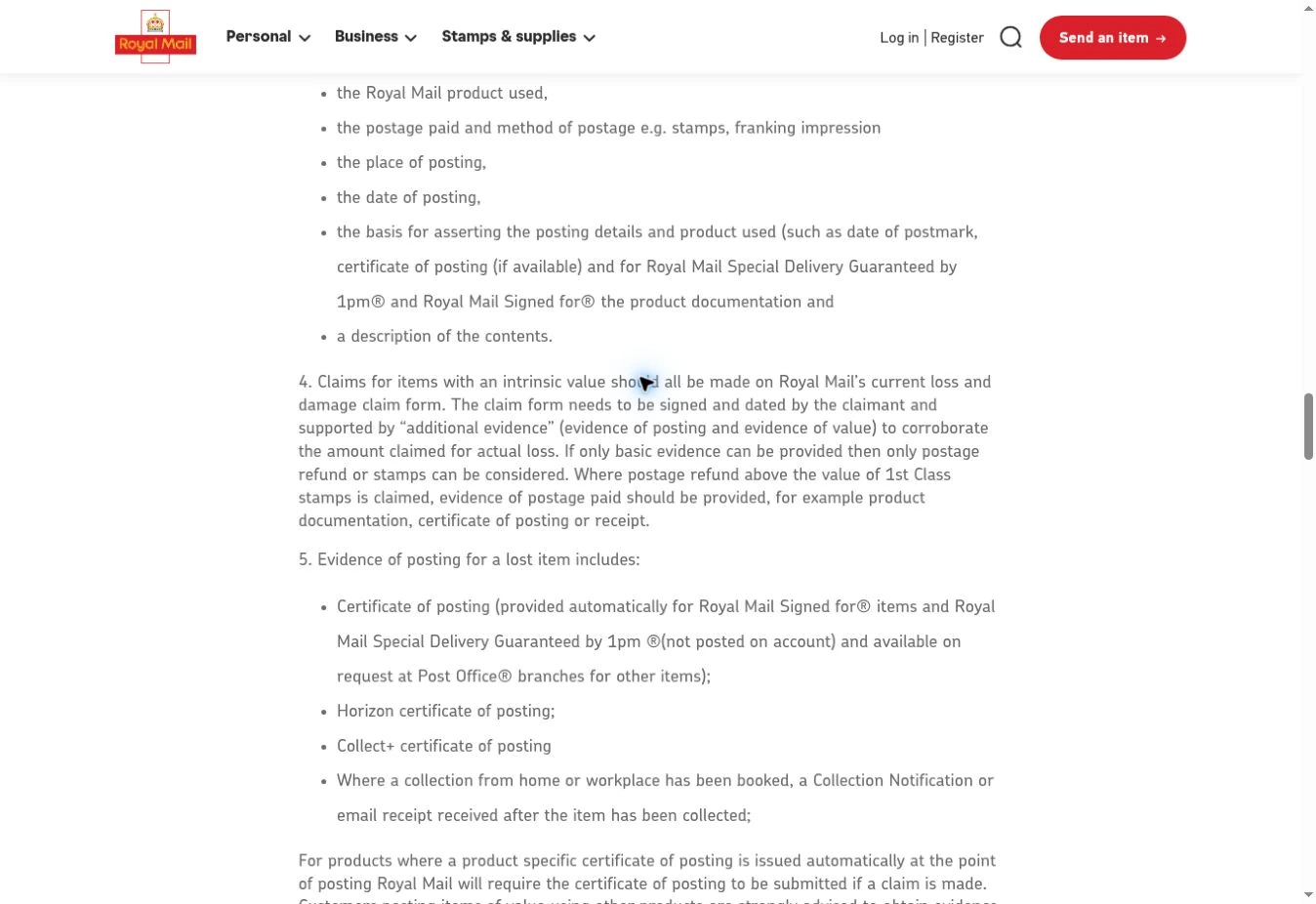
A collection notification or email received after collection is among the examples in the retail policy. Preserve that original message if it applies to your shipment. For a shop-bought item, retain its itemised purchase record. If one invoice covers several goods, identify the item concerned without editing the invoice or inventing a separate price.
- Photograph paper records flat, in even light, with the relevant date, service and reference readable.
- Keep original documents and messages. Make working copies for your own records rather than overwriting the originals.
- Use clear filenames such as posting-receipt and purchase-record so you choose the right file.
- Write a short chronological description; a long complaint is not a substitute for missing evidence.
- Follow the live form’s file-type and size limits. We could not verify those limits in this review.
How to reach the official claim route
- Open Royal Mail’s missing-item guidance and expand the service used.
- Check the waiting period, the destination and whether a sender or provider needs to act.
- Follow the Claims Centre link to Royal Mail’s current claims-process page.
- Use the route appropriate to your purchased service and claim type. Have the evidence pack ready.
- If the form opens, answer its actual questions, review the details and retain any acknowledgement/reference after submitting.
What we could verify: the service-selection guidance, the waiting-period panels, the linked claims destination and the published terms. What we could not verify: the current claim-form fields, upload screen, submission or payment details. The public claim link redirected to the newer help site, which returned a connection error in our session. That does not show that the service is unavailable to everyone.
If you see the same problem, keep your evidence and check the contact/help options on the official website. Do not start repeated submissions if you are unsure whether an earlier request succeeded. Post Office directs Royal Mail customers to Royal Mail for claims; for a Parcelforce service it directs them to Parcelforce’s own support. Buying the postage at a Post Office does not make every claim a Post Office compensation application.
How much compensation should you expect?
Treat compensation limits as caps, not promised payouts. The Royal Mail Tracked 48 product page advertises cover up to £75 or the item’s value, whichever is lower, with exclusions. The current non-account Tracked terms also limit loss compensation by the price paid and the £75 cap. Check the exact product and terms before writing a claim amount.
For example, a qualifying loss of an item bought for £28 does not become a £75 claim simply because the service has a £75 ceiling. This is an illustration of a cap, not an assessment of a real claim or a promise to reimburse postage or other costs. An advertised replacement price, your selling price and what you paid may be different figures; provide genuine evidence and follow the applicable basis of valuation.
The Tracked 48 page excludes compensation for valuables such as money and jewellery. More generally, the contents, packaging and compliance with service conditions can affect a claim. Do not assume that paying for a tracked label insures every possible item or every consequence of its loss.
Keep loss, delay and damage separate
- Not delivered and the loss threshold has passed: check the loss route for that service.
- Delivered late: use the delay rules, if the product provides an entitlement; a previously missing parcel is not necessarily a continuing loss.
- Arrived damaged or with contents missing: retain the packaging and contents, then consult damage/part-loss instructions.
- Marked delivered but not received: report the specific discrepancy to the sender/provider and preserve the tracking information; do not rewrite it as a different event to fit a form.
Do not borrow a damage deadline to calculate a total-loss claim. Different policy pages can use different starting dates and cover different products. If two pages appear inconsistent, match the exact service, purchase channel and current contract instead of choosing whichever gives the longest window.
Message template for an undelivered order
Hello, my order [order number] has not arrived. The delivery date given was [date], and the latest tracking status is [status and date]. I have checked [relevant checks actually made]. Please investigate with the delivery provider and confirm the next step for resolving the undelivered order. If a postal claim is being made, please tell me who is handling it so we avoid duplicate claims.
Replace each bracket with accurate information. This is an editorial template for communicating with the sender, not a Royal Mail form or a legal demand. Include only checks you actually made and send private order details through the retailer’s established channel.
After a claim: keep one record and verify follow-up messages
Keep the claim reference, submission date, documents supplied and later correspondence in one folder. If further evidence is requested, link it to the existing reference. A screen saying that a request was received is not the same as acceptance of the claim or agreement to an amount.
If the parcel arrives after you report it lost, tell the party handling the claim. Do not continue describing it as undelivered. If you receive an outcome you do not understand, ask for the reason and the applicable review or complaint route through official support; do not assume that creating a second claim is an appeal.
Be wary of messages requesting an unexpected fee to “release” compensation. Verify any request independently through your existing claim or order channel. For a separate guide to checking suspicious courier messages, read How to Recognize a Fake Delivery Text.
Frequently asked questions
Can the recipient claim directly?
Some retail services allow it under their loss policy, with only one payment per item. Royal Mail’s practical missing-item guidance nevertheless tells recipients to contact the sender. Tracked and account services have different contractual arrangements, so do not treat recipient eligibility as universal.
Does every Royal Mail loss claim have an 80-day deadline?
No. The retail loss policy uses 80 calendar days from posting for the services it lists. Non-account domestic Tracked uses its own eligibility and submission window. International claims covered by the linked policy have another deadline. Read the matching row and the underlying terms.
Does “working days” always exclude Saturday?
No. The cited domestic Tracked loss rule includes Monday to Saturday and excludes public/bank holidays. Other services can define working days differently; use the definition attached to the relevant rule.
Can I claim without proof of posting?
Do not assume a tracking number or a label-purchase email replaces every required record. Look for the actual handover/collection evidence and ask the provider what it accepts. Missing evidence can affect whether a claim or a particular amount is payable.
Official sources and scope
- Royal Mail: my item has not arrived — service selection and waiting-period guidance.
- Non-account domestic Tracked terms, Version 21, October 2026 — clause 11.2 on eligibility and filing, plus compensation conditions.
- Royal Mail terms changes — notice explaining the separate Tracked claim window.
- Royal Mail retail compensation policy for loss — the specifically listed retail services, evidence and claimant rules.
- Royal Mail international compensation — separate international eligibility and deadlines.
- Royal Mail Tracked 48 — advertised cover and exclusions.
- Royal Mail Claims Centre process and options — official destination; connection failed during our inspection.
- Post Office: lost or damaged post help — which operator handles enquiries and claims.
The article focuses on preparing a UK personal/non-account loss claim, with international differences flagged separately. It is not a review of every business account agreement. Screenshots show public guidance as captured on 2 November 2026; Royal Mail retains rights in its website content and branding. Their use here does not imply endorsement. No private tracking number, identity, claim or payment was used.
You may also like
 Useful Information
Wrong Mileage on MOT History? How to Correct the Record
Correct an MOT mileage error using the right 28-day route. Genuine government screenshots, evidence checks and practical steps…
 Useful Information
Changed Your Driving Licence Address? Your V5C Needs Updating Too
Updated your driving licence after moving? Change your V5C and vehicle tax Direct Debit separately. Official links, real…
 Useful Information
DVLA Driving Licence Rules for Over-70s in 2026: Renewal, Eye Tests and Fines Explained
Renewing a driving licence after 70? Check the free DVLA process, current eyesight duties, the 2026 consultation, medical…